Search
Close
  • The Pattern Shop
  • Our Free Patterns
    • Browse All Our Free Patterns
    • Our Free Knitting Patterns
    • Our Free Crochet Patterns
  • Blog
    • All Blog Posts
    • All Free Patterns
    • Dibble Dabble Inspiration
    • Giveaways
    • Make-Alongs
    • Product Reviews
    • Roundups
    • Tips, Tricks, Techniques for Knitting and Crochet
Stylized bird with pink and gray swirling tail above elegant “Marly” text, logo for crochet accessories and home decor.
  • Marly Bird House
  • Learn to Knit & Crochet
    • Newbie? Start Here
    • Video Tutorials
    • Knitting Definitions
    • Crochet Definitions
    • Common Techniques
    • Size Charts for Knitting and Crochet Projects
  • About
×
  • The Pattern Shop
  • Free Patterns
  • Blog
  • Marly Bird House
  • Learn to Knit & Crochet
    • Newbie? Start Here
    • Video Tutorials
    • Knitting Definitions
    • Crochet Definitions
    • Common Techniques
    • Size Charts for Knitting and Crochet Projects
  • About
Stylized bird with pink and gray swirling tail above elegant “Marly” text, logo for crochet accessories and home decor.
Search
Close

New Patterns NOW Available in Ad-Free PDF! Check out The Pattern Shop

100+ O’Go Yarn Patterns: Free, Knit and Crochet Patterns…

August 23, 2021 By Marly Bird 1 Comment

Earlier this week I was thrilled to share my review of the new yarn O’Go with you. This is a totally new format of yarn delivery, available for four different popular yarn types. Each of the yarns comes in lots of different colorways. And now Yarnspirations has rounded up more than 100 O’Go Yarn patterns for you to use. There are both knit and crochet patterns for each yarn in different skill levels. There’s a project for everyone. We’ve broken down these categories below with easy links to each section that might interest you. Plus, we’ve shared some of our favorite patterns from the collection.

100+ Patterns Using O'Go Yarn

Quick Recap On O’Go Yarn

O’Go isn’t a brand new yarn. Instead, it’s a new format of delivery for some of your favorite yarns. Some yarn comes in balls, others in skeins … now you also have the option of O’Go. It’s a super smooth approach to easily getting the yarn from where it’s start onto your hooks or needles. Plus it offers convenience when playing with the different colors within the same O’Go. Again, check out my full review here; scroll down on that post to see the YouTube video showcasing what I’m loving about it.

Four Yarn Options for O’Go Yarn Patterns

There are currently four different O’Go yarns:

  • Bernat Blanket – #6 super bulky weight yarn
  • Caron Big Donut – #4 worsted weight yar
  • Caron Colorama – #5 bulky weight yarn
  • Red Heart Super Saver – #4 worsted weight yarn

There are different patterns associated with each one. If you have a preferred option among these yarns, then you can use the filtering tool on the website to choose the yarn you want to work with. Or, of course, if you’ve already purchased one or two of these yarns, then that’s another reason to filter the patterns in this way.

Here’s one example of O’Go Yarn patterns we like from each of the four options:

1. Bernat Blanket

Bernat Blanket O'Go Yarn Patterns

2. Caron Big Donut

Caron Doggie Sweater in O'Go Yarn

3. Caron Colorama

Caron Colorama O'Go Yarn knit scarf pattern

4. Red Heart Super Saver

Red Heart crochet pillow pattern with poms

Different Types of O’Go Yarn Patterns

In addition to sorting by the yarn itself, you can use the filter options on the O’Go Yarn Patterns page (HERE) to find specific types of project. For example, here you’ll find one Marly Bird team favorite from each of the three options in “pattern category”.

1. O’Go Yarn Patterns for Accessories

These further break down into “project type” which includes cowls, gloves and mittens, hats, scarves, shawls and wraps, toys, and general accessories. One of our favorites:

crochet plaid shawl vest free pattern

2. O’Go Yarn Patterns for Clothing

This is currently just broken down into patterns for sweaters and cardigans. One of our favorites:

knit sweater vest free pattern

3. O’Go Yarn Patterns: Home Decor

Finally, there’s the home decor section. These knit and crochet patterns break further down into the following project types: afghans and blankets, baskets, pets, and pillows and poufs. One of our favorites:

O'Go Yarn Patterns mosaic knit pillow

O’Go Yarn Patterns by Craft and Skill Type

Alternatively, you can focus your search by craft (knit or crochet) as well as by skill type (beginner, easy, intermediate, and experienced.) At this time there’s only one experienced level yarn pattern using O’Go Yarn but of course designers will be adding more soon. That one is:

O'Go Yarn Patterns for experienced crocheters.

And here’s one knit and one crochet pattern from each of the other skill levels that we think you might want to check out:

1. Intermediate

O'Go Yarn Patterns for Crochet Fair Isle Cowl
knit brioche scarf free pattern

2. Easy

O'Go Yarn Patterns for knit baskets
modern geometry blanket free crochet pattern

3. Beginner

Beginner Hat Crochet Pattern
Beginner Ribbed Knit Cowl Free Pattern

I’m excited about O’Go Yarn so I hope that you are too. If you start making any of these patterns, be sure to share them with us on social media so we can check them out!

Frequently Asked Questions

What is O’Go yarn?

O’Go is Red Heart’s innovative “tangle-free” yarn format… instead of a traditional skein or cake, it comes in a unique stretchable container that lets you pull the yarn out without it tangling. The yarn feeds smoothly from its special packaging without knotting or collapsing. It’s a brilliant solution to one of the most frustrating aspects of working from a center-pull cake! With 100+ compatible patterns available, it’s a format designed to make your crafting experience as smooth as the yarn itself.

Why is tangle-free yarn such a big deal?

Anyone who’s had a center-pull cake collapse into a tangled nightmare in the middle of a project knows the frustration! Regular yarn cakes can collapse and bunch up as you work, creating tangled messes that take ages to fix. O’Go’s special container format prevents this… the yarn feeds out cleanly without the inner section collapsing. For projects where you’re pulling from the center of a ball or cake, this is genuinely a quality-of-life improvement. Less fighting with your yarn means more enjoying the actual crafting.

What kinds of projects work best with O’Go yarn?

Any project where you’d normally use a center-pull cake! Blankets, scarves, hats, shawls, amigurumi… the format works for anything. Projects that use the whole skein without color changes benefit most from the tangle-free format because you’re pulling from it continuously for a long time. The 100+ patterns in this collection span all types of projects at various skill levels. Check the pattern that appeals to you… it will specify any specific yarn requirements within the O’Go line.

Can I substitute regular Red Heart yarn for O’Go patterns?

Yes! O’Go is a different format, not a different yarn fiber or weight. If a pattern calls for O’Go in a specific color and you have a compatible Red Heart yarn in the same weight and similar yardage… it’ll work. Check that the weight and yardage match, and check if the color you want is available in O’Go or in a compatible Red Heart line. The tangle-free benefit is lost when you substitute, but the knitting and crocheting results will be the same.

Is O’Go yarn good for beginners?

It’s actually a great beginner yarn! The tangle-free format means less fighting with yarn tangles, which is a common beginner frustration. Red Heart is consistently weighted and behaves predictably, which helps with learning consistent tension. The wide color range and accessibility at major craft stores makes it easy to find. And with 100+ free patterns specifically designed for it, you have a huge range of beginner-friendly projects to choose from. Less yarn-wrangling means more energy for actually learning the craft!

Filed Under: Crochet, Free Patterns, Knitting, Pattern, Product Reviews

Learn Knit Dip Stitch with this Easy, Ribbed Knit Hat…

August 23, 2021 By Marly Bird Leave a Comment

If you earn how to knit dip stitches, then you can easily add a lot of texture to your knitting. In this ribbed knit hat free pattern, I show you exactly how to work a specific type of dip stitch. The result is texture that looks like fishtail braids. It’s fun and interesting to the eye. In fact, this is one of my most popular free knit hat patterns. Therefore, I wanted to showcase it for you again in case you missed it the first time around. It’s a great project to learn something new. Moreover, it’s perfect to make for lots of people as we head into the season for gifting crochet to others!

This post may contain affiliate links. If you click one then make a purchase, I get a percentage of the sale. Your price doesn’t change. Thank you for your support.

Double Dip Knit Hat Free Pattern By Marly Bird

What Are Knit Dip Stitches?

Knit dip stitches refer to stitches that you knit into the fabric lower than the row where your needles are located. In other words you “dip down” to knit into the fabric.Note that you don’t drop or unravel any stitches in the process of making dip stitches.

There are many different types of knit stitches, depending on how far down you dip. In this pattern, you’ll  Identify the 2nd stitch from tip of the left hand needle and 4 rows down below it. Then you’ll use your right needle to knit into that stitch. That’s your dip stitch, worked four rows below the working row. You could work one three rows down instead, as an example of a variation on knit dip stitch.

Working the dip stitches closer together (meaning not having many rows between the dip point of one stitch pattern repeat to the next one up) makes this version look like a fishtail braid! I love the effect and hope that you will, too!

This ribbed knit hat free pattern includes a photo tutorial for how to work this variation of knit stitch. Additionally, I’ve completed a video tutorial for this ribbed knit hat free pattern to show you exactly how to work it, including how to to knit the dip stitches. This is a great new way to improve your knitting skills.

ribbed knit hat free pattern

More About This Ribbed Knit Hat Free Pattern

The Double Dip Knit Hat free pattern is all about showcasing that textured dip stitch. However, you’ll have the opportunity to work some other special stitches as well. Of course, I’ve described these in detail in the pattern itself. But in brief, the three other special stitches you’ll use are all methods of decreasing as you build the hat:

  • Center Double Decrease (CDD)
  • Knit Two Together-through the back leg (k2tog-tbl)
  • Slip, Knit Two Together-through the back leg (sk2tog-tbl)

This is a relatively easy knitting pattern. A brand-new beginner would want to start with something a bit simpler. But an ambitious or advanced beginner could figure out this hat. If you can knit 3, purl 2 to make knit ribbing, and you’re comfortable learning how to knit dip stitches, then you can complete this ribbed knit hat free pattern.

Get the Ribbed Knit Hat Free Pattern

Are you ready to knit this hat? If so, then click here or on the image below. That will take you to the free pattern here on my site. There you’ll find the instructions for how to knit the dip stitches. Additionally, you’ll find the video tutorial for the entire hat, including the pom that tops it off. Moreover, you’ll find a link to the Ravelry PDF if you’re looking to purchase an ad-free version of this ribbed knit hat pattern.

Ribbed Knit Hat Pattern by Marly Bird

Watch the Video

The free hat pattern above also comes with a video tutorial. Therefore, you should find it easy to craft this super-wearable hat pattern:

You Might Also Like:

  • 30 Marly Bird Knit Hat Patterns – One For Every Season and Occasion
  • Learn Dip Stitch from Firmament, a Self-Published Knitting Book
  • Chill Out Winter Hat Pattern with Latvian Braid

Frequently Asked Questions

What is the dip stitch in knitting?

The dip stitch (also called the drop stitch elongated version) is worked by inserting your needle into a stitch several rows below your current row and pulling up a long loop, which “dips” through the fabric between the rows. When you complete the stitch and let the stitches above drop, it creates a beautiful vertical textured line that adds a slight elongated drop to the pattern. In this ribbed hat, the dip stitch creates a beautiful decorative element within the ribbing structure. It sounds scarier than it is… the tutorial demonstrates it very clearly.

Is this hat pattern appropriate for beginners?

It’s rated for adventurous beginners or those with some knitting experience. The base hat construction is worked in the round using ribbing… if you can K2, P2 in the round, you have the foundational skill. The dip stitch is the added challenge and is the specific technique this pattern teaches. The hat is designed as a skill-building project, not just a pattern… it gives you a beautiful finished hat PLUS a new technique in your toolkit. If you’re comfortable with basic in-the-round knitting and ready for your next challenge, this is a perfect project.

What yarn should I use for this ribbed hat?

Worsted weight in a smooth yarn that shows stitch detail clearly is ideal for a ribbed hat… the ribbing and dip stitch both need to be legible in the fabric. Wool or wool blend gives excellent stitch definition and the natural elasticity that makes ribbing spring back perfectly. Acrylic works well too. For the dip stitch specifically, avoid very slippery yarns (silk, bamboo blends) at first because managing the dropped stitch rows is easier with yarn that has some grip. A classic worsted weight wool or wool-blend is the safest choice for learning the technique.

How do I keep the ribbing even throughout a whole hat?

Consistent tension is the key! Ribbing requires alternating between knit and purl stitches, and the transition between them is where tension issues often appear. The most common problem: pulling the yarn too tightly when moving from purl to knit (or vice versa) creates tight loops that pucker the fabric. Practice keeping an even, relaxed tension across all stitches and specifically at the transitions. Checking your work every few rows and gently evening out any puckered spots while the fabric is still on the needle helps. Blocking after finishing also smooths out minor tension variations.

Can I make this hat in different sizes?

Yes! Ribbed hats are actually very size-adaptable because ribbing fabric stretches significantly. A hat worked to fit a smaller circumference will stretch to fit a larger head due to the elastic quality of ribbing. Most ribbed hat patterns include 2×2 rib which stretches about 20-30% beyond the cast-on circumference. For a precise fit, calculate your stitch count based on gauge and desired finished circumference. For a gift where you’re not sure of the recipient’s head size, ribbing’s natural stretch makes it more forgiving than a hat worked in plain stockinette.

Filed Under: Knitting, Our Free Patterns, Pattern

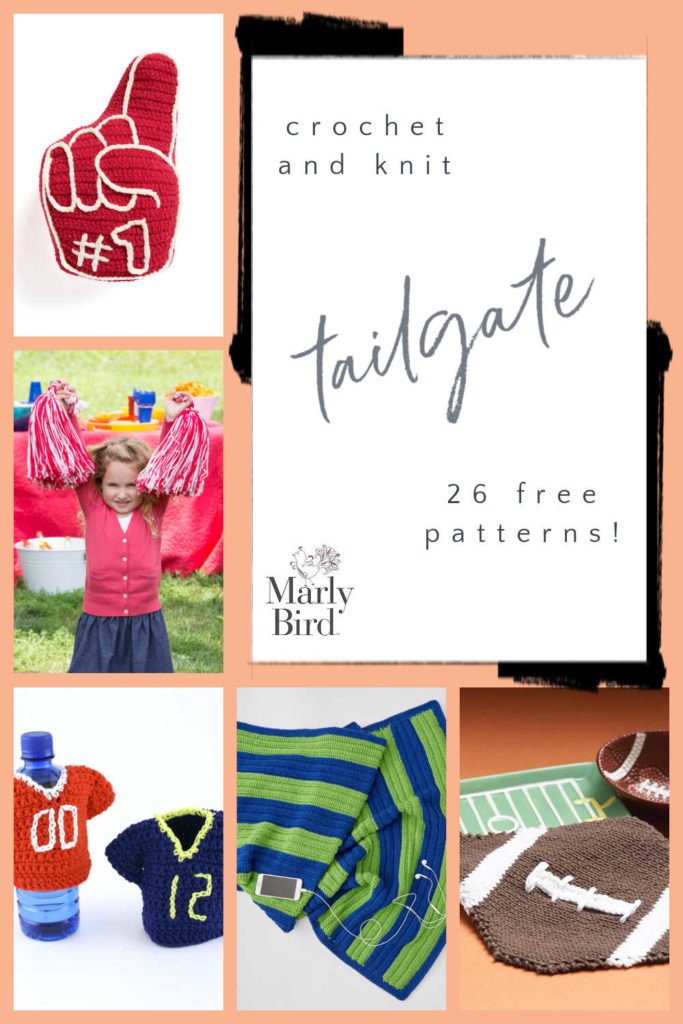
26 Free Knit and Crochet Tailgate Projects

August 22, 2021 By Marly Bird Leave a Comment

Kids of all ages are returning to school. Fall sports are about to begin. Make enjoying all of these games and tailgates more comfortable with these free knit and crochet tailgate projects from Yarnspirations! Craft homemade pompoms in your team colors, wrap yourself in a blanket, keep a bottle cold in a cozy, and otherwise improve your day. Bonus: you can show your team spirit at the same time!

26 Free Tailgate Projects

What Are Knit and Crochet Tailgate Projects?

When we talk about knit and crochet tailgate projects, we’re really talking about anything that helps you celebrate fall sports. Obviously, football is the first sport that comes to mind for most people. However, you can tailgate for other sports as well. The point is not just the sport itself, but the celebration around the event. It’s the fun of sitting around with other people, gathering up your team spirit, enjoying the season together.

Therefore, knit and crochet tailgate patterns are anything that supports this time together. At the beginning of the season, it might still be warm out during games. Therefore you’ll want to look at knit and crochet tailgate projects that keep your cans of beer or soda cool. Later in the season, it gets chilly. Therefore, you’ll want blankets so that you can stay warm while you watch the game.

Furthermore, you might want to show your love of the game in your own home. For example, themed pillows and dishcloths help remind you of the season. In other words, you don’t have to make something specifically for a tailgate party to enjoy tailgate patterns.

Free Knit and Crochet Tailgate Projects

  • Keep It Cool Cozy
  • #1 Fan Crochet Pillow
  • Football Lovers Crochet Throw
  • Tailgate Cozies
  • Tailgating Table Runner
  • Football Can Cozy
  • Touchdown Knit Pillow
  • Touchdown Dishcloth
  • Buffalo Plaid Bottle Cozy
  • Knit Stadium Lapghan
  • Basketball Can Cozy
  • Crochet Can Cozies
  • Knit Can Cozies
  • Team Jersey Bottle Coozy
  • Crochet Stadium Seat Cover
  • Stadium Crochet Lapghan
  • Knit Stadium Seat Cover
  • Game Day Stadium Throw
  • Buffalo Plaid Crochet Stadium Blanket
  • Game Day Knit Hat
  • Game Day Crochet Hats
  • Beginner Well-Schooled Throw
  • School Colors Blanket
  • Athleisure Striping Throw
  • Cheerleading Pompoms
  • Fifty Yarn Line Crochet Blanket

Also on the Blog

  • 28 Free Picnic Patterns to Knit and Crochet
  • 38 Free Bottle and Can Cozies, Bags and Toppers
  • Donna’s Denver Football Hat
  • Denver Football Free Crochet Scarf Pattern

Frequently Asked Questions

What kind of projects can I make for tailgating?

So here’s the thing… tailgate projects are really anything that helps you celebrate fall sports! That could be anything from keeping your drinks cold with a cozy to staying warm with a blanket… or even just making some fun pillows or dishcloths to show your team spirit at home.

Are these projects just for football?

Honestly… while football is definitely the first sport that comes to mind, you can totally make these for any sport you like to tailgate for! It’s all about celebrating the season and having fun with people you love.

I’m going to a game in the fall, will these keep me warm?

Yes! As the season gets cooler, you’ll definitely want to check out the blankets and lapghans to stay cozy while you watch the game. There are some super warm options available.

Can I make something to keep my drinks cool?

Absolutely! There are tons of free patterns for can cozies and bottle cozies listed on the page… perfect for keeping your drinks nice and chilly while you’re out enjoying the game!

Are these patterns complicated?

The page mentions that the projects are suitable for “Advanced Beginner” crafters, and there’s even a “Beginner Well-Schooled Throw” listed… so there are definitely options for different skill levels!

Filed Under: Free Patterns

“I Learned To Knit”: Wrap-Up Reflections on BiCrafty…

August 20, 2021 By Marly Bird Leave a Comment

When we started BiCrafty Bootcamp: Knitting Lessons for Crocheters, we honestly didn’t have any idea what to expect. We knew that Marly Bird team members Cryssi and Kathryn were crocheters who wanted to learn to knit. We knew Marly could use their crochet skills to make learning knitting easier. Plus we had a good guess that other crocheters might be into that, too. So, we set off with a loose plan in place. And now we, along with the 1000+ people who joined us for BiCrafty Bootcamp, can now say, “I learned to knit.” Let’s take a look back at how it went along the way:

I Learned to Knit with Marly Bird's BiCrafty Bootcamp

The BiCrafty Bootcamp Lesson Plan

Here’s what we ended up with between April and today.

Getting Started With Knitting Basics

“I Learned to Knit” started with basics. First, we gave you a couple of guides: Ultimate Guide to Knitting Needles for Beginners and I’m New To Knitting: What Are The Best Needles For Beginners? Then we began with the lessons:

  • Getting started with knitting basics. How to knit cast-on and long-tail cast on and begin to learn the knit stitch.
  • Knitting Basics Parts 2. More practice with knit stitch. Learn garter stitch. Learn basic bind off.
  • Knitting Basics Part 3. Learn purl stitch and stockinette stitch.

At this point both Cryssi and Kathryn were remembering the joys and challenges of being a beginner again. It was exciting to learn something new with yarn. However, it was tough to get used to the mistakes and slowness of being new at it. Still, both were excited.

Mug Rugs and Coffee Cup Sleeves

These were the first projects we really learned to knit. We did so as we practiced these lessons and skills:

  • How to Knit Stripes. Plus we practiced weaving in ends, which can be slightly different in knitting than in crochet.
  • Learn How to Knit Ribbing. Specifically, we learned 2×2 knit ribbing. 

By this point, Cryssi was already able to say, “I learned to knit.” She was moving easily through the projects. Plus, she was excited about the instant gratification of those small projects. Kathryn was having a tougher time, but this was when she realized that she knits a lot easier on straights than circulars.

How to Knit a Cowl in the Round

This was when we started what would become our first knit accessories set. We began with the knit cowl.

  • How to Knit 1×1 Ribbing in the Round.
  • How to Knit Seed Stitch (in the round).
  • From there, we learned How to Knit Double Moss Stitch in the Round. Plus extra credit: how to knit slip stitch. 
  • Knit Sampler Stitch Cowl in the Round continued. How to Knit Seersucker stitch and Long Slip Textured stitch.
  • Knit Sampler Stitch Cowl in the Round continued. 

This was about the stage where Cryssi and Kathryn began to diverge. Both found it hard to switch to working in the round. But Kathryn still hasn’t quite gotten the hang of it so at this point she kind of diverged and just began knitting more as occupational therapy and less in line with the camp’s schedule. Cryssi had a bumpy start on the cowl. However, midway through, she really felt like she was getting it. Although she could’ve said it before, this was where she personally felt she could say, “look, I learned to knit.”

How to Knit a Hat in the Round

At this point the BiCrafty Bootcampers could definitely say, “I learned to knit.” But we weren’t done, yet. It was time to knit a hat with these lessons:

  • Begin Knit Sampler Stitch Hat in the Round to Complement Cowl.
  • Knit Hat: Latvian Braid. This was one of the favorite techniques people learned. Even experienced knitters were wowed by the look and ease of it.
  • Knit Hat: Stranded Knitting.
  • Knit Hat: Triangle Lace.
  • Wrapping up the Knit Hat: How to Knit Cables and Finish Your Hat on DPNs.

In month three, Kathryn continued watching the videos and writing up the blog posts. At least she could absorb as much information as possible even if she wasn’t knitting a lot yet. Cryssi had trouble with her hat. It wasn’t easy. However, she eventually got there. This goes to remind us that there are ebbs and flows in every learning process. That’s why you’re learning; because you don’t already know. The mistakes you make are helpful because then you better understand how to do more right.

How to Knit Mittens in the Round

Finally, we wrapped up our set with a pair of beautiful knit mittens.

  • How to Knit Mittens: Part 1 – Lacy Arrow Stitch Cuff.
  • Knit Mittens Part 2: Latvian Braid, picking up stitches, thumb gusset.
  • Knit Mittens Part 3: Duplicate stitch, shaping mitten top, kitchener stitch.

Remember that the links to the instructional live videos can be found here or directly on YouTube.

Final Wrap-Up Thoughts from Kathryn and Cryssi

Despite not making it too far, Kathryn feels proud of the knitting skills she gained. She can knit and purl on straights, which means she can say, “I learned to knit.” She can also knit on circulars. So, she’ll get there. Overall, she was thrilled to be a part of bootcamp. Her biggest passion is crafting as therapy and she learned a lot about knit therapy through the process. Plus she really loves the Marly Bird community and was happy to be active in the live video chats whenever she could.

One of the things Cryssi realized when talking to someone else about making the knit mittens was that she’s beyond being able to say, “I learned to knit.” The BiCrafty Bootcampers who made it to this stage are really advanced beginners at this point, if not intermediate knitters. If you’re one of them, don’t be afraid to tackle the knit versions of Marly’s upcoming stitchalongs as well as her excellent body of free knitting patterns.

Asked for some wrap-up thoughts, Cryssi said, “I’m just amazed that five months ago I had no idea what I was doing and now I’m an “intermediate knitter.” The weekly challenges from Bootcamp are the only reason I’ve achieved what I have. If I had not stuck with it, then I would have been really upset with myself! I’ve wanted to learn to knit for years. I’m so grateful I finally got to do so with the guidance and leadership from Marly.”

BiCrafty Bootcamp Sponsors

Cryssi also wanted to say, “I can’t thank the sponsors enough for their gracious donations and support.” They gave knitting needles to our team. Moreover, they gave us some good giveaway prizes to let other Bootcampers try their stuff, too. We got such a variety from them. We did reviews for each; here they are in very brief summary:

  • Signature Needle Arts Review. With a stiletto point that cuts through yarn like a hot knife through butter, these are a must-have. We also like the storage tubes their DPNs come in.
  • ChiaoGoo Knitting Needles. Kathryn loved the bamboo straights. As a beginner Cryssi also liked the bamboo, and she enjoyed working with the interchangeable circulars. We all loved the storage that the supplies came in.
  • Jimmy Beans Wool SmartStix Interchangeables. Cryssi loves the ingenious design which includes a measuring tape built directly into the needle.
  • Prym. Knitting needles come in such a variety of materials. The plastic of Pryms worked really well for Kathryn; faster than bamboo but not as slick as metal. The team also likes the unique teardrop hook that makes it easy to pick up the yarn when knitting.

By the end of Bootcamp, lots of people said that they were as obsessed with buying knitting needles as they were with buying yarn! So, we created a guide for all your options for how to store knitting needles.

Look Out for BiCrafty Bootcamp: Crochet Lessons for Knitters!

BiCrafty Bootcamp part one has come to an end. If you didn’t keep up with all the lessons, they’re still there for you to work with (for now!) However, we aren’t stopping here on the Marly Bird team. Come September, we’re launching BiCrafty Bootcamp: Crochet Lessons for Knitters. All the newbie knitters from the first bootcamp are welcome to join in for crafting along each week. Plus we hope to make lots of other knitters BiCrafty with these lessons. More from us soon!

Frequently Asked Questions

What was the BiCrafty Bootcamp all about?

So here’s the thing… it was a knitting lesson program Marly Bird created for crocheters! The goal was to help crocheters learn to knit, using their existing crochet skills to make it easier.

How did the Bootcamp progress through the lessons?

Honestly… it started with the absolute basics, like knitting needles and how to cast on. Then it moved into practicing stitches, making small projects like mug rugs, and eventually tackling more complex items like cowls, hats, and mittens all worked in the round.

Did everyone in the Bootcamp find it easy to learn knitting?

Yes! Well, kind of. Some, like Cryssi, picked it up quickly and felt like they were knitting intermediate level pretty fast. Others, like Kathryn, had a tougher time with certain things, like knitting in the round, but still made progress and learned a lot!

What kind of projects did the Bootcampers make?

They started with simple things like mug rugs and coffee cup sleeves to practice skills like knitting stripes and ribbing. Then they moved on to knitting cowls and hats, and finally, they finished up with knitting mittens!

What’s next after the “I Learned to Knit” Bootcamp?

Oh, the fun doesn’t stop! Marly and her team launched “BiCrafty Bootcamp: Crochet Lessons for Knitters” to help knitters learn to crochet… it’s all about being bi-crafty!

Filed Under: BiCrafty Bootcamp Learn to Knit, Knitting, Tips, Tricks, Techniques for Knitting and Crochet

Learn How to Crochet: The First Five Things You Need to…

August 19, 2021 By Marly Bird Leave a Comment

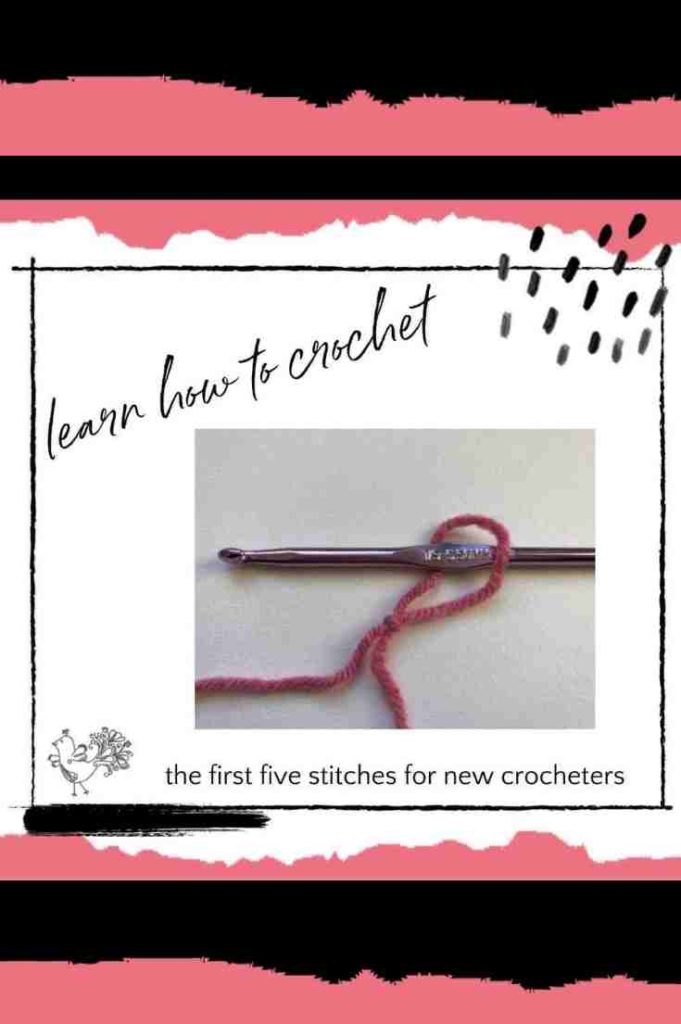
So, you want to learn how to crochet? Where should you begin? There are a lot of things that you’re going to need to learn eventually. You’ll need to learn about yarn weights and fibers, crochet hook sizes, and more. But in terms of basic stitches, there are five things you need to learn when you first start to crochet. What’s interesting is that after you’ve learned the first two, you basically know how to crochet. The next three are essentially variations on those. And with that, you’ll be able to crochet blankets, scarves, and so much more. So, in terms of first techniques and basic stitches, here are the first five things you want to learn how to crochet.

beginner crochet stitches

How to Slip Knot and Make Your Foundation Chain

In order to start a crochet project, you have to first get the yarn onto your hook. There are different ways of doing this. However, the most common method is to make a slip knot. You place the knot on the hook. Then you crochet a chain. If you can do this, then you’ve begun to learn how to crochet.

How to Crochet the Single Crochet Stitch

The single crochet stitch is the most basic, simple crochet stitch. Take the time to learn how to work this stitch, because the essential steps of working it are going to apply to almost every other stitch you ever make in crochet.

How to Crochet the Double Crochet Stitch

The double crochet stitch is worked very similar to the single crochet stitch. However, it’s double the height. That’s where the name comes from. Just like with the single crochet, you’re going to use the techniques of “yarn over” and “pull through loops”. You just use them slightly differently to get that higher height.

How to Half Double Crochet

As you may guess by the name, this stitch is halfway between the single crochet stitch and the double crochet stitch in height. You’ll pull the yarn through a different number of loops to achieve this effect. But the time that you’re this far in learning how to crochet, you’ll start to get a really good sense of stitch anatomy.

How to Make The Treble Crochet Stitch

Finally, we’ll complete your beginner crochet stitches with the treble crochet stitch. Using the same foundational methods, you’ll make a stitch that’s taller than the double crochet stitch. As you can see, you can do a lot when learning to crochet even by just learning a few really basic things.

What You Can Do With This Knowledge

With the “learn how to crochet” skills from the videos above, you can now work in rows. This means that you’ll be able to crochet anything that is square or rectangular. At this stage, you’ll want to work one stitch into one stitch. You’ll probably also want to work the same stitch across the whole row.

For example, you might crochet a foundation chain that’s 20 stitches long.

Then you might turn the work and make one single crochet into each of those twenty chains.

You could continue to work 20 single crochet stitches across the row until you have a square or rectangle the length that you desire. This might be a crochet mug rug, for example.

Alternatively, you might work 20 double crochet stitches as a row, or twenty half double crochet stitches. The only thing that you need to know differently for each of those rows is how many stitches to make each turning chain. Which is why you also need this information:

With this knowledge you can crochet anything square or rectangular. Make crochet scarves, blankets, square shawls, placemats, dishcloths, etc.

What’s Next In Learning How to Crochet

Obviously, when you learn how to crochet you want to learn lots of different things. There are a lot of different stitch patterns and crochet techniques to learn. You’ll also want to learn how to work with different stitches in the same row (single crochet, double crochet, across a row, for example.) Plus you’ll want to know how to change colors in a project. Moreover, you’ll want to learn how to increase and decrease rows to create different shapes besides the rectangle or square. Finally, you’ll want to learn how to crochet in the round, rather than just in rows.

But these five stitches (chain, single crochet, double crochet, half double crochet, and treble crochet) give you a very solid foundation when you first learn how to crochet. Then you can take it from there. Check my YouTube channel for lots more instructional videos to take it further.

You Might Also Like:

  • Variations on the HDC Stitch
  • 2021’s Best Crochet Books
  • Free Crochet Patterns by Marly Bird

Frequently Asked Questions

What are the first five things to learn when starting crochet?

The fundamentals that unlock everything else! First: how to hold the hook and yarn comfortably. Second: the slip knot and foundation chain… the starting point of almost every crochet project. Third: single crochet, which is the building block of most beginner patterns. Fourth: how to turn at the end of a row (the turning chain) and work back across. Fifth: how to count your stitches to make sure you’re not accidentally adding or losing any. Master these five things and you can make a dishcloth, a swatch, or start simple patterns… you’re a crocheter.

How long does it take to learn to crochet?

Most people can learn to make simple single-crochet projects within a few hours of practice! The physical coordination takes some getting used to at first… holding the hook, maintaining yarn tension, and inserting the hook consistently. But once the motion clicks, it clicks. Many complete beginners watch a tutorial and make their first swatch in the same afternoon. Being able to make beautiful projects with confidence takes longer… months of practice across different techniques. But the basics are genuinely accessible quickly, which is one of the reasons crochet has such a wide following.

What supplies do I need to start crocheting?

Honestly, very few! A size H crochet hook (5mm) and a skein of smooth worsted weight yarn in a light color (so you can see your stitches clearly). That’s the minimum. Light-colored smooth acrylic is ideal for learning… it’s affordable, consistent, and easy to see. Everything else (scissors, tapestry needle, stitch markers) can be added as you go. The barrier to entry for crochet is remarkably low… you can start learning for under $10 in supplies. Fancy ergonomic hooks and premium yarn come later, once you know you love the craft.

Is it easier to learn crochet from a video or from written instructions?

For most people, video is much better for learning physical craft skills! Seeing exactly how the hook moves, how the yarn wraps, where the hook inserts… makes the physical motion immediately understandable in a way that written “insert hook into stitch, yarn over, draw through two loops” can’t quite achieve. Marly Bird’s YouTube videos are specifically designed to be clear and encouraging for beginners. Watch the video, pause and try it yourself, rewind if needed. Written instructions become more useful once you have the physical motion and need to follow specific pattern sequences.

What’s the most common mistake beginners make?

Accidentally adding stitches at the end of rows! This causes your work to gradually get wider and wider. It happens because the turning chain can look like a stitch and you inadvertently work into it. The fix: count your stitches at the end of every row for the first several projects… if you have more than you started with, you added accidentally. Also common: crocheting too tightly because of tension nervousness. Relax! Yarn should slide freely. And not recognizing which loops to insert the hook through… always check that you’re going under both top loops unless a pattern specifically says otherwise.

Filed Under: Crochet, Tips, Tricks, Techniques for Knitting and Crochet

Signature Needle Arts Knitting Needles Review

August 19, 2021 By Marly Bird Leave a Comment

We were so lucky to have so many terrific knitting needle sponsors for BiCrafty Bootcamp. After all, we wanted to show all the new knitters the many different options out there. Most of them started out not even knowing about different types of knitting needles, let alone which brands might be best. We got to use a different brand every month, wrapping everything up this past month with Signature. So, here’s our Signature Needle Arts review. (Although if you’ve been following along with BiCrafty Bootcamp then you already know that we LOVE these knitting needles.)

Signature Knitting Needles

The Stiletto Point

What sets Signature Needle Arts apart from the rest is their design of the stiletto point for their knitting needles. It’s a sharper point that allows for such great ease of knitting. In fact, this company formed when the President of a family-owned machine shop called Bothe Associates Inc, who also happened to be a knitter, asked, “why can’t I have better needle points?” Then they decided to make them. The company grew from there. In the chat portion of the final live video chat for BiCrafty Bootcamp, we were joking (kinda, not really) about how we’d rather have stiletto needle points than stiletto heels. They make the knitting go fast and smooth.

But They Have Other Point Options, Too

All of the experienced knitters in BiCrafty Bootcamp seemed to love those stiletto points. And Marly is one of Signature’s biggest fans. But it’s important to note that their needles come with other point options as well. Why does that matter? Well, for example, BiCrafty Bootcamper and Marly Bird team member Kathryn has been slow to pick up knitting and still finds the ease of the stiletto point just a bit too fast for her hands. So it’s good to know that some of the their knitting needles also come in “Middy” and “Blunt” points.

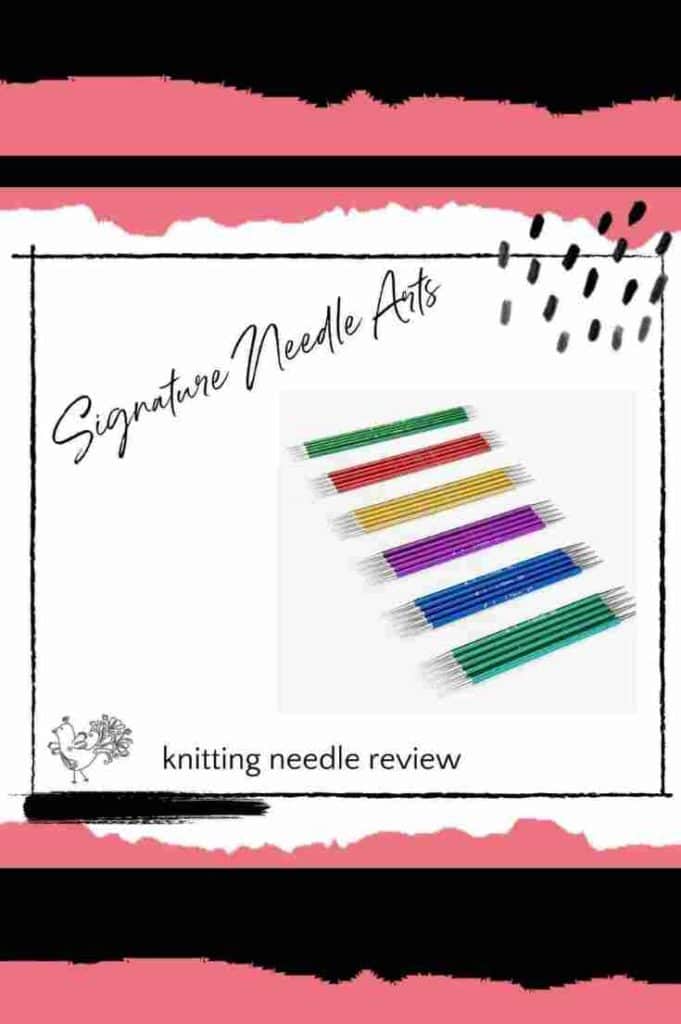
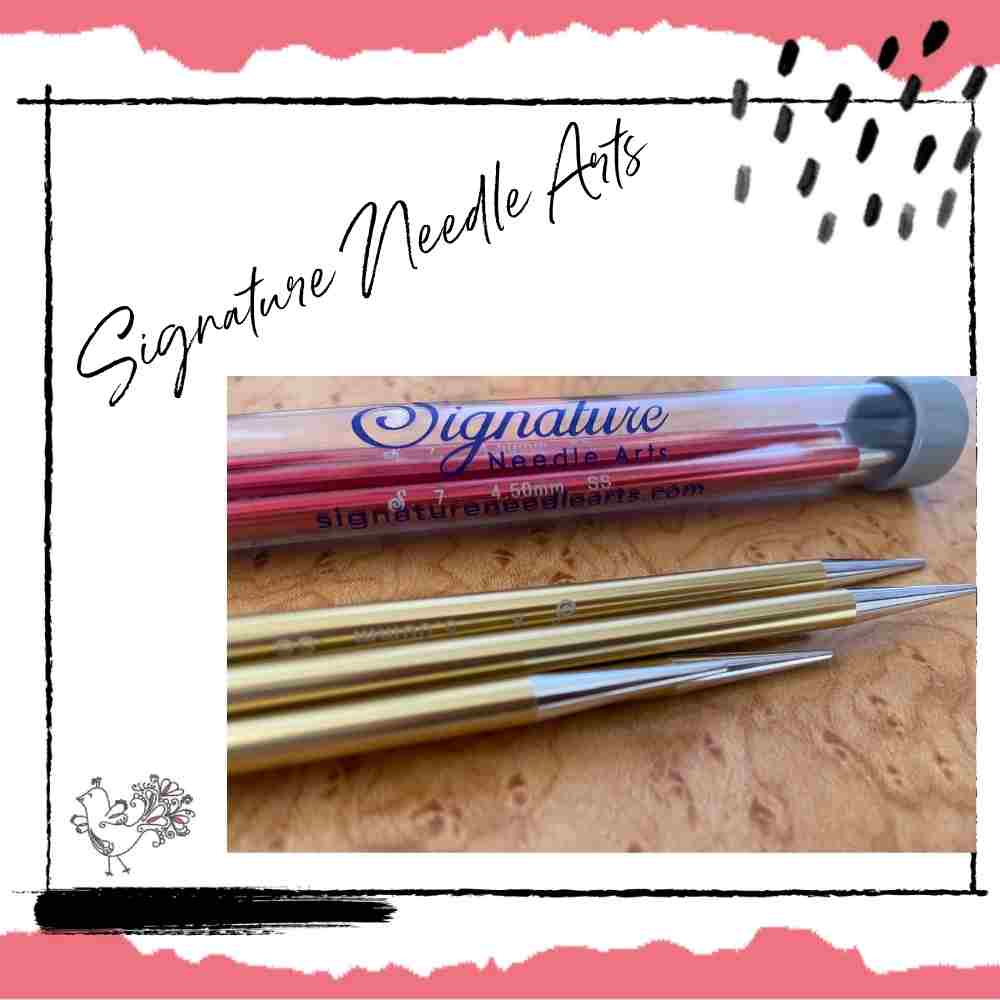
Signature Needle Arts Review DPNs 2

Types of Signature Arts Knitting Needles

The company has everything you might want including straights (single points), double points (DPNs), and Circulars.

Single Points

Signature’s set of single point needles ranges in size from 1/2.25MM-10/6.0MM. You also have a variety of options to choose from:

  • Knitting needle length: 7″ or 10″ or 14″
  • Needle point type: stiletto, middy, or blunt
  • Knitting cap type (the end opposite the needle): shaped as bell, spiral, or tear
  • Option to monogram!

That’s right – you can monogram your Signature Knitting Needles. This is great for inspirational phrases, intentional crafting with a message, gifts, putting your name on your needles, and more.

DPNs

A set of DPNs from Signature ranges from 01/2.25MM-06/4.0MM. Each set includes five needles. One of the things the Marly Bird team loved was having each set arrive in its own tube, making it easy to keep the sets together without anything getting lost. Choices you have for Signature DPNs:

  • Knitting needle length: 4″, 5″, 6″ or 8″
  • Note that they are all stiletto points except the 4″ which combine stiletto and blunt
  • Option to monogram

Circulars

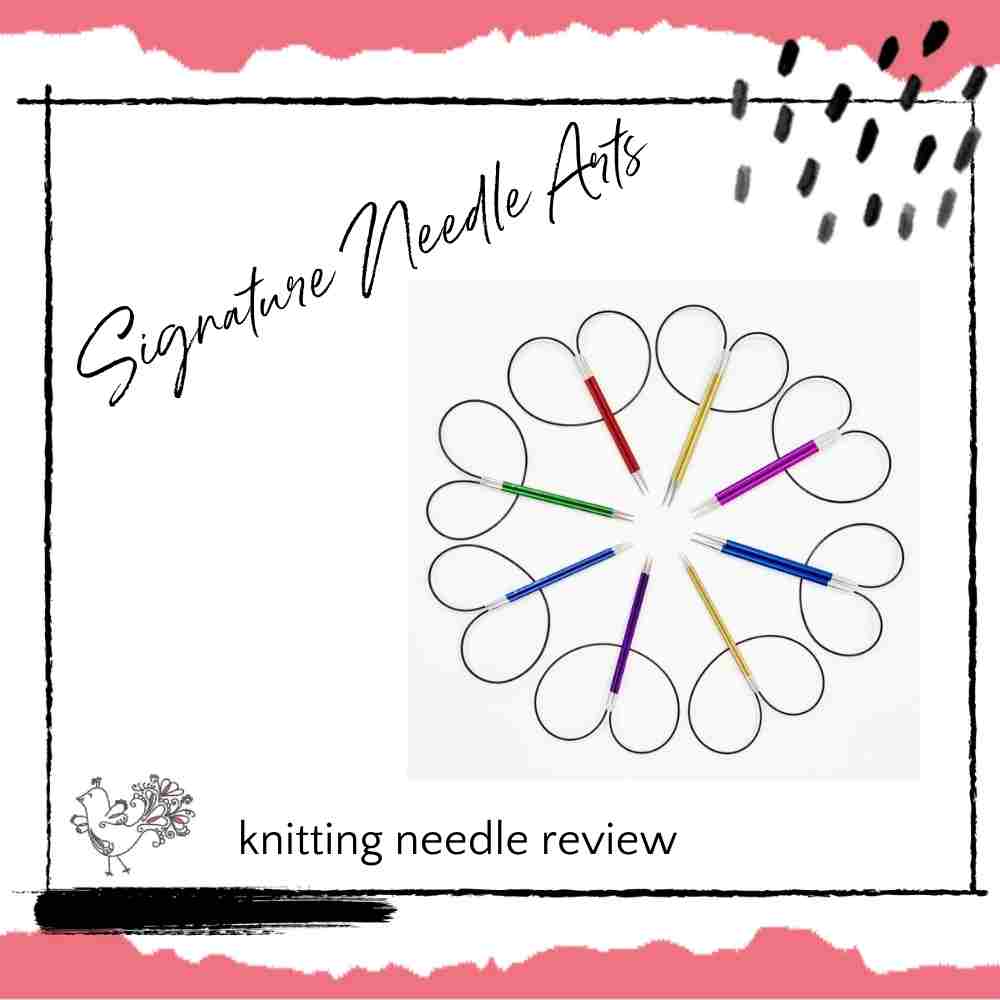
Signature Convertible Circular Knitting Needles Set are interchangeable circulars. They range in size from 03/3.25MM-10/6.0MM. Options include:

  • 4″, 5″ or 6″ needle length or “stalks”
  • 16″, 20″, 24″, 32″, 40″ or 47″ overall length with cables (note that not all sizes are available for all stalk lengths)
  • Stiletto tip or middy tip
  • Option to monogram

High-End Signature Arts Knitting Needles Review: Worth the Investment

It’s true that Signature Needle Arts knitting needles tend to be on the high end as far as price goes. But their quality is well worth it. Of course, not everyone can afford them, and that’s okay. It’s okay to knit with whatever you can get your hands on. But if you have a little bit of money to treat yourself – or a crafting friend – to something special then our Signature Needle Arts review is: GET THEM.

Signature Needle Arts Review

Cryssi’s Signature Needle Arts Review

BiCrafty Bootcamper, Marly Bird team member and now-knitter Cryssi says her Signature Needle Arts review is: “slices through yarn like a hot knife through butter.” She really loves working with these, says they are “such a dream” to use. Moreover, she is excited to be at the stage of knitting where she can use them comfortably.

Kathryn’s Signature Needle Arts Review

Although Kathryn might not be at the knitting level where she works quickly with the metal needles, she doesn’t deny that she’s lucky to own a set. First of all, they’re beautiful. Displaying them makes her want to improve her knitting. Second, she loves the storage tubes the DPNs came in. And finally, she can see that they’re of great quality.

You Might Also Like:

  • What Are The Best Knitting Needles for Beginners
  • Oldie-But-Goodie: Signature on the YarnThing Podcast
  • Ultimate Guide to Knitting Needle Storage and Organization

Frequently Asked Questions

What makes Signature Needle Arts needles special?

Signature Needle Arts is a small American company making premium knitting needles that are beloved in the knitting community for a specific reason: their needle tips. Signature offers multiple tip styles on the same size needle… from very sharp (ideal for lace and fine detail work) to blunter (better for bulky yarn and continental knitting). They’re made with meticulous attention to quality and crafted in California. Many serious knitters consider them the finest available. They’re a luxury investment but an investment that crafters often say transforms their knitting experience.

Are Signature Needle Arts needles worth the price?

That’s the central question! They’re significantly more expensive than most knitting needles. Whether they’re worth it depends on how much you knit, what you knit, and whether needle quality affects your experience. For casual knitters or beginners, the difference may not justify the cost. For dedicated knitters who spend hours on their needles every week, the ergonomics, the tip quality, and the craftsmanship can genuinely improve the experience and reduce hand fatigue. Marly’s review in this post gives her honest assessment based on real use… check it for her specific verdict.

What types of needles does Signature offer?

Signature makes straight needles, circular needles (fixed and interchangeable), and double-pointed needles. The interchangeable circular system is particularly popular because it lets you swap needle tips onto different cable lengths… one set of tips works with multiple project sizes. They offer several tip styles: stiletto (very sharp), midrange, and blunt. The needle material is aluminum with a very smooth, consistent finish. Cable quality and joins are excellent, which matters a lot for smooth stitching without yarn catching at the connection point.

How do Signature needles compare to other premium brands?

Premium knitting needle brands commonly discussed alongside Signature include ChiaoGoo (known for excellent flexible cables), Addi (German engineering, very smooth joins), Knitter’s Pride (good value in the premium space), and HiyaHiya (sharp tips, very flexible cables). Each has devoted fans. Signature stands out for the US craftsmanship and especially the multiple tip style options… that customization is unique in the market. If sharp tips are your priority, Signature Stilettos are frequently cited as the sharpest available. If cable flexibility is your priority, ChiaoGoo may edge them out.

Can I try Signature needles before buying a full set?

Buying a single needle size to try before investing in a full set is smart! Signature sells individual needle sizes, so you can test one circular needle at your most-used size before committing to a full interchangeable set. Some yarn shops that carry premium needles may have testers available to try in-store. Knitting friends are often willing to let you try their needles for a few rows… the knitting community is generous that way. Given the investment, trying before committing to a complete set is definitely the right approach.

Filed Under: BiCrafty Bootcamp Learn to Knit, Knitting, Product Reviews

  • « Previous Page
  • 1
  • …
  • 63
  • 64
  • 65
  • 66
  • 67
  • …
  • 97
  • Next Page »

Let's Be Social

Join the Marly's Minions Facebook group to share, ask questions, or chat about all of your yarn related crafts!

Join the group
Cartoon of a smiling woman with brown hair in a bun, glasses, black jacket and green shirt, waving next to large "hi" text.

Quick Links

The Pattern Shop

Our Free Patterns

Blog

Marly Bird House

Learn to Knit & Crochet

About

Giveaway Terms and Privacy Notice

Find Us Everywhere

Join the Newsletter

YouTube Channel

Marly's Minions FB Group

Etsy Store

Ravelry Store


AN ELITE CAFEMEDIA HOME/DIY PUBLISHER

Information from your device can be used to personalize your ad experience. Do not sell or share my personal information.

Privacy Policy   Terms   Marly Bird Legal Documents Copyright © 2026