
Knitting as Occupational Therapy
Hi, Kathryn here today! If you've been following along with BiCrafty Boot Camp: Knitting Lessons for Crocheters then you already know that I suffered a hand injury a few months ago. Obviously, it put a cramp in my crafting. As we've continued on with these knitting lessons, I've found ways to make use of knitting as occupational therapy. Going back to my roots, I reviewed what I'd researched in the past. I had looked into crochet for occupational therapy. So, I adapted that to my current situation.
Important Note on Crafting for Hand Therapy
Both knitting and crochet can be used as therapy for mental and physical health ailments. However, as with any injury or therapy, you should always consult professionals before proceeding. The information here is based on my own research. More importantly, it's based on my own hand injury. Every situation is different. So, although I hope you'll take some tips and thoughts about knitting as occupational therapy from this article, it should not replace direct advice from your doctor, physical therapist, etc.
What Is Occupational Therapy?
Excerpted from my book Crochet Saved My Life:
“Occupational therapy is a significant part of healing in the treatment of a diverse range of conditions including physical problems, mental health issues and developmental disabilities. The Bureau of Labor Statistics describes the work that occupational therapists do as treating “patients with injuries, illnesses, or disabilities through the therapeutic use of everyday activities. They help these patients develop, recover, and improve the skills needed for daily living and working.” The “everyday tasks” that are used as tools by occupational therapists are as diverse as the conditions for which the treatment is used and yes, one of the tasks in some settings can be crochet. An article by Erin Morton about therapist Mary E. Black goes further in defining the occupational therapist as “part nurse, part social worker, part psychologist and part craftsman”. That’s right, craftsman (or craftsperson if you prefer).”
History of Crochet and Knitting as Occupational Therapy
Also excerpted from Crochet Saved My Life. Note that while the book emphasizes crochet, most of the same benefits apply to knitting. This includes knitting as occupational therapy.
“Crochet is a craft that is great for use in occupational therapy settings. It can be used to help develop neuromuscular skills, fine motor skills and cognitive skills and it is something that can be done by people of almost any age. This, along with its affordability, makes it a great option for occupational therapists to consider.
In fact, in the 1970s alternative therapies and crafting was popular. Therefore, some instructors at Occupational Therapy schools required their students to create files of instructions for crafts including crochet and macramé to use as a resource for their future patients.”
Crafts Work As Therapy For All Ages
“Crafts can be widely used in occupational therapy because they’re appropriate to all ages, developmental levels and institutional settings. Sara Gormley, OTS, writing for StuNurse Magazine, says, “Crafts are an appropriate medium across the lifespan from toddlers stringing cereal necklaces to the elderly crocheting pot holders. Settings appropriate for use to assess or treat disability include, but are not limited to: early intervention programs, school based settings, mental health and rehabilitation, hospitals and nursing homes.”
Crochet and Knitting as Occupational Therapy Has Changed Over Time
There have been “ups and downs of how crafting was used over time in therapeutic settings and how the waxing and waning of its use tends to have a lot to do with the politics of occupational therapy as an industry rather than the way patients may perceive its benefits. The very first professional journal of occupational therapy included an article recommending crafting in OT settings and crafting was first used as a treatment for the mentally ill and then after World War I it was extended to use in physical therapy settings for war-injured veterans.
But things get tricky over time when it comes to crafting in therapeutic settings because of the changing philosophies surrounding “best practices” in the field. This is something you can see in any field, of course. From 1900 – 1930 or thereabouts occupational therapy included an emphasis on crafting to encourage individual self-expression as part of the treatment process. In fact, from 1920 – 1930 there was a lot of momentum in spreading the word about the benefits of occupational therapy including crafting. This was, in many ways, the heyday of crafting as a form of occupational therapy with many strides made in celebrating how crafts can heal in both physical ways and psycho-social ones.”
However, things changed with The Depression Era. When money goes away, social programs often change their emphasis and focus. Crafting was still used as treatment but with a heavy emphasis on physical treatment, not mental treatment. It became primarily a form of physical therapy. This lingered for decades although we saw some return to mental health crafting after The Depression was over.
Knitting as Occupational Therapy for Hand Injuries
Although we now realize the mental benefits of crochet and knitting as occupational therapy, this emphasis on physical therapy alone has helped us in regards to knitting as hand therapy. And that's what's been useful to me during this time of healing.
Knitting and crochet are useful in treating both acute pain and chronic pain. Ironically, they can treat arthritis even though arthritis can make it difficult to knit or crochet. What's true, and became obvious to me in recent weeks, is that you have to be deliberate, intentional, slow, and steady in order to make knitting as occupational therapy a positive thing rather than a negative thing.
What I'm Learning About Knitting to Heal My Hands
As we first started BiCrafty Boot Camp, I kept overdoing it in order to quickly learn how to knit. Then my hands would seize up and I'd barely be able to function. However, after slowing down, I realized that knitting (and crochet) actually helps my hands if I don't rush it. I realized:
- I had to craft for very short periods of time with long break in between. Overdoing it made the injury worse instead of better.
- Paying close attention to how each stitch felt was critical. I learned to adjust the way I was holding needles and yarn to feel right in my hands given the constraints of the injury,
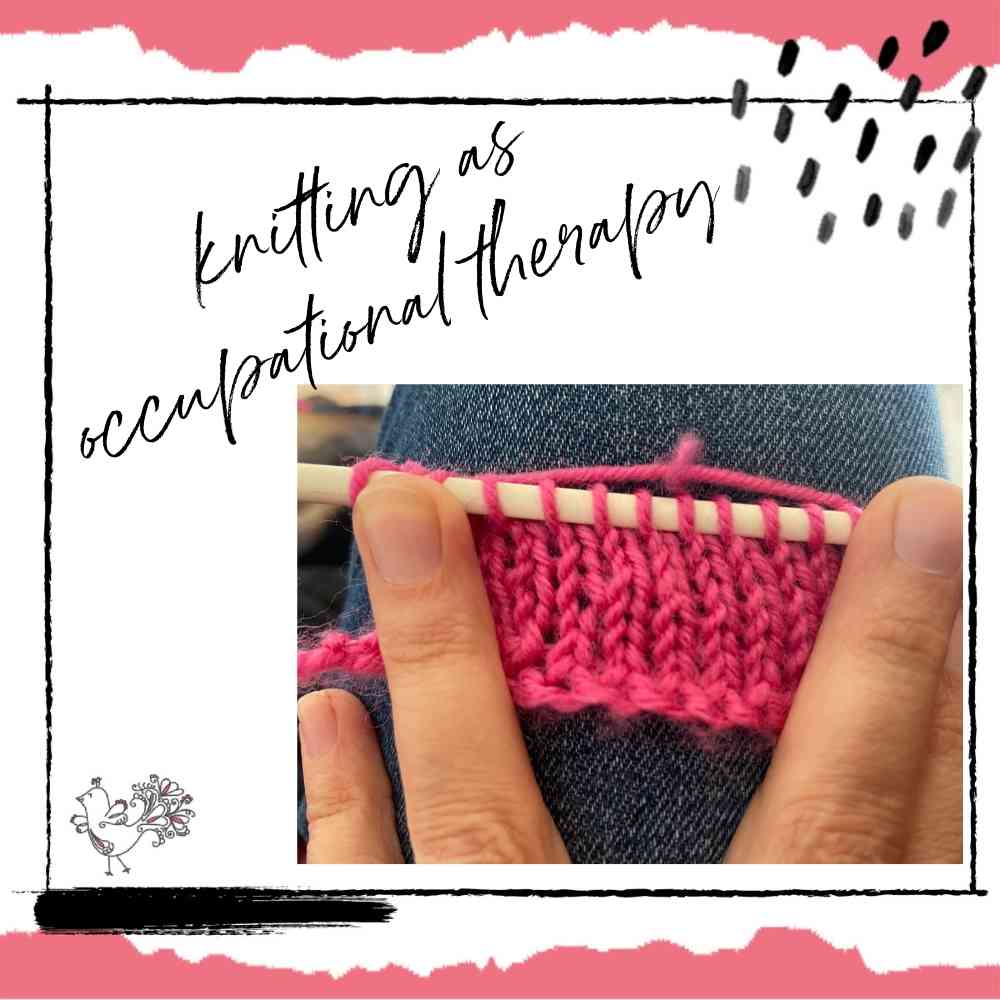
- Held correctly and worked slowly, knitting helped to stretch out the damaged area of my hand. (I got a dog bite and the scar tissue caused a tightening in my hand.) Therefore, I could actually use the knitting as exercise.
- Knitting and crochet work slightly different muscles. It's been best to do a little of each, alternating one, then the other. How awesome to be bicrafty!
Remember again that all of this is very individual. Work with your professionals. Trust yourself. Pay attention to your needs. See how knitting as occupational therapy can work for you personally.
You Might Also Like:
- 3 Mindfulness Crochet Exercises to Help You DeStress
- Making With Meaning Book Review
- 20 Reasons I Am Thankful For Crochet (And Knitting Too!)
- Olympian Tom Daley Knits and Crochets for Therapy
Frequently Asked Questions
How does knitting function as occupational therapy?
Occupational therapy helps people develop, maintain, or restore skills needed for daily life and meaningful activities. Knitting checks a lot of OT boxes! It develops fine motor skills and hand-eye coordination. It requires following a pattern which exercises cognitive function, memory, and sequencing. The bilateral hand movements promote brain connectivity. The rhythmic, repetitive motion has well-documented calming effects on the nervous system. And the sense of accomplishment from completing a project builds confidence and motivation. Occupational therapists sometimes specifically recommend craft activities for patients recovering from various conditions.
Can knitting help with anxiety and stress?
Research and lived experience both strongly support this! The repetitive hand movements in knitting trigger a relaxation response similar to meditation… slowing heart rate, lowering blood pressure, and reducing cortisol levels. The focus required to follow a pattern creates a mindfulness state that naturally quiets anxious thoughts. Many knitters describe it as their primary stress management tool. Knitting circles (in-person and online communities) also provide social connection, which is powerful for mental health. It's not therapy in the clinical sense… but knitting has genuine therapeutic benefits for many people.
Is knitting good for people recovering from injury or illness?
It can be! Knitting is used in rehabilitation for people recovering from strokes, brain injuries, and hand/arm surgeries… the fine motor movements support neurological recovery and hand strengthening. For people dealing with chronic illness, knitting provides meaningful activity during periods of limited physical capability. For those managing chronic pain, the absorption of knitting can help shift focus away from pain. Always consult healthcare providers about specific rehabilitation goals, but knitting is generally considered a beneficial and accessible activity for many recovery situations.
Are there specific types of knitting better suited for therapeutic purposes?
Simpler, repetitive patterns work best for therapeutic use because the focus should be on the process and movement rather than complex problem-solving. Garter stitch (knit every row) is wonderfully meditative. Stockinette in the round (knit every round) is rhythmic and calming. Anything with a simple repeat you can memorize and work without constant reference to a pattern. For cognitive benefits, pattern work that requires attention and counting can be deliberately challenging in a good way. The “right” therapeutic knitting depends entirely on the specific person and their goals.
How can I introduce knitting to someone as a therapeutic activity?
Start very simple! Chunky yarn and large needles make the movements slower, more visible, and less demanding of fine motor precision… ideal for someone new to the craft or working through limited dexterity. A garter stitch square is a perfect first project. Short sessions are better than long ones, especially at first. Celebrate small wins and focus on the process rather than the finished product. If the person has specific physical limitations, a knitting OT (yes, there are specialists!) can provide adaptations like needle holders, modified grips, or one-handed techniques.
Categories: BiCrafty Bootcamp Learn to Knit, Dibble Dabble Inspiration, Knitting




When I was receiving chemotherapy, I would have a week of exhaustion after each treatment. In between I’d collapse in the evening. But I felt the need to do something so I crocheted. I made many afghans during that time. It helped so much to feel productive when I was unable to do very much. Seeing the colors of the yarn come together in pretty patterns made me happy. Plus it helped the restlessness that happens when you have too much down tine