Search
Close
  • The Pattern Shop
  • Our Free Patterns
    • Browse All Our Free Patterns
    • Our Free Knitting Patterns
    • Our Free Crochet Patterns
  • Blog
    • All Blog Posts
    • All Free Patterns
    • Dibble Dabble Inspiration
    • Giveaways
    • Make-Alongs
    • Product Reviews
    • Roundups
    • Tips, Tricks, Techniques for Knitting and Crochet
Stylized bird with pink and gray swirling tail above elegant “Marly” text, logo for crochet accessories and home decor.
  • Marly Bird House
  • Learn to Knit & Crochet
    • Newbie? Start Here
    • Video Tutorials
    • Knitting Definitions
    • Crochet Definitions
    • Common Techniques
    • Size Charts for Knitting and Crochet Projects
  • About
×
  • The Pattern Shop
  • Free Patterns
  • Blog
  • Marly Bird House
  • Learn to Knit & Crochet
    • Newbie? Start Here
    • Video Tutorials
    • Knitting Definitions
    • Crochet Definitions
    • Common Techniques
    • Size Charts for Knitting and Crochet Projects
  • About
Stylized bird with pink and gray swirling tail above elegant “Marly” text, logo for crochet accessories and home decor.
Search
Close

New Patterns NOW Available in Ad-Free PDF! Check out The Pattern Shop

Learn How to Crochet: The First Five Things You Need to…

August 19, 2021 By Marly Bird Leave a Comment

So, you want to learn how to crochet? Where should you begin? There are a lot of things that you're going to need to learn eventually. You'll need to learn about yarn weights and fibers, crochet hook sizes, and more. But in terms of basic stitches, there are five things you need to learn when you first start to crochet. What's interesting is that after you've learned the first two, you basically know how to crochet. The next three are essentially variations on those. And with that, you'll be able to crochet blankets, scarves, and so much more. So, in terms of first techniques and basic stitches, here are the first five things you want to learn how to crochet.

beginner crochet stitches

How to Slip Knot and Make Your Foundation Chain

In order to start a crochet project, you have to first get the yarn onto your hook. There are different ways of doing this. However, the most common method is to make a slip knot. You place the knot on the hook. Then you crochet a chain. If you can do this, then you've begun to learn how to crochet.

How to Crochet the Single Crochet Stitch

The single crochet stitch is the most basic, simple crochet stitch. Take the time to learn how to work this stitch, because the essential steps of working it are going to apply to almost every other stitch you ever make in crochet.

How to Crochet the Double Crochet Stitch

The double crochet stitch is worked very similar to the single crochet stitch. However, it's double the height. That's where the name comes from. Just like with the single crochet, you're going to use the techniques of “yarn over” and “pull through loops”. You just use them slightly differently to get that higher height.

How to Half Double Crochet

As you may guess by the name, this stitch is halfway between the single crochet stitch and the double crochet stitch in height. You'll pull the yarn through a different number of loops to achieve this effect. But the time that you're this far in learning how to crochet, you'll start to get a really good sense of stitch anatomy.

How to Make The Treble Crochet Stitch

Finally, we'll complete your beginner crochet stitches with the treble crochet stitch. Using the same foundational methods, you'll make a stitch that's taller than the double crochet stitch. As you can see, you can do a lot when learning to crochet even by just learning a few really basic things.

What You Can Do With This Knowledge

With the “learn how to crochet” skills from the videos above, you can now work in rows. This means that you'll be able to crochet anything that is square or rectangular. At this stage, you'll want to work one stitch into one stitch. You'll probably also want to work the same stitch across the whole row.

For example, you might crochet a foundation chain that's 20 stitches long.

Then you might turn the work and make one single crochet into each of those twenty chains.

You could continue to work 20 single crochet stitches across the row until you have a square or rectangle the length that you desire. This might be a crochet mug rug, for example.

Alternatively, you might work 20 double crochet stitches as a row, or twenty half double crochet stitches. The only thing that you need to know differently for each of those rows is how many stitches to make each turning chain. Which is why you also need this information:

With this knowledge you can crochet anything square or rectangular. Make crochet scarves, blankets, square shawls, placemats, dishcloths, etc.

What's Next In Learning How to Crochet

Obviously, when you learn how to crochet you want to learn lots of different things. There are a lot of different stitch patterns and crochet techniques to learn. You'll also want to learn how to work with different stitches in the same row (single crochet, double crochet, across a row, for example.) Plus you'll want to know how to change colors in a project. Moreover, you'll want to learn how to increase and decrease rows to create different shapes besides the rectangle or square. Finally, you'll want to learn how to crochet in the round, rather than just in rows.

But these five stitches (chain, single crochet, double crochet, half double crochet, and treble crochet) give you a very solid foundation when you first learn how to crochet. Then you can take it from there. Check my YouTube channel for lots more instructional videos to take it further.

You Might Also Like:

  • Variations on the HDC Stitch
  • 2021's Best Crochet Books
  • Free Crochet Patterns by Marly Bird

Frequently Asked Questions

What are the first five things to learn when starting crochet?

The fundamentals that unlock everything else! First: how to hold the hook and yarn comfortably. Second: the slip knot and foundation chain… the starting point of almost every crochet project. Third: single crochet, which is the building block of most beginner patterns. Fourth: how to turn at the end of a row (the turning chain) and work back across. Fifth: how to count your stitches to make sure you're not accidentally adding or losing any. Master these five things and you can make a dishcloth, a swatch, or start simple patterns… you're a crocheter.

How long does it take to learn to crochet?

Most people can learn to make simple single-crochet projects within a few hours of practice! The physical coordination takes some getting used to at first… holding the hook, maintaining yarn tension, and inserting the hook consistently. But once the motion clicks, it clicks. Many complete beginners watch a tutorial and make their first swatch in the same afternoon. Being able to make beautiful projects with confidence takes longer… months of practice across different techniques. But the basics are genuinely accessible quickly, which is one of the reasons crochet has such a wide following.

What supplies do I need to start crocheting?

Honestly, very few! A size H crochet hook (5mm) and a skein of smooth worsted weight yarn in a light color (so you can see your stitches clearly). That's the minimum. Light-colored smooth acrylic is ideal for learning… it's affordable, consistent, and easy to see. Everything else (scissors, tapestry needle, stitch markers) can be added as you go. The barrier to entry for crochet is remarkably low… you can start learning for under $10 in supplies. Fancy ergonomic hooks and premium yarn come later, once you know you love the craft.

Is it easier to learn crochet from a video or from written instructions?

For most people, video is much better for learning physical craft skills! Seeing exactly how the hook moves, how the yarn wraps, where the hook inserts… makes the physical motion immediately understandable in a way that written “insert hook into stitch, yarn over, draw through two loops” can't quite achieve. Marly Bird's YouTube videos are specifically designed to be clear and encouraging for beginners. Watch the video, pause and try it yourself, rewind if needed. Written instructions become more useful once you have the physical motion and need to follow specific pattern sequences.

What's the most common mistake beginners make?

Accidentally adding stitches at the end of rows! This causes your work to gradually get wider and wider. It happens because the turning chain can look like a stitch and you inadvertently work into it. The fix: count your stitches at the end of every row for the first several projects… if you have more than you started with, you added accidentally. Also common: crocheting too tightly because of tension nervousness. Relax! Yarn should slide freely. And not recognizing which loops to insert the hook through… always check that you're going under both top loops unless a pattern specifically says otherwise.

Filed Under: Crochet, Tips, Tricks, Techniques for Knitting and Crochet

Signature Needle Arts Knitting Needles Review

August 19, 2021 By Marly Bird Leave a Comment

We were so lucky to have so many terrific knitting needle sponsors for BiCrafty Bootcamp. After all, we wanted to show all the new knitters the many different options out there. Most of them started out not even knowing about different types of knitting needles, let alone which brands might be best. We got to use a different brand every month, wrapping everything up this past month with Signature. So, here's our Signature Needle Arts review. (Although if you've been following along with BiCrafty Bootcamp then you already know that we LOVE these knitting needles.)

Signature Knitting Needles

The Stiletto Point

What sets Signature Needle Arts apart from the rest is their design of the stiletto point for their knitting needles. It's a sharper point that allows for such great ease of knitting. In fact, this company formed when the President of a family-owned machine shop called Bothe Associates Inc, who also happened to be a knitter, asked, “why can't I have better needle points?” Then they decided to make them. The company grew from there. In the chat portion of the final live video chat for BiCrafty Bootcamp, we were joking (kinda, not really) about how we'd rather have stiletto needle points than stiletto heels. They make the knitting go fast and smooth.

But They Have Other Point Options, Too

All of the experienced knitters in BiCrafty Bootcamp seemed to love those stiletto points. And Marly is one of Signature's biggest fans. But it's important to note that their needles come with other point options as well. Why does that matter? Well, for example, BiCrafty Bootcamper and Marly Bird team member Kathryn has been slow to pick up knitting and still finds the ease of the stiletto point just a bit too fast for her hands. So it's good to know that some of the their knitting needles also come in “Middy” and “Blunt” points.

Signature Needle Arts Review DPNs 2

Types of Signature Arts Knitting Needles

The company has everything you might want including straights (single points), double points (DPNs), and Circulars.

Single Points

Signature's set of single point needles ranges in size from 1/2.25MM-10/6.0MM. You also have a variety of options to choose from:

  • Knitting needle length: 7″ or 10″ or 14″
  • Needle point type: stiletto, middy, or blunt
  • Knitting cap type (the end opposite the needle): shaped as bell, spiral, or tear
  • Option to monogram!

That's right – you can monogram your Signature Knitting Needles. This is great for inspirational phrases, intentional crafting with a message, gifts, putting your name on your needles, and more.

DPNs

A set of DPNs from Signature ranges from 01/2.25MM-06/4.0MM. Each set includes five needles. One of the things the Marly Bird team loved was having each set arrive in its own tube, making it easy to keep the sets together without anything getting lost. Choices you have for Signature DPNs:

  • Knitting needle length: 4″, 5″, 6″ or 8″
  • Note that they are all stiletto points except the 4″ which combine stiletto and blunt
  • Option to monogram

Circulars

Signature Convertible Circular Knitting Needles Set are interchangeable circulars. They range in size from 03/3.25MM-10/6.0MM. Options include:

  • 4″, 5″ or 6″ needle length or “stalks”
  • 16″, 20″, 24″, 32″, 40″ or 47″ overall length with cables (note that not all sizes are available for all stalk lengths)
  • Stiletto tip or middy tip
  • Option to monogram

High-End Signature Arts Knitting Needles Review: Worth the Investment

It's true that Signature Needle Arts knitting needles tend to be on the high end as far as price goes. But their quality is well worth it. Of course, not everyone can afford them, and that's okay. It's okay to knit with whatever you can get your hands on. But if you have a little bit of money to treat yourself – or a crafting friend – to something special then our Signature Needle Arts review is: GET THEM.

Signature Needle Arts Review

Cryssi's Signature Needle Arts Review

BiCrafty Bootcamper, Marly Bird team member and now-knitter Cryssi says her Signature Needle Arts review is: “slices through yarn like a hot knife through butter.” She really loves working with these, says they are “such a dream” to use. Moreover, she is excited to be at the stage of knitting where she can use them comfortably.

Kathryn's Signature Needle Arts Review

Although Kathryn might not be at the knitting level where she works quickly with the metal needles, she doesn't deny that she's lucky to own a set. First of all, they're beautiful. Displaying them makes her want to improve her knitting. Second, she loves the storage tubes the DPNs came in. And finally, she can see that they're of great quality.

You Might Also Like:

  • What Are The Best Knitting Needles for Beginners
  • Oldie-But-Goodie: Signature on the YarnThing Podcast
  • Ultimate Guide to Knitting Needle Storage and Organization

Frequently Asked Questions

What makes Signature Needle Arts needles special?

Signature Needle Arts is a small American company making premium knitting needles that are beloved in the knitting community for a specific reason: their needle tips. Signature offers multiple tip styles on the same size needle… from very sharp (ideal for lace and fine detail work) to blunter (better for bulky yarn and continental knitting). They're made with meticulous attention to quality and crafted in California. Many serious knitters consider them the finest available. They're a luxury investment but an investment that crafters often say transforms their knitting experience.

Are Signature Needle Arts needles worth the price?

That's the central question! They're significantly more expensive than most knitting needles. Whether they're worth it depends on how much you knit, what you knit, and whether needle quality affects your experience. For casual knitters or beginners, the difference may not justify the cost. For dedicated knitters who spend hours on their needles every week, the ergonomics, the tip quality, and the craftsmanship can genuinely improve the experience and reduce hand fatigue. Marly's review in this post gives her honest assessment based on real use… check it for her specific verdict.

What types of needles does Signature offer?

Signature makes straight needles, circular needles (fixed and interchangeable), and double-pointed needles. The interchangeable circular system is particularly popular because it lets you swap needle tips onto different cable lengths… one set of tips works with multiple project sizes. They offer several tip styles: stiletto (very sharp), midrange, and blunt. The needle material is aluminum with a very smooth, consistent finish. Cable quality and joins are excellent, which matters a lot for smooth stitching without yarn catching at the connection point.

How do Signature needles compare to other premium brands?

Premium knitting needle brands commonly discussed alongside Signature include ChiaoGoo (known for excellent flexible cables), Addi (German engineering, very smooth joins), Knitter's Pride (good value in the premium space), and HiyaHiya (sharp tips, very flexible cables). Each has devoted fans. Signature stands out for the US craftsmanship and especially the multiple tip style options… that customization is unique in the market. If sharp tips are your priority, Signature Stilettos are frequently cited as the sharpest available. If cable flexibility is your priority, ChiaoGoo may edge them out.

Can I try Signature needles before buying a full set?

Buying a single needle size to try before investing in a full set is smart! Signature sells individual needle sizes, so you can test one circular needle at your most-used size before committing to a full interchangeable set. Some yarn shops that carry premium needles may have testers available to try in-store. Knitting friends are often willing to let you try their needles for a few rows… the knitting community is generous that way. Given the investment, trying before committing to a complete set is definitely the right approach.

Filed Under: BiCrafty Bootcamp Learn to Knit, Knitting, Product Reviews

Marly Bird Crochet Block: MooglyCAL2021

August 19, 2021 By Marly Bird Leave a Comment

If you haven't been following along with the MooglyCAL2021, then you've been missing out. Just like last year's project, dozens of designers have come together to create crochet blocks throughout the year. Moogly shares all of the blocks on her site. By working on them, we all learn new crochet stitches, techniques, and approaches to creating a square. Ultimately, in the end, you have the beautiful MooglyCAL2021 crochet blanket. As you know, I love to collaborate and be a part of the community in as many ways as I can. Therefore, I'm thrilled to share my Marly Bird Crochet Block with you today!

MooglyCal2021 Marly Bird Crochet Square Pattern

MooglyCAL2021 Marly Bird Crochet Block Pattern

By Robyn Chachula and Marly Bird; we collaborated to make this design happen! After all, if I can add collaboration to a collaboration project, then that's even better. And of course you know I think Robyn is a rockstar!

Materials

Yarn 

Red Heart, With Love (CYCA #4), 100% Acrylic, 198 g/7 oz, 338 meters/370 yards. You'll need one skein each of three different colors of your choosing.

Crochet Hook  

J (6mm) or hook needed to obtain gauge

Notions 

Yarn Needle

Stitches Used

beg beginning

ch  Chain

ch-sp   Chain Space

sl st Slip Stitch

sc Single Crochet

dc  Double Crochet

tch   Turning Chain

st Stitch

RS     Right Side

WS    Wrong Side

Gauge 

1 motif = 12”(30.5 cm) x 12” (30.5 cm) in pattern, BLOCKED.

Size 

12”(30.5 cm) x 12” (30.5 cm)

SPECIAL STITCHES

2 Double Crochet Cluster (2dc-cl) *Yarn over hook, insert hook into chain space indicated, yarn over and pull up a loop, yarn over and draw through 2 loops on hook; repeat from * once more in same space, yarn over and draw through all loops on hook.

Double 2 Together (dc2tog) *Yarn over hook, insert hook into chain space indicated, yarn over and pull up a loop, yarn over and draw through 2 loops on hook; repeat from * once more in next space, yarn over and draw through all loops on hook.

NOTES

  1. See stitch diagram for assistance. 
  2. You can change the ch 8 + sl st to start Round 1 with a stacked dc, ch 5, sl st to stacked dc.
  3. Stitches on Round 2, 3, 5, 6, 7, and 8 are worked behind the ch-5 sps.  Open up the ch-5 sp and push forward, insert hook working through the horizontal bars at the base of the ch-5 sp/ top of stitch indicated.  You can go into the back loop only or through both loops, whatever is easiest for you to see.  

MooglyCAL2021 Marly Bird Crochet Motif Instructions

With A, make an adjustable ring, 

Round 1 (RS): Ch 8 (counts as dc + ch-5 sp), sl st to 6th ch from hook, [dc in ring, ch 5, sl st to previous dc] 11 times, push first ch-5 sp forward, sl st to top of beg ch in same place as first sl st, pull ring closed, do not turn, Fasten off A. (12 dc + 12 ch-5 sps)

Round 2: Join B in same st as join, ch 2, dc in same st as join behind ch-5 sp (counts as 2 dc-cl), ch 5, sl st to previous dc, *ch 2, 2 dc-cl in next dc behind ch-5 sp, ch 5, sl st to previous dc-cl; repeat from * around, ch 2, sl st to first dc behind ch-5 sp, do not turn. Fasten off B. (12 dc-cl + 12 ch-5 sps + 12 ch -2 sps)

Round 3: Join C in same st as join, ch 3 (counts as dc), (2 dc, ch 3, 3 dc) in same st as join behind ch-5 sp, *[ch 1, 2 dc in next dc-cl behind ch-5 sp] twice, ch 1**, (3 dc, ch 3, 3 dc) in next dc-cl behind ch-5 sp; repeat from * around ending at **, sl st to top of beginning ch, do not turn. Fasten off C. (4 corner ch-3 sp + 12 ch-1 sps + 40 dc)

Round 4: Join B to corner ch-3 sp with sl st, ch 1, 2 sc in corner ch-3 sp, ch 5, sl st to previous st, sc in same corner ch-3 sp, dc in ch-5 sp from Round 2, *skip 1 dc, sc in next 2 dc, dc in next ch-5 sp from Round 2, ch 5, sl st to previous st, sc in next 2 dc, dc2tog over previous and next ch-5 sps from Round 2, ch 5, sl st to previous st, sc in next 2 dc, dc in previous ch-5 sp from Round 2, ch 5, sl st to previous st, sc in next 2 dc, dc in next ch-5 sp from Round 2**, 2 sc in corner ch-3 sp, ch 5, sl st to previous st, sc in same corner ch-3 sp, dc in previous ch-5 sp from Round 2; repeat from * around ending at **, sl st to first sc, do not turn. Fasten off B. (16 ch-5 sps+16 dc+4 dc2tog+44sc)

Round 5: Join A with sl st behind any corner ch-5 sp in corner sc, ch 3 (counts as dc), (2 dc, ch 3, 3 dc) in same sc behind ch-5 sp, *ch 5, sl st to previous st, skip 4 sts, 3 dc in next st behind ch-5 sp, [ch 5, sl st to previous st, skip 2 sts, 3 dc in next st behind ch-5 sp] twice, ch 5, sl st to previous st**, (3 dc, ch 3, 3 dc) in corner sc behind ch-5 sp; repeat from * around ending at **, sl st to top of beg ch, do not turn. Fasten off A.  (16 ch-5 sps, 4 ch-3 corner sps)

Round 6: Join C to any ch-3 corner sp, ch 3 (counts as dc), (2 dc, ch 3, 3 dc) in corner ch-3 sp, *[ch 5, sl st to previous st, skip 2 dc, 3 dc in next st behind ch-5 sp] 4 times, ch 5, sl st to previous st**, (3 dc, ch 3, 3 dc) in corner ch-3 sp; repeat from * around ending at **, sl st to top of beg ch, do not turn, do not fasten off. (20 ch-5 sps, 4 ch-3 corner sps)

Round 7: Sl st to next 2 dc, sl st in corner ch-3 sp, ch 3 (counts as dc), (2 dc, ch 3, 3 dc) in corner ch-3 sp, *[ch 5, sl st to previous st, skip 2 dc, 3 dc in next st behind ch-5 sp] 5 times, ch 5, sl st to previous st**, (3 dc, ch 3, 3 dc) in corner ch-3 sp; repeat from * around ending at **, sl st to top of beg ch, do not turn, do not fasten off. (24 ch-5 sps, 4 ch-3 corner sps)

Round 8: Sl st to next 2 dc, sl st in corner ch-3 sp, ch 3 (counts as dc), (2 dc, ch 3, 3 dc) in corner ch-3 sp, *[ch 1, skip 2 dc,  3 dc in next st behind ch-5 sp] 6 times, ch 1**, (3 dc, ch 3, 3 dc) in corner ch-3 sp; repeat from * around ending at **, sl st to top of beg ch, do not turn, do not fasten off. (28 ch-1 sps, 4 ch-3 corner sps)Round 9: Ch 3 (counts as dc), dc in next 2 dc, *5 dc in corner ch-3 sp, dc in each dc and ch-1 sp across to corner ch-3 sp; repeat from * around, sl st to top of beg ch. Fasten off, weave in ends. (144 dc)

MooglyCAL2021 Marly Bird Crochet Block Chart

MooglyCAL2021 Marly Bird Block crochet chart

You Might Also Like:

  • See what all of the MooglyCAL2021 squares look like so far on this Moogly Pinterest board.
  • Oldie But Goodie: Moogly on the Marly Bird Podcast
  • Marly Bird CAL Archives

Frequently Asked Questions

What yarn do I need for the MooglyCAL2021 Marly Bird Crochet Block?

So here's the thing… you'll need three different colors of Red Heart With Love yarn. It's a CYC #4 weight, 100% acrylic, and you get 338 meters/370 yards per skein. Just grab three colors you love!

Can you tell me about the special stitches for this MooglyCAL2021 block?

Honestly… there are a couple of fun ones! We've got the 2 Double Crochet Cluster (2dc-cl) and the Double 2 Together (dc2tog). They add some really neat texture to the block, and I've explained how to do them right in the post if you need a reminder.

Is this MooglyCAL2021 block suitable for beginners?

Yes! While the pattern is listed as advanced beginner, it's a really great way to stretch your skills. If you're comfortable with basic stitches and following a pattern, you should be totally fine… just take your time!

I'm having trouble with Round 2… any tips?

Oh, I hear you! The trick with Round 2 is to work the stitches *behind* the ch-5 loops from Round 1. Just gently open up that ch-5 space and work into the horizontal bars at the base… it makes a world of difference!

What's the final size of this Marly Bird crochet block?

Great question! Once it's all done and blocked, this beautiful MooglyCAL2021 block will measure 12 inches by 12 inches (or about 30.5 cm x 30.5 cm). Perfect for making a cozy blanket!

Filed Under: Crochet, Make-Alongs

Exciting New Yarn O’Go ~ Tangle-Free, Revolutionary New…

August 16, 2021 By Marly Bird Leave a Comment

It's always exciting to get the chance to try out a new yarn. O'Go Yarn is particularly exciting because it comes in an entirely new shape that changes the game. Of course, we all know that yarn comes in balls, skeins, hanks, cones, cakes … and often if things don't go right those turn into big tangles of yarn barf. Well, both knitters and crocheters can rejoice because yarn barf is a thing of the past, at least when it comes to O'Go Yarn.

You can buy O'Go Yarn on Yarnspirations right now.

Colorful yarns in various packaging, promoting a knitting and crochet project with vibrant hues and playful patterns.

What Is This New Yarn O'Go All About?

The thing that you need to know about O'Go is that it's not actually new yarn. Instead, it's a new way of getting your yarn to you. It's your favorite yarn that you already buy from places like Yarnspirations. It's just delivered to you in a new, revolutionary, smarter way.

O'Go is a donut or ring of yarn. For example. you'll be able to get Bernat Blanket yarn, which you might already love, in this revolutionary new format. It's the same great blanket yarn, but it's wound into this new O'Go form. And that keeps it tangle-free.

You pull it from the outside. (Although you could use it like a center-pull yarn, it's designed for you to pull it from the outside.)

Which Yarn Will Come in the O'Go Form?

As aforementioned, it's some of your favorite yarn just delivered to you in a new way. You'll be able to get O'Go for:

  • Bernat Blanket
  • Red Heart Super Saver
  • Caron Big Donut
  • Caron Colorama

So you'll get four of Yarnspirations most popular yarns available as the O'Go format.

More About the O'Go Format

The yarn design team sat down to solve knitters' and crocheters' most common yarn complaint: yarn barf. How can we take the yarn we love and make it tangle-free? That's how they came up with O'Go. It's not yarn wrapped around a foam core or a cardboard donut or anything like that. Instead, it's an entirely new shape for wound yarn. It's not a ball, it's not a skein, it's an O'Go.

It's especially great for beginner knitters and crocheters. I like to say that you can just “O'Go and Flow.” In other words, you pull on the yarn, and it comes out easily – tangle-free. You don't ever have to put your needles or hook down to tug on tangled yarn. Therefore, you easily keep working on your project. Obviously, experienced crafters who have had to deal with a lot of yarn barf over the years will also appreciate this.

How Can I Work With O'Go Yarn?

The yarn is designed so that you have an array of different colors in one O'Go. You can work it from end to end and you'll have a self-striping yarn. However, that's not your only option. You can separate out the colors as well. Therefore, you can easily use this yarn to play with knit and crochet colorwork.

Each yarn comes in multiple colorways. For example, Caron Colorama O'Go has 12 different colorways. But each O'Go then also has different colors within that. It's designed so that you can separate out each color super easily, allowing you to work them in the order that you want for your project. Alternatively, just O'Go and Flow from beginning to end.

How Much Yarn Will I Get?

This is an affordable yarn and you get a lot of bang for your buck. For example, the Bernat Blanket yarn is a #6 bulky weight yarn. You get 300 grams, which is 220 yards of yarn, in one O'Go. That's a lot of yarn for such a bulky weight.

Similarly, Caron Colorama is a #5 bulky weight yarn. In that O'Go, you'll get 180 grams or 228 yards of yarn.

The Red Heart Super Saver and the Caron Big Donut are both #4 worsted weight yarns. So, you have a bit of a variety for working with this yarn.

When and Where Can I Get This Awesome New Yarn?

You can find O'Go at JOANN and Michaels stores. You can also buy it online at Yarnspirations!

Keep an eye out here as well as on my YouTube, Facebook, and Instagram for more announcements including patterns for using this yarn.

Revolutionary New Yarn O'Go Format: Full Review

As soon as I was allowed to tell you about this new yarn O'Go, I hopped online to share it with you. Here's my full review. You'll see all about how it works including different methods of storage for this new yarn:

You Might Also Like:

  • Yarn Weight Chart and Recommended Yarns for Each Weight
  • How To Use a Yarn Bowl
  • 7 Affordable Yarns That Give Big Bang for Their Buck
“`html

Frequently Asked Questions

What's this O'Go yarn all about?

So here's the thing… O'Go isn't a new type of yarn, it's a new way to package your favorite yarns! It's wound into a donut or ring shape, which means no more yarn barf… yay!

Which yarns can I get in this O'Go format?

Honestly… you can get some of the most popular yarns you already love! Think Bernat Blanket, Red Heart Super Saver, Caron Big Donut, and Caron Colorama. They're all coming in this awesome new O'Go shape.

How do I actually work with this O'Go yarn?

Yes! You can just pull from the outside and let it unwind as you knit or crochet… it's designed to be tangle-free. Or, you can even separate out the individual colors if you want to get creative with colorwork!

How much yarn do I get in one O'Go?

You get a really good amount! For example, the Bernat Blanket O'Go gives you 300 grams, which is 220 yards of that super bulky yarn. It's a lot of bang for your buck!

Where can I buy this cool new O'Go yarn?

You can grab it at JOANN and Michaels stores, and of course, you can always buy it online directly from Yarnspirations. Keep an eye out for more info on my channels too!

“`

Filed Under: Product Reviews, Yarn Review

26 Free Knit and Crochet 18″ Doll Clothes & Accessories

August 16, 2021 By Marly Bird Leave a Comment

Expand the wardrobe of your child's 18″ dolls with these outfits and accessories from Yarnspirations! Whether the doll wants to be a baker, a cowgirl, a super hero, or just be cozy in a bathroom and bunny slippers, there's the perfect project. (Plus a few for children and their dolls to match!)
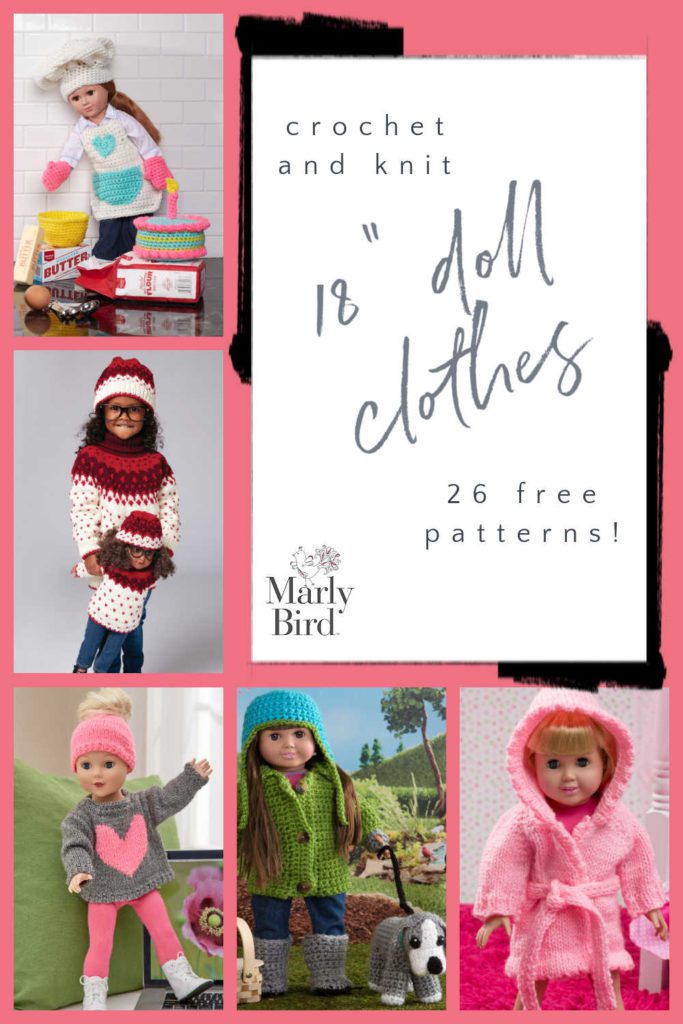
26 Free Knit and Crochet 18" Doll Clothes & Accessories

18″ Doll Clothes

An 18″ doll can be anything she wants with this collection of clothing and accessories!

  • Mermaid Doll Outfit
  • Doll Wedding Dress
  • Floral Knit Doll Accessories
  • Royal Princess Doll Outfit
  • Love My Doll Sweater & Messy Bun Hat
  • Love My Doll Sweater
  • Retro Doll Accessories
  • Aloha Hula Doll
  • Wedding Dress for Doll
  • Party Time Doll Outfit
  • Debutante Doll Dress
  • Dollie Cowgirl Partner
  • Baking Chef Doll
  • My Doll's Easter Frock
  • Bedtime for Dolls
  • Summertime Frills for Dolls
  • Doll Witch Costume
  • Boy and Girl Super Heroes
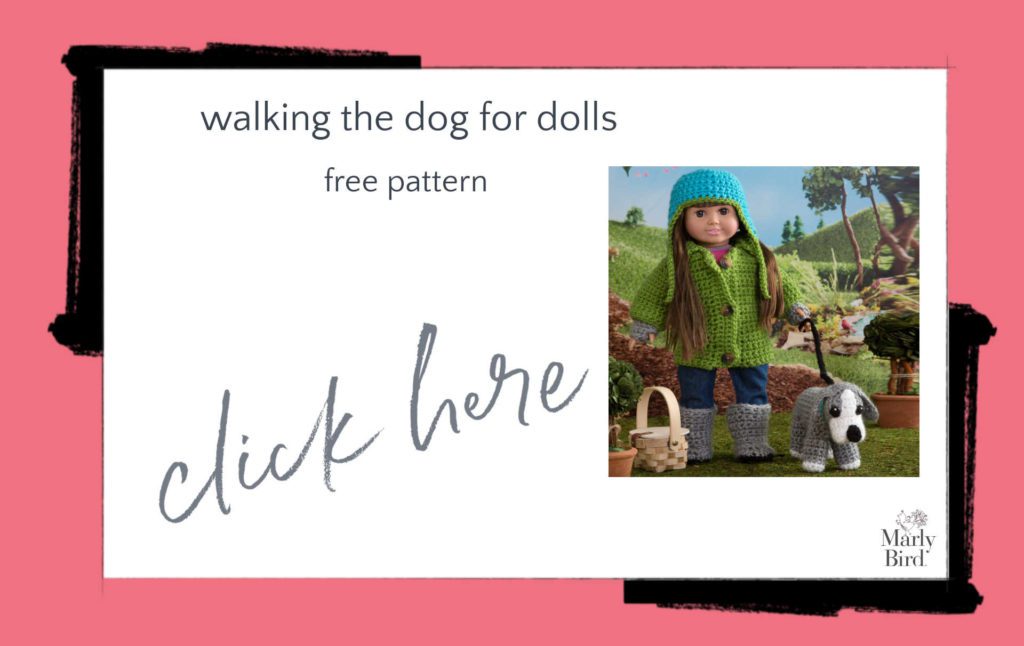
  • Walking the Dog for Dolls
  • Doll Size Beanie and Cowl
  • Doll Robe and Bunny Slippers
  • Doll's Day at School
  • Caring Nurse Doll to Crochet
  • Caring Nurse Doll to Knit
Walking the Dog for Dolls Free Crochet Pattern

Matching Clothes 18″ Doll and Child

Kids can dress just like their doll with these matching projects!
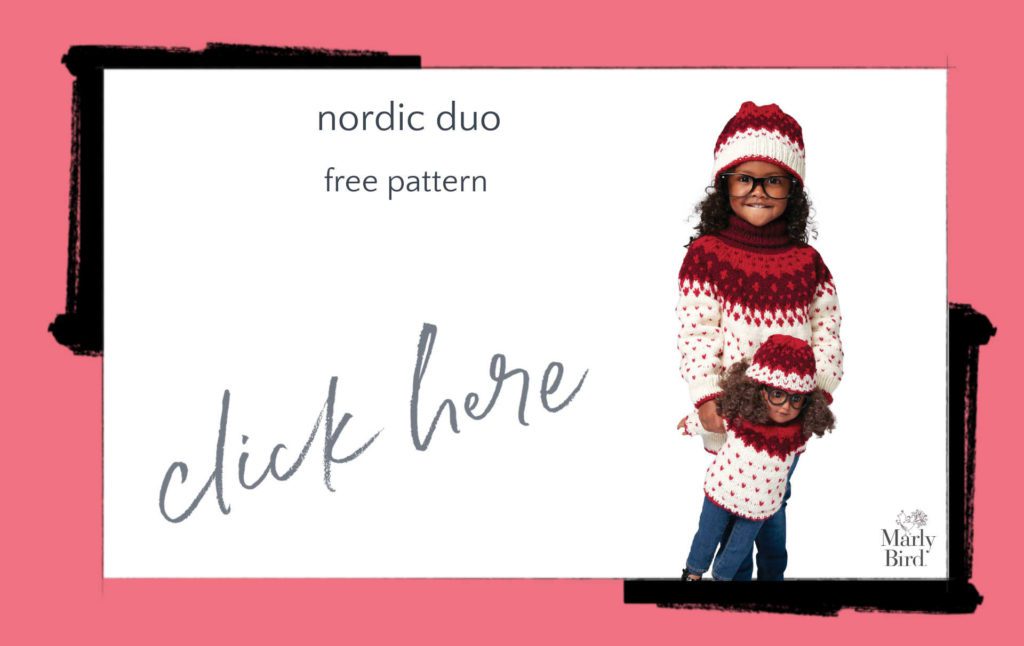
  • Nordic Duo
  • Poncho for You and Me
  • Just Like Me Doll Shrug
  • Aran Look Set
Nordic Duo Free Knitting Pattern

Also on the Blog

  • 20 Free Mommy and Me Knit and Crochet Patterns
  • 32 Free Knit Dress Projects
  • 30 Free Crochet Dress Projects

Frequently Asked Questions

What size are 18-inch doll clothes in terms of yarn and gauge?

18-inch doll clothes are tiny… which means gauge matters a lot here! Most doll clothing patterns use fingering or sport weight yarn with small hooks or needles to get the scale right. Some use DK weight for slightly chunkier doll clothes. Always check the pattern's gauge and finished measurements before starting so the clothes actually fit the doll. Off-gauge doll clothes won't close or will be too baggy… and a tiny sweater that doesn't fit is really sad.

Can I use leftover yarn from other projects for doll clothes?

Yes! This is one of the best uses for yarn scraps. Doll clothes are small projects that use very little yardage, so those leftover fingering and DK weight scraps from socks and shawls are perfect here. It's a great way to use up small amounts of special or expensive yarn that aren't enough for a full project but too pretty to throw away. Doll clothes are stash busting at its most adorable.

What skill level do I need for doll clothing patterns?

It varies! Simple doll tops and skirts that are essentially tiny rectangles with shaping are great for advanced beginners. More detailed patterns with set-in sleeves, buttonholes, and fine lace work require more skill. The challenge with doll clothes isn't usually the stitch pattern… it's the small scale. Tiny stitches require good tension control and patience. If you're new to small-scale work, start with a simple piece like a hat or basic dress before tackling something with detailed shaping.

Are these patterns specifically for American Girl dolls?

The 18-inch standard fits American Girl dolls and most similar 18-inch play dolls. Always double-check by measuring your doll… not all 18-inch dolls have exactly the same proportions. The chest, waist, and shoulder width can vary between brands. If a pattern's finished measurements don't quite match your doll, you may need to adjust needle size or stitch count slightly. But most 18-inch standard patterns fit American Girl dolls with no modification needed.

Are handmade doll clothes good gifts?

They are such a special gift! A child who loves their doll will treasure a handmade wardrobe for it. Matching doll-and-child sweaters or hats (some designers make patterns for both!) are incredibly popular and adorable. For a really memorable gift, make a small collection… a cozy sweater, a hat, and a blanket for the doll. The effort shows, and kids love that their doll has clothes that were made just for it.

“`html

Tips for Making Doll Clothes That Actually Fit

Here's the thing about 18″ doll projects… they're basically tiny versions of real garments, but the fit matters just as much! Before you dive in, measure your specific doll. Those American Girl dolls? They're all pretty standard, but every doll has her own personality… and her own measurements. A quick check with a soft measuring tape around the chest and length from shoulder to hem takes two minutes and saves you from frogging later.

Most of these patterns call for sport or DK weight yarn with smaller hooks or needles (usually size US 4-6), which means your tension is extra important. Even a half-stitch off can make a sweater too snug or baggy on tiny stitches. Take time with your gauge swatch… I know, I know, but trust me on this one!

Yarn Picks That Work Best

  • Red Heart Super Saver (budget-friendly and comes in tons of colors)
  • Caron Simply Soft (super soft against doll “skin”)
  • Lily Sugar ‘n Cream (perfect for delicate accessories)

Want to level up your doll project game? Check out our guide to weaving in ends perfectly… those tiny projects show every stitch, so clean finishing really counts. And if you're new to amigurumi or small-scale shaping, our decreases tutorial will be your new best friend for getting those doll proportions just right!

“`
Filed Under: Free Patterns

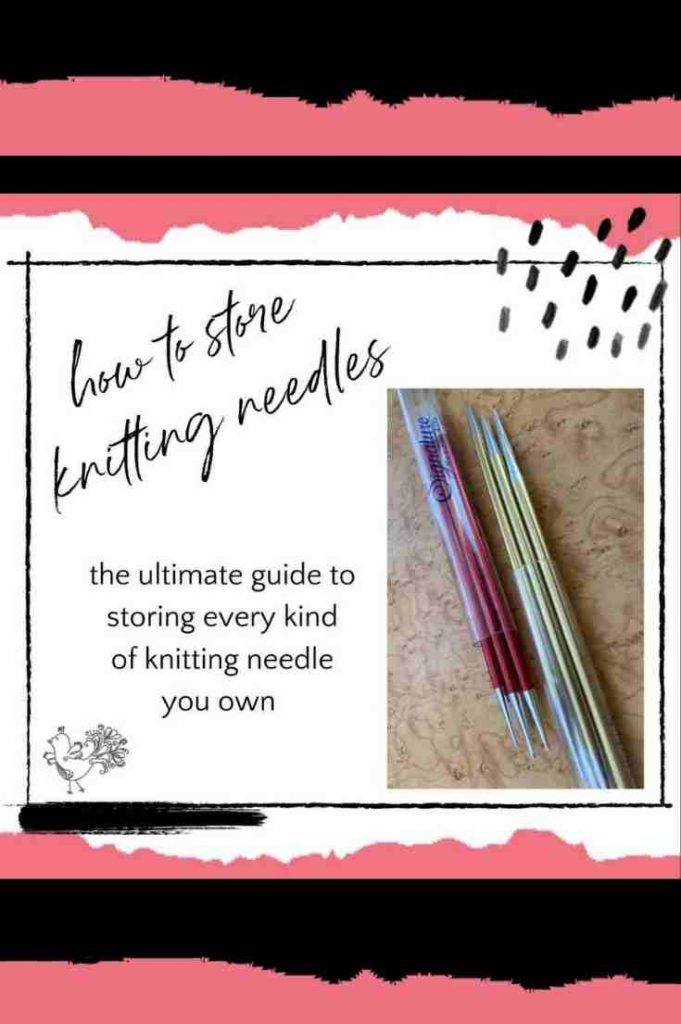
How to Store Knitting Needles: Ultimate Guide

August 12, 2021 By Marly Bird 1 Comment

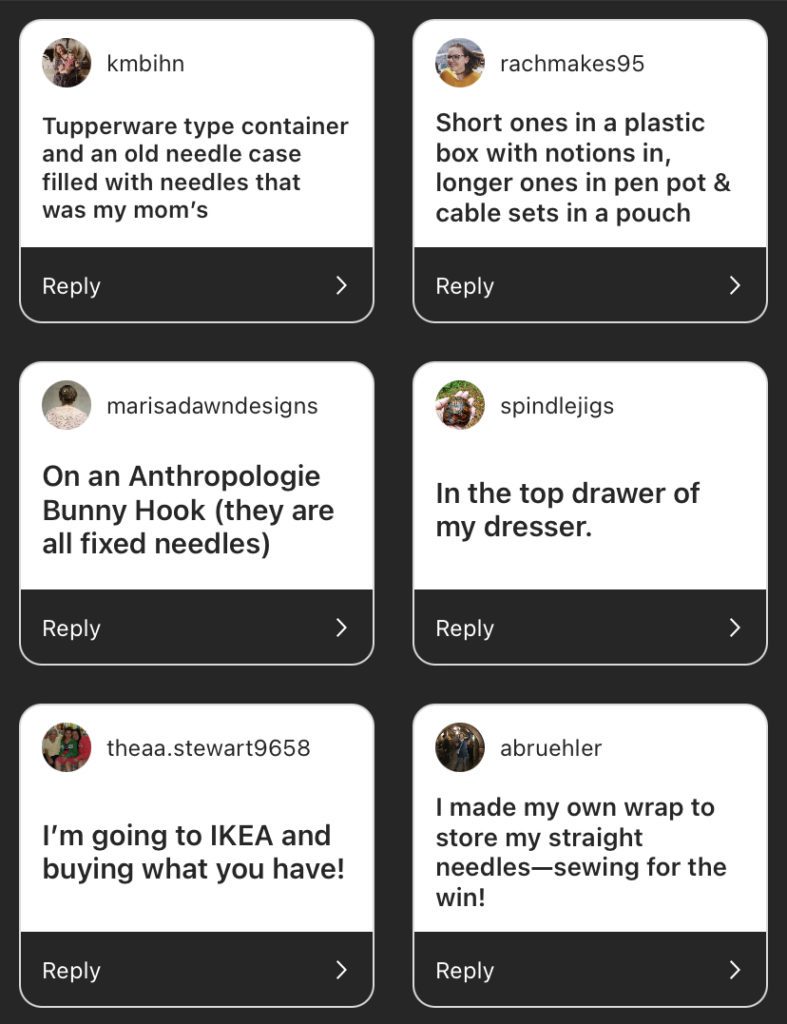
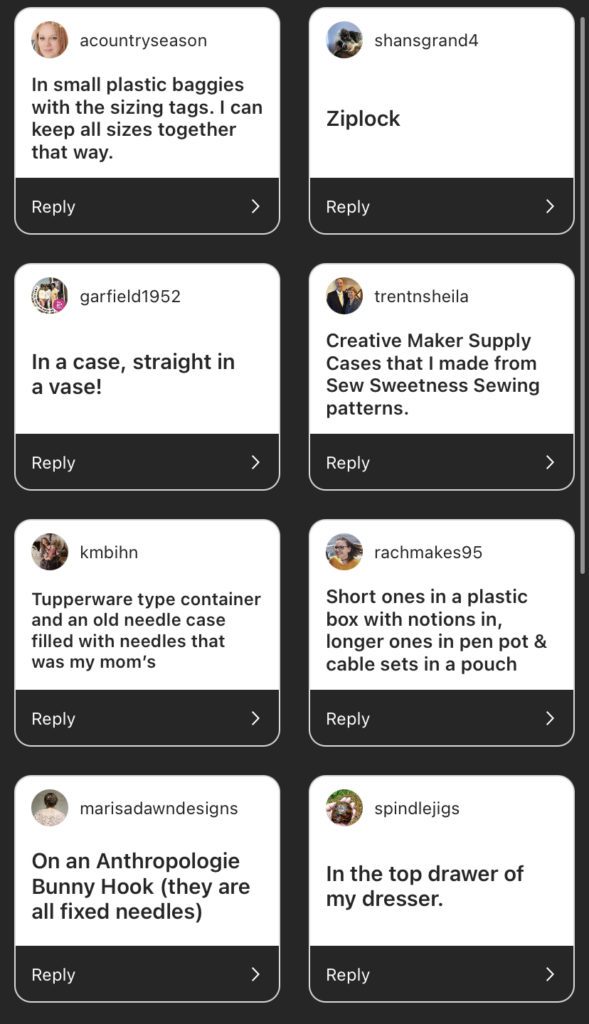
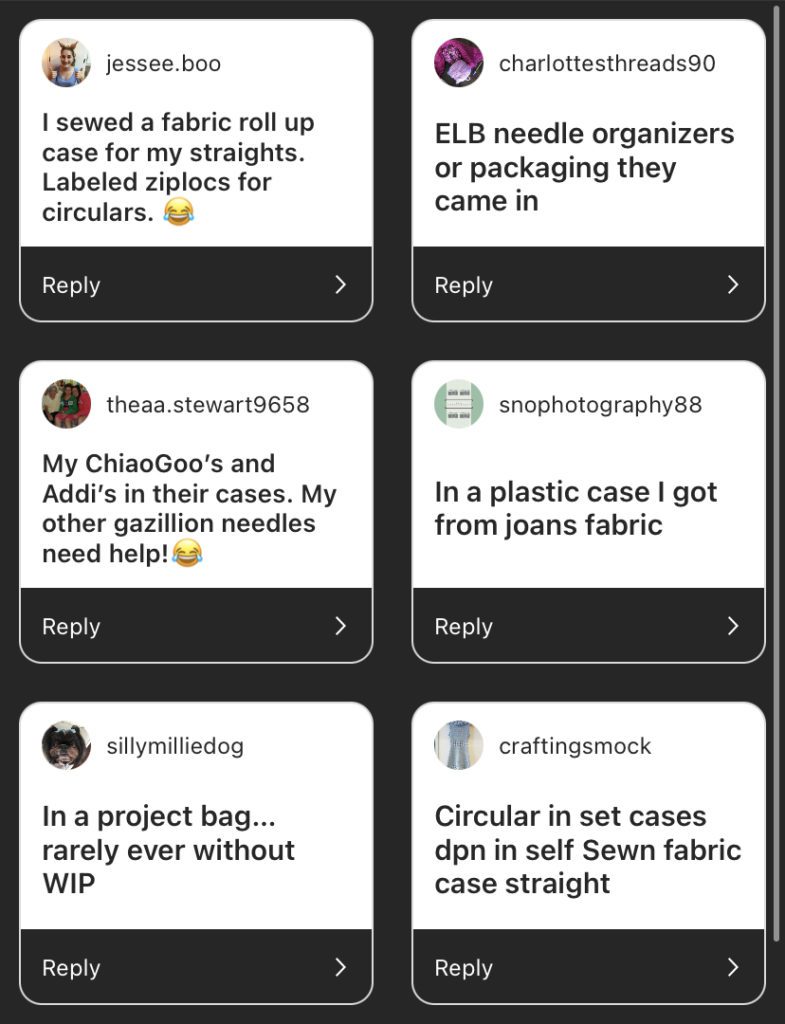
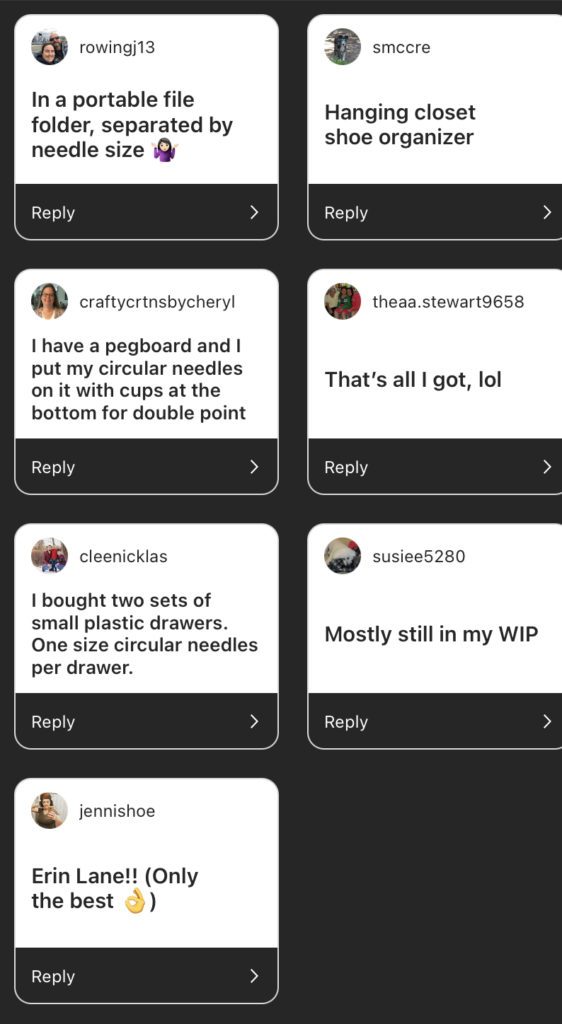
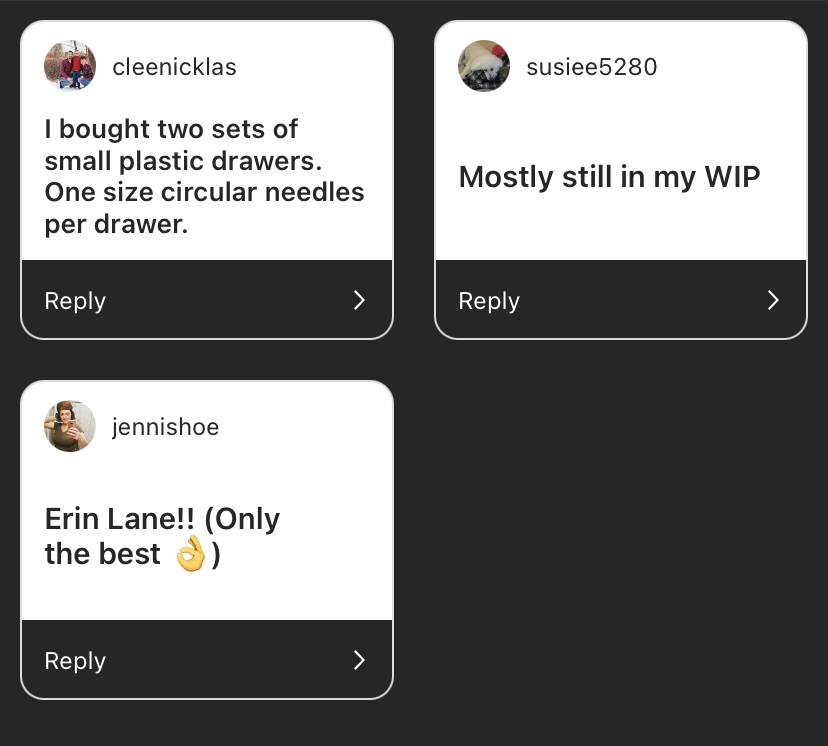
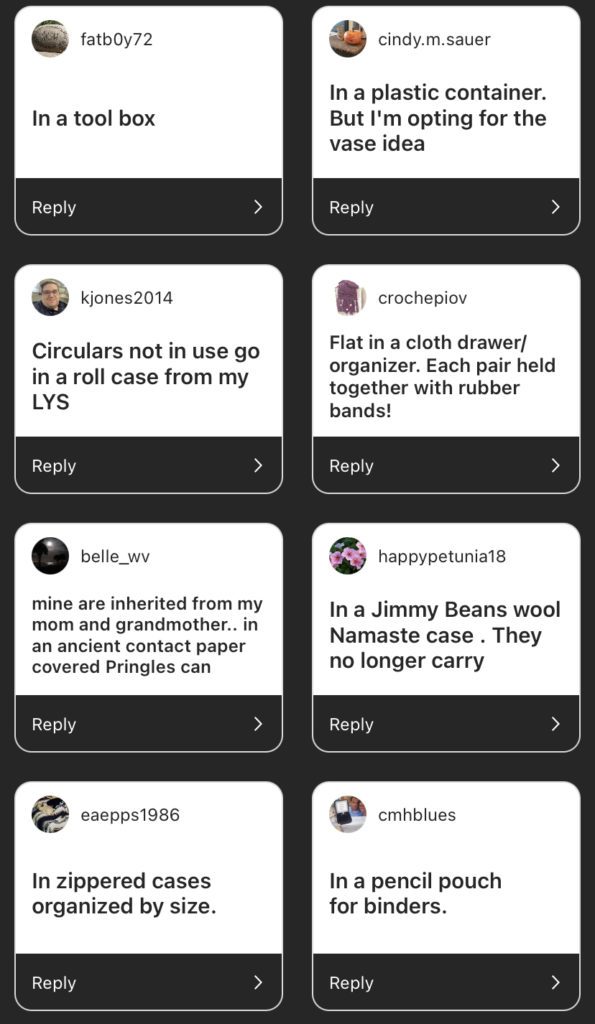
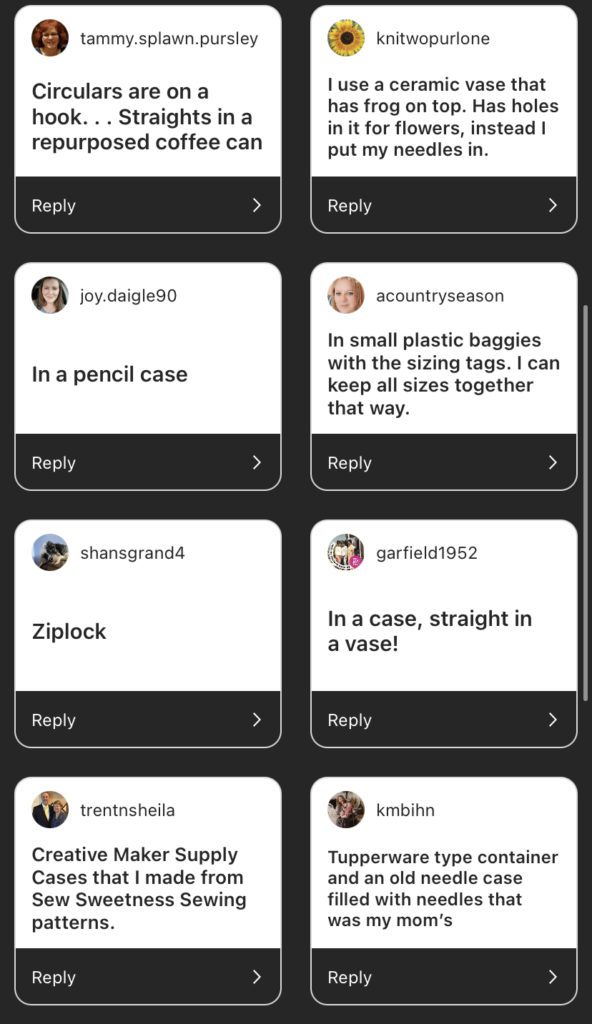
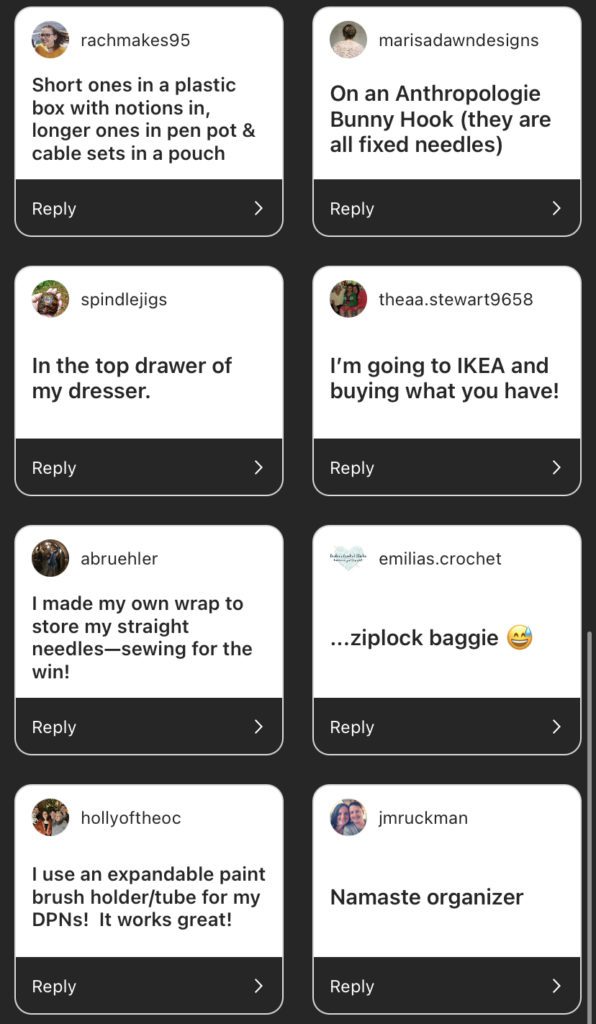
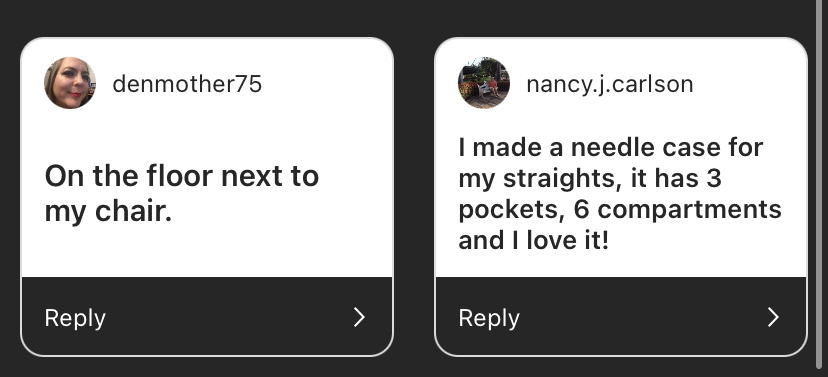
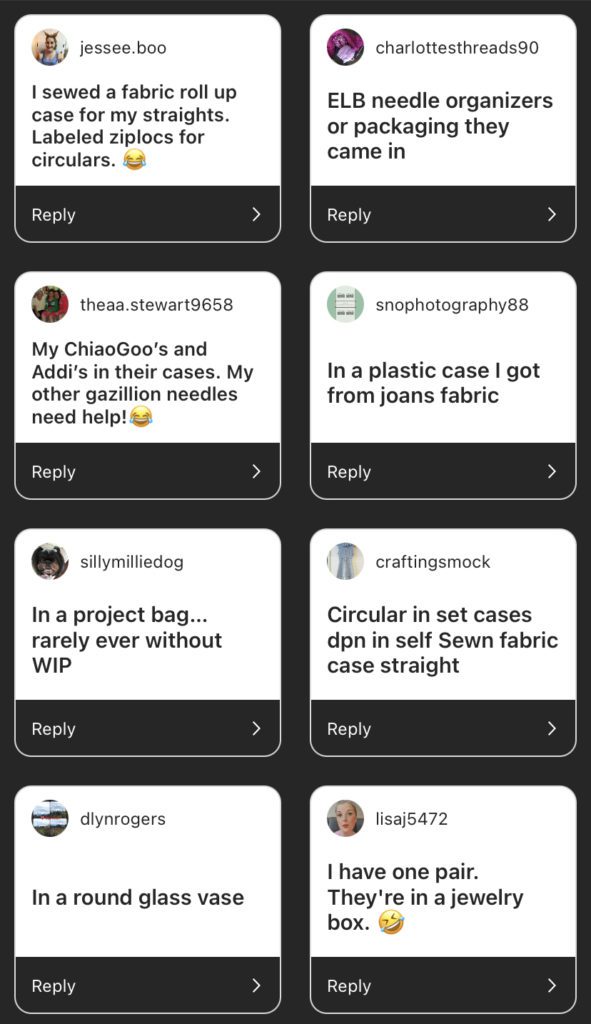
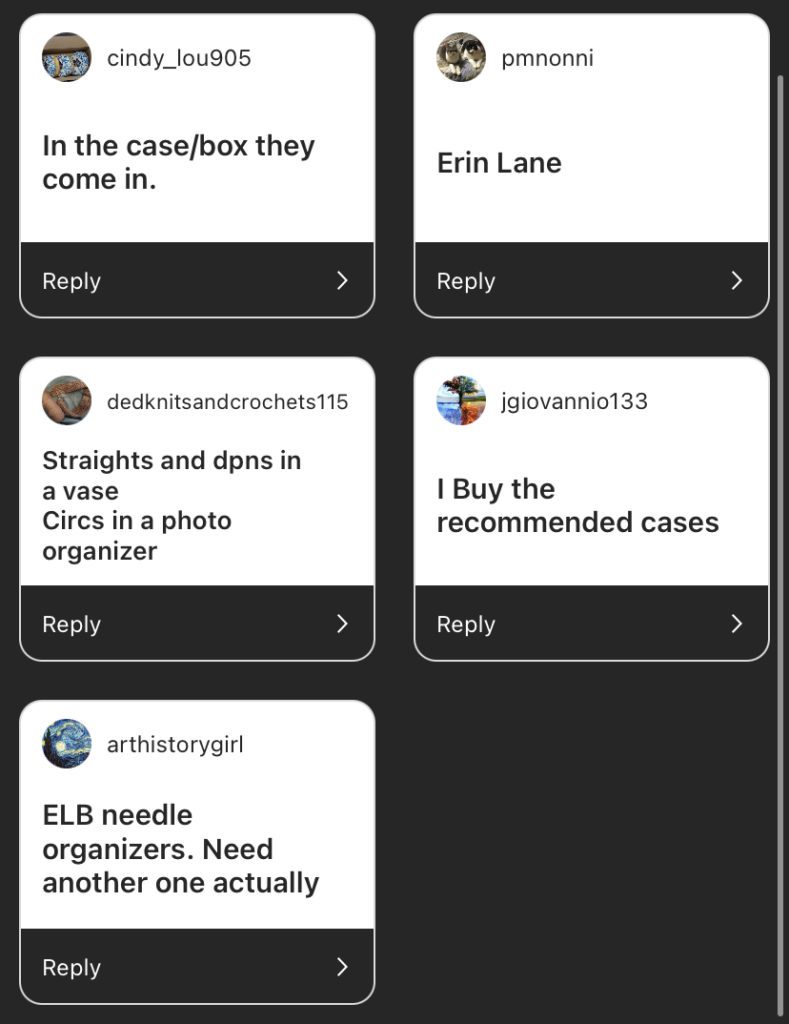
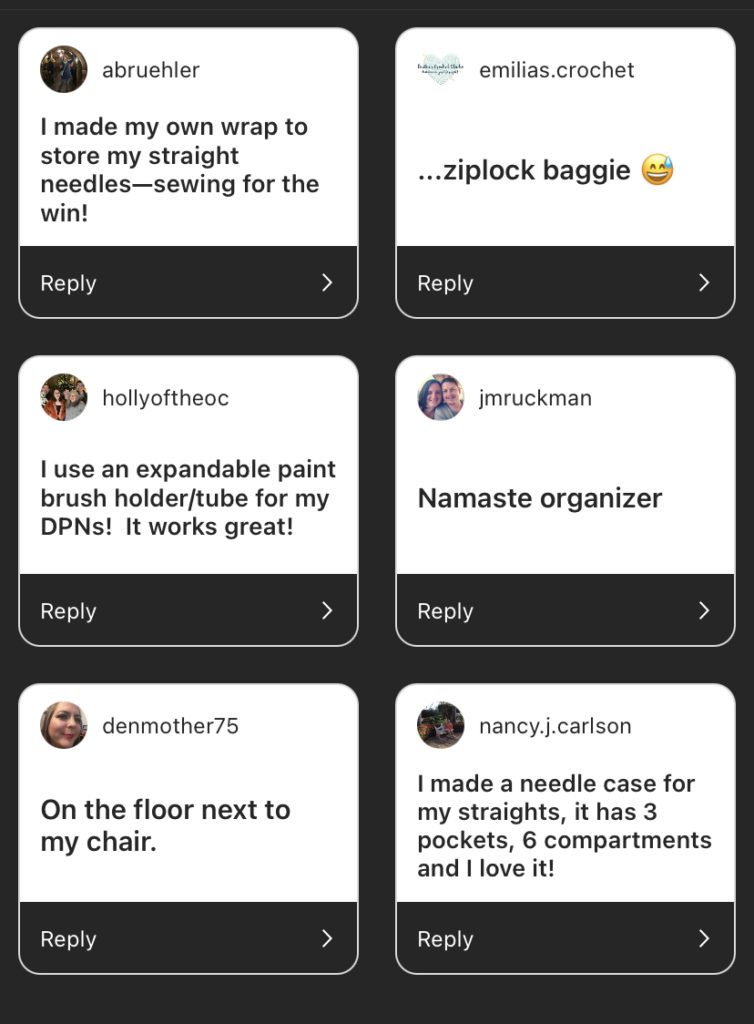
Life is a lot easier for crafters when their supplies are well-organized. If you can go straight to your craft closet and reach right for the item that you need, then you can begin your next project without any stress. Therefore, it's important to learn how to store knitting needles, crochet hooks, notions, and other craft supplies. What's particularly unique about how to store knitting needles is that there are so many different types of knitting needles. Therefore, you need more than one type of storage solution. We asked on Instagram for how people store theirs, and you'll see those responses interspersed throughout this article in the black and white text images below. We'll also share our additional thoughts on how to store knitting needles.

Disclosure: This post might contain affiliate links which means I get a percentage of sales from clicks on those links. This doesn't affect your price. Thank you for your support.

knitting needle storage and organization

There Are Many Ways for How To Store Knitting Needles

ideas for storing knitting needles

As you can already begin to see from the Instagram responses that we received, there are so many different ways to store knitting needles. You can use supplies that you already have around the home such as vases, bowls, jewelry containers, tackle boxes, craft drawers, and other containers. You can DIY your own knitting needle cases via sewing, knitting, or crochet. Or you can purchase knitting needle organizers that are specifically designed and sold for this exact purpose. The knitting needle storage that you use will depend on how many knitting needles you have, what kind and size they are, your personal organization preferences, and your budget.

Why You Need a Variety of Knitting Needle Storage Solutions

ideas for knitting needles storage

If you're an active knitter, then you probably own a variety of different types of needles. These may include:

  • Single point or straight needles. Each size comes as a set of two. Therefore, you'll need storage that keeps that set of two together. And of course you'll probably have different sizes. Therefore, you need storage that contains multiple sets, with each pair together.
  • Double point needles or DPNs. Each sizes comes as a set of four or five. Similarly, you'll want to keep each full set together by size. Plus you'll want multiple sizes held together.
  • Fixed circular needles. Basically, you have one needle on each end connected by a cable in the center. This is a single item per needle size.
  • Interchangeable circular knitting needles. In this case, you can detach cables of different sizes and re-attach them to different size needles. Therefore, you need to figure out how to store knitting needles together with cables in a way that makes them easy to mix-and-match without losing any of them. This is often the most difficult style for finding storage solutions. However, there are a lot of great options out there.

Tip: Store Knitting Needles In The Containers They Came In

knitting needles storage

This is an especially smart option when you buy an entire set of knitting needles at once. Often, they come inside of organized containers, folders, or project bags. Since the container was designed to hold the whole set, this is a smart way to keep the whole set together. For example: check out how the Jimmy Beans Wool SmartStix Interchangeable Set with its own easy storage:

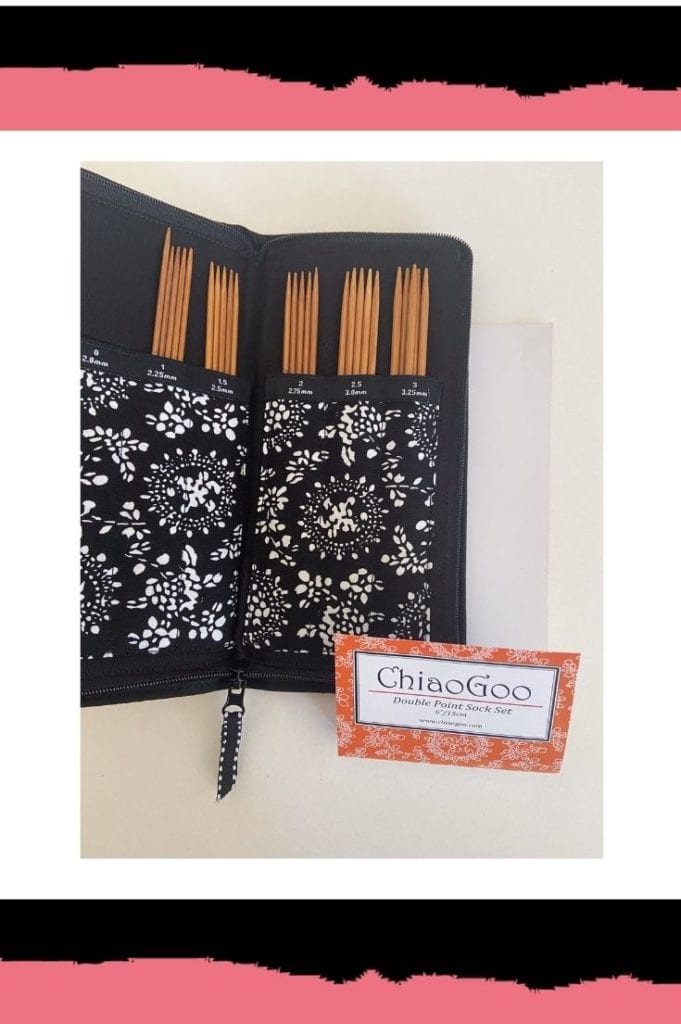
If you're in BiCrafty Bootcamp, then you might recall that one of the many things we loved about our ChiaoGoo knitting needles was the zippable storage containers they arrived in:

ChiaoGoo knitting needles-2

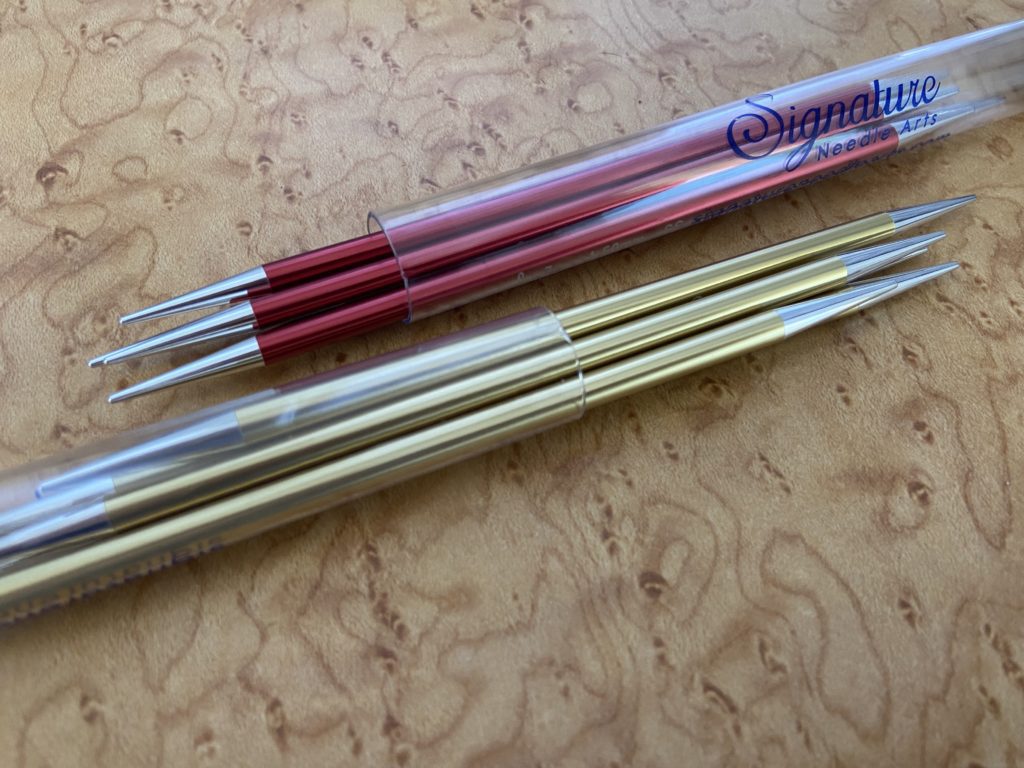
Even if you don't buy full knitting needle sets, sometimes the storage containers they come in are still the best storage solution. For example, Signature Needle Arts sells their DPN sets in these cute little tubes that open on either end. Keep each set in its own tube. Keep the tubes together in a larger box. Take a look:

signature needle arts tube dpns

Marly Bird Favorite Knitting Needle Storage Supplies: Erin Lane Bags

knitting needles storage and organization

You know that the whole Marly Bird team loves to team up with Erin Lane Bags. Truly, we can't recommend their products enough. And they have a whole host of ready-made solutions for how to store knitting needles. If you head to the website and check out the left sidebar, you'll see “Needle Organizers.” Then if you hit the dropdown button, you'll see that's further broken down into:

  • Circular solutions
  • Single Interchangeable Storage
  • Double Interchangeable Storage
  • Interchangeable Tips Pocket
  • DPN/Crochet Organizers
  • All-In-One Solutions

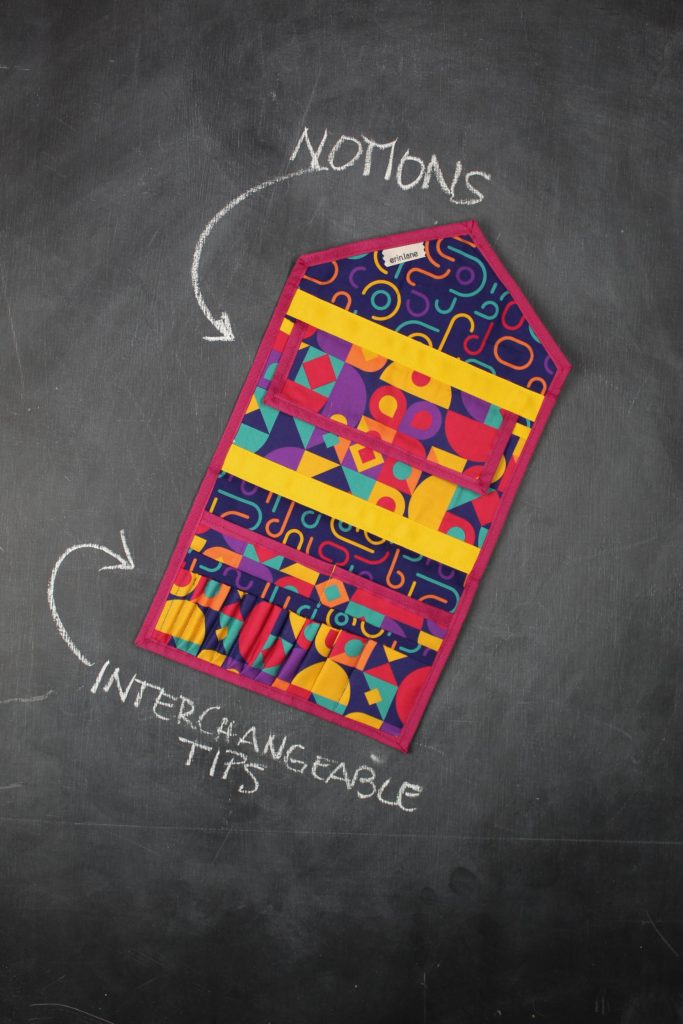
Plus she has a pattern keeper and organizers for your knitting notions. If you're just beginning to try to figure out which options are out there for storing your knitting needles, this is a great resource. For example, you'll see that this Knitpack holds interchangeable needles at the bottom and knitting notions at the top:

Erin Lane Bags Knitting Storage Solutions

Marly Bird Team Member Meg Likes The Circular Solution

how to store knitting needles of all kinds

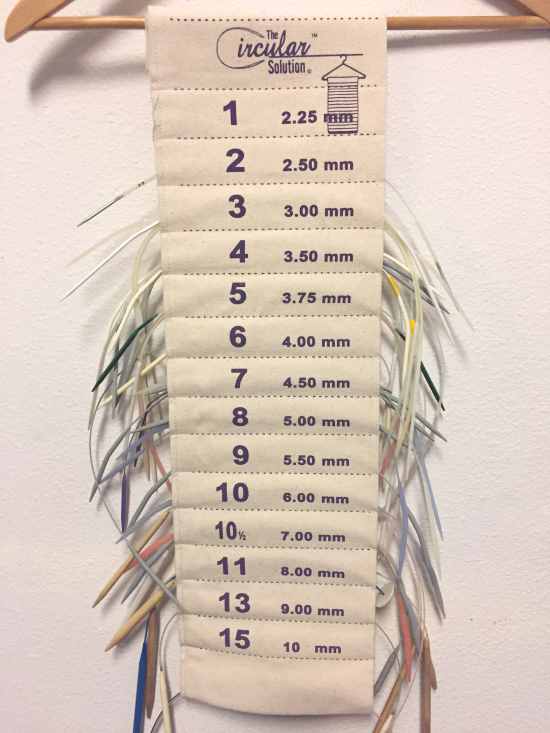
Obviously, Erin Lane Bags isn't the only one creating ready-made solutions for knitting needle storage. Team member Meg uses DPN storage as well as circular needle storage from The Circular Solution. Check out their smart, convenient, well-labeled hanging bag for storing your fixed circular needles:

How to store fixed circular knitting needles

Of course, you could make your own hanging bags, roll-up bags, or flat storage bags using sewing skills or other crafting skills. There are tons of great DIY options out there. Moreover, there are lots of great Etsy sellers who offer similar solutions. You just have to find what's right for you.

More Jimmy Beans Wool Knitting Needle Storage Solutions

how to store knitting needles

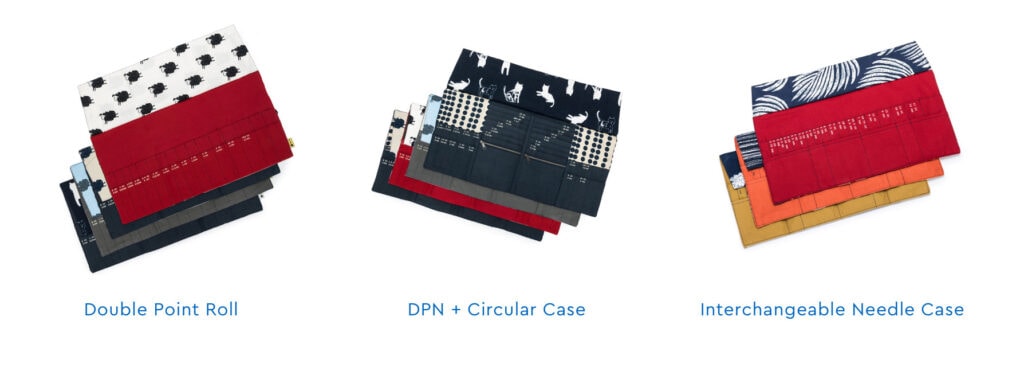
We already mentioned that Jimmy Beans Wool knitting needle sets come in their own organizers that are great to just keep on using. However, we want to make sure that you know that they also have a ton of different organizers similar to those from Erin Lane Bags and The Circular Solution. Their collaboration with DellaQ includes everything from backpacks and project bags to knitting needle storage solutions. For example, here are just three options from their Cotton Print Collection:

DPN, Circular and Interchangeable knitting needle cases

Don't Forget About Project Bags

craft storage for knitting needles

Project bags are designed to hold one or a few projects at a time. A good project bag also has some storage for your knitting needles. So, although this won't likely be your primary form of knitting needle storage, you should always keep it in mind as one option. See some of our favorite knitting project bags here.

Can You Use Crochet Hook Storage to Store Knitting Needles?

storage for knitting needles

Marly Bird team member Kathryn is primarily a crocheter. She loves how easy it is to organize crochet hooks (which we'll do a post on soon!) After all, unlike with knitting needles, you don't necessarily have to keep sets together. In other words, you need to be able to find your G hook or your J hook but not necessarily at the same time. Therefore, you can easily just store crochet hooks in zippered pouches, Tupperware, beautiful vases, etc. Can you store knitting needles the same way?

Yes and no. Now that Kathryn's become bicrafty, she has a whole lot of knitting needles. And she's found that she needs some of these other more advanced solutions in order to keep those knitting needles organized. That said, though, she's discovered that unlike many crafters, she prefers large straight knitting needles. Sure, there's a place for the DPNs and the circulars, but she loves her single-points. And since that only means keeping a pair of two together, she does store those similarly to how she stores her crochet hooks. The ones she uses most often are in a ready-to-go zippered pouch. The ones she uses less frequently are stored together in a larger bag. She particularly loves the Prym straight needles because the two ends interlock with one another. Therefore, it's easy to keep each set together even when throwing a bunch of different sizes together in one bag.

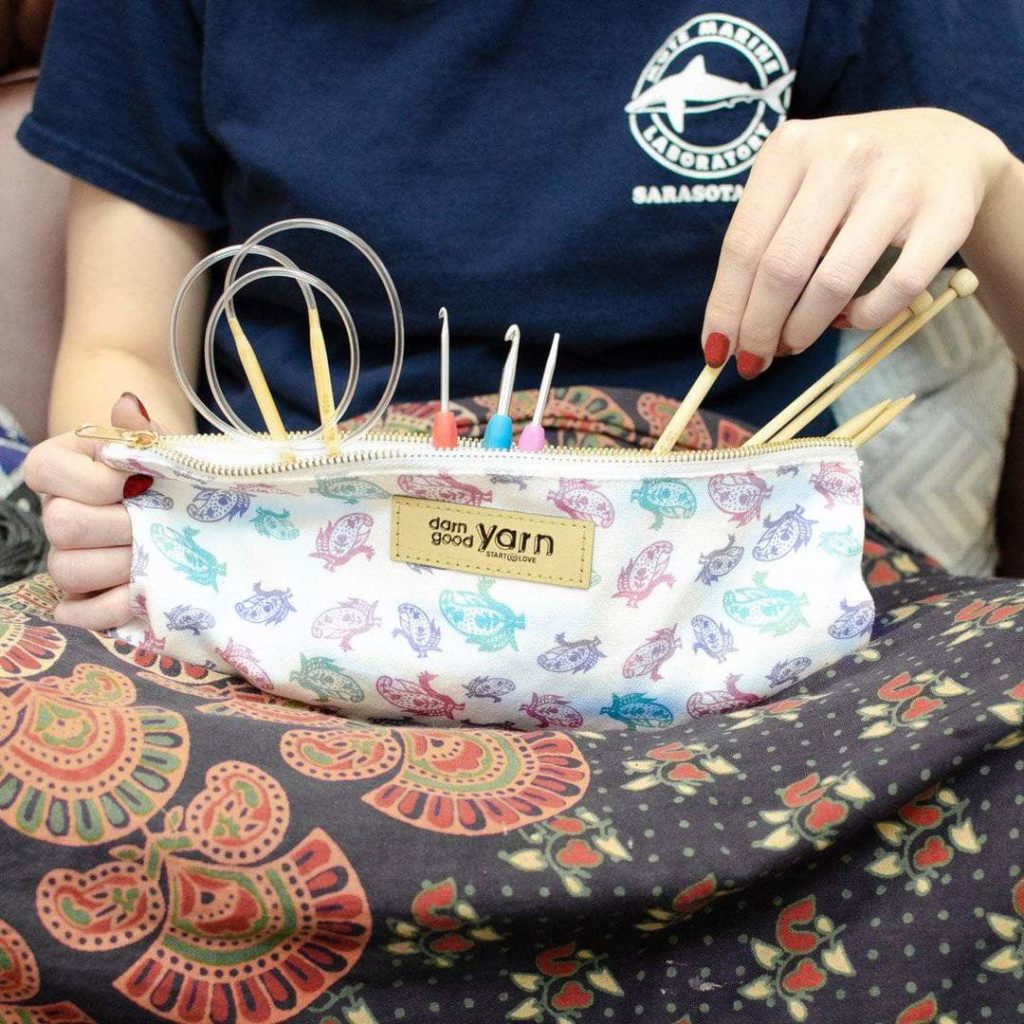
And theoretically, you can store a small selection of varied needles and hooks together in one zippered pouch, such as this one from Darn Good Yarn:

Knitting needle and crochet hook pouch

Knitting Needles You Use Often vs. Rarely vs. Just Display

how to organize knitting needles

A lot of us have a variety of different knitting needles. Mostly, we have a few go-to sets that we use all of the time. We want to keep these as organized as possible but also as accessible as possible.

Then we have the ones that we use for certain projects but don't need all that often. For example, extra jumbo knitting needles for working with Super Bulky Yarn. We want those stored conveniently where we can easily find them when we need them. However, they don't need to be immediately accessible. Therefore, they might go into boxes in under-the-bed storage or back-of-the-closet shelves.

And then we have some special needles that we don't really use but we keep because they're pretty. Maybe they're a vintage set passed down from a family member. Maybe you bought them because they were so beautiful but then realized you didn't like working with them as much. Those are the ones you should display. Put them in clear glass vases or something similar and store them in your craft space to inspire you!

More Great Ways for How to Store Knitting Needles

ways to store knitting needles
smart ways to store knitting needles

We really loved all of these answers that you gave us over on Instagram. And we hope that as you read through them here, you're getting tons of great ideas for the best ways to organize your own knitting supplies. We've also curated a few other lists of ideas to share with you, although you'll discover that a lot of those suggestions are already given here by you smart readers!

knitting needle storage solutions

Other Articles About Knitting Needle Storage:

  • All Free Knitting offers 61 reader solutions to knitting needle storage
  • WEBS has a breakdown of 30+ crochet hook and knitting needle storage ideas
  • This Pinterest page offers a great visual look at how to store knitting needles

And we want to see how you store yours! So take a photo of your knitting needle storage (super organized or super messy, there's no right way!) Share it in the Marly's Minions Facebook Group or over on Instagram with @themarlybird #marlybird and we'll take a look!

Frequently Asked Questions

What are the best ways to store straight knitting needles?

Several great options! A tall jar or vase on your craft table holds straight needles upright and makes them easy to grab… and looks beautiful. Fabric rolls with individual pockets keep each size separate and protected… great for traveling. Fabric pouches with elastic loops hold each size. Cork cylinders with the needles stuck upright work well for displayed storage. Repurposed tall boxes, tubes, or containers work great. The main goal is keeping sizes together (or clearly labeled) so you can find what you need without digging through a pile.

How should I store circular needles to prevent tangling?

The biggest challenge with circular needles is that pesky cable tangling. Individual zippered bags for each size is one of the most popular solutions. Binder pocket pages in a ring binder (each pocket holds one circular, labeled by size) is very organized and visible. Plastic key rings tagged with the size and hung on a hook create easy-access hanging storage. Dedicated circular needle cases with individual slots are great if you have a large collection. Whatever system you choose, the key is keeping each needle individual rather than tossed together in a pouch where they'll tangle hopelessly.

How do I organize interchangeable needle sets?

Most interchangeable sets come with their own case designed for the specific tips, cables, and connectors. If your original case is worn out or doesn't work for you, invest in a dedicated interchangeable needle organizer with clear pockets or slots. Keep the tips sorted by size (most cases are designed for this already). Keep cables sorted by length. Store connectors and tightening tools in a small zipper pouch within the case. The original manufacturer's case is usually well-designed for the set… if you keep it, use it as intended.

What about double-pointed needles?

DPNs are tiny and love to escape! The classic solution is keeping each set (usually 4-5 needles in the same size) together in a labeled tube, pouch, or case. You can buy purpose-made DPN cases with multiple slots. Repurposed prescription bottles (clean and relabeled) hold a set of small DPNs perfectly. Some crafters fold and snap them into the center of the ball of yarn they're using them with. The most important thing is keeping all needles of the same size together… losing one DPN out of a set of 4 is genuinely frustrating when you need all of them for a small-circumference project.

Should I label all my knitting needles by size?

Yes! Especially if you're building a collection. Many needles are labeled with size somewhere on the needle, but it can be hard to read without good lighting. A paint marker or nail polish dot in different colors for each size range is a quick labeling system. For circular needles in zipper bags, a label on the bag makes identification instant. Many crafters use a needle gauge (a small tool with holes in various sizes) to check unlabeled needles… it's a useful tool to have even if you do label everything, because labels fall off and older needles often came without clear markings.

Filed Under: Dibble Dabble Inspiration, Knitting, Tips, Tricks, Techniques for Knitting and Crochet

  • « Previous Page
  • 1
  • …
  • 64
  • 65
  • 66
  • 67
  • 68
  • …
  • 97
  • Next Page »

Let's Be Social

Join the Marly's Minions Facebook group to share, ask questions, or chat about all of your yarn related crafts!

Join the group
Cartoon of a smiling woman with brown hair in a bun, glasses, black jacket and green shirt, waving next to large "hi" text.

Quick Links

The Pattern Shop

Our Free Patterns

Blog

Marly Bird House

Learn to Knit & Crochet

About

Giveaway Terms and Privacy Notice

Find Us Everywhere

Join the Newsletter

YouTube Channel

Marly's Minions FB Group

Etsy Store

Ravelry Store


AN ELITE CAFEMEDIA HOME/DIY PUBLISHER

Information from your device can be used to personalize your ad experience. Do not sell or share my personal information.

Privacy Policy   Terms   Marly Bird Legal Documents Copyright © 2026