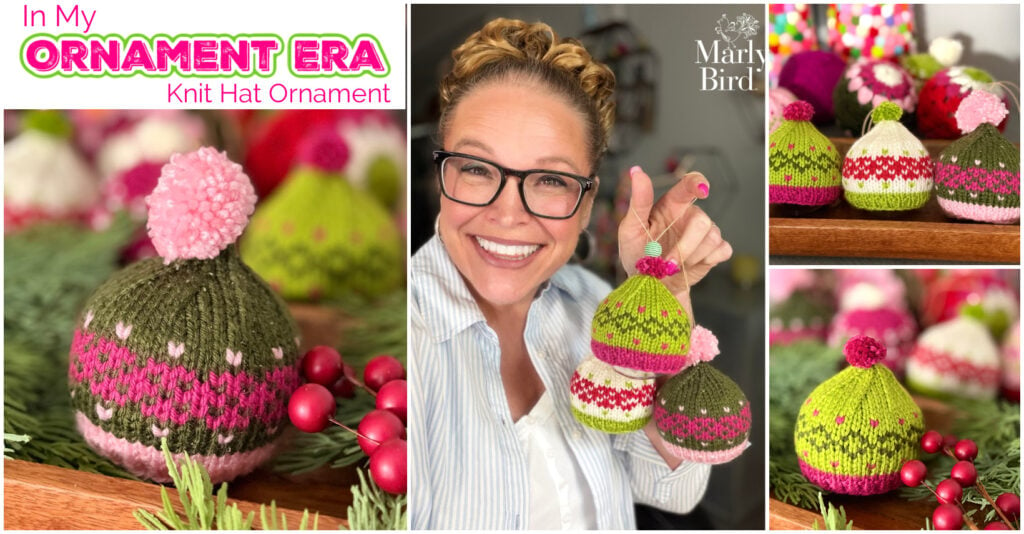
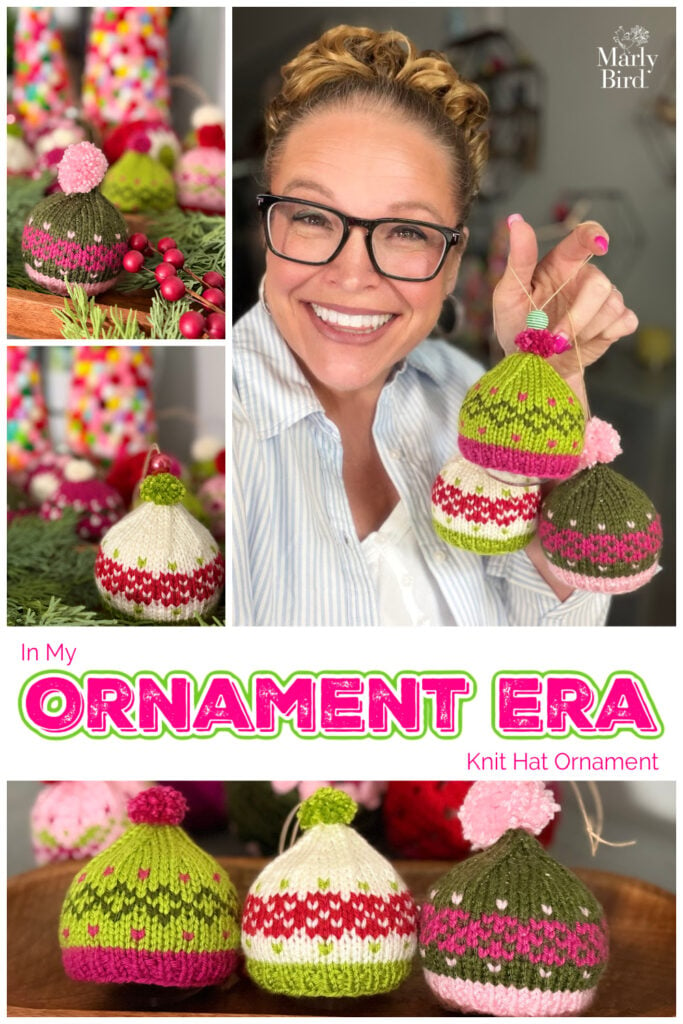
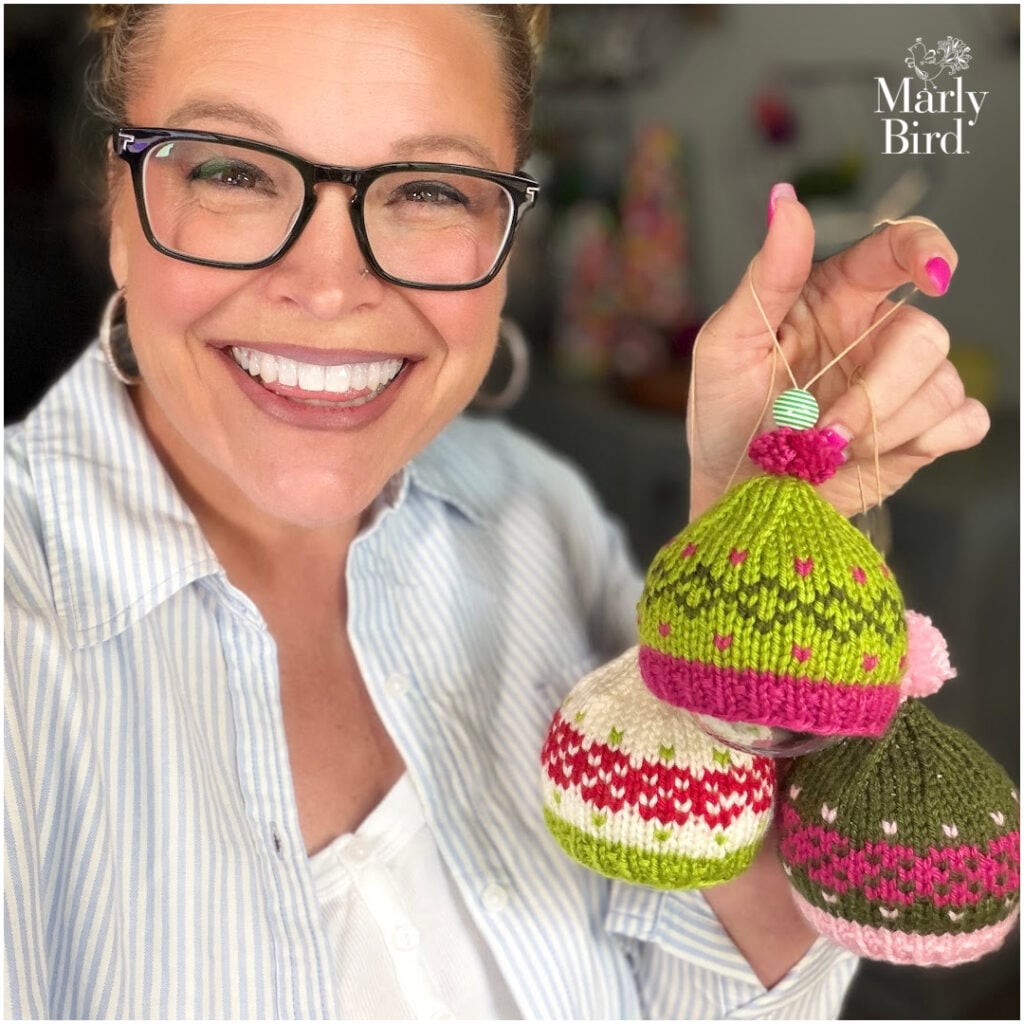
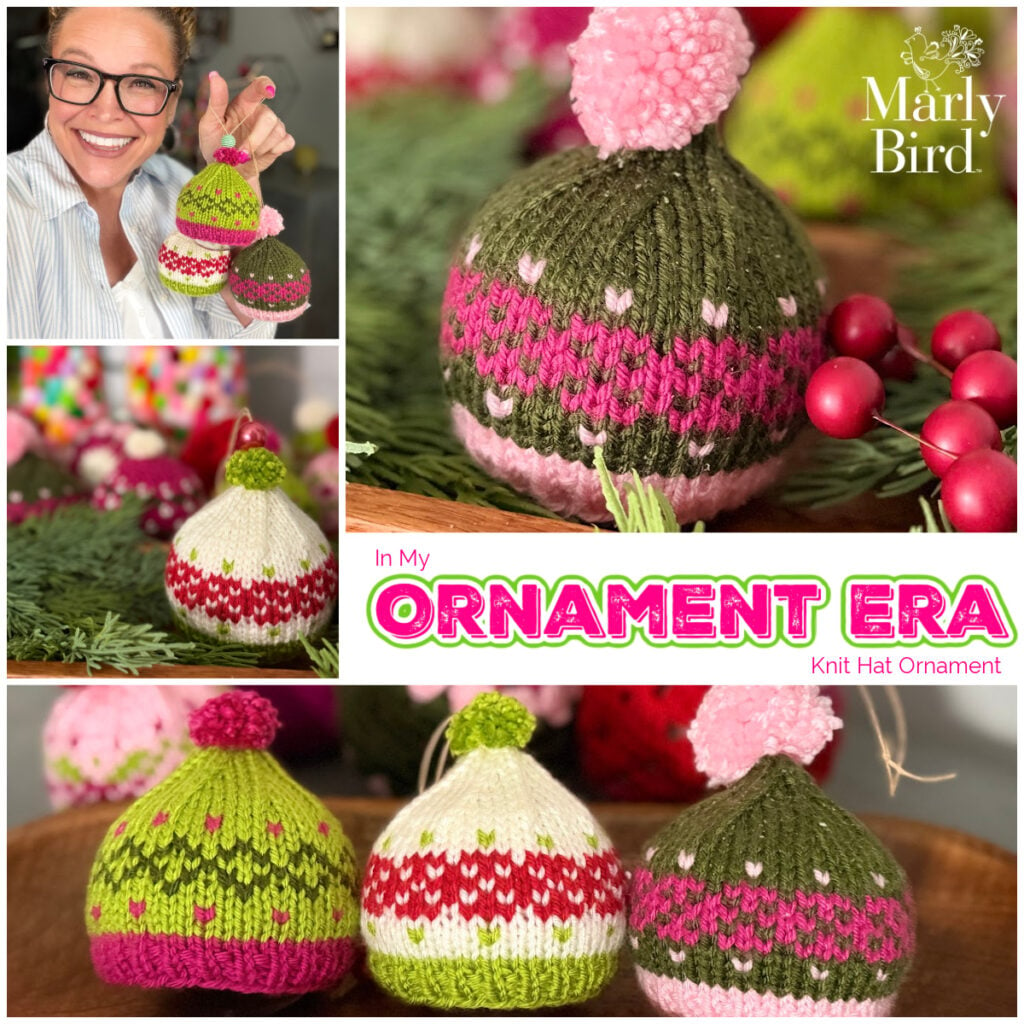
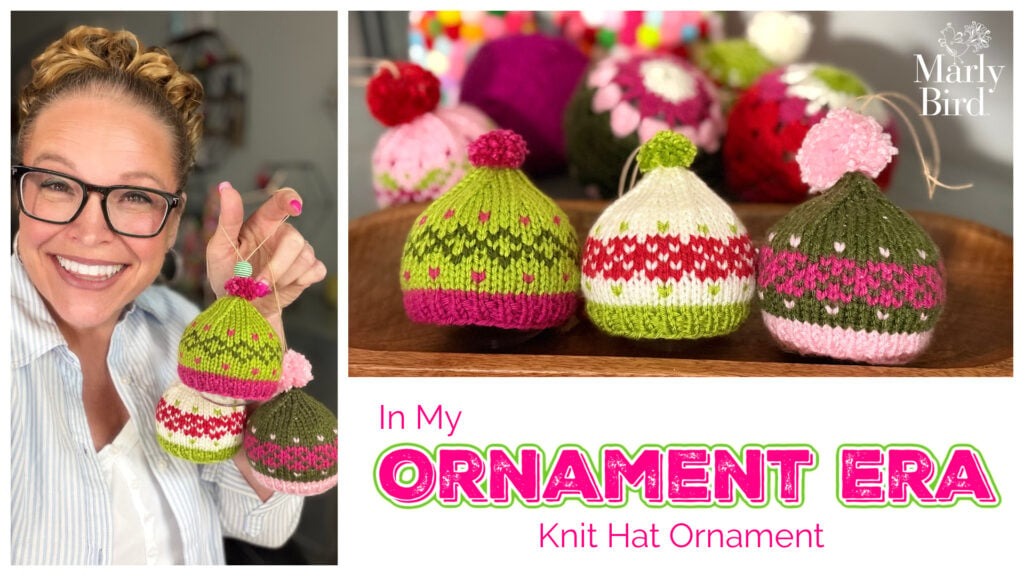
The In My Ornament Era Knit Ornament pattern is a free Fair Isle colorwork pattern by Marly Bird — a miniature hat worked in the round from the bottom up using approximately 100 yards of worsted weight yarn in three colors. Sized at approximately 3″ in diameter and 9½” in circumference, this adventurous beginner project is the perfect introduction to stranded colorwork, reading a colorwork chart, and working in the round on DPNs or Magic Loop.
⚡ Quick Answer:
In My Ornament Era is a free knit ornament pattern by Marly Bird. You need approximately 100 yards of worsted weight (#4) yarn in three colors, US 5 (3.75mm) DPNs or circular needles for Magic Loop, and basic knitting-in-the-round skills. It finishes at approximately 3″ in diameter — perfect as a tree ornament, gift topper, or handmade keepsake that lasts for years. 🎄
Hey, bestie 💛
I have a confession: I designed this one for Sleigh the Holiday 2026… and then completely lost an afternoon making it in five different color combinations.
That's the magic of a project this small. It's fast enough to be dangerous. You knock one out while watching a Christmas movie, decide the green and cream version needs a twin, and suddenly you're three ornaments deep and completely okay about it.
But here's what I REALLY love about this one: it's a genuinely great first colorwork project.
We're talking a tiny circle of stitches, three colors, and a chart that you read from the bottom up. Everything that feels intimidating about stranded colorwork? This ornament gives you a safe, low-stakes place to practice it. Including two methods of working in the round — DPNs and Magic Loop — both covered step by step in the video tutorial.
One hundred yards. That's the whole project. Your scrap basket called… it has GREAT news. 🎉
Why You'll Love This Pattern 💖
🎄 It's the perfect first colorwork project. Most colorwork patterns ask you to dive headfirst into a full sweater or an 80-stitch hat. This ornament is just 48 stitches on a needle — a tiny, low-stakes sandbox where you can practice Fair Isle without committing to 500+ yards of your favorite yarn. If you've been curious about stranded colorwork but nervous to try it, this is your entry point.
🧶 Scrap yarn? YES, PLEASE. The whole ornament uses approximately 100 yards across three colors — which means this is basically an excuse to dig out every gorgeous leftover you've been hoarding and turn them into actual decorations. Holiday red, cream, and green. Dusty blue with silver. Team colors for the sports fan who has everything. Your scrap basket was MADE for this.
⚡ Quick and deeply satisfying. Once you get the colorwork rhythm going, this ornament knits up in a single evening. It's that kind of project. Small enough to finish, substantial enough to feel proud of, and cute enough that one will absolutely turn into a collection.
🎁 It makes a gorgeous handmade gift. Tuck it on a gift bag instead of a bow. Hang it on the tree. Tuck it in a stocking. Slip it inside a card to a fellow yarn lover who gets it. Handmade gifts with this much personality never go out of style.
📖 You'll come away knowing: how to knit in the round on DPNs or Magic Loop, how to read and work from a colorwork chart, how to carry yarn floats without puckering your fabric, and how to shape a crown with k2tog decreases. That's a genuinely impressive skills checklist… hidden inside a little hat for your Christmas tree.
Quick Pattern Overview
In My Ornament Era is a miniature Fair Isle hat knitted in the round from the bottom up. You start with a ribbed brim, work through a three-color stranded colorwork section using the included chart, then shape the crown with simple k2tog decreases until the stitches are gathered and closed.
The pattern is written for three colors — but it loves to be played with. More than three colors? Go for it. Skipping the pom pom? Totally valid. Want to use jute twine instead of the crocheted hanging loop? That's actually really cute.
Optional finishing includes a tiny pom pom (adding major personality) and a clear ornament ball stuffed inside to help the finished piece hold its round shape on the tree.
Join our Newsletter
Get Free Crochet & Knitting
Pattern Links & Coupons!

Your First Colorwork Project — Getting Started with Fair Isle 🌈
Fair Isle knitting — technically called “stranded colorwork” — is the technique of carrying two or more yarn colors across your work to create a pattern. When you're not actively knitting with a color, it floats loose behind the work, ready to pick up again when the chart calls for it.
It sounds intimidating. And I'll be honest: a full-size Fair Isle sweater IS a commitment. But a tiny ornament? That's the ideal training ground, and here's exactly why:
- The stitch count is small — so the colorwork chart flies by
- The colorwork section is only a handful of rounds, not 100 rows of a sweater
- ~100 yards of scrap yarn means zero guilt if you need to frog and try again
- The finished result is something adorable you actually want on your tree
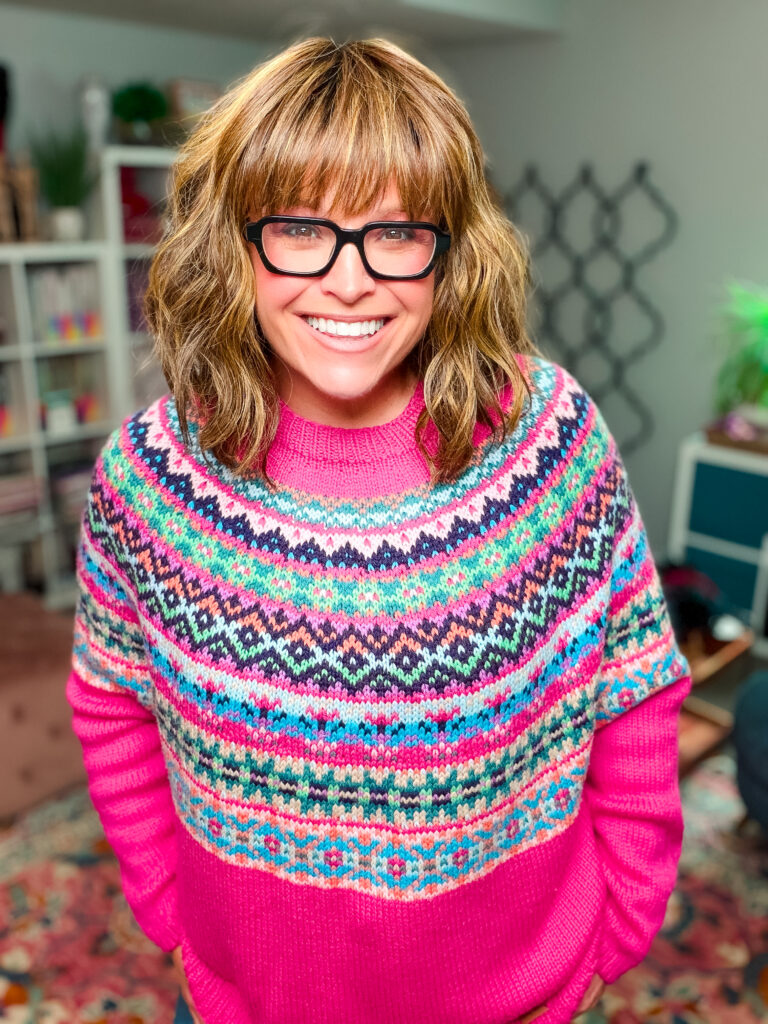
The one skill to focus on as you practice: managing your floats. A float is that carried strand of yarn sitting behind your work. The goal is to keep floats relaxed — not so tight that they pucker the fabric, and not so loose that they snag when you put the ornament on the tree.
Once you've made one ornament with a relaxed float hand? You'll never look at a colorwork sweater the same way again. That's how it starts. 😉
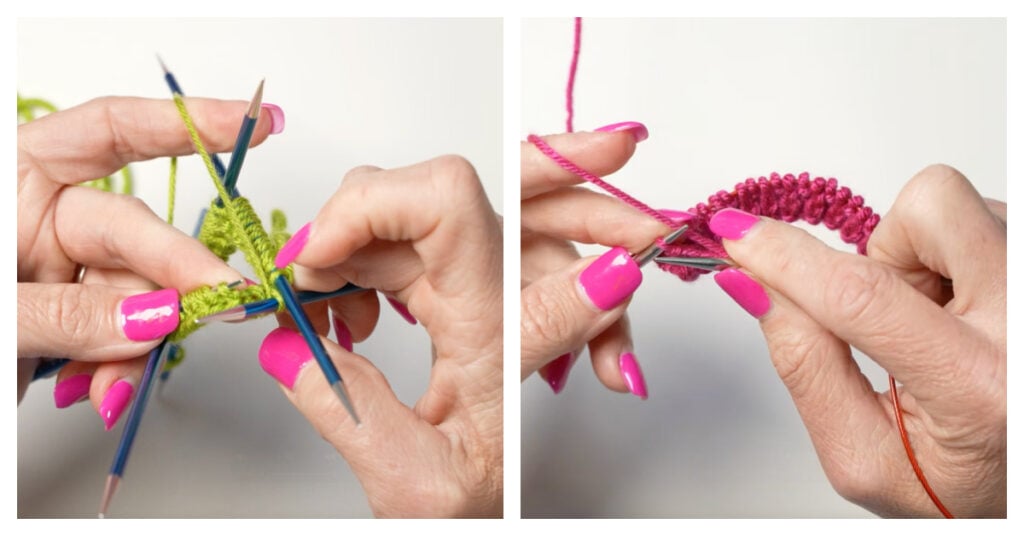
DPNs vs. Magic Loop — Two Ways to Knit Small in the Round 🧶
Working a tiny circular project like this ornament means choosing how you'll knit in the round. You have two great options:
Option 1: Double-Pointed Needles (DPNs)
DPNs are a set of short needles (typically 4 or 5 in a set) where you distribute your stitches across multiple needles and knit from one to the next, rotating as you go. They're the traditional method for small-circumference projects like hats, socks, mittens… and ornaments. The needles look like a little star or spider when you first get going, which feels chaotic — but within a round or two, you'll have it. And there's something deeply satisfying about working with DPNs once you get the rhythm.
Option 2: Magic Loop
Magic Loop uses a single long circular needle (32-60″ cable works best) to knit small circumferences. You pull the cable into a loop, divide your stitches in half, and knit around two halves at a time. If you're already comfortable with circular needles and don't want to invest in DPNs, this is your method. It works beautifully for colorwork because you're always working with the same needle orientation.
Both methods are fully covered in the video tutorial — including the No Cuss Cast-On for DPNs, which I promise will make your life easier. Watch it before you cast on!
Video Tutorials 🎬
Yarn & Materials for In My Ornament Era 🧶
This project uses approximately 100 yards total across three colors — roughly 35 yards per color. That's scrap yarn territory. Your stash is basically a pile of future ornaments waiting to happen.
My Pick: Premier Anti-Pilling Everyday Worsted
I made mine with Premier Anti-Pilling Everyday Worsted… and I am obsessed. Smooth, affordable, and the anti-pilling finish means your ornaments will look just as beautiful in year ten as they did the first December you pulled them out of the box. It comes in a gorgeous range of holiday-ready colors, and the stitch definition is excellent for showing off a colorwork chart.
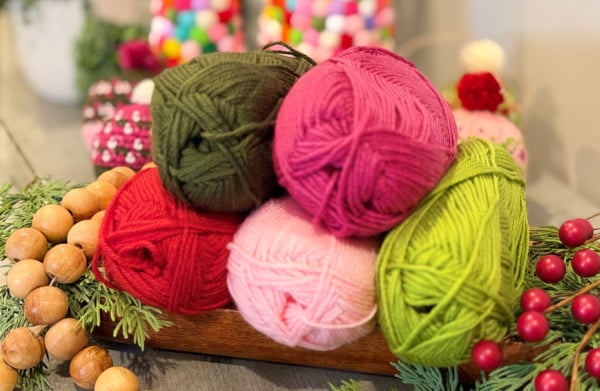
Other Worsted Weight Yarns That Work Beautifully
This is a great time to raid your stash! Any worsted weight (#4) yarn will work. Here are some of my favorites for colorwork:
- KnitPicks Brava Worsted — 100% premium acrylic, machine washable, incredible color range, budget-friendly. A colorwork dream.
- KnitPicks Wool of the Andes Worsted — 100% Peruvian Highland wool with beautiful natural stitch definition. A classic colorwork yarn.
- Berroco Vintage Worsted — wool/acrylic blend, machine washable, gorgeous muted color palette perfect for traditional Fair Isle.
- Cascade 220 Superwash — machine washable wool, one of the most popular colorwork yarns in the knitting world. Crisp stitch definition.
- WeCrochet Mighty Stitch Worsted — wool/acrylic blend, great softness and warmth. Works well for colorwork with excellent washability.
- Lion Brand Heartland — widely available at craft stores, great color selection, smooth texture. An easy grab if you need yarn today.
Materials List
- Approximately 100 yards / 92 m total worsted weight (#4) yarn in 3 colors (approx. 35 yards per color)
- US 5 / 3.75mm double-pointed needles OR a 47–60″ circular needle for Magic Loop — or size needed to obtain gauge
- Stitch markers
- Tapestry / yarn needle for weaving in ends
- Small amount of polyester fiberfill OR a clear round ornament ball (to help it hold its shape on the tree)
- Optional: pom pom maker or two pieces of cardboard for the optional pom pom
- Optional: crochet hook for the optional hanging loop
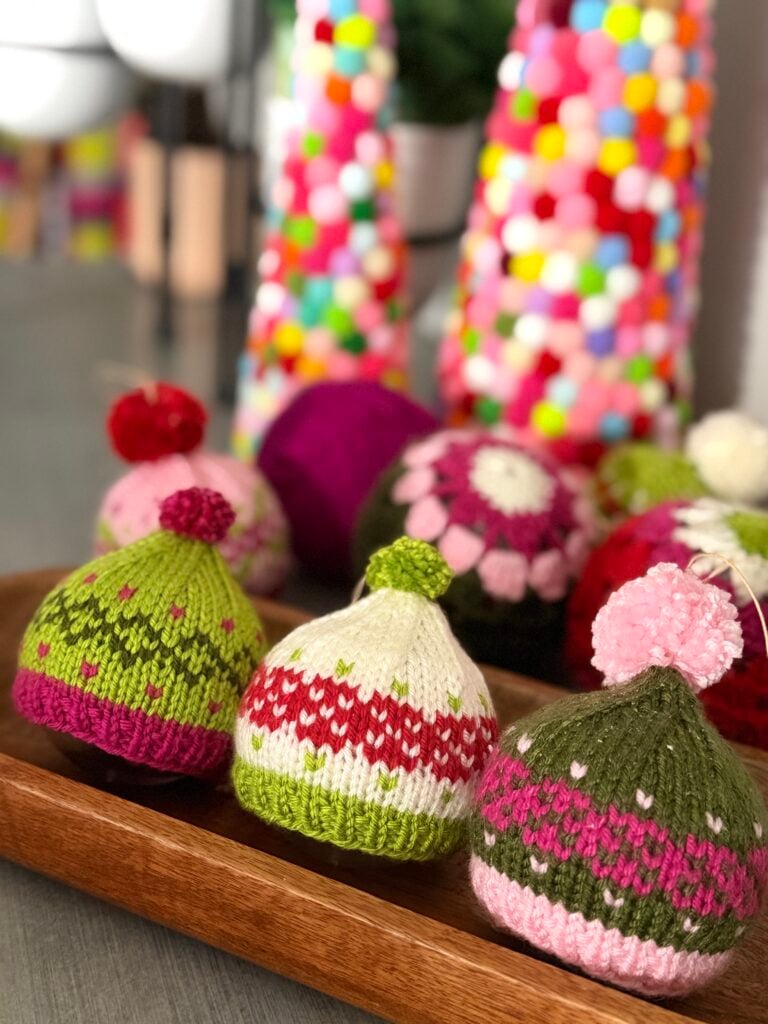
In My Ornament Era || Pattern Details
Designed by Marly Bird
SKILL LEVEL
Adventurous Beginner
MEASUREMENTS
Ornament measures 3” [7.5 cm] in diameter and 9½“ [24 cm] in circumference.
Gauge
20 sts = 4” [10 cm] in Stockinette St.
Note: Gauge is not essential for this item.
MATERIALS
Yarn
Approximately 100 yds [92 m] total of scraps of worsted weight yarn in 3 colors:
A (shown in light pink)
B (shown in green)
C (shown in red)
Needles
U.S. 5 [3.75 mm] set of 5 double-pointed needles, or size required for gauge.
Hook
Crochet hook in similar size for use in creating the (optional) hanging loop.
Notions
- Stitch markers
- Tapestry needle
- Scissors
- Tape measure
- Jute Twine for the Hanging Loop (optional)
- Clover Pom Pom Maker Extra Small (optional)
- 3″ DIY Clear Glass Ball Ornament (optional)
Note: the ornament is not 100% necessary but it fills out the hat ornament nicely as it hangs.
ABBREVIATIONS
K – Knit
K2tog – Knit Two Together
P – Purl
RS – Right Side
St(s) – Stitch(es)
WS – Wrong Side
STITCH PATTERN
1 x 1 Rib
Worked circularly over an even number of sts.
Every Round: * K1, p1; repeat from * around.
CHARTS
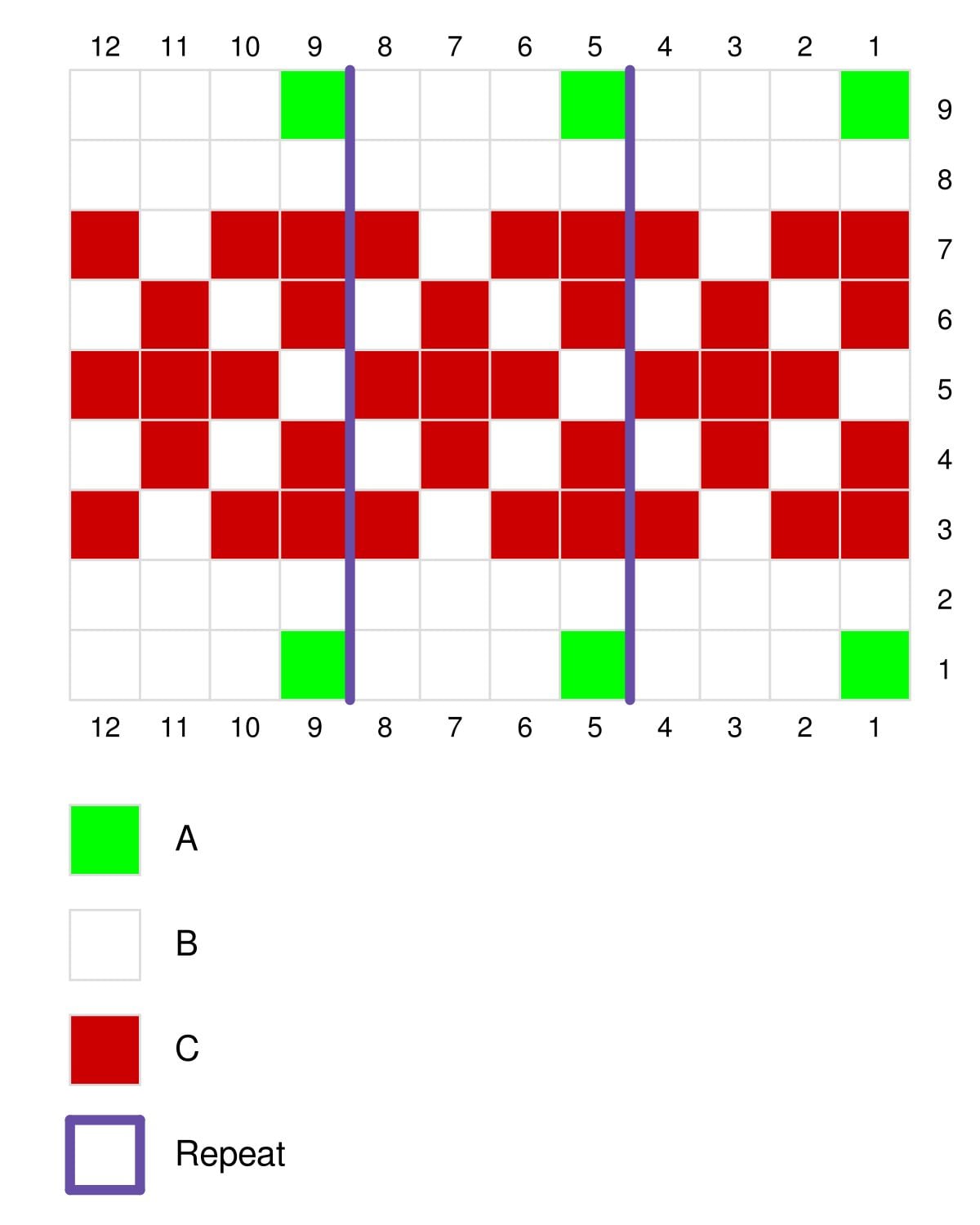
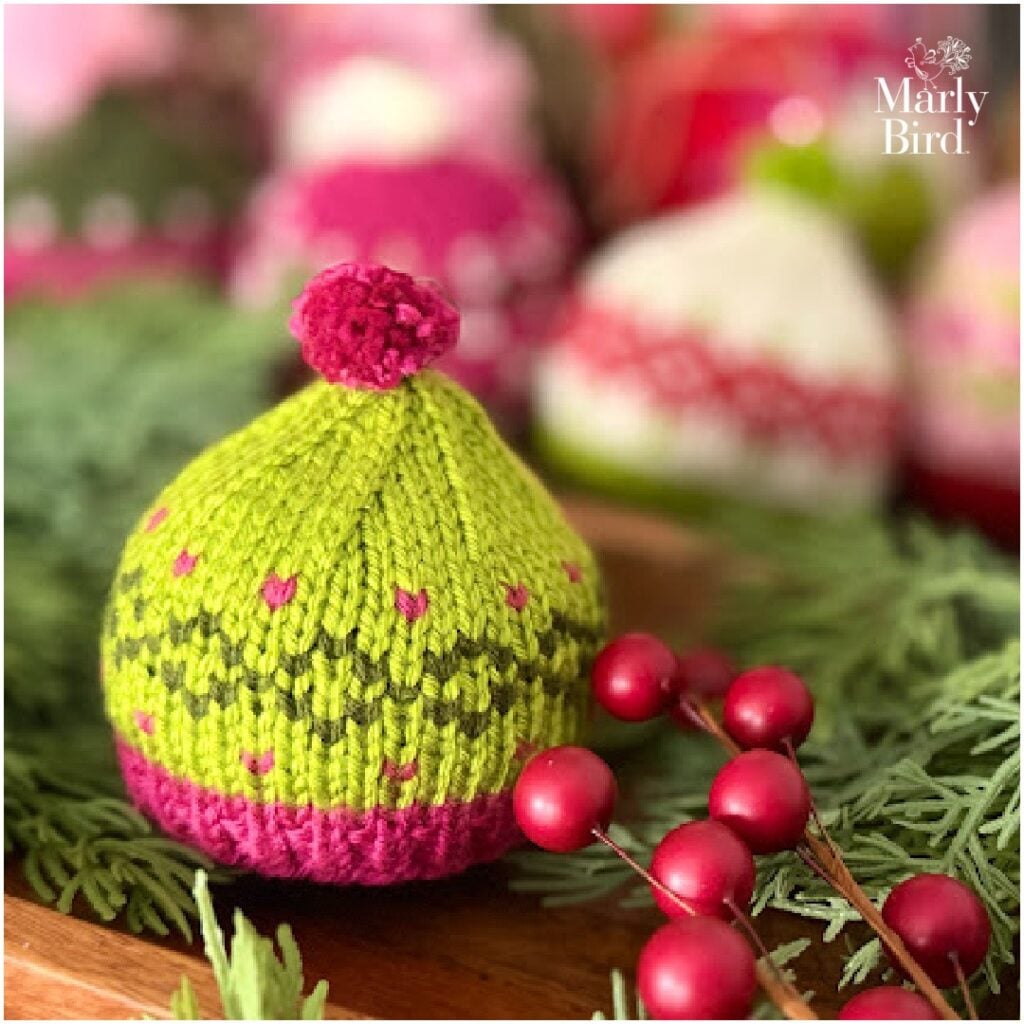
Fair Isle Colorwork chart
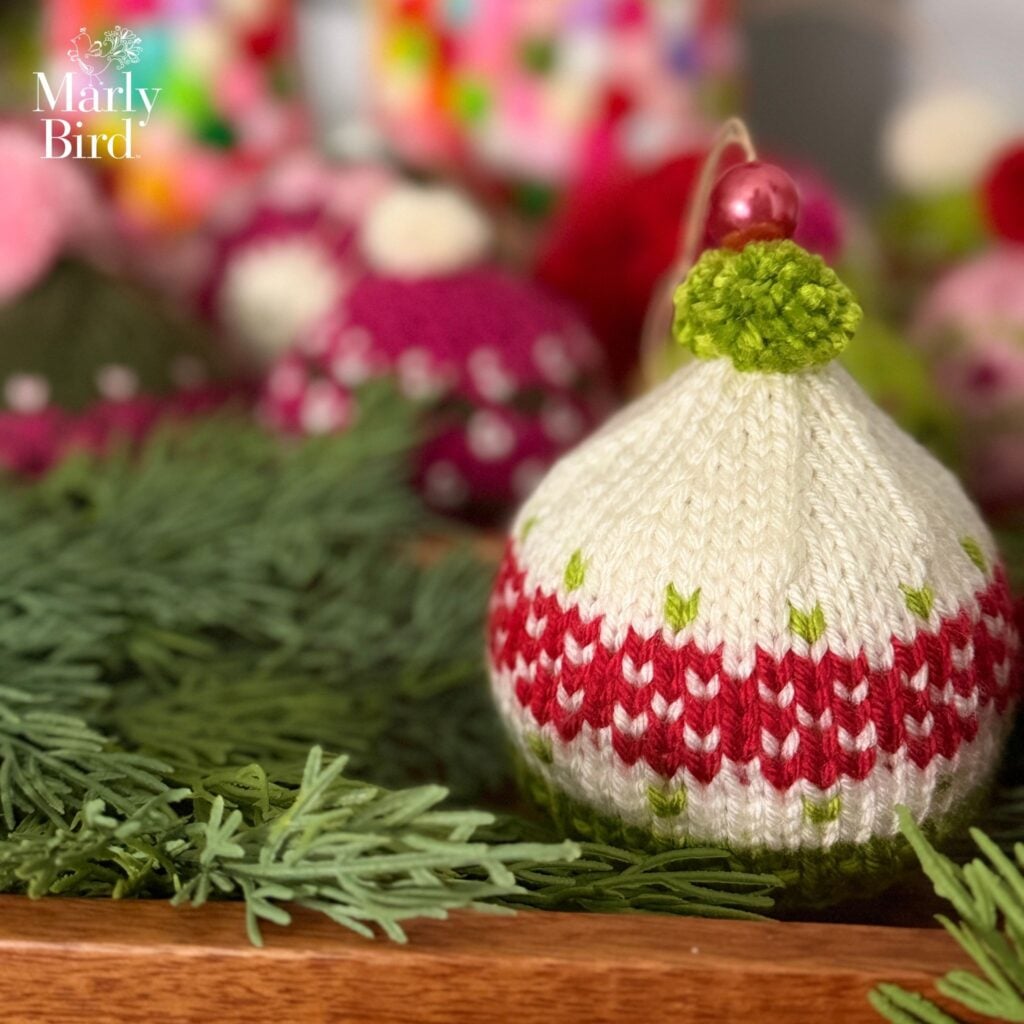
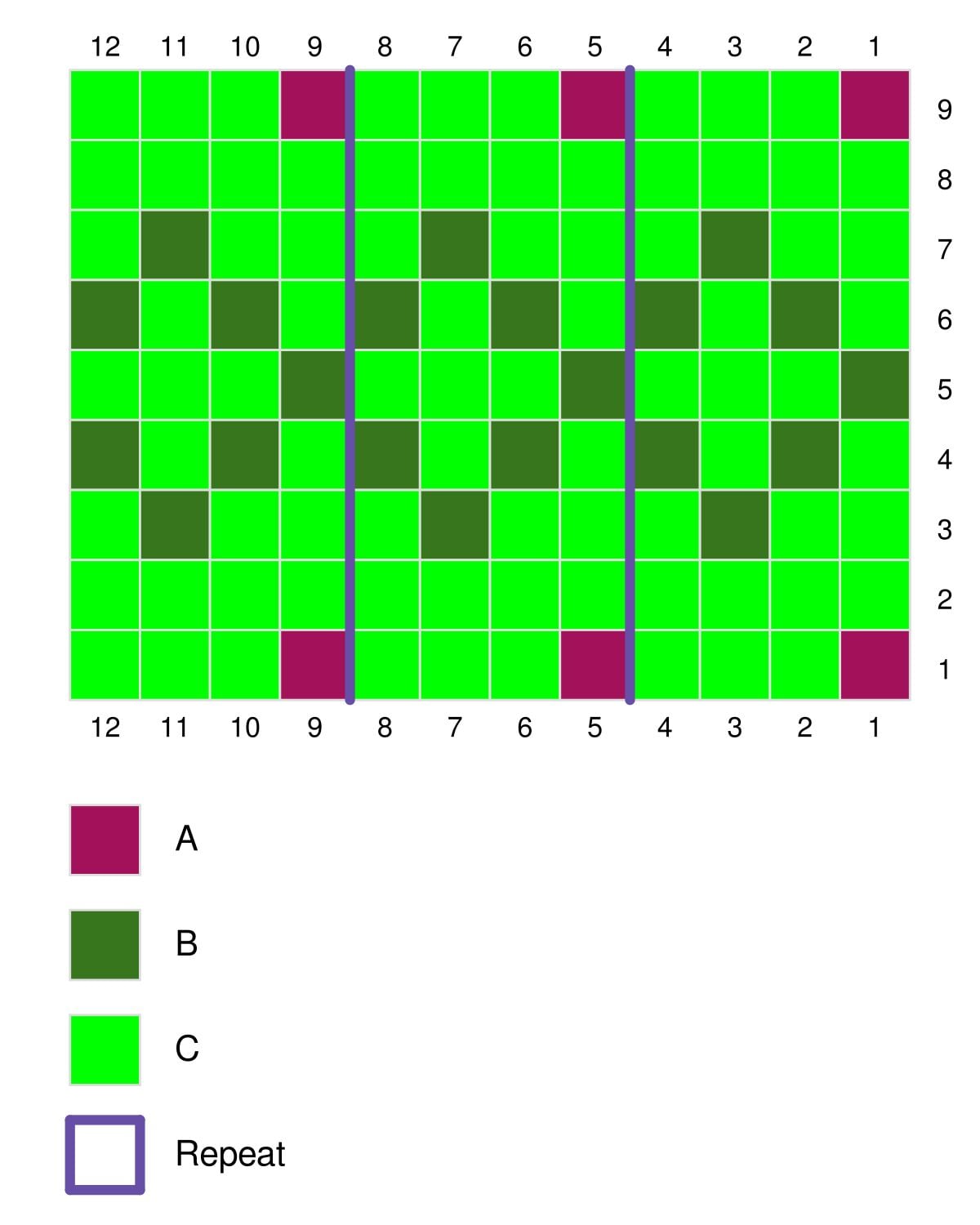
Fair Isle Colorwork chart – alternative color arrangement
NOTES
- Directions are for using 3 colors. More can be used, taking into account that this will change the appearance of the colorwork pattern.
- Hat ornament is worked in the round from the bottom up.
- A DIY ornament ball is placed into fabric after it is completed to help Hat hold its shape.
- A hanging loop is crocheted onto the Hat, with an alternate option to use twine as the loop instead.
- Do not cut unused colors unless instructed to do so; carry yarns up inside of project instead.
- When working in Fair Isle colorwork (see Video Tutorials), keep the yarn floats on the inside with some give, or the fabric will become too tight. Spread the fabric out on the right needle after every few worked stitches to make sure it remains flexible.
VIDEO TUTORIALS
- No Cuss Cast-on (for Double Pointed Needles) >> https://youtu.be/0d6i5bRL52A <<
- Knit Stitch (Continental) >> https://www.youtube.com/watch?v=M3brKFKg5Yc <<
- Purl Stitch (Continental) >> https://www.youtube.com/watch?v=LuDt-8jqh4g <<
- Fair Isle Technique >> https://youtu.be/OaJg_hh1VVw <<
- How to Add a Lifeline (3 ways) >> https://youtu.be/FiqYUE_aHAw <<
- How to tink >> https://youtu.be/c7Gud7k4Y8k <<
- How to Bury Ends >> https://www.youtube.com/watch?v=8_NBGUKjO-E <<
- How to Make a Pom Pom >> https://www.youtube.com/watch?v=JRdcqTD13AE <<
- How to Knit the Brim of the In My Ornament Era Hat (DPN’s and Magic Loop) >> https://youtu.be/12V27yu_rBU <<
- How to Knit the Body of the In My Ornament Era Hat (DPN’s) >> https://youtu.be/Hl0uKQ7-l40 <<
- How to Knit the Body of the In My Ornament Era Hat (Magic Loop) >> https://youtu.be/12V27yu_rBU <<
GROW
To Unlock Exclusive Subscriber Content click the Box below and join for free by simply adding your email and creating a password! If you are having troubles, clear your cache or reset your password or login to the Grow Publisher Portal.
>> Learn More About Grow Here <<
I'm thrilled to share this amazing pattern with you, many patterns on my blog are absolutely free! I kindly request that you don't copy and paste or distribute this pattern. Prefer an ad-free experience? Buy a digital PDF pattern for a small fee from one of my online stores for a seamless crafting journey.
I appreciate your support and readership. You are the reason I can keep doing what I love and sharing it with others. So, thank you from the bottom of my yarn-loving heart! Disclosure: This post contains affiliate links, meaning I get a commission if you decide to make a purchase through my links at no cost to you.
In My Ornament Era || Pattern Instructions
BRIM
With A (shown in light pink), cast on 48 sts using the No Cuss Cast on (see Video Tutorials).
Join round being careful to not twist cast-on edge, and mark first st.
Work 3 rounds in 1 x 1 Rib, then knit 1 round.
BODY COLORWORK SECTION
Change B (shown in green), and knit 2 rounds.
Work 9 rounds in Fair Isle Colorwork, changing colors as indicated on chart.
⭐️ Fair Isle Colorwork chart above 👆
Cut A and C (shown in red), and continue with B only.
Knit 3 rounds.
SHAPE CROWN
Round 1: * K4, k2tog; repeat from * around.
Count: 40 sts.
Round 2: Knit.
Round 3: * K3, k2tog; repeat from * around.
Count: 32 sts.
Round 4: Knit.
Round 5: * K2, k2tog; repeat from * around.
Count: 24 sts.
Round 6: Knit.
Round 7: * K1, k2tog; repeat from * around.
Count: 16 sts.
Round 8: Knit.
Round 9: K2tog around.
Count: 8 sts.
FINISHING
Break yarn, thread tail into tapestry needle, and draw through each remaining st knitwise.
Pull tight like a drawstring to close.
Weave in all loose ends on WS.
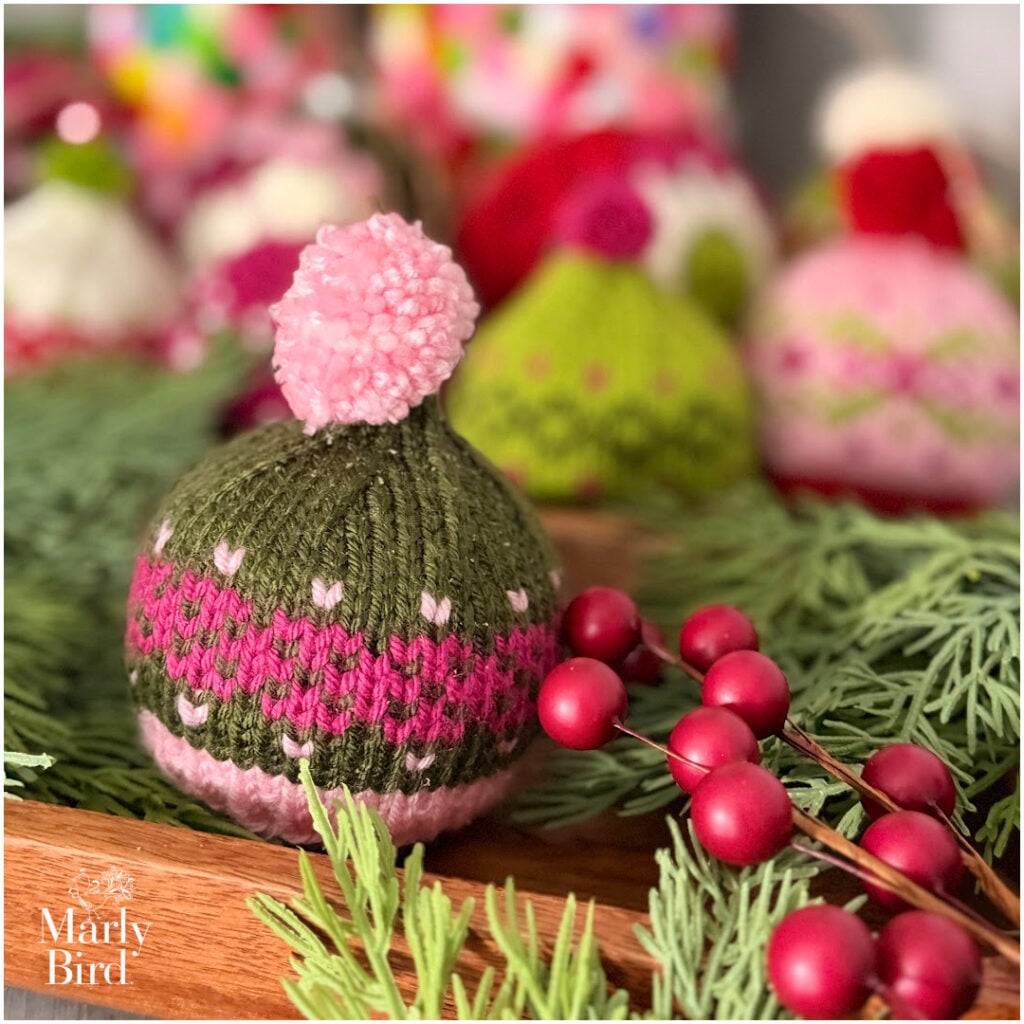
Optional: Make a tiny pom pom and sew to top of Hat.
Crochet Hanging Loop (Optional)
Place slip knot on crochet hook, and slip stitch to top of Hat
Create a chain 9” [23 cm] long, then slip stitch again to top of Hat.
Fasten off.
Alternately: Use twine of the same length for Hanging Loop.
Insert DIY ornament ball into Hat to plump out the shape.
More Holiday Knit Patterns You'll Love 🎄
Love a small, satisfying knit? Here are more of my favorites to keep those needles moving:
- Free Rory Knit Hat Pattern — the coziest worsted weight beanie in 5 sizes, another great knit-in-the-round project
- Keystone Cable Knit Hat Pattern — chunky cables, satisfying texture, a fast and impressive make
- Wellington Stranded Colorwork Pullover — ready to level up? This sweater is the next step in your colorwork journey
- Undercover Wine Sleeve — another quick holiday knit that makes a perfect gift
- 30 Free Mini Christmas Ornament Patterns — if you've caught the ornament bug (no shame here 😄), here's a whole collection
Frequently Asked Questions
Is the knit ornament pattern really free?
Yes! The full pattern is free to read right here on the blog. Scroll up to the Pattern Instructions section or click the “Jump to pattern” link at the top of the page. If you'd like an ad-free printable PDF, you can purchase that on Ravelry, Etsy, or my Shopify shop (to be added after the make-along).
What if I've never tried Fair Isle knitting before?
This ornament is genuinely designed with first-time colorwork knitters in mind! The colorwork section is just a few rounds, the stitch count is tiny, and the video tutorial walks you through every technique step by step. If you can knit and purl in the round, you can do this. I promise.
Can I use any worsted weight yarn, or does it need to be a specific fiber?
Any worsted weight (#4) yarn works! The most important quality for colorwork is smooth stitch definition — you want to be able to see each individual stitch clearly so the color pattern pops. Avoid fluffy or textured yarns (like mohair or bouclé) which will blur the chart. Check out the yarn suggestions in the Yarn & Materials section for my favorites.
Do I need DPNs specifically, or can I use circular needles?
You can use either! The pattern is written for US 5 (3.75mm) double-pointed needles, but Magic Loop on a long circular needle (47–60″ works great) is a totally valid option. Both methods are covered in the video tutorial so you can pick whichever feels more comfortable.
How long does it take to knit?
Most knitters finish in one to two evenings. The whole project is about 100 yards — it's a very quick knit once you get the colorwork chart going. It's a great take-along project for a movie night or a long car ride.
Can I make this without using three colors? What if I only have two?
Absolutely! You can simplify the colorwork to two colors by using one color for the main color and one contrast color throughout the chart. The result will look different from the original, but it'll still be adorable. You can also go wild and use MORE than three colors if your chart permits — this little ornament handles creativity beautifully.
What is the Sleigh the Holiday VIP and how is it related to this pattern?
In My Ornament Era was originally part of the Sleigh the Holiday 2026 Make-Along — a free annual event where knitters and crocheters stitch ornaments together! The VIP version gives access to the full ornament collection. The free pattern is the one right here on this page — you don't need VIP to make it.
Final Thoughts
Here's the thing about In My Ornament Era: it started as a make-along pattern, and it became one of my favorite things I've ever designed.
It's small. It's satisfying. It teaches real skills. It uses yarn you already own. It makes a gift that actually means something. And it looks completely adorable on a Christmas tree.
If you've been putting off trying stranded colorwork because it felt like too much… this is your sign to start here. On a tiny ornament. With your scrap yarn. With no pressure and everything to gain.
I cannot wait to see what color combinations you choose. 💛
If you cast it on, please please please share your progress… tag me @marlybird on Instagram or Facebook and use #MMMDI (Marly Made Me Do It), #MarlyBird, or #InMyOrnamentEra so I can see it. 💛
❤️ Your BiCrafty Bestie,
Marly Bird