Search
Close
  • The Pattern Shop
  • Our Free Patterns
    • Browse All Our Free Patterns
    • Our Free Knitting Patterns
    • Our Free Crochet Patterns
  • Blog
    • All Blog Posts
    • All Free Patterns
    • Dibble Dabble Inspiration
    • Giveaways
    • Make-Alongs
    • Product Reviews
    • Roundups
    • Tips, Tricks, Techniques for Knitting and Crochet
Stylized bird with pink and gray swirling tail above elegant “Marly” text, logo for crochet accessories and home decor.
  • Marly Bird House
  • Learn to Knit & Crochet
    • Newbie? Start Here
    • Video Tutorials
    • Knitting Definitions
    • Crochet Definitions
    • Common Techniques
    • Size Charts for Knitting and Crochet Projects
  • About
×
  • The Pattern Shop
  • Free Patterns
  • Blog
  • Marly Bird House
  • Learn to Knit & Crochet
    • Newbie? Start Here
    • Video Tutorials
    • Knitting Definitions
    • Crochet Definitions
    • Common Techniques
    • Size Charts for Knitting and Crochet Projects
  • About
Stylized bird with pink and gray swirling tail above elegant “Marly” text, logo for crochet accessories and home decor.
Search
Close

New Patterns NOW Available in Ad-Free PDF! Check out The Pattern Shop

Eowyn Free Cable Knit Shawl Pattern – Textured Right Triangle Shawl

May 7, 2026 By Marly Bird Leave a Comment

The Eowyn Free Cable Knit Shawl Pattern is a textured right triangle shawl knitting pattern that combines a Snug Cable Pattern with double moss stitch in a sport weight wool bamboo blend. This intermediate-level free knit shawl pattern is worked flat on US 7 needles, finishes at approximately 37″ across the top edge by 50″ along the side, and gives you the perfect balance of squishy cables, gentle drape, and wearable shape.

Looking for a free cable knit shawl pattern that combines texture, structure, and elegance? This right triangle shawl knitting pattern features a beautiful mix of snug cables and double moss stitch using soft wool bamboo yarn. It’s an intermediate-level, sport weight knitting pattern that creates a cozy yet lightweight accessory perfect for layering.

Hey, bestie 💛

If you’ve been craving a textured knit shawl that feels just as good to make as it does to wear… this one is going to hit all the right notes. We’re talking rich, squishy cables, relaxing double moss stitch, a wearable right triangle shape, and a yarn that gives you that perfect blend of softness and structure.

This isn’t just another shawl… it’s the kind of piece that makes people ask, “Wait… you MADE that?!”

This post contains affiliate links. If you purchase through one of these links I earn a small commission at no extra cost to you… and you get to support this yarn-loving heart while I keep the free patterns coming. Thank you!
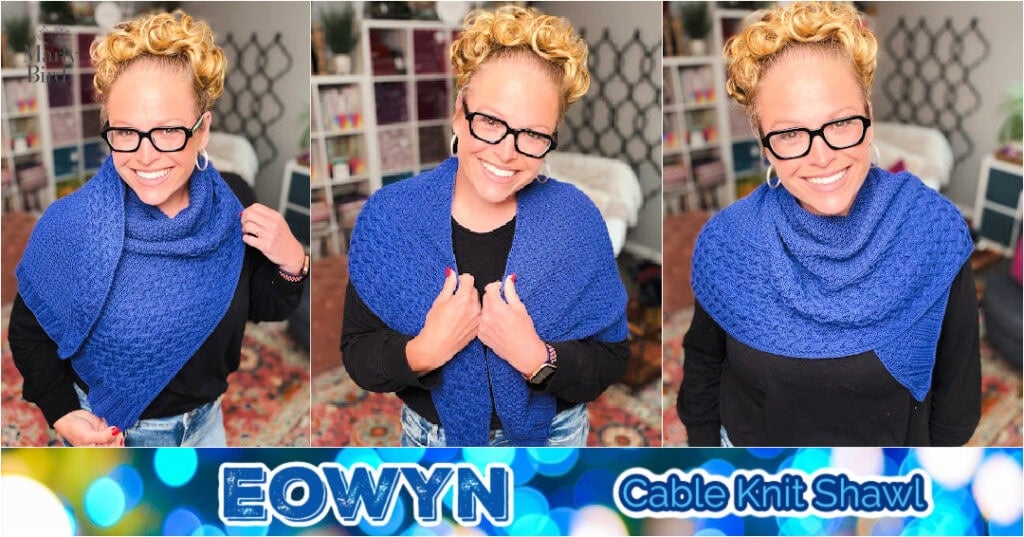
🌸 Spring Fling 2026 Featured Pattern: The Eowyn Cable Knit Shawl debuted as Day 5 of Spring Fling 2026, my 20-day knit and crochet pattern celebration. Cast on, share your progress, and tag me @themarlybird with #EowynCableShawl + #SpringFling2026 to be featured. ❤️
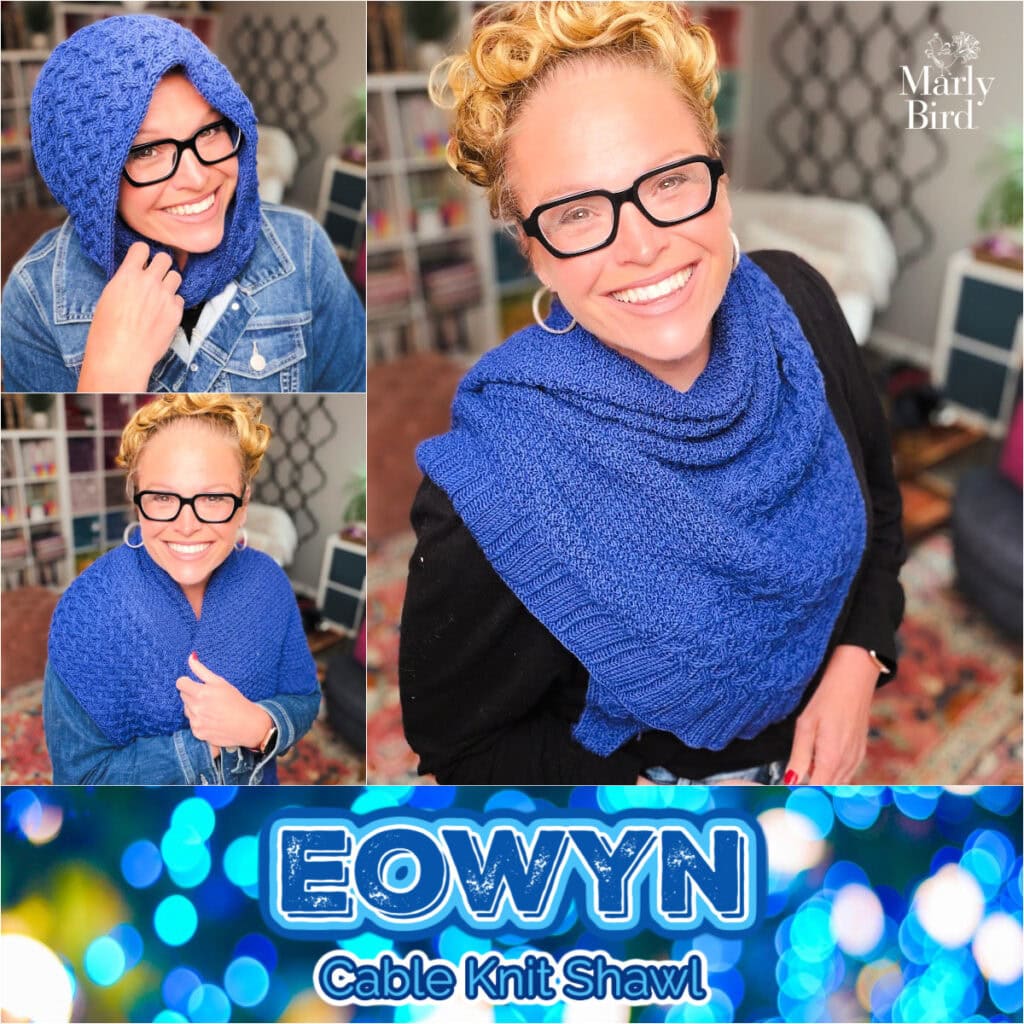
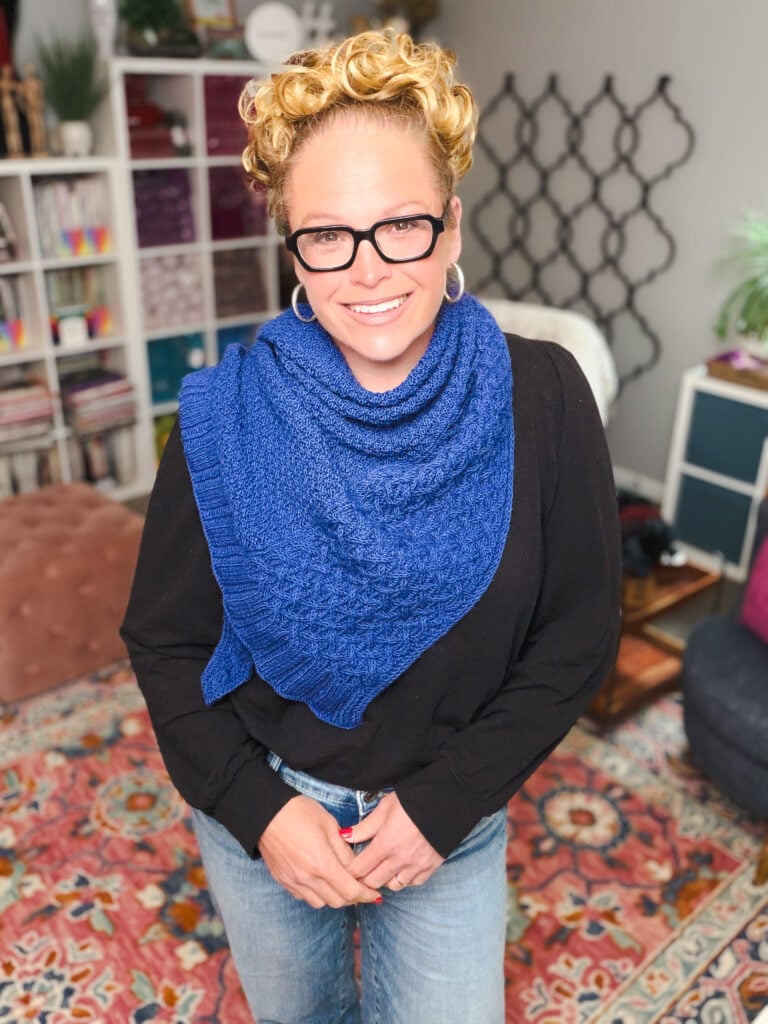
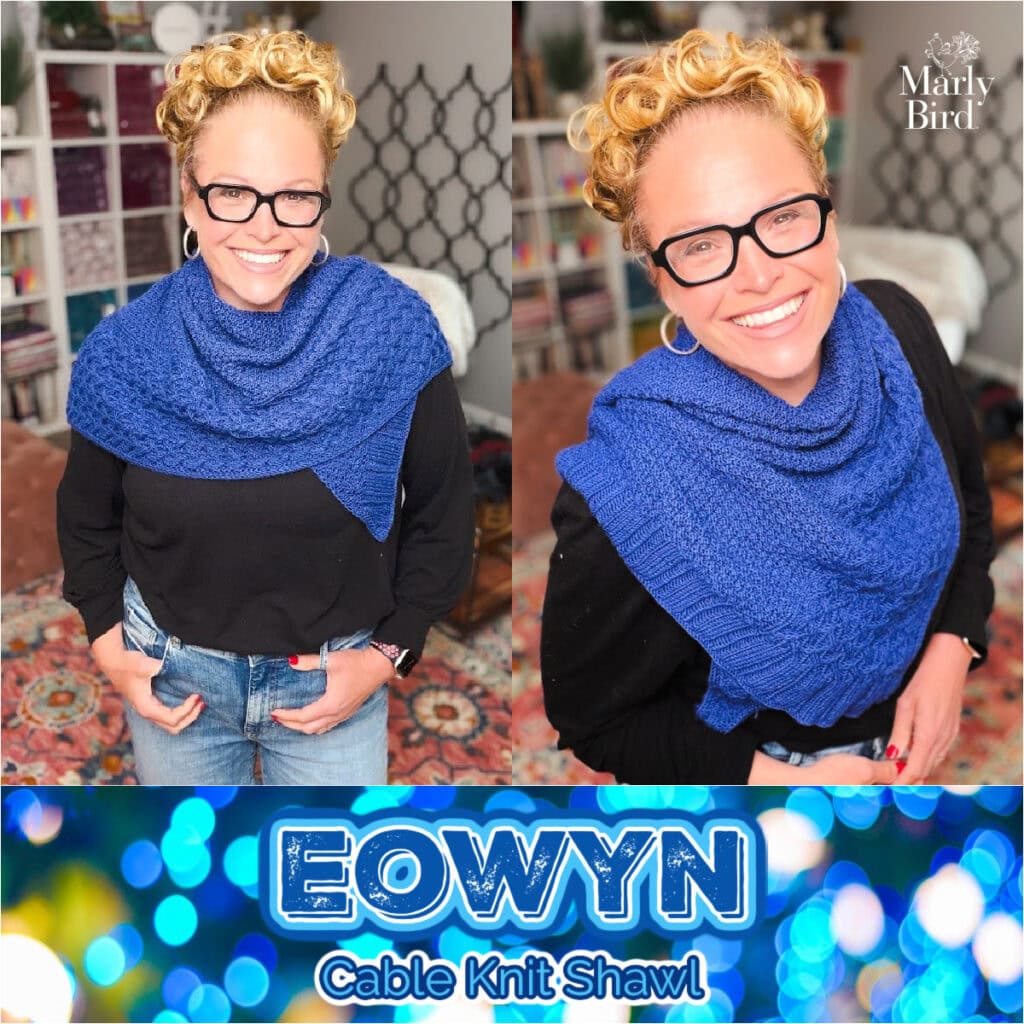
Eowyn free cable knit shawl pattern by Marly Bird, shown styled three ways in textured navy blue sport weight wool bamboo yarn.

💖 What You Will Love About This Pattern

✨ Texture that pops. The combination of the Snug Cable Pattern and double moss stitch gives this shawl incredible dimension… without overwhelming your stitches or your eyeballs.

✨ A wearable right triangle shape. This right triangle shawl knitting pattern is easy to style… wrap it, drape it, or toss it over your shoulders for effortless coziness. It’s the kind of shape that goes with everything from a denim jacket to a little black dress.

✨ Balanced skill-building. If you’re ready to level up your knitting, this pattern introduces cables in a structured, repeatable way that builds confidence one row at a time.

✨ Lightweight but warm. Using a wool bamboo yarn, you get warmth from wool and drape from bamboo… aka the dream combo for a year-round shawl.
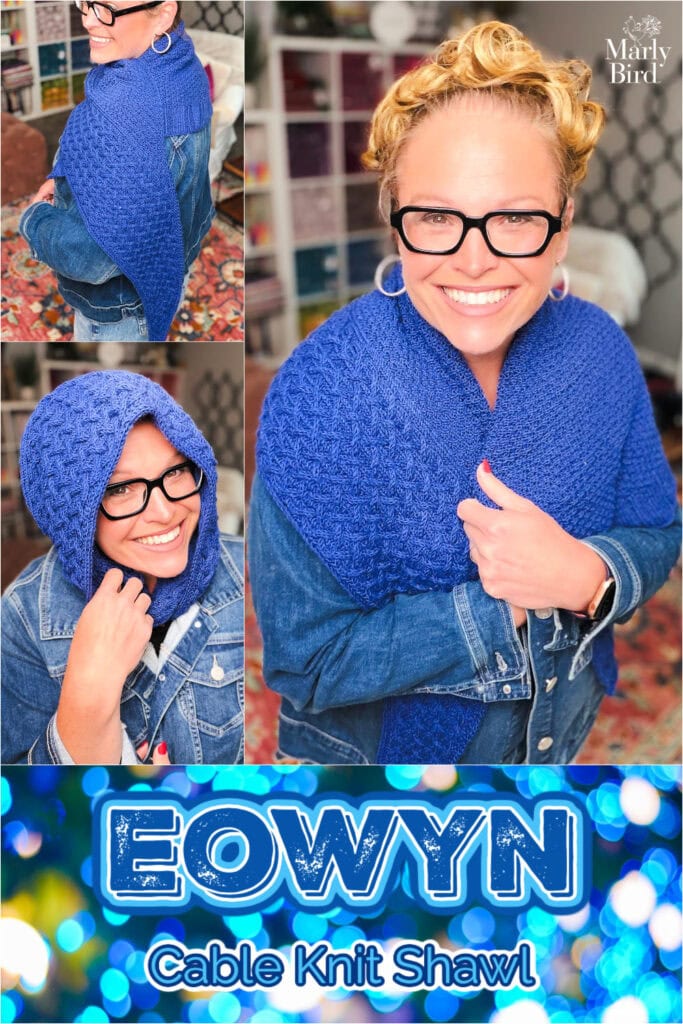
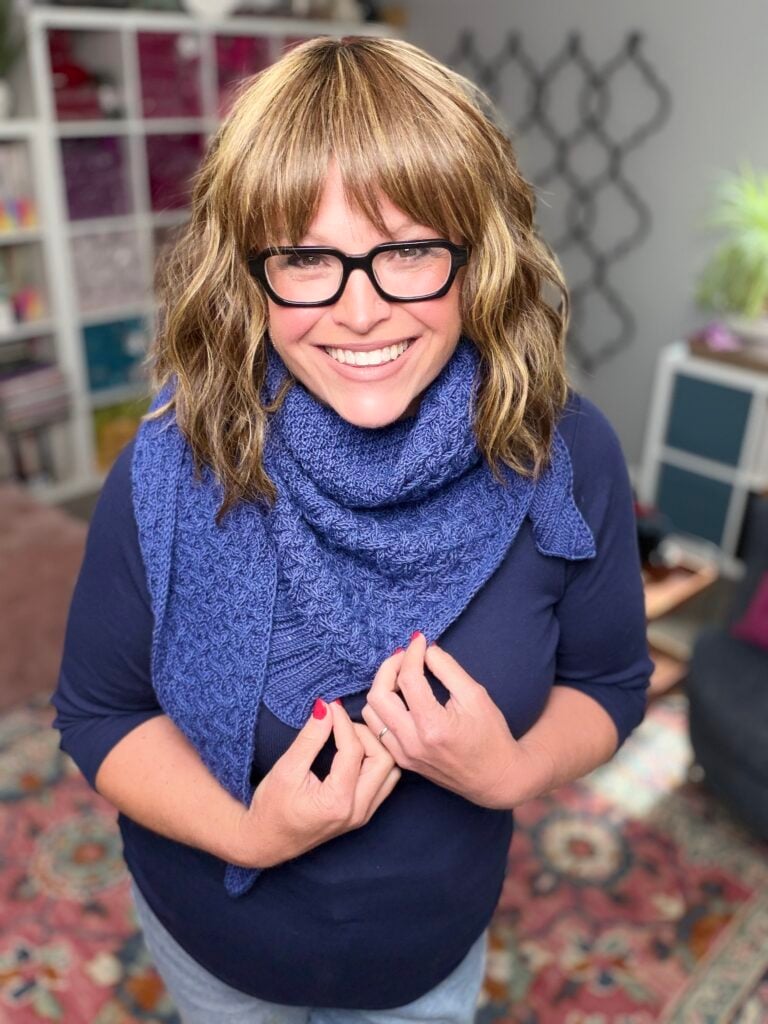
Eowyn cable knit shawl pattern shown in three poses, highlighting the snug cable and double moss stitch texture in navy blue.

🧵 Quick Pattern Overview

🧶 Skill Level: Intermediate

📏 Shape: Right triangle shawl

📐 Finished Size: Approx. 37″ across top edge and 50″ along straight side

🪡 Yarn Weight: Sport weight (CYCA #2)

🧵 Yarn: Classic Elite Wool Bam Boo (50% wool / 50% bamboo) … discontinued, see substitutes below

🪡 Needles: US 7 (4.5 mm)

This is a free triangle shawl knitting pattern that grows gradually… which means you’ll see your progress almost every row. Always a win when cables are involved.
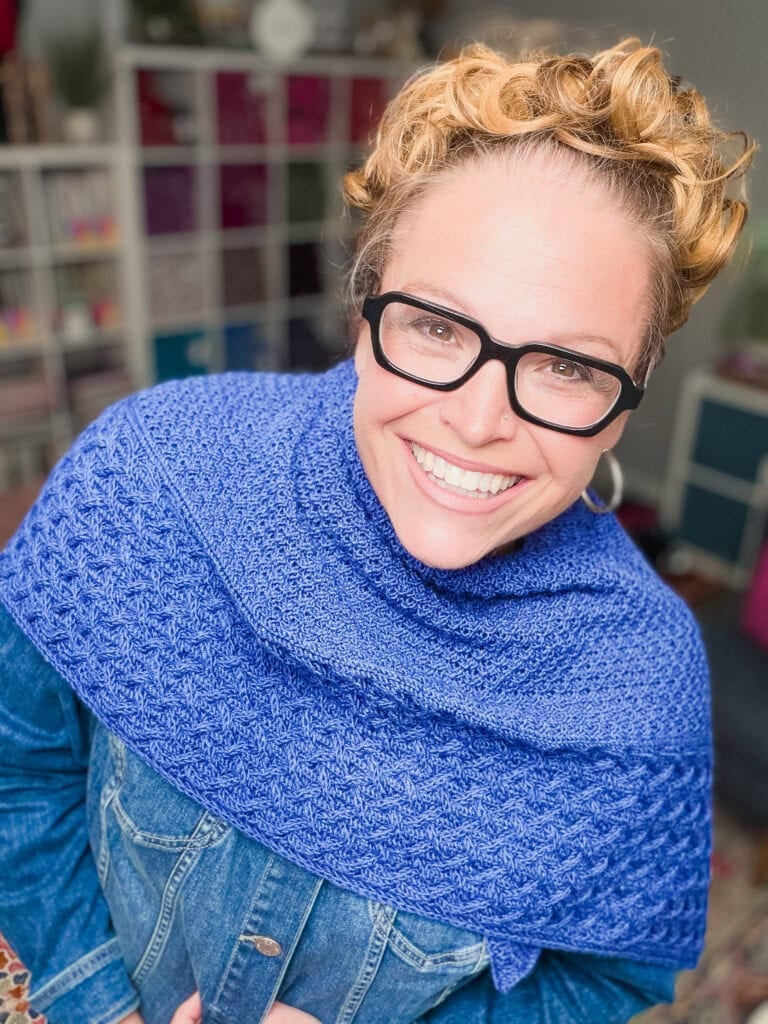
Eowyn cable knit shawl draped over a denim jacket, showing the textured snug cables and double moss stitch in navy blue sport weight yarn.

🤔 Is This Right Triangle Shawl Knitting Pattern Right for You?

This pattern is perfect for you if you…

✔️ Are comfortable with knit and purl stitches
✔️ Want to learn or improve your cable techniques
✔️ Love textured fabrics like a double moss stitch shawl
✔️ Enjoy relaxing repeats with visual interest
✔️ Are ready for a project that grows with you (literally)

✨ Designer Tip: If cables have intimidated you in the past… this is a great place to start. The repeats are consistent, the chart is fully written out, and once you “see” the pattern, it clicks beautifully.
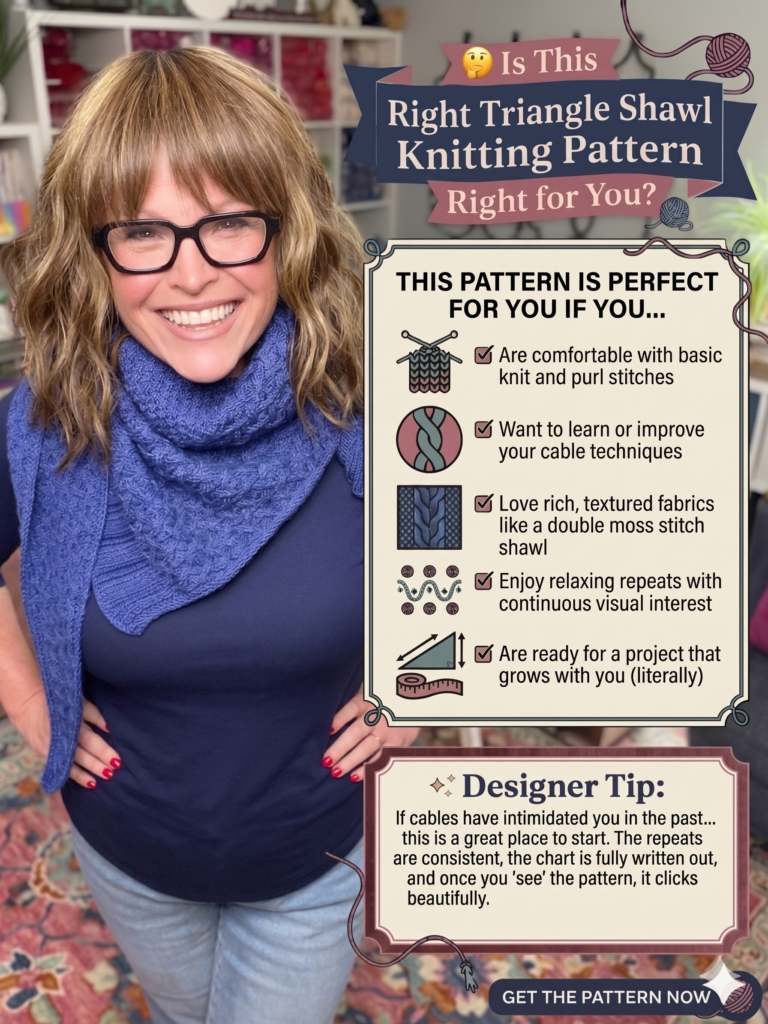
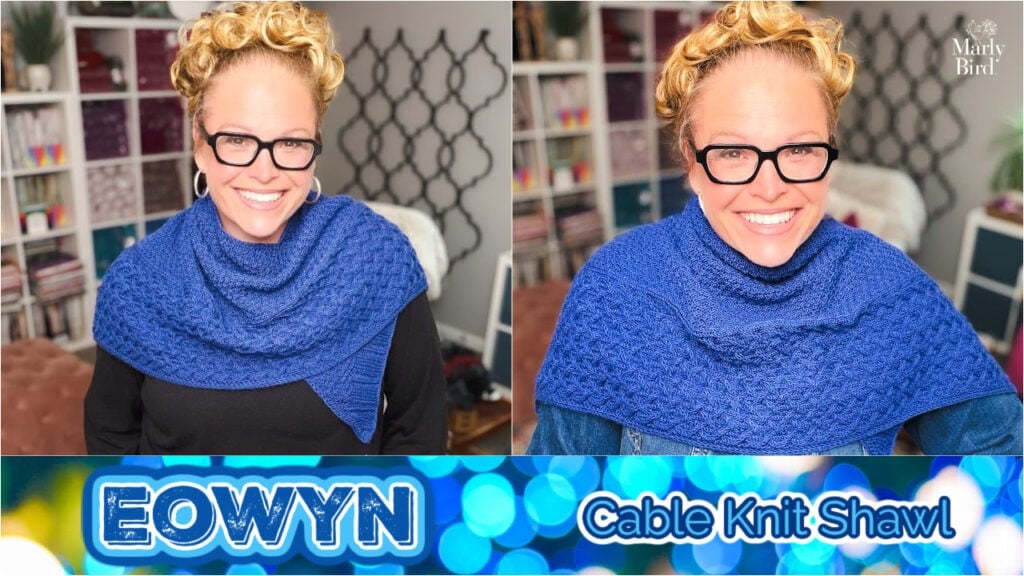
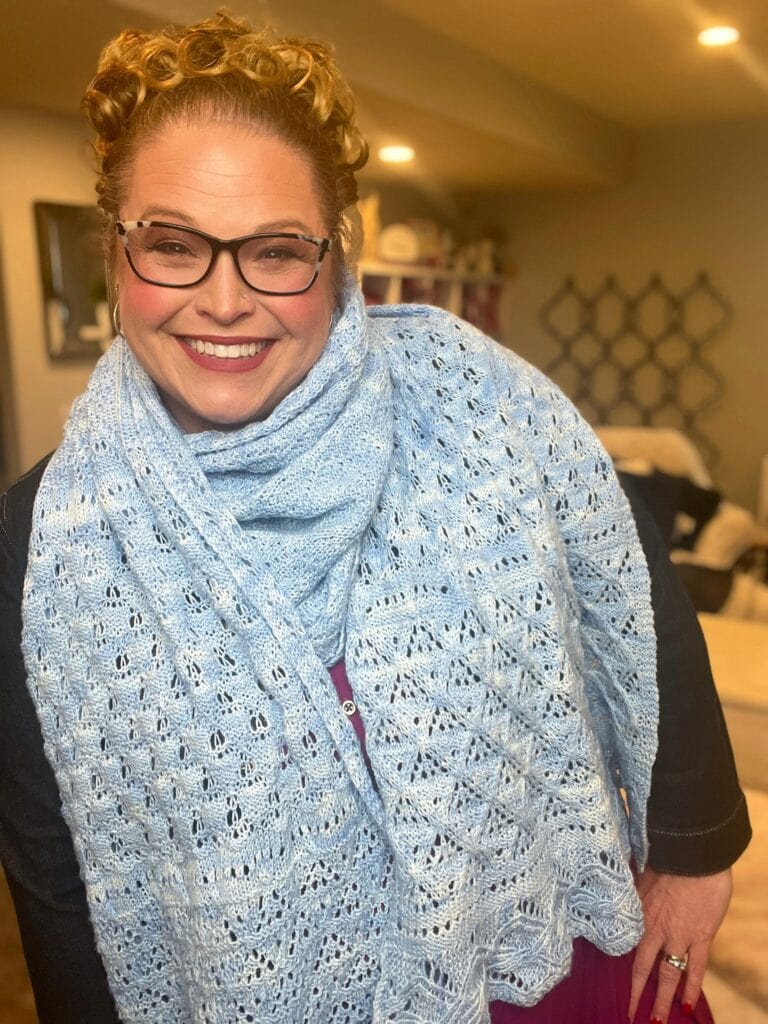
Woman modeling a textured blue cable knit triangle shawl, showing detailed stitching and cozy drape.

🧶 Explore More Free Knit Shawl Patterns

Eowyn lives inside a much bigger collection of free knit shawl patterns here on the blog… triangles, crescents, boomerangs, half-circles, lace, mosaic, brioche, and more. If you love a textured triangle, you might also love the Mariposa Textured Triangle Shawl (worsted weight) or the Return to Me Boomerang Shawl (cables and lace) or the Make It Mine Shawl (sport weight).
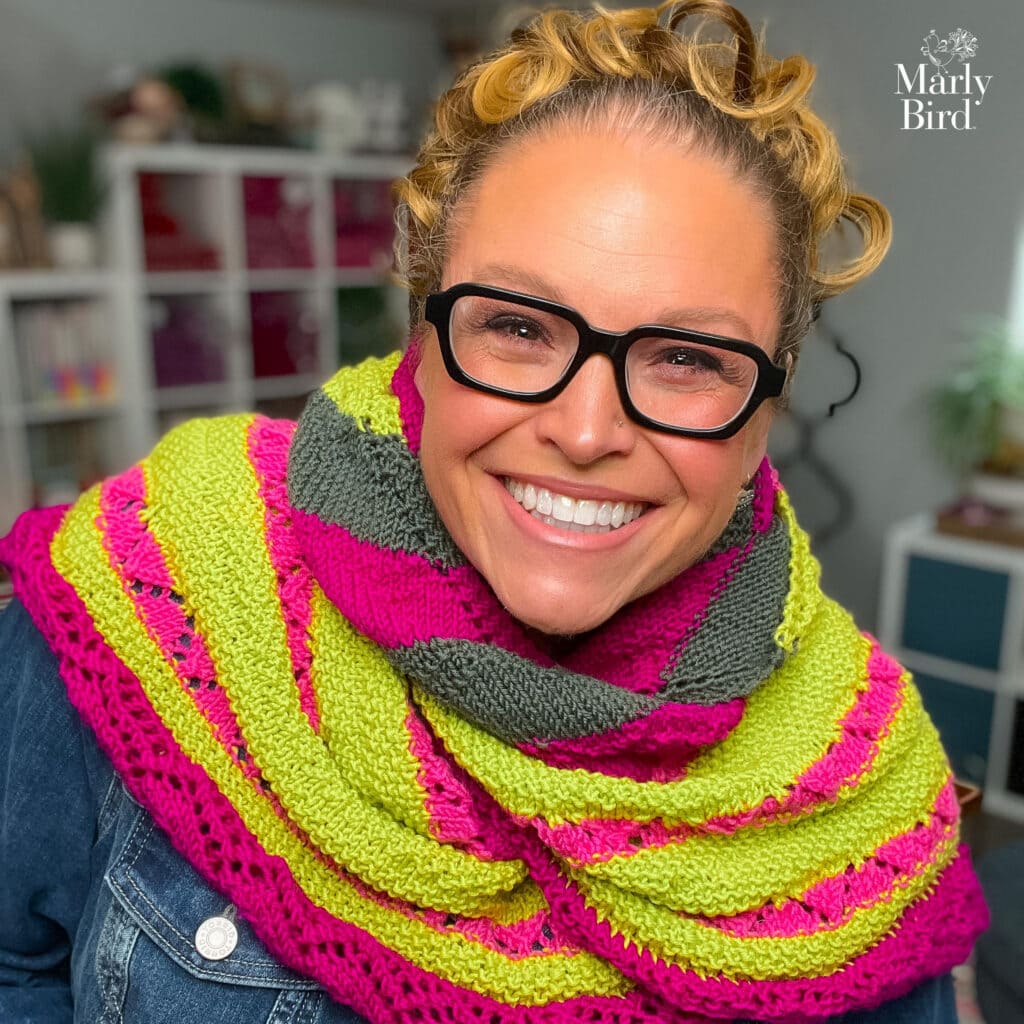
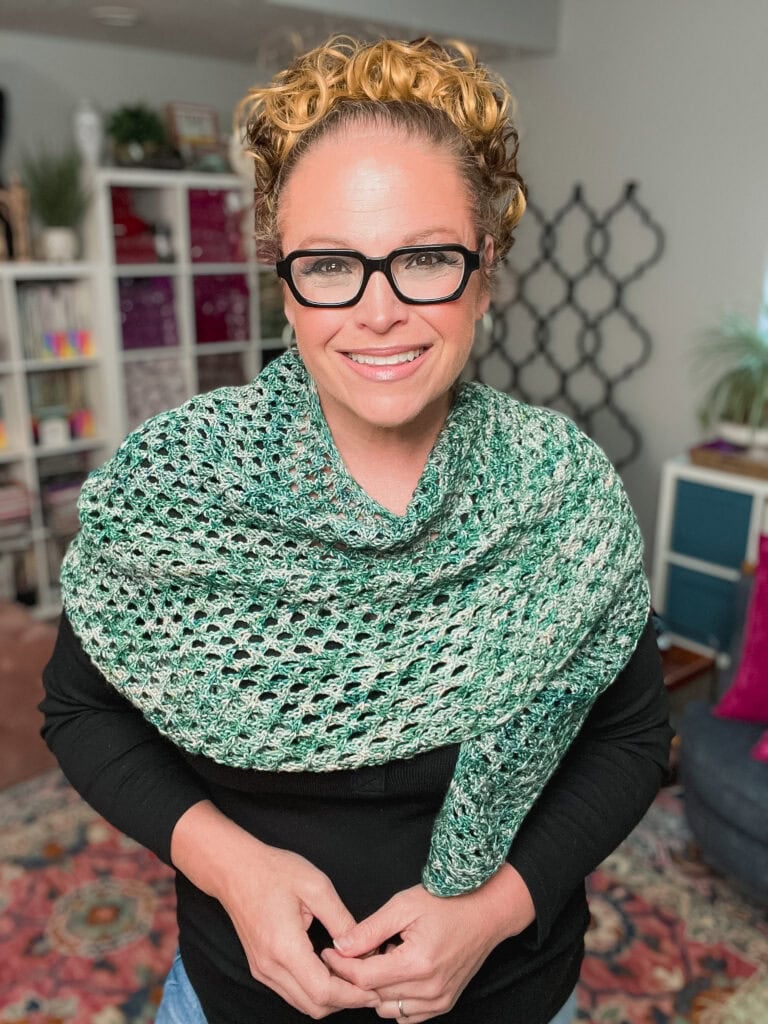
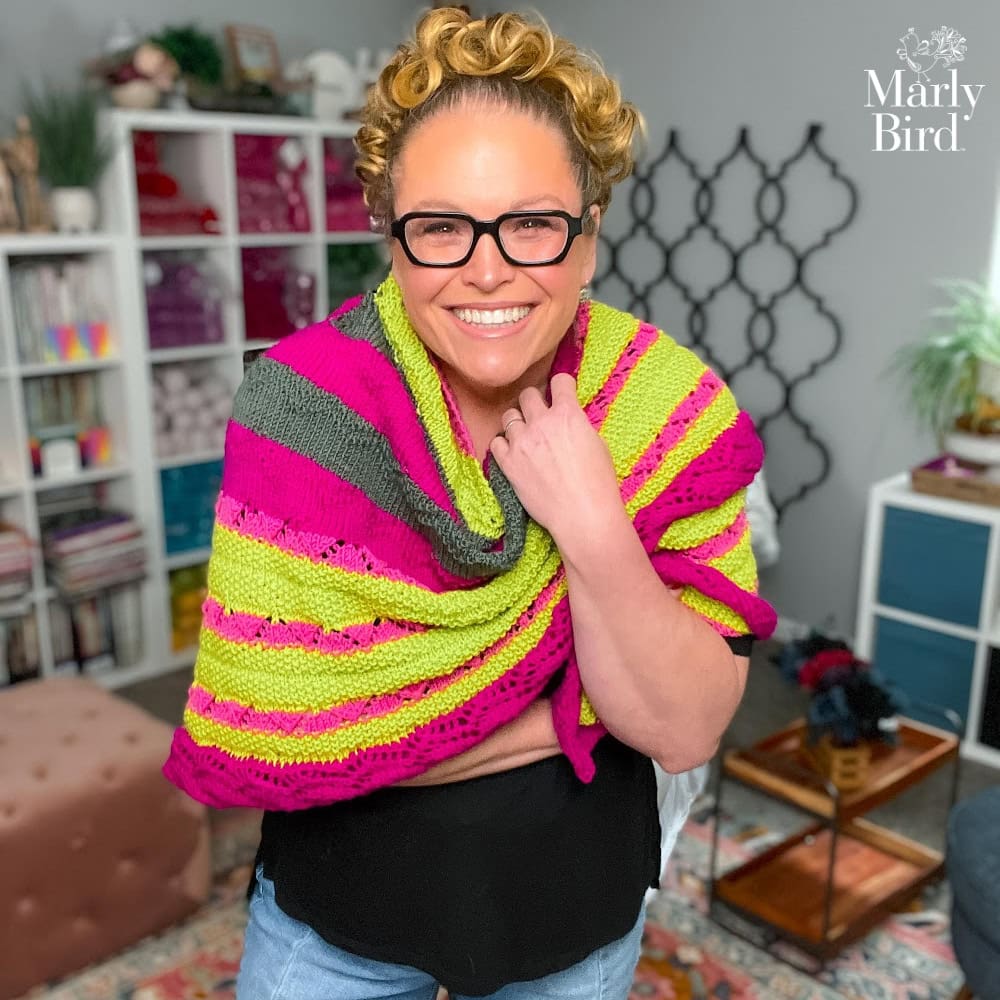
Person models a vibrant pink, green, and gray knitted shawl with textured stitch detail; yarn shelves and Marly Bird logo behind.
Mariposa Knit Shawl
Green Boomerang Knit Shawl draped over shoulders, showing textured stitches and neat edges in a bright, creative space.
Return to Me Boomerang Shawl
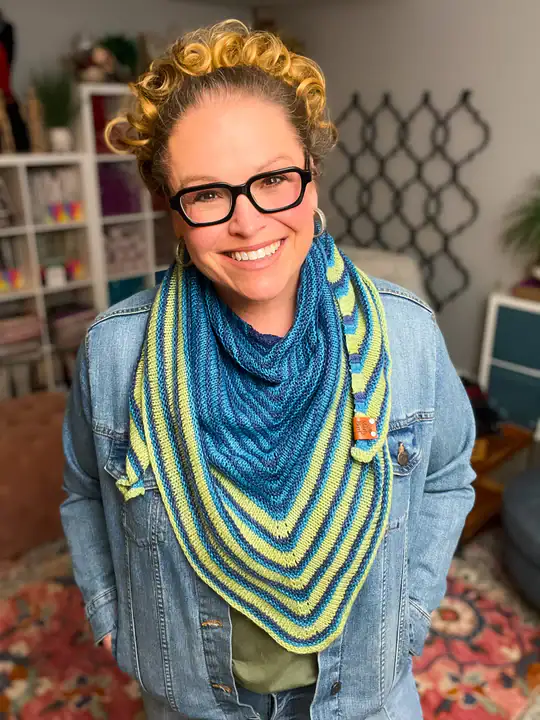
Blue and green striped knit or crochet shawl, showing textured stitches, draped over denim jacket.
Make It Mine Triangle Shawl

🧠 Build Your Skills with This Pattern

This shawl helps you practice:

  • 2/2 LPC and 2/2 RPC cable techniques
  • Reading written stitch patterns and charts together
  • Managing stitch markers across multiple sections
  • Working increases inside a triangular shape without losing your pattern

✨ Designer Tip: Place your stitch markers exactly as the pattern instructs… they’re doing a LOT of heavy lifting to keep your cable section and your double moss section organized as the shawl grows.


🧶 Yarn & Materials

The original sample was knit in Classic Elite Wool Bam Boo, a sport weight 50% wool / 50% bamboo blend… soft, breathable, and lovely with a drapey hand. Sadly this yarn has been discontinued, but the substitutes below give you the same blend of warmth and drape.

You’ll need:

  • 8 balls of sport weight (CYCA #2) yarn… approx. 944 yards / 864 meters total
  • US 7 (4.5 mm) knitting needles, or size needed to match gauge
  • Cable needle
  • Removable stitch markers
  • Tapestry needle
  • Blocking squares and blocking pins
  • Soaking basin and Eucalan wool wash

✨ Designer Tip: If you tend to knit tightly, check your gauge early… bamboo blends don’t bounce back the way pure wool does, so a tight gauge will stay tight and your stitches will look squeezed.

Yarn Substitutes for the Eowyn Shawl

Not every substitute below is the exact same fiber blend as the original… but each one is a yarn I’d happily reach for if I were knitting Eowyn again today. Pick the one that fits your stash, your climate, and your color story.

  • Knit Picks Galileo … sport weight, merino/bamboo blend. The closest match to the original blend and feel.
  • Berroco Ultra Alpaca Light … sport weight wool/alpaca, warm with beautiful stitch definition and drape.
  • HiKoo Sueno … 80% superwash merino, 20% bamboo. Slightly less drape but excellent structure for cables.
  • Universal Yarns Bamboo Pop … cotton/bamboo blend with a beautiful sheen. Slightly thinner, but it would knit up gorgeously with a gauge check.
  • Malabrigo Caprino … 80% superfine merino wool, 20% cashmere. Smooth stitch definition. Sub with a gauge check.
⭐️ Marly Bird Amazon Storefront ⭐️

🎥 Video Tutorials

Need a refresher on a stitch or technique? I’ve got you covered. Here are video tutorials for every stitch and skill used in the Eowyn shawl…

  • Knit Stitch (continental style)
  • Purl Stitch (continental style)
  • Kfb (knit front and back)
  • Long Tail Cast-On
  • Cable Without a Cable Needle
  • How to Fix Miscrossed Cables
  • How to Add a Lifeline
  • How to Tink (un-knit)
  • How to Bury Ends

Eowyn cable knit shawl styled three ways: as a hood, draped over the shoulders, and wrapped around the neck, in textured navy blue.

💎 Love the Pattern but Want an Ad-Free PDF?

This cable knit shawl pattern is ideal for intermediate knitters looking to expand their skills and get cozy doing it. But what if you’d rather knit from a clean, printable, ad-free version that you can mark up, take on the go, and keep forever?

You can grab the ad-free PDF on:

  • Etsy
  • Ravelry
  • Shopify

📄 Ad-Free PDF Pattern Format & Details

This is a comprehensive, in-depth knitting pattern designed to guide you every step of the way.

  • 27-page digital PDF pattern
  • Detailed written instructions from cast-on to bind-off
  • Stitch pattern breakdowns (cables and texture stitches)
  • Chart support for visual learners
  • Helpful notes, tips, and guidance throughout
  • Finishing instructions including blocking

This isn’t just a quick pattern… it’s a fully supported project experience so you can knit with confidence. Perfect for printing, marking your progress, and knitting on the go.
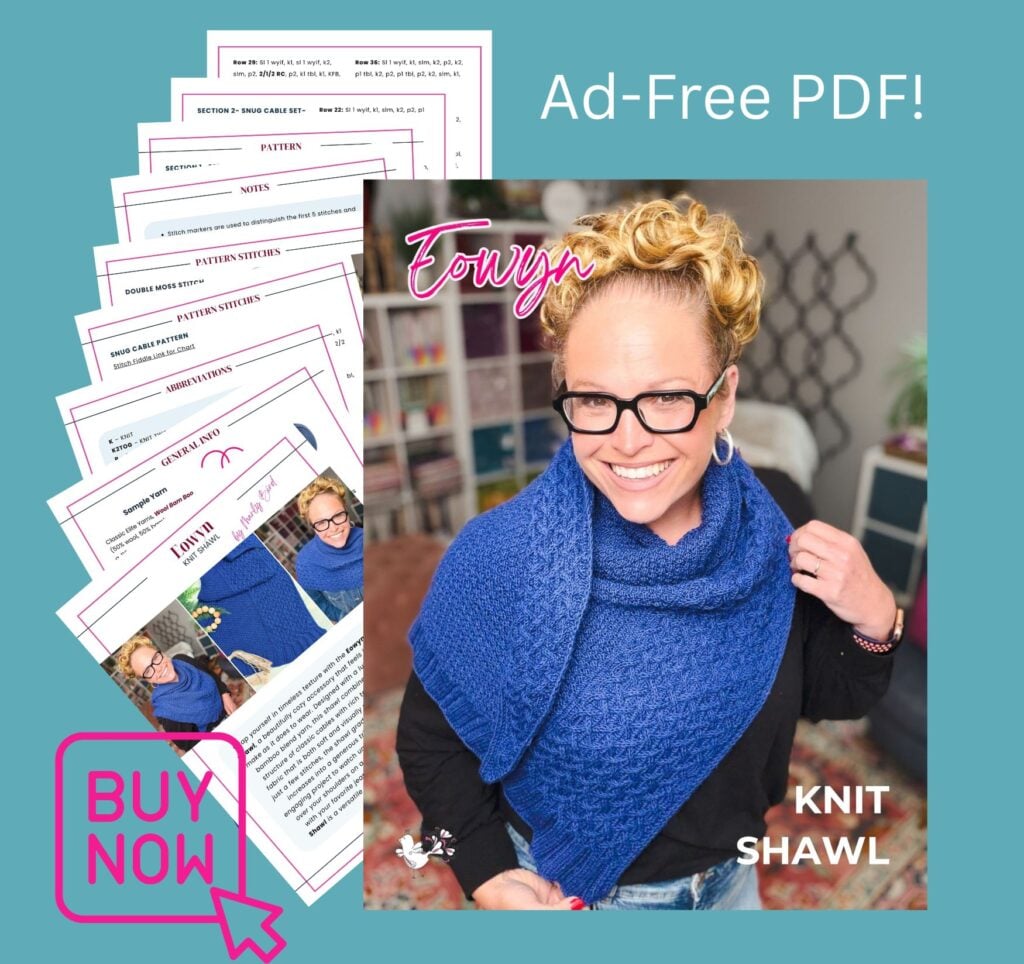
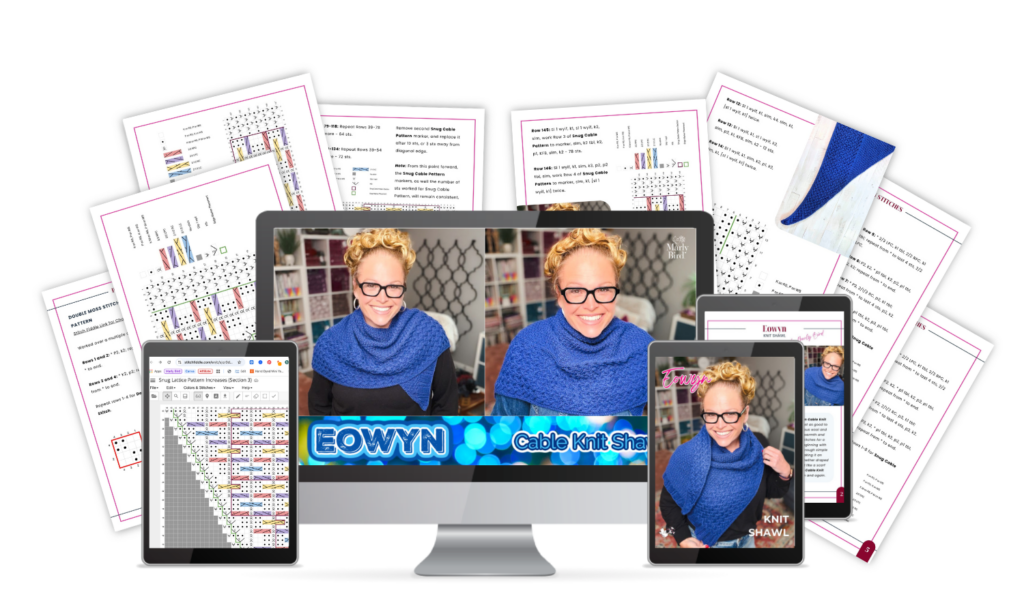
Eowyn cable knit shawl ad-free PDF mockup showing the printed pattern pages alongside the finished textured navy shawl.
Etsy
Shopify
Ravelry

Join our Newsletter

Get Free Crochet & Knitting
Pattern Links & Coupons!

Hand-drawn bird with curling, detailed feathers and pink accents; cheerful pose showcases fine line and texture work.
>> Become An Insider <<
A woman with glasses and curly hair models a colorful crocheted scarf, showing textured stitches and vibrant yarn.

Eowyn textured triangle cable knit shawl pattern by Marly Bird, modeled in front of a wall of colorful yarn.

🧶 Eowyn Cable Knit Shawl — Pattern Details

Skill Level

Intermediate

MEASUREMENTS

Finished Measurements

Wrap measures 37″ [131 cm] across top edge and 50″ [127 cm] along straight side edge

Gauge

21 sts and 34 rows in Double Moss Stitch = 4″ [10 cm]

MATERIALS

Yarn

Classic Elite Yarns, Wool Bam Boo (50% wool, 50% bamboo, 1¾ oz / 50 g, 118 yards / 108 m, CYCA #2 Sport)

8 balls: #1647 Navy

Needle

U.S. 7 [4.5 mm], or size required for gauge.

Notions

  • Removable Stitch Markers
  • Tapestry needle
  • Scissors
  • Tape measure
  • Cable Needle
  • Notions Bag for Supplies
  • Blocking Squares
  • Blocking Pins
  • Soaking Basin
  • Eucalan Wool Wash

ABBREVIATIONS

  • K – Knit
  • K2tog – Knit Two Stitches Together
  • P – Purl
  • Pm – Place Marker
  • Sl – Slip
  • Slm – Slip Marker
  • St(s) – Stitches
  • Tbl – Through The Back Leg
  • Wyif – With Yarn In Front
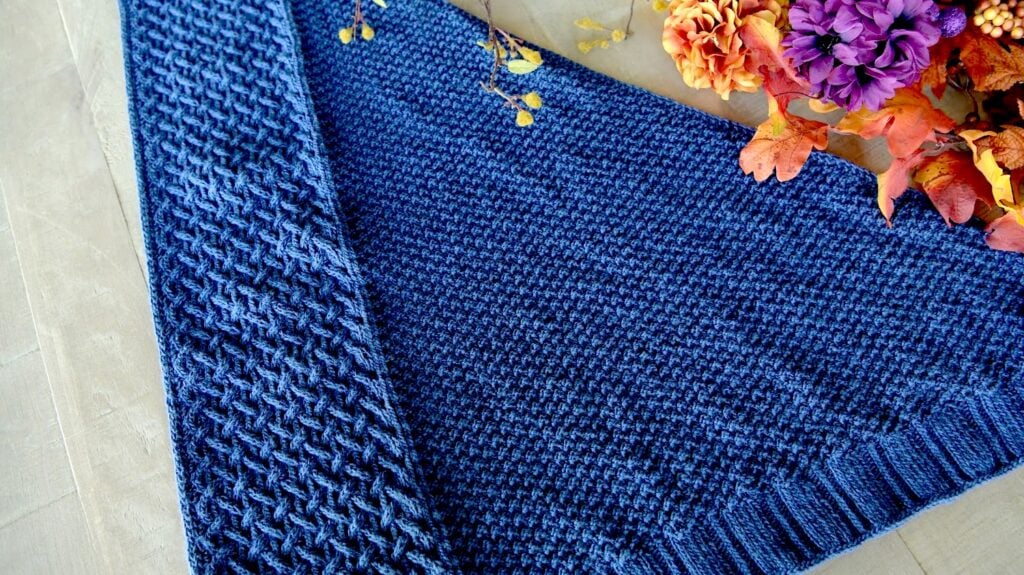
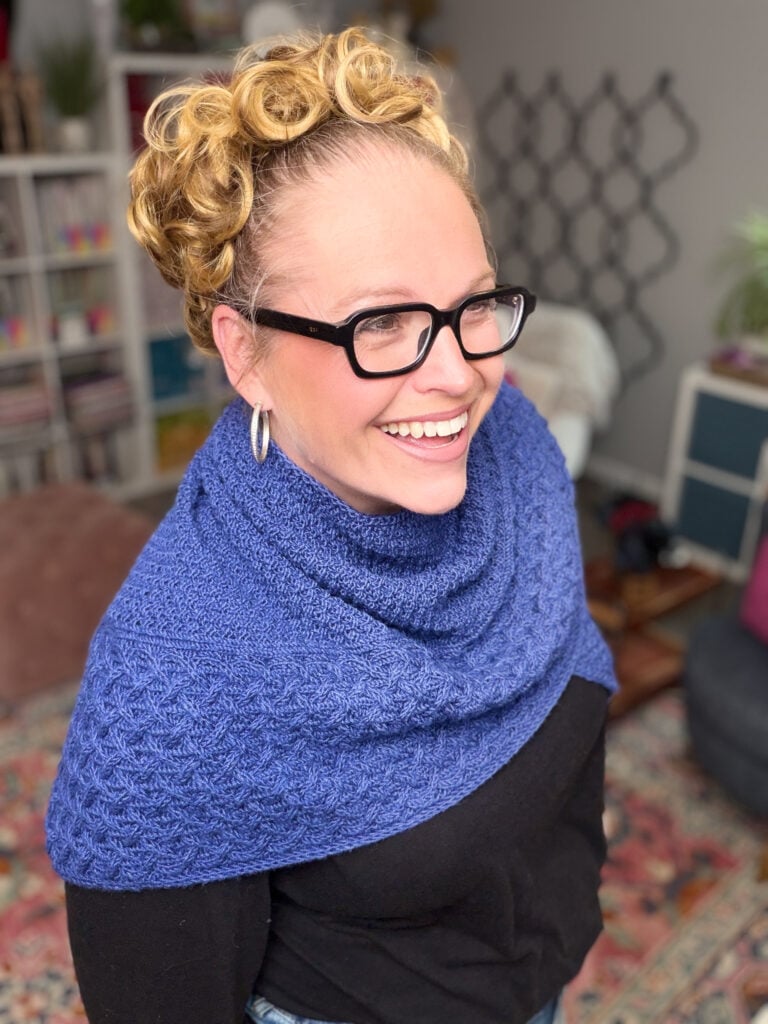
Eowyn cable knit shawl displayed flat in navy blue, showing the snug cable and double moss stitch texture in detail.

CABLE STITCHES

⭐️ 2/2 LPC (2/2 Left Purl Cable): Slip 2 sts onto cable needle and hold in front, k2 from left hand needle, p2 from cable needle.

⭐️ 2/2 RPC (2/2 Right Purl Cable): Slip 2 sts onto cable needle and hold in back, k2 from left hand needle, p2 from cable needle.

⭐️ 2/1/2 RC (1/1/1 Right Cable): Slip 3 sts onto cable needle and hold in back, k2 from left hand needle, return sts from cable needle onto left hand needle, slip 2 sts onto cable needle and hold in front, k1 from left hand needle, k2 from cable needle.

⭐️ 2/1/2 LC (1/1/1 Left Cable): Slip 2 sts onto cable needle and hold in front, slip 1 st onto second cable needle and hold in back, k2 from left hand needle, return st from back cable needle onto left hand needle, k1 from left hand needle, k2 from front cable needle.


PATTERN STITCHES

Snug Cable Pattern

Worked over a multiple of 10 sts + 4.

Row 1 (RS): 2/2 RPC, * k1 tbl, 2/2 LPC, k1 tbl, 2/2 RPC; repeat from * to end.

Row 2: * K2, p2, p1 tbl, p2, k2, p1 tbl; repeat from * to last 4 sts, k2, p2.

Row 3: K2, p2, * k1 tbl, p2, 2/1/2 LC, p2; repeat from * to end.

Row 4: * K2, p2, p1 tbl, p2, k2, p1 tbl; repeat from * to last 4 sts, k2, p2.

Row 5: * 2/2 LPC, k1 tbl, 2/2 RPC, k1 tbl; repeat from * to last 4 sts, 2/2 LPC.

Row 6: P2, k2, * p1 tbl, k2, p2, p1 tbl, p2, k2; repeat from * to end.

Row 7: * P2, 2/1/2 RC, p2, k1 tbl; repeat from * to last 4 sts, p2, k2.

Row 8: P2, k2, * p1 tbl, k2, p2, p1 tbl, p2, k2; repeat from * to end.

Repeat Rows 1-8 for Snug Cable Pattern.

Double Moss Stitch

Worked over a multiple of 4 sts.

Rows 1 and 2: * P2, k2; repeat from * to end.

Rows 3 and 4: * K2, p2; repeat from * to end.

Repeat rows 1-4 for Double Moss Stitch.


CHARTS

Full shawl charts are exclusive to the ad-free PDF, including the Stitch Fiddle link to use the progress tracker. If you love charts, you will love the chart for this shawl… it’s 100% complete. Every. Row.

Eowyn cable knit shawl chart preview shown on a computer, tablet, and phone alongside the finished navy shawl.
Etsy
Shopify
Ravelry

NOTES

  • Stitch markers are used to distinguish the first 5 stitches and last 2 stitches of the RS row (edge stitches), as well as the separation of the Snug Cable Pattern section and the Double Moss Stitch section.
  • When reading the knitting charts, begin at the bottom right corner and read right to left on RS, and left to right on WS.

GROW

To Unlock Exclusive Subscriber Content click the Box below and join for free by simply adding your email and creating a password! If you are having troubles, clear your cache or reset your password or login to the Grow Publisher Portal.

>> Learn More About Grow Here <<

I’m thrilled to share this amazing pattern with you, many patterns on my blog are absolutely free! I kindly request that you don’t copy and paste or distribute this pattern. Prefer an ad-free experience? Buy a digital PDF pattern for a small fee from one of my online stores for a seamless crafting journey. 

I appreciate your support and readership. You are the reason I can keep doing what I love and sharing it with others. So, thank you from the bottom of my yarn-loving heart! Disclosure: This post contains affiliate links, meaning I get a commission if you decide to make a purchase through my links at no cost to you.


Woman models a blue cable knit shawl, showing its textured stitch detail in a cozy room with bookshelves and decor.

EOWYN CABLE KNIT SHAWL — PATTERN INSTRUCTIONS

SECTION 1 – SET-UP

Cast on 5 sts using long tail cast-on.

Row 1 (RS): Sl 1 wyif, k1, sl 1 wyif, KFB, k1 – 6 sts.

Row 2: (Sl 1 wyif, k) 3 times.

Row 3: Sl 1 wyif, k1, sl 1 wyif, KFB, slm, k2 – 7 sts.

Row 4: Sl 1 wyif, k1, (k1, sl 1 wyif) twice, k1.

Row 5: (Sl 1 wyif, k1) twice, KFB, slm, k2 – 8 sts.

Row 6: Sl 1 wyif, k3, sl 1 wyif, k1, sl 1 wyif, k1.

Row 7: Sl 1 wyif, k1, sl 1 wyif, k2, KFB, slm, k2 – 9 sts.

Row 8: Sl 1 wyif, k4, [sl 1 wyif, k1] twice.

Establish Edge Pattern

With RS Facing, place after the first 5 sts and before the last 2 sts.

The edge sts will always be worked as follow for the remainder of the pattern:

RS rows: Sl 1 wyif, k1, sl 1 wyif, k2, slm, . . . follow pattern to last 3 sts . . . , KFB, slm, k2.

WS rows: Sl 1 wyif, k1, slm, k2,  . . . follow pattern to last 5 sts . . . , slm, k1, [sl 1 wyif, k1] twice.

Continue as follows:

Row 9: Sl 1 wyif, k1, sl 1 wyif, k2, slm, p1, KFB, slm, k2 – 10 sts.

Row 10: Sl 1 wyif, k1, slm, k3, slm, k1, [sl 1 wyif, k1] twice.

Row 11: Sl 1 wyif, k1, sl 1 wyif, k2, slm, p2, KFB, slm, k2 – 11 sts.

Row 12: Sl 1 wyif, k1, slm, k4, slm, k1, [sl 1 wyif, k1] twice.

Row 13: Sl 1 wyif, k1, sl 1 wyif, k2, slm, p2, k1, KFB, slm, k2 – 12 sts.

Row 14: Sl 1 wyif, k1, slm, k2, p1, k2, slm, k1, [sl 1 wyif, k1] twice.


SECTION 2 – SNUG CABLE PATTERN SET-UP

Row 15: Sl 1 wyif, k1, sl 1 wyif, k2, slm, 2/2 RPC, KFB, slm, k2 – 13 sts.

Row 16: Sl 1 wyif, k1, slm, k4, p2, slm, k1, [sl 1 wyif, k1] twice.

Row 17: Sl 1 wyif, k1, sl 1 wyif, k2, slm, k2, p2, k1 tbl, KFB, slm, k2 – 14 sts.

Row 18: Sl 1 wyif, k1, slm, k2, p1 tbl, k2, p2, slm, k1, [sl 1 wyif, k1] twice.

Row 19: Sl 1 wyif, k1, sl 1 wyif, k2, slm, 2/2 LPC, k1 tbl, k1, KFB, slm, k2 – 15 sts.

Row 20: Sl 1 wyif, k1, slm, k2, p1, p1 tbl, p2, k2, slm, k1, [sl 1 wyif, k1] twice.

Row 21: Sl 1 wyif, k1, sl 1 wyif, k2, slm, p2, k2, k1 tbl, k2, KFB, slm, k2  – 16 sts.

Row 22: Sl 1 wyif, k1, slm, k2, p2, p1 tbl, p2, k2, slm, k1, [sl 1 wyif, k1] twice.

Row 23: Sl 1 wyif, k1, sl 1 wyif, k2, slm, 2/2 RPC, k1 tbl, k2, p1, KFB, slm, k2 – 17 sts.

Row 24: Sl 1 wyif, k1, slm, k2, p1, k2, p1 tbl, k2, p2, slm, k1, [sl 1 wyif, k1] twice.

Row 25: Sl 1 wyif, k1, sl 1 wyif, k2, slm, k2, p2, k1 tbl, p2, k2, KFB, slm, k2 – 18 sts.

Row 26: Sl 1 wyif, k1, slm, k2, p2, k2, p1 tbl, k2, p2, slm, k1, [sl 1 wyif, k1] twice.

Row 27: Sl 1 wyif, k1, sl 1 wyif, k2, slm, 2/2 LPC, k1 tbl, 2/2 RPC, k1 tbl, KFB, slm, k2 – 19 sts.

Row 28: Sl 1 wyif, k1, slm, k2, p1 tbl, k2, p2, p1 tbl, p2, k2, slm, k1, [sl 1 wyif, k1] twice.

Row 29: Sl 1 wyif, k1, sl 1 wyif, k2, slm, p2, 2/1/2 RC, p2, k1 tbl, k1, KFB, slm, k2 – 20 sts.

Row 30: Sl 1 wyif, k1, slm, k2, p1, p1 tbl, k2, p2, p1 tbl, p2, k2, slm, k1, [sl 1 wyif, k1] twice. 

Row 31: Sl 1 wyif, k1, sl 1 wyif, k2, slm, 2/2 RPC, k1 tbl, 2/2 LPC, k1 tbl, k2, KFB, slm, k2 – 21 sts.

Row 32: Sl 1 wyif, k1, slm, k2, p2, p1 tbl, p2, k2, p1 tbl, k2, p2, slm, k1, [sl 1 wyif, k1] twice. 

Row 33: Sl 1 wyif, k1, sl 1 wyif, k2, slm, k2, p2, k1 tbl, p2, 2/1/2 LC, p1, KFB, slm, k2 – 22 sts.

Row 34: Sl 1 wyif, k1, slm, k3, p2, p1 tbl, p2, k2, p1 tbl, k2, p2, slm, k1, [sl 1 wyif, k1] twice.

Row 35: Sl 1 wyif, k1, sl 1 wyif, k2, slm, 2/2 LPC, k1 tbl, 2/2 RPC, k1 tbl, 2/2 LPC, KFB, slm, k2 – 23 sts.

Row 36: Sl 1 wyif, k1, slm, k2, p2, k2, p1 tbl, k2, p2, p1 tbl, p2, k2, slm, k1, [sl 1 wyif, k1] twice.

Row 37: Sl 1 wyif, k1, sl 1 wyif, k2, slm, p2, 2/1/2 RC, p2, k1 tbl, p2, k2, k1 tbl, KFB, slm, k2 – 24 sts.

Row 38: Sl 1 wyif, k1, slm, k2, p1 tbl, p2, k2, p1 tbl, k2, p2, p1 tbl, p2, k2, slm, k1, [sl 1 wyif, k1] twice.


SECTION 3 – BEGIN AND INCREASE SNUG CABLE PATTERN REPEATS

Row 39: Sl 1 wyif, k1, sl 1 wyif, k2, slm, work Row 1 of Snug Cable Pattern to last 5 sts, pm, k1 tbl, k1, KFB, slm, k2 – 25 sts.

Row 40: Sl 1 wyif, k1, slm, k2, p1, p1 tbl, slm, work Row 2 of Snug Cable Pattern to marker, slm, k1, [sl 1 wyif, k1] twice.

Row 41: Sl 1 wyif, k1, sl 1 wyif, k2, slm, work Row 3 of Snug Cable Pattern to marker, slm, k1 tbl, k2, KFB, slm, k2 – 26 sts.

Row 42: Sl 1 wyif, k1, slm, k2, p2, p1 tbl, slm, work Row 4 of Snug Cable Pattern to marker, slm, k1, [sl 1 wyif, k1] twice.

Row 43: Sl 1 wyif, k1, sl 1 wyif, k2, slm, work Row 5 of Snug Cable Pattern to marker, slm, k1 tbl, k2, p1, KFB, slm, k2 – 27 sts.

Row 44: Sl 1 wyif, k1, slm, k3, p2, p1 tbl, slm, work Row 6 of Snug Cable Pattern to marker, slm, k1, [sl 1 wyif, k1] twice.

Row 45: Sl 1 wyif, k1, sl 1 wyif, k2, slm, work Row 7 of Snug Cable Pattern to 2 sts before marker, remove marker, 2/1/2 RC, replace marker after 2nd of the 5 cable sts just worked, p2, KFB, slm, k2 – 28 sts.

Row 46: Sl 1 wyif, k1, slm, k4, p2, p1 tbl, slm, work Row 8 of Snug Cable Pattern to marker, slm, k1, [sl 1 wyif, k1] twice.

Row 47: Sl 1 wyif, k1, sl 1 wyif, k2, slm, work Row 1 of Snug Cable Pattern to marker, slm, k1 tbl, 2/2 LPC, k1 tbl, KFB, slm, k2 – 29 sts.

Row 48: Sl 1 wyif, k1, slm, k2, p1 tbl, p2, k2, p1 tbl, slm, work Row 2 of Snug Cable Pattern to marker, slm, k1, [sl 1 wyif, k1] twice.

Row 49: Sl 1 wyif, k1, sl 1 wyif, k2, slm, work Row 3 of Snug Cable Pattern to marker, slm, k1 tbl, p2, k2, k2 tbl, k1, KFB, slm, k2 – 30 sts.

Row 50: Sl 1 wyif, k1, slm, k2, p1, p1 tbl, p2, k2, p1 tbl, slm, work Row 4 of Snug Cable Pattern to marker, slm, k1, [sl 1 wyif, k1] twice.

Row 51: Sl 1 wyif, k1, sl 1 wyif, k2, slm, work Row 5 of Snug Cable Pattern to marker, slm, k1 tbl, 2/2 RPC, k1 tbl, k2, KFB, slm, k2 – 31 sts.

Row 52: Sl 1 wyif, k1, slm, k4, p1 tbl, k2, p2, p1 tbl, slm, work Row 6 of Snug Cable Pattern to marker, slm, k1, [sl 1 wyif, k1] twice.

Row 53: Sl 1 wyif, k1, sl 1 wyif, k2, slm, work Row 7 of Snug Cable Pattern to 2 sts before marker, remove marker, 2/1/2 RC, replace marker after 2nd of the 5 cable sts just worked, p2, k1 tbl, p2, k1, KFB, slm, k2 – 32 sts.

Row 54: Sl 1 wyif, k1, slm, k2, p1, k2, p1 tbl, k2, p2, p1 tbl, slm, work Row 8 of Snug Cable Pattern to marker, slm, k1, [sl 1 wyif, k1] twice.

Row 55: Sl 1 wyif, k1, sl 1 wyif, k2, slm, work Row 1 of Snug Cable Pattern to marker, remove marker, k1 tbl, 2/2 LPC, k1 tbl, 2/2 RPC, replace marker, KFB, slm, k2 – 33 sts.

Row 56: Sl 1 wyif, k1, slm, k2, slm, work Row 2 of Snug Cable Pattern to marker, slm, k1, [sl 1 wyif, k1] twice.

Row 57: Sl 1 wyif, k1, sl 1 wyif, k2, slm, work Row 3 of Snug Cable Pattern to marker, slm, k1, KFB, slm, k2 – 34 sts.

Row 58: Sl 1 wyif, k1, slm, k2, p1, slm, work Row 4 of Snug Cable Pattern to marker, slm, k1, [sl 1 wyif, k1] twice.

Row 59: Sl 1 wyif, k1, sl 1 wyif, k2, slm, work Row 5 of Snug Cable Pattern to marker, slm, k1 tbl, k1, KFB, slm, k2 – 35 sts.

Row 60: Sl 1 wyif, k1, slm, k2, p1, p1 tbl, slm, work Row 6 of Snug Cable Pattern to marker, slm, k1, [sl 1 wyif, k1] twice.

Row 61: Sl 1 wyif, k1, sl 1 wyif, k2, slm, work Row 7 of Snug Cable Pattern to 2 sts before marker, remove marker, 2/1/2 RC, replace marker after 2nd of the 5 cable sts just worked, KFB, slm, k2 – 36 sts.

Row 62: Sl 1 wyif, k1, slm, k2, p2, p1 tbl, slm, work Row 8 of Snug Cable Pattern to marker, slm, k1, [sl 1 wyif, k1] twice.

Row 63: Sl 1 wyif, k1, sl 1 wyif, k2, slm, work Row 1 of Snug Cable Pattern to marker, slm, k1 tbl, k2, p1, KFB, slm, k2 – 37 sts.

Row 64: Sl 1 wyif, k1, slm, k2, p1, k2, p1 tbl, slm, work Row 2 of Snug Cable Pattern to marker, slm, k1, [sl 1 wyif, k1] twice.

Row 65: Sl 1 wyif, k1, sl 1 wyif, k2, slm, work Row 3 of Snug Cable Pattern to marker, slm, k1 tbl, p2, k2, KFB, slm, k2 – 38 sts.

Row 66: Sl 1 wyif, k1, slm, k2, p2, k2, p1 tbl, slm, work Row 4 of Snug Cable Pattern to marker, slm, k1, [sl 1 wyif, k1] twice.

Row 67: Sl 1 wyif, k1, sl 1 wyif, k2, slm, work Row 5 of Snug Cable Pattern to marker, slm, k1 tbl, 2/2 RPC, k1 tbl, KFB, slm, k2 – 39 sts.

Row 68: Sl 1 wyif, k1, slm, k2, p1 tbl, k2, p2, p1 tbl, slm, work Row 6 of Snug Cable Pattern to marker, slm, k1, [sl 1 wyif, k1] twice.

Row 69: Sl 1 wyif, k1, sl 1 wyif, k2, slm, work Row 7 of Snug Cable Pattern to 2 sts before marker, remove marker, 2/1/2 RC, replace marker after 2nd of the 5 cable sts just worked, p2, k1 tbl, p1, KFB, slm, k2 – 40 sts.

Row 70: Sl 1 wyif, k1, slm, k3, p1 tbl, k2, p2, p1 tbl, slm, work Row 8 of Snug Cable Pattern to marker, slm, k1, [sl 1 wyif, k1] twice.

Row 71: Sl 1 wyif, k1, sl 1 wyif, k2, slm, work Row 1 of Snug Cable Pattern to marker, slm, k1 tbl, 2/2 LPC, k1 tbl, k2, KFB, slm, k2 – 41 sts.

Row 72: Sl 1 wyif, k1, slm, k2, p2, p1 tbl, p2, k2, p1 tbl, slm, work Row 2 of Snug Cable Pattern to marker, slm, k1, [sl 1 wyif, k1] twice.

Row 73: Sl 1 wyif, k1, sl 1 wyif, k2, slm, work Row 3 of Snug Cable Pattern to marker, slm, k1 tbl, p2, 2/1/2 LC, p1, KFB, slm, k2 – 42 sts.

Row 74: Sl 1 wyif, k1, slm, k3, p2, p1 tbl, p2, k2, p1 tbl, slm, work Row 4 of Snug Cable Pattern to marker, slm, k1, [sl 1 wyif, k1] twice.

Row 75: Sl 1 wyif, k1, sl 1 wyif, k2, slm, work Row 5 of Snug Cable Pattern to marker, slm, k1 tbl, 2/2 RC, k1 tbl, 2/2 LC, KFB, slm, k2 – 43 sts.

Row 76: Sl 1 wyif, k1, slm, k2, p2, k2, p1 tbl, k2, p2, p1 tbl, slm, work Row 6 of Snug Cable Pattern to marker, slm, k1, [sl 1 wyif, k1] twice.

Row 77: Sl 1 wyif, k1, sl 1 wyif, k2, slm, work Row 7 of Snug Cable Pattern to 2 sts before marker, remove marker, 2/1/2 RC, replace marker after 2nd of the 5 cable sts just worked, p2, k1tbl, p2, k2, k2tbl, KFB, slm, k2 – 44 sts.

Row 78: Sl 1 wyif, k1, slm, k2, p1 tbl, p2, k2, p1 tbl, k2, p2, p1 tbl, slm, work Row 8 of Snug Cable Pattern to marker, slm, k1, [sl 1 wyif, k1] twice.

Rows 79-118: Repeat Rows 39-78 once more – 64 sts.

Rows 119-134: Repeat Rows 39-54 once more – 72 sts.

Remove second Snug Cable Pattern marker, and replace it after 10 sts, or 3 sts away from diagonal edge.

Note: From this point forward, the Snug Cable Pattern markers, as well the number of sts worked for Snug Cable Pattern, will remain consistent.


A smiling person models a textured cable knit shawl with visible stitch detail, standing on a colorful rug among books and yarn.

SECTION 4 – DOUBLE MOSS STITCH SET-UP

Row 135: Sl 1 wyif, k1, sl 1 wyif, k2, slm, work Row 1 of Snug Cable Pattern to marker, slm, KFB, slm, k2 – 73 sts.

Row 136: Sl 1 wyif, k1, slm, k2, slm, work Row 2 of Snug Cable Pattern to marker, slm, k1, [sl 1 wyif, k1] twice.

Row 137: Sl 1 wyif, k1, sl 1 wyif, k2, slm, work Row 3 of Snug Cable Pattern to marker, slm, k1 tbl, KFB, slm, k2 – 74 sts.

Row 138: Sl 1 wyif, k1, slm, k2, p1 tbl, slm, work Row 4 of Snug Cable Pattern to marker, slm, k1, [sl 1 wyif, k1] twice.

Row 139: Sl 1 wyif, k1, sl 1 wyif, k2, slm, work Row 5 of Snug Cable Pattern to marker, slm, k2 tbl, KFB, slm, k2 – 75 sts.

Row 140: Sl 1 wyif, k1, slm, k2, p2 tbl, slm, work Row 6 of Snug Cable Pattern to marker, slm, k1, [sl 1 wyif, k1] twice. 

Row 141: Sl 1 wyif, k1, sl 1 wyif, k2, slm, work Row 7 of Snug Cable Pattern to marker, slm, k2 tbl, k1, KFB, slm, k2 – 76 sts.

Row 142: Sl 1 wyif, k1, slm, k2, p1, p2 tbl, slm, work Row 8 of Snug Cable Pattern to marker, slm, k1, [sl 1 wyif, k1] twice. 

Row 143: Sl 1 wyif, k1, sl 1 wyif, k2, slm, work Row 1 of Snug Cable Pattern to marker, slm, k2 tbl, p2, KFB, slm, k2 – 77 sts.

Row 144: Sl 1 wyif, k1, slm, k4, p2 tbl, slm, work Row 2 of Snug Cable Pattern to marker, slm, k1, [sl 1 wyif, k1] twice. 

Row 145: Sl 1 wyif, k1, sl 1 wyif, k2, slm, work Row 3 of Snug Cable Pattern to marker, slm, k2 tbl, k2, p1, KFB, slm, k2 – 78 sts.

Row 146: Sl 1 wyif, k1, slm, k3, p2, p2 tbl, slm, work Row 4 of Snug Cable Pattern to marker, slm, k1, [sl 1 wyif, k1] twice.


SECTION 5 – BEGIN AND INCREASE DOUBLE MOSS STITCH REPEATS

Row 147: Sl 1 wyif, k1, sl 1 wyif, k2, slm, work Row 5 of Snug Cable Pattern to marker, slm, k2 tbl, pm, p2, k2, (the last 4 sts count as Row 1 of Double Moss Stitch), pm, KFB, slm, k2 – 79 sts.

Row 148: Sl 1 wyif, k1, slm, k2, slm, work Row 2 of Double Moss Stitch to marker, slm, p2 tbl, slm, work Row 6 of Snug Cable Pattern to marker, slm, k1, [sl 1 wyif, k1] twice.

Row 149: Sl 1 wyif, k1, sl 1 wyif, k2, slm, work Row 7 of Snug Cable Pattern to marker, slm, k2 tbl, slm, work Row 3 of Double Moss Stitch to marker, slm, k1, KFB, slm, k2 – 80 sts.

Row 150: Sl 1 wyif, k1, slm, k2, p1, slm, work Row 4 of Double Moss Stitch to marker, slm, p2 tbl, slm, work Row 8 of Snug Cable Pattern to marker, slm, k1, [sl 1 wyif, k1] twice.

Row 151: Sl 1 wyif, k1, sl 1 wyif, k2, slm, work Row 1 of Snug Cable Pattern to marker, slm, k2 tbl, slm, work Row 1 of Double Moss Stitch to marker, slm, p2, KFB, slm, k2 – 81 sts.

Row 152: Sl 1 wyif, k1, slm, k4, slm, work Row 2 of Double Moss Stitch to marker, slm, p2 tbl, slm, work Row 2 of Snug Cable Pattern to marker, slm, k1, [sl 1 wyif, k1] twice. 

Row 153: Sl 1 wyif, k1, sl 1 wyif, k2, slm, work Row 3 of Snug Cable Pattern to marker, slm, k2 tbl, slm, work Row 3 of Double Moss Stitch to marker, slm, k2, p1, KFB, slm, k2 – 82 sts.

Row 154: Sl 1 wyif, k1, slm, k3, p2, slm, work Row 4 of Double Moss Stitch to marker, slm, p2 tbl, slm, work Row 4 of Snug Cable Pattern to marker, slm, k1, [sl 1 wyif, k1] twice.

Row 155: Sl 1 wyif, k1, sl 1 wyif, k2, slm, work Row 5 of Snug Cable Pattern to marker, slm, k2 tbl, slm, work Row 1 of Double Moss Stitch to marker, remove marker, p2, k2, replace marker, KFB, slm, k2 – 83 sts.

Row 156: Sl 1 wyif, k1, slm, k2, slm, work Row 2 of Double Moss Stitch to marker, slm, p2 tbl, slm, work Row 6 of Snug Cable Pattern to marker, slm, k1, [sl 1 wyif, k1] twice.

Row 157: Sl 1 wyif, k1, sl 1 wyif, k2, slm, work Row 7 of Snug Cable Pattern to marker, slm, k2 tbl, slm, work Row 3 of Double Moss Stitch to marker, slm, k1, KFB, slm, k2 – 84 sts.

Row 158: Sl 1 wyif, k1, slm, k2, p1, slm, work Row 4 of Double Moss Stitch to marker, slm, p2 tbl, slm, work Row 8 of Snug Cable Pattern to marker, slm, k1, [sl 1 wyif, k1] twice.

Rows 159-398: Repeat Rows 151-158 only 30 more times – 204 sts.

Row 399: Repeat Row 151 only once more – 205 sts.

Remove Snug Cable Pattern and Double Moss Stitch markers, leaving only first marker (after the first 5 sts) and last marker (before the last 2 sts) on the needle.


Woman modeling a blue textured triangle shawl over a navy shirt, showing stitch detail in a bright, cozy room.

SECTION 6 – BORDER

Row 400: Sl 1 wyif, k1, slm, k3, p1 tbl, k2, p2, * p1 tbl, p2, k2, p1 tbl, k2, p2; repeat from * to marker, slm,  k1, [sl 1 wyif, k1] twice.

Row 401: Sl 1 wyif, k1, sl 1 wyif, k2, slm, * k2, p2, k1 tbl, p2, k2, k1 tbl; repeat from * to 8 sts before marker, k2, p2, k1 tbl, p2, kfb, slm, k2 – 206 sts.

Row 402: Sl 1 wyif, k1, slm, k4, p1 tbl, k2, p2, * p1 tbl, p2, k2, p1 tbl, k2, p2; repeat from * to marker, slm,  k1, [sl 1 wyif, k1] twice.

Row 403: Sl 1 wyif, k1, sl 1 wyif, k2, slm, * k2, p2, k1 tbl, p2, k2, k1 tbl; repeat from * to 9 sts before marker, k2, p2, k1 tbl, p2, k1, kfb, slm, k2 – 207 sts.

Row 404: Sl 1 wyif, k1, slm, k2, p1, k2, p1 tbl, k2, p2, * p1 tbl, p2, k2, p1 tbl, k2, p2; repeat from * to marker, slm,  k1, [sl 1 wyif, k1] twice.

Row 405: Sl 1 wyif, k1, sl 1 wyif, k2, slm, * k2, p2, k1 tbl, p2, k2, k1 tbl; repeat from * to 10 sts before marker, k2, p2, k1 tbl, p2, k2, kfb, slm, k2 – 208 sts.

Row 406: Sl 1 wyif, k1, slm, k2, p2, k2, p1 tbl, k2, p2, * p1 tbl, p2, k2, p1 tbl, k2, p2; repeat from * to marker, slm,  k1, [sl 1 wyif, k1] twice.

Row 407: Sl 1 wyif, k1, sl 1 wyif, k2, slm, * k2, p2, k1 tbl, p2, k2, k1 tbl; repeat from * to 1 st before marker, kfb, slm, k2 – 209 sts.

Row 408: Sl 1 wyif, k1, slm, k2, * p1 tbl, p2, k2, p1 tbl, k2, p2; repeat from * to marker, slm,  k1, [sl 1 wyif, k1] twice.

Row 409: Sl 1 wyif, k1, sl 1 wyif, k2, slm, * k2, p2, k1 tbl, p2, k2, k1 tbl; repeat from * to 2 sts before marker, k1, kfb, slm, k2 – 210 sts.

Row 410: Sl 1 wyif, k1, slm, k2, p1, * p1 tbl, p2, k2, p1 tbl, k2, p2; repeat from * to marker, slm,  k1, [sl 1 wyif, k1] twice.

Row 411: Sl 1 wyif, k1, sl 1 wyif, k2, slm, * k2, p2, k1 tbl, p2, k2, k1 tbl; repeat from * to 3 sts before marker, k2, kfb, slm, k2 – 211 sts.

Row 412: Sl 1 wyif, k1, slm, k2, p2, * p1 tbl, p2, k2, p1 tbl, k2, p2; repeat from * to marker, slm,  k1, [sl 1 wyif, k1] twice.

Row 413: Sl 1 wyif, k1, sl 1 wyif, k2, slm, * k2, p2, k1 tbl, p2, k2, k1 tbl; repeat from * to 4 sts before marker, k2, p1, kfb, slm, k2 – 212 sts.

Row 414: Sl 1 wyif, k1, slm, k3, p2, * p1 tbl, p2, k2, p1 tbl, k2, p2; repeat from * to marker, slm,  k1, [sl 1 wyif, k1] twice.

Row 415: Sl 1 wyif, k1, sl 1 wyif, k2, slm, * k2, p2, k1 tbl, p2, k2, k1 tbl; repeat from * to 5 sts before marker, k2, p2, kfb, slm, k2 – 213 sts.

Row 416: Sl 1 wyif, k1, slm, k4, p2, * p1 tbl, p2, k2, p1 tbl, k2, p2; repeat from * to marker, slm,  k1, [sl 1 wyif, k1] twice.

Row 417: Sl 1 wyif, k1, sl 1 wyif, k2, slm, * k2, p2, k1 tbl, p2, k2, k1 tbl; repeat from * to 6 sts before marker, k2, p2, k1 tbl, kfb, slm, k2 – 214 sts.

Row 418: Sl 1 wyif, k1, slm, k2, p1 tbl, k2, p2, * p1 tbl, p2, k2, p1 tbl, k2, p2; repeat from * to marker, slm,  k1, [sl 1 wyif, k1] twice.

Row 419: Sl 1 wyif, k1, sl 1 wyif, k2, slm, * k2, p2, k1 tbl, p2, k2, k1 tbl; repeat from * to 7 sts before marker, k2, p2, k1 tbl, p1, kfb, slm, k2 – 215 sts.

Row 420: Sl 1 wyif, k1, slm, k3, p1 tbl, k2, p2, * p1 tbl, p2, k2, p1 tbl, k2, p2; repeat from * to marker, slm,  k1, [sl 1 wyif, k1] twice.


I-CORD BIND OFF

Sl 1 wyif, k1, * slip both sts on the right needle back onto the left needle, k1, k2tog-tbl; repeat from * until 2 sts remain on the right needle, pass first st over the second st.

Fasten off.

FINISHING

Weave in all loose ends.

Block to measurements as needed.

Finished Eowyn cable knit triangle shawl modeled over a black top, showing intricate cable and double moss stitch detail.

🧼 Blocking Tips

Blocking will take your shawl from “nice” to “WOW.” Don’t skip it… blocking is what opens up your cable texture, evens out your stitches, and makes the finished shawl look like the photos.

  • Gently soak your finished shawl in lukewarm water with a splash of Eucalan wool wash
  • Press out (don’t wring) the excess water with a clean towel
  • Lay it flat on blocking squares and shape into a clean right triangle
  • Pin the edges with blocking pins and open up the cable texture for maximum definition
  • Let it dry completely before unpinning

✨ Designer Tip: Bamboo fibers relax beautifully when blocked… do NOT skip this step. The shawl you pull off the needles and the shawl you put on after blocking are basically two different garments.


🧶 Love This Yarn? More Sport Weight Knit Shawls You’ll Adore

Since the original Wool Bam Boo is no longer in production, the better question is… where else can you put that same soft, drapey, sport weight love? Here are a few favorite knit shawls that work beautifully in similar fiber blends:

  • Stellar Stripes Knit Shawl … a free sport weight hexagon shawl pattern with bold stripe play.
  • Peak Serenity One Ball Knit Shawl … easy, beginner-friendly, perfect for sampling a new yarn.
  • Blood of My Blood Outlander Shawl … a lace knit shawl that drapes like a dream in soft fiber blends.
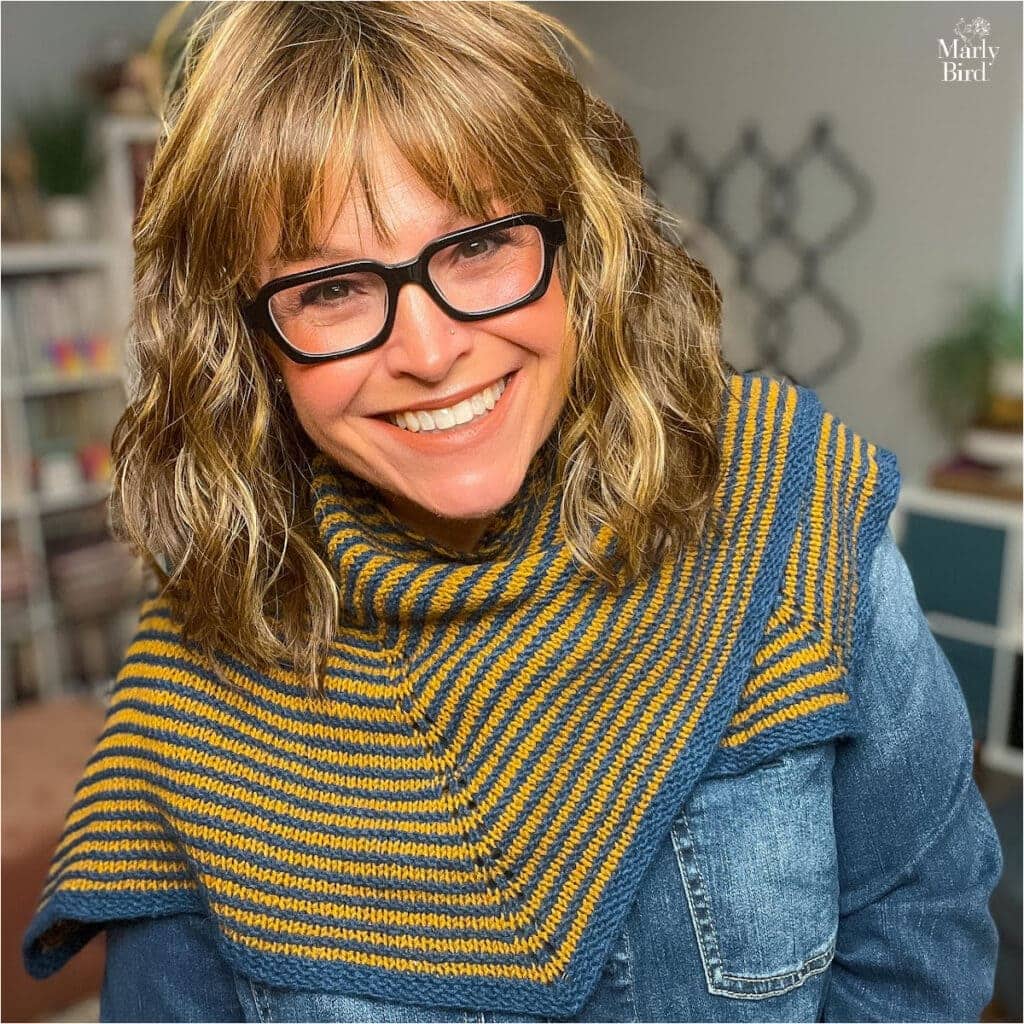
Blue and yellow striped knit shawl draped over a denim jacket, showing even stitches and soft texture. Shelves in background.
Stellar Stripes Knit Hexagon Shawl
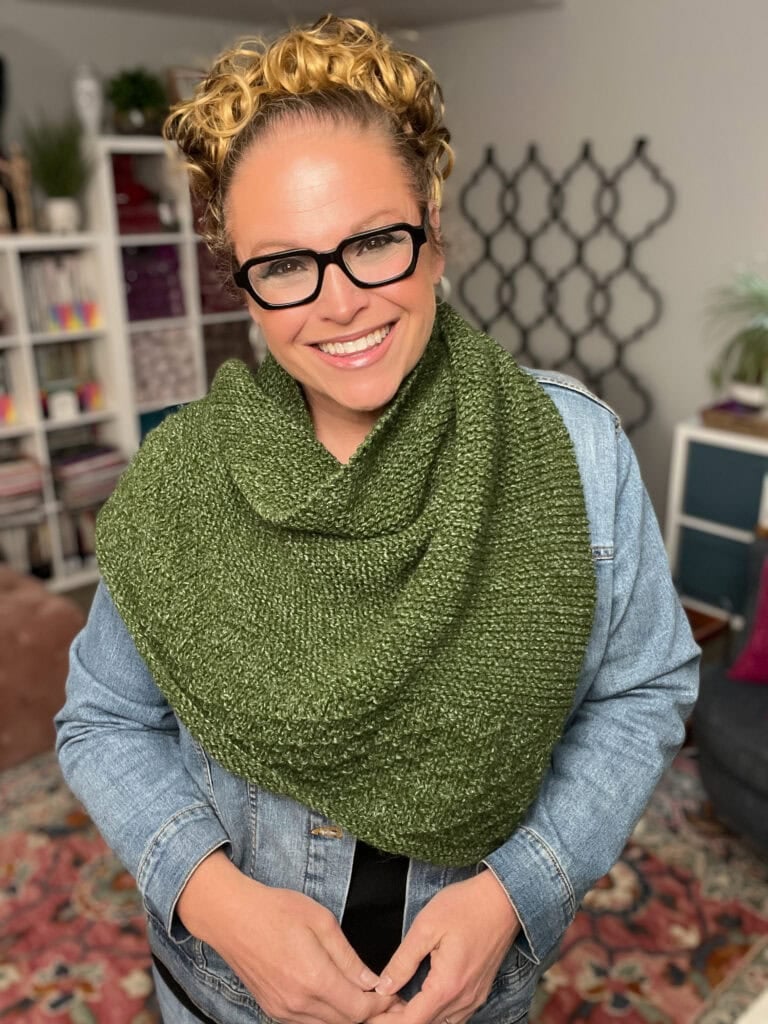
Person models a hand-knit green textured scarf indoors, with visible stitch detail; denim jacket and bookshelves behind.
Peak Serenity Knit Shawl
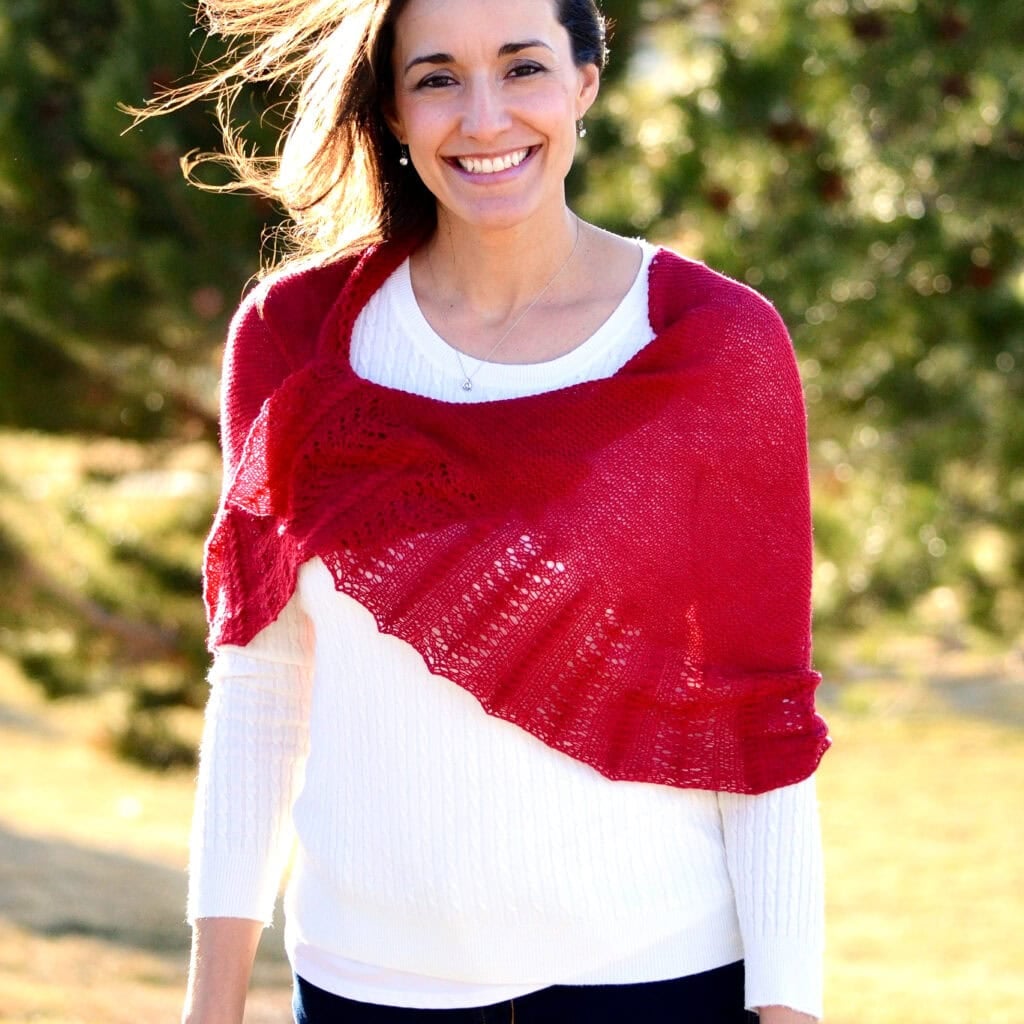
A woman models a red Outlander knit shawl with textured stitches over a white sweater, outdoors in sunlight.
Blood of My Blood Knit Shawl

💖 Favorite This Pattern on Ravelry

Add Eowyn to your queue… favorite it… and don’t forget to share your finished project so we can all admire those cables!

Favorite the Eowyn Cable Knit Shawl pattern on Ravelry - Marly Bird

🧵 More Knit Shawl Patterns You’ll Love

Looking for more inspiration? Here are a few more free knit shawl patterns that pair beautifully with Eowyn’s cable-and-texture vibe:

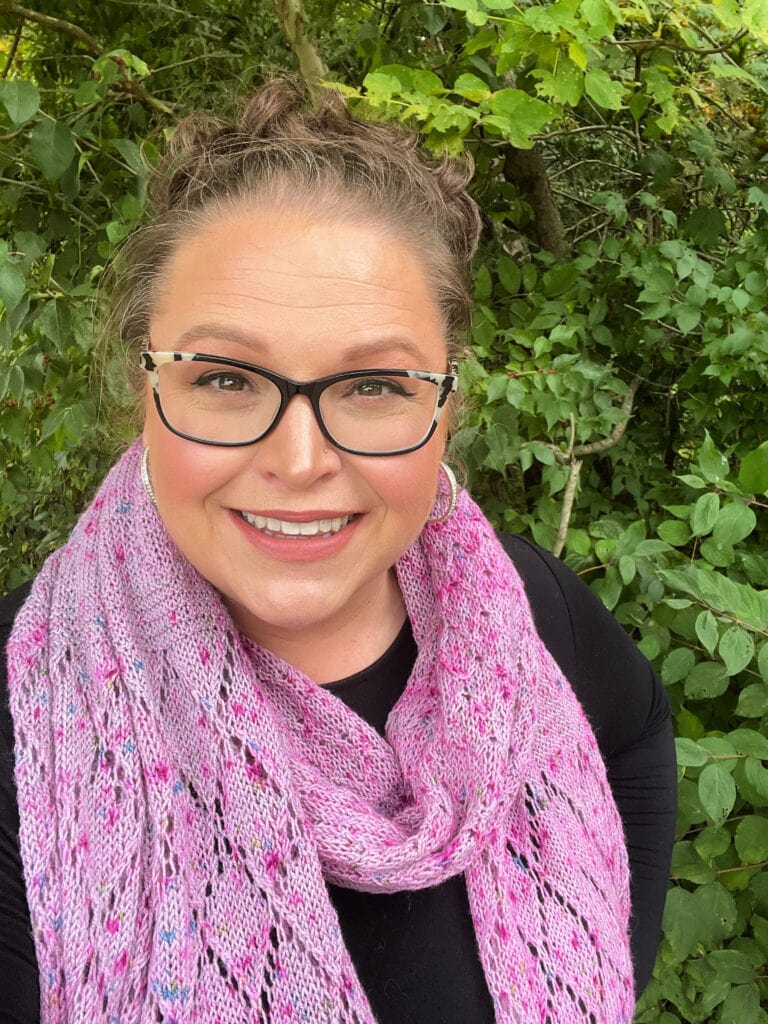
  • Return to Me Boomerang Knit Shawl … cables and lace in an asymmetrical boomerang shape.
  • Flirt Alert Triangle Shawl … another textured intermediate triangle, this time in worsted weight.
  • Knit Mosaic Triangle Shawl … a slip-stitch corner-to-corner design with bold colorwork.
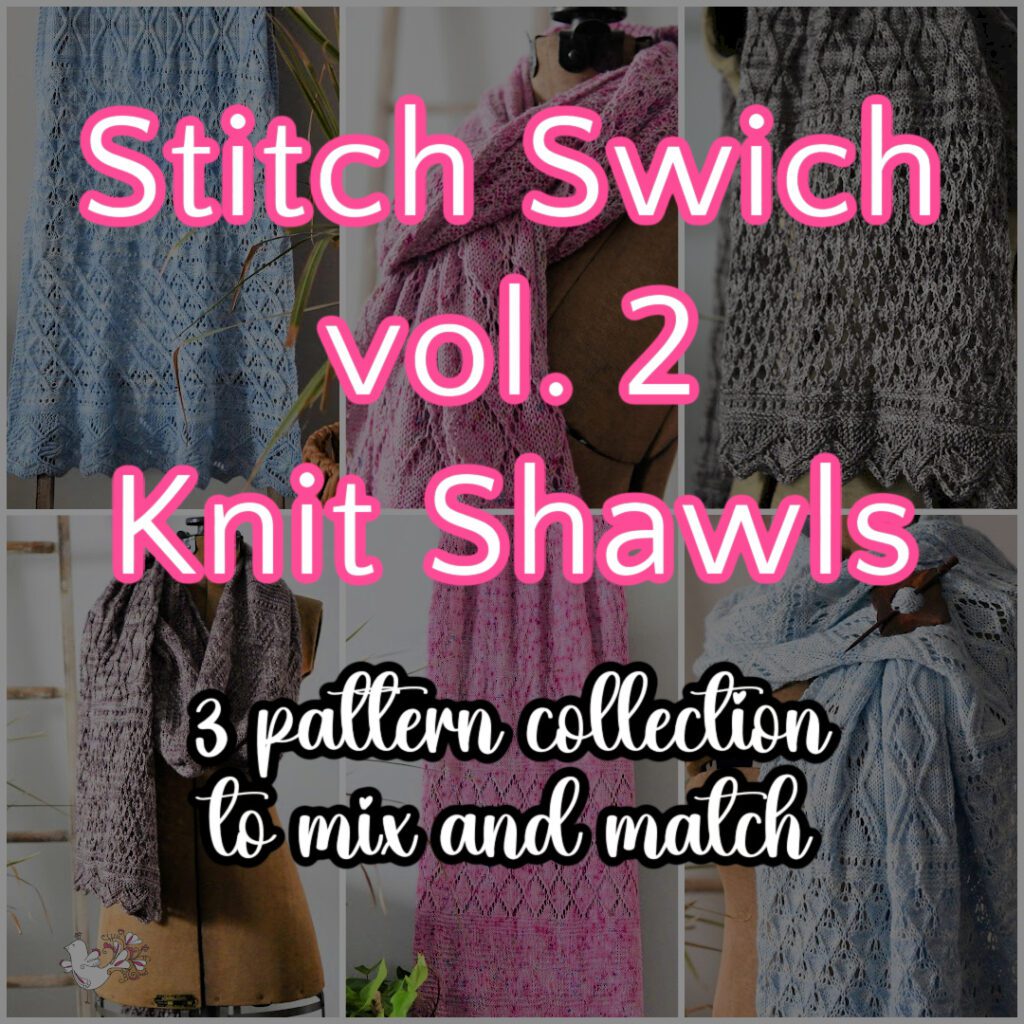
  • Stitch Switch Shawls … get a full collection of shawls that can be mix and matched to create something truly unique!
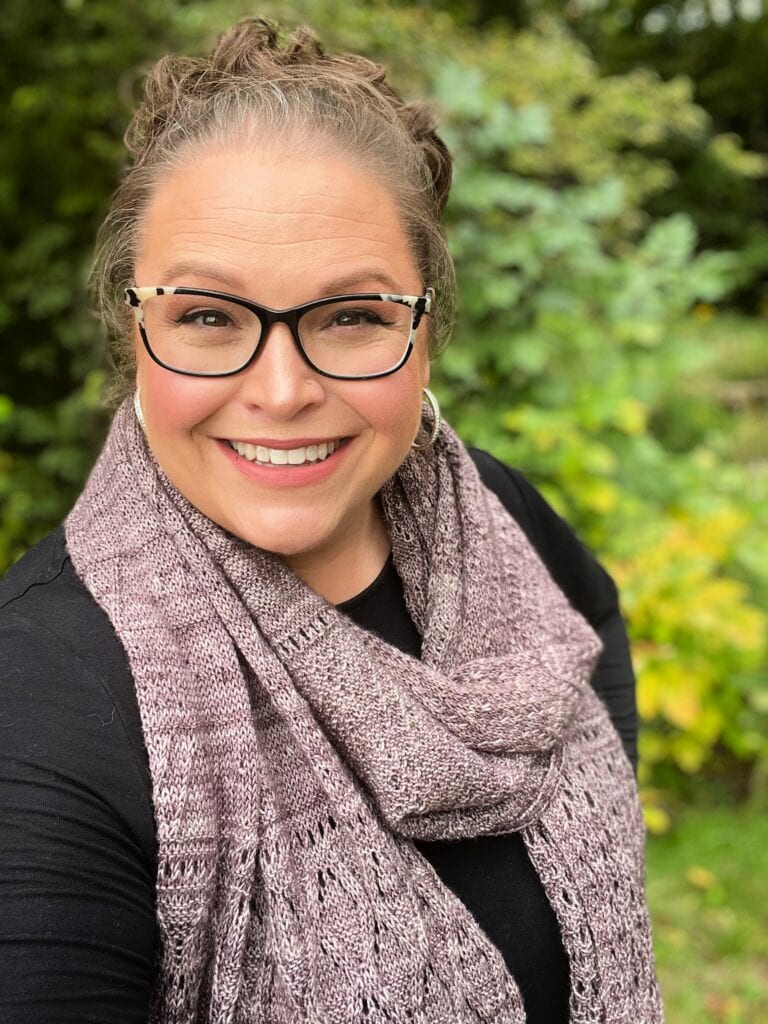
Pink slip stitch knitted scarf with visible texture, worn by a woman outdoors, highlighting stitch detail against green foliage.
Light blue knitted Triangle Shawl Pattern drapes over shoulders, highlighting textured stitches, worn indoors with soft lighting.
Woman models a knitted mosaic triangle shawl outdoors, showing off textured stitches against a lush green backdrop.
Four colorful shawls, knit and Tunisian crochet, displayed on mannequins and hangers; visible stitch texture and drape.

Marly Bird in a navy blue Eowyn cable knit shawl, with FAQ banner about the free knit shawl pattern.

❓ Frequently Asked Questions

What makes this a good free cable knit shawl pattern for intermediate knitters?

It combines simple repeats with structured cables, which makes it approachable while still challenging enough to build new skills. The Snug Cable Pattern uses just a handful of cable abbreviations (2/2 LPC, 2/2 RPC, and a couple of three-stitch crosses) and the double moss stitch is just knits and purls in a simple rotation. If you can knit, purl, and follow a written pattern, you can knit Eowyn.

Is this a true right triangle shawl knitting pattern?

Yes. The shawl increases along one edge to create a classic right triangle shape with one straight side and one diagonal side. The finished dimensions are approximately 37″ along the top edge and 50″ along the straight side, which gives you plenty of fabric to wrap, drape, or wear as a hood.

Can beginners knit this shawl?

Advanced beginners can absolutely tackle this shawl, but I’d recommend being comfortable with knit, purl, kfb increases, and reading a written stitch pattern before you cast on. If cables are brand new to you, watch the Cable Without a Cable Needle video tutorial in the Video Tutorials section first… it makes the whole process click.

What is double moss stitch and why is it used here?

Double moss stitch alternates blocks of knit and purl stitches over a four-row repeat, which creates a soft, pebbly texture. It’s used here as the perfect counterbalance to the Snug Cable Pattern… it adds visual interest without competing with the cables, and it keeps the fabric from curling at the edges.

Can I substitute the wool bamboo yarn?

Yes, and you’ll need to since Classic Elite Wool Bam Boo has been discontinued. Look for a sport weight (CYCA #2) yarn with similar drape. My top picks are Knit Picks Galileo, Berroco Ultra Alpaca Light, and HiKoo Sueno… all linked above in the Yarn Substitutes section. Always work a gauge swatch before committing to a substitute, especially with cables.

How long does it take to knit this shawl?

It depends on your knitting pace, but expect several evenings or a couple of relaxed weeks of knitting. The early rows go quickly, and the later rows are longer (more stitches) but very rhythmic once the cable pattern becomes second nature. This is the kind of project that’s beautiful to work on in the evenings with a good show.

Do I need a cable needle?

A cable needle is recommended, especially for the 2/1/2 RC and 2/1/2 LC stitches that move three stitches at a time. Experienced knitters can cable without one for the 2/2 crosses… I have a tutorial linked above in the Video Tutorials section if you want to try.

Is this shawl wearable year-round?

Yes. The bamboo content keeps it breathable for spring and summer, while the wool content adds enough warmth for fall and winter layering. It’s the kind of accessory that lives in your bag and bridges the seasons beautifully.


Eowyn cable knit shawl ad-free PDF mockup with finished navy blue textured shawl.
Etsy
Shopify
Ravelry

💛 Final Thoughts

This free cable knit shawl pattern is one of those pieces that feels timeless… textured without being overwhelming, structured without being stiff, and cozy without being bulky.

If you’ve been looking for a free triangle shawl knitting pattern that actually teaches you something while still being relaxing to knit… this is it. Cast on, take it slow, trust your stitch markers, and enjoy the rhythm of the cables.

I can’t wait to see your finished Eowyn shawl. Tag me on Instagram @themarlybird or share it in the Marly Bird Community on Facebook… I love seeing what you make.


❤️ Your BiCrafty Bestie,
Marly Bird

A cartoon avatar of a person with glasses and a brown bun smiles warmly. Their green shirt and black jacket add a stylish touch, while colorful hearts surround them like loving temperature blankets, stitching together an aura of love and positivity. -Marly Bird

Filed Under: Free Patterns, Knit Shawl Patterns, Knitting, Marly Bird Premium Patterns, Our Free Patterns, Pattern Tagged With: badge-new-pattern, cable knit shawl, cable knitting, double moss stitch, free knit pattern, free shawl pattern, intermediate knitting, knit cable pattern, knit shawl, knit triangle shawl, sport weight knit, triangle shawl, wool bamboo yarn

Free Knit Triangle Shawl Pattern (Worsted Weight) – Mariposa Textured Shawl

March 9, 2026 By Marly Bird Leave a Comment

The Mariposa Textured Triangle Shawl is a free intermediate knit triangle shawl pattern in worsted weight yarn… a top-down design with four progressive textured stitch sections, yarn-over increases that create a subtle lace spine, and a bold applied border. Worked on US 9 needles, this knit shawl is warm, wearable, and ideal for crafters ready to stretch their skills with focus and rhythm.

📝 Updated May 7, 2026: Voice and framework refresh… added an AI summary, expanded the FAQ with deeper answers + schema markup, refreshed yarn substitute notes, and tucked in the standard Marly sign-off.

Knitting a textured triangle shawl in worsted weight yarn is one of the most satisfying ways to challenge your skills while creating a warm, wearable piece. The Mariposa Shawl is a top-down intermediate knit triangle shawl pattern originally designed as the “Be Quiet, I’m Knitting” concentration level from the first Tournament of Stitches in 2018.

If you love projects that require focus, reward attention to detail, and result in a cozy, snuggle-worthy shawl you’ll actually wear… this one is for you. 🦋

Hey, bestie 💛 If you love knit shawls, you should check out my entire collection of knit shawl patterns here on my website.

This post contains affiliate links. If you purchase through one of these links I earn a small commission at no extra cost to you… and you get to support this yarn-loving heart while I keep the free patterns coming. Thank you!

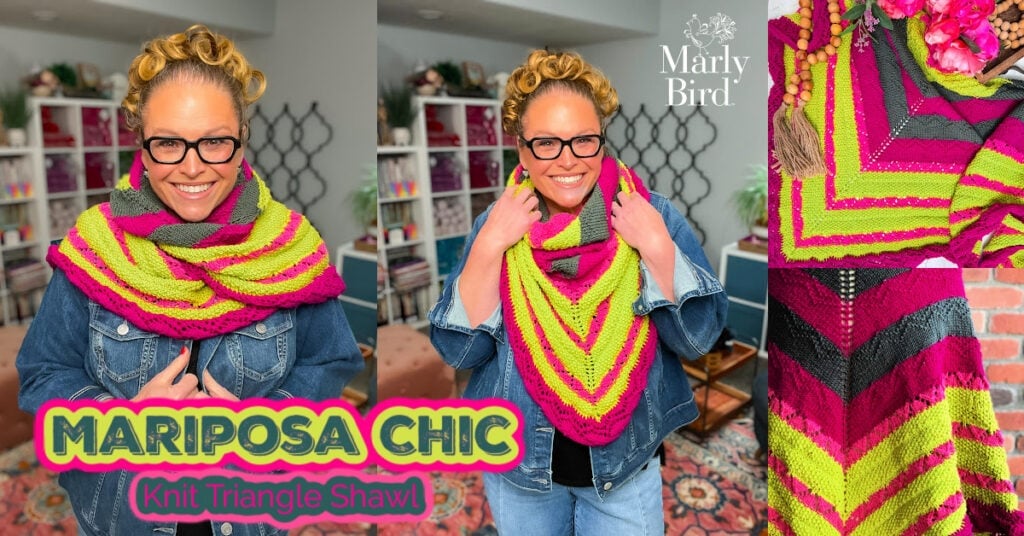
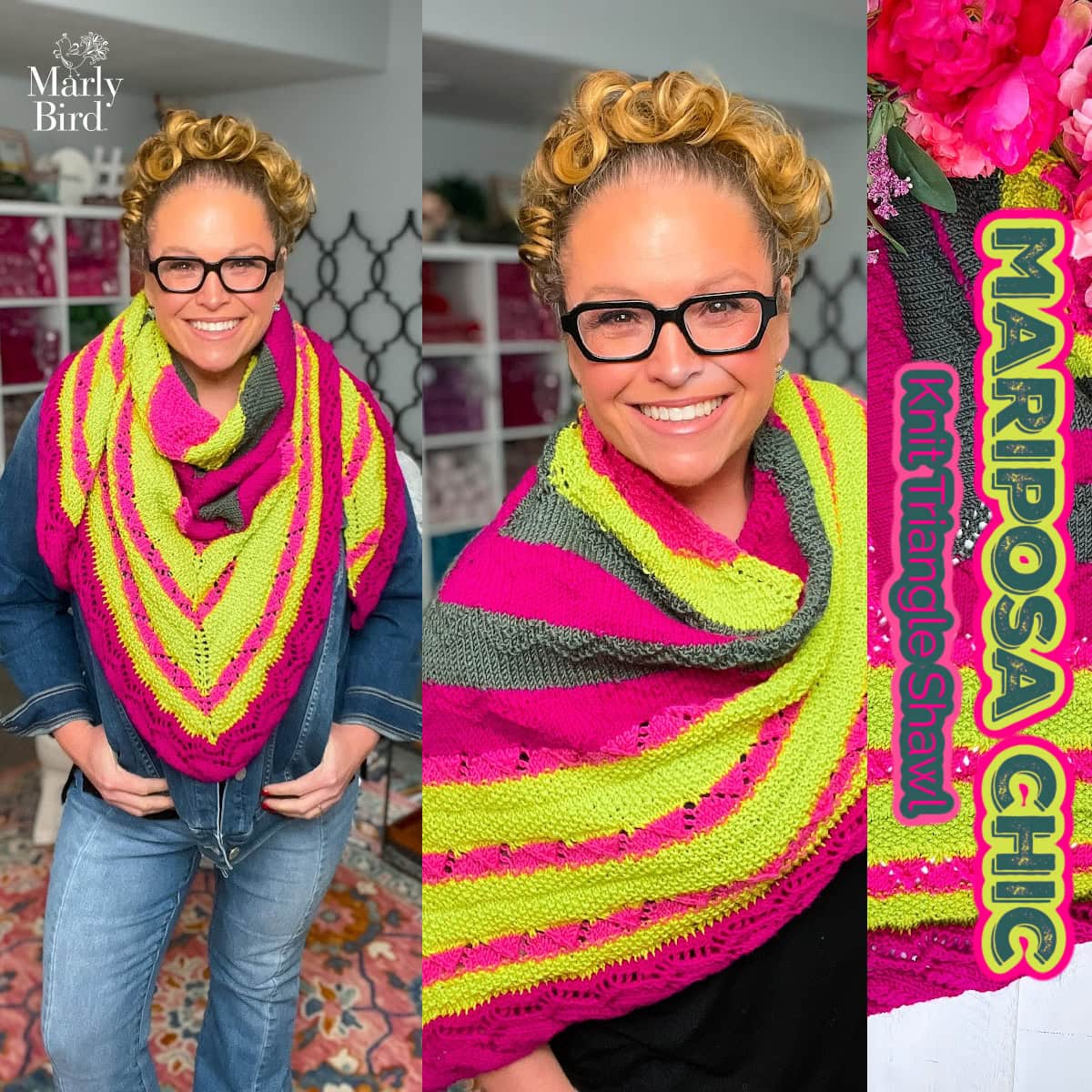
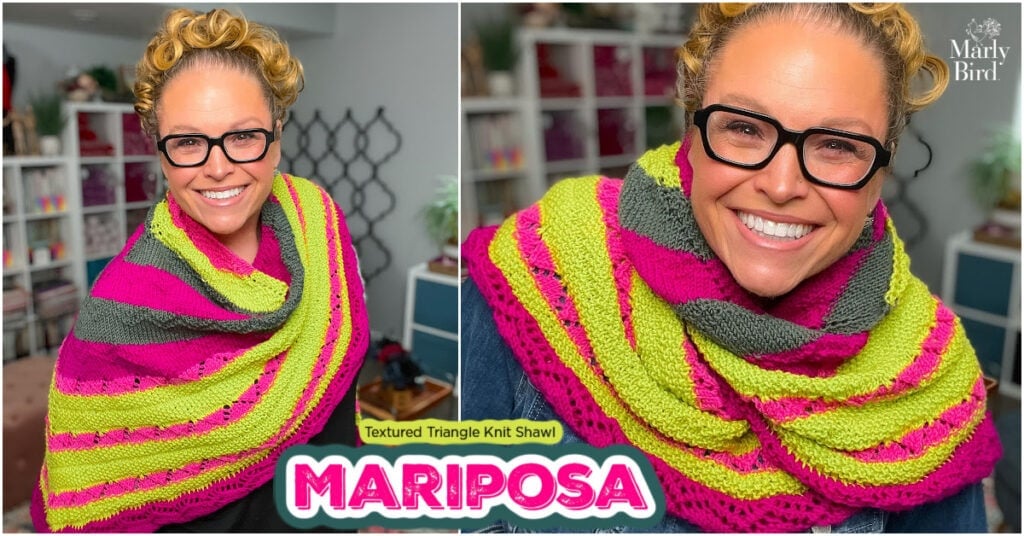
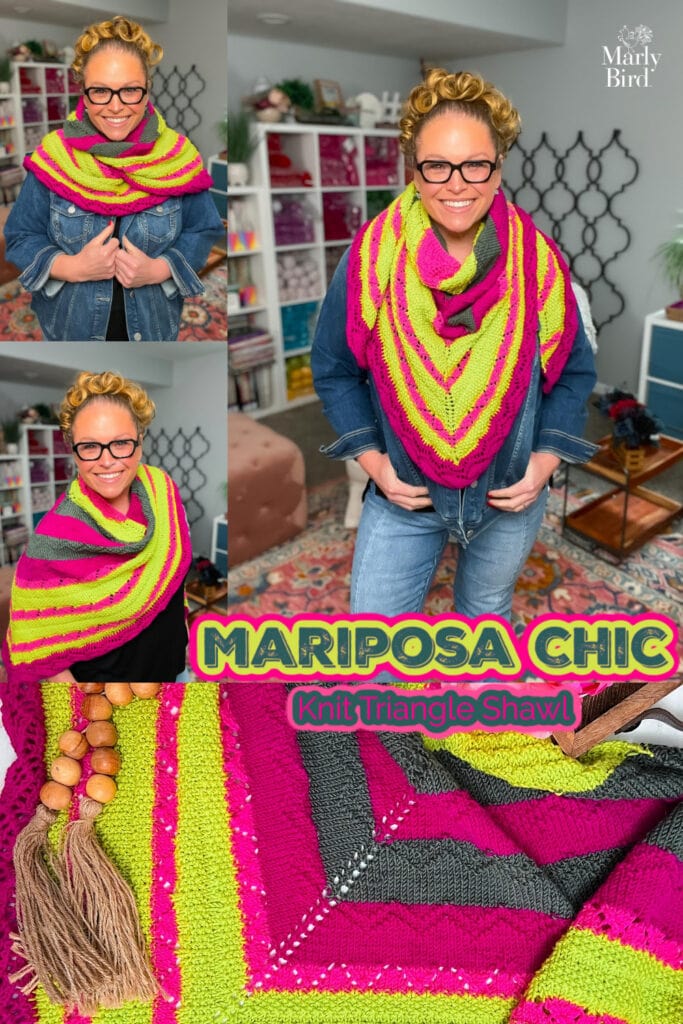
Bright knit shawl in pink, yellow, and green chevrons; worsted weight yarn. Mariposa Chic Knit Triangle Shawl.

Affiliate Disclosure: This post contains affiliate links. To learn more please visit my privacy policy here💖

What You Will Love About This Pattern 💖

  • A true top-down triangle shawl construction
  • Four progressive textured stitch sections
  • Yarn-over increases creating a subtle lace spine
  • A bold applied border worked perpendicular to the body
  • Warm, cushy worsted weight fabric
  • Customizable color possibilities
  • Designed for knitters ready to stretch their skills

✨ Designer Note: This is a “Be Quiet, I’m Knitting” project. There are moments where you’ll want to pause the movie, count carefully, and trust your stitches. And that’s part of the magic.

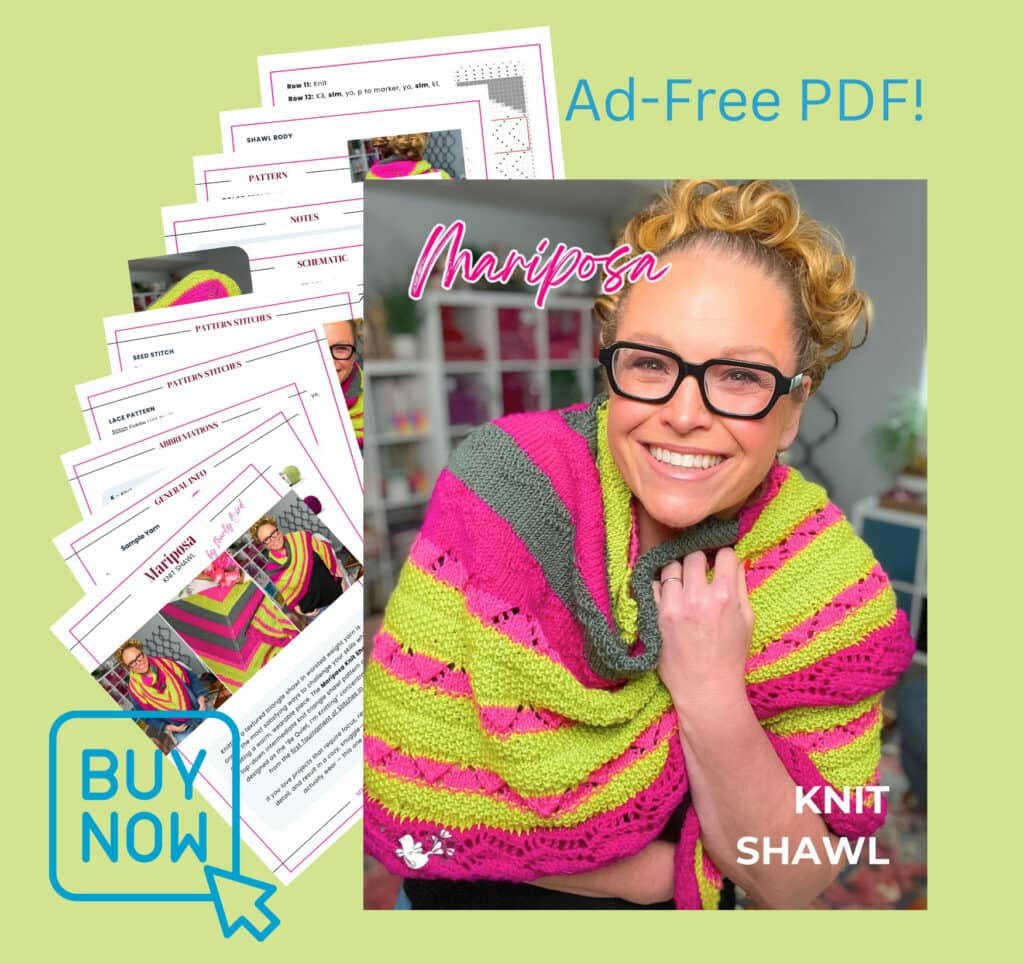
Mariposa knit shawl pattern by Marly Bird shown with colorful striped triangle shawl and ad-free PDF knitting pattern pages
Download the ad-free PDF for the Mariposa Knit Shawl knitting pattern by Marly Bird.
Etsy
Shopify
Ravelry

Marly Bird wears a colorful knit triangle shawl pattern called Mariposa Chic Knit Triangle Shawl -- free pattern with an ad-free pdf available for purchase.

Quick Pattern Overview

Skill Level: Intermediate (strong intermediate skills recommended)
Concentration Level: Be Quiet, I’m Knitting 🎧
Construction: Top-down triangle
Sections: Four distinct textured stitch patterns
Border: Applied border worked off live stitches
Yarn Weight: Worsted (#4)

Finished Size (excluding border):

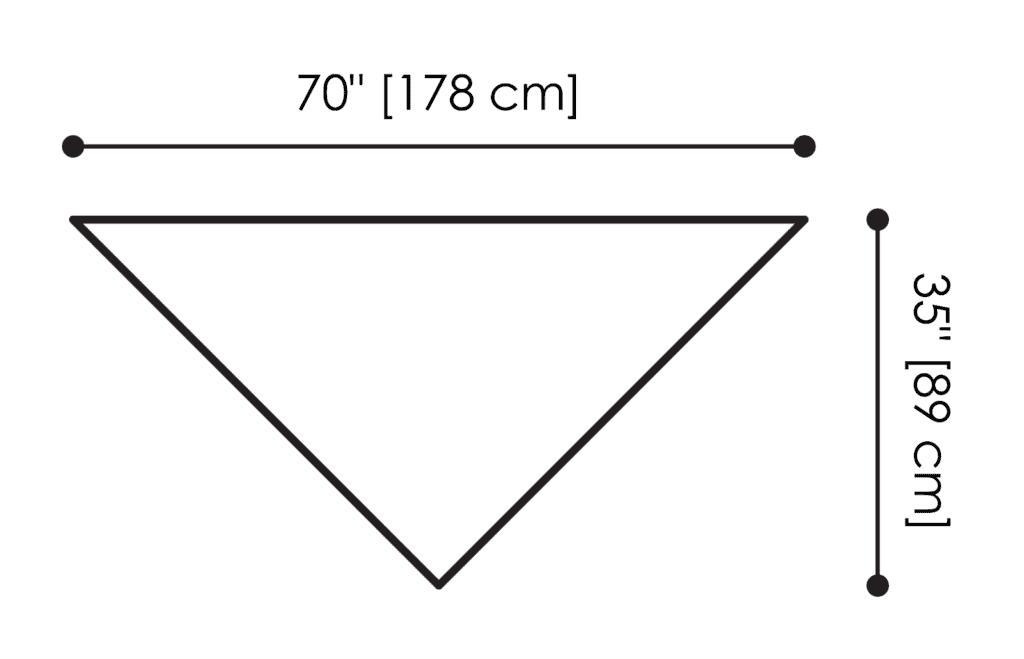
  • Wingspan: 70” (178 cm)
  • Depth: 34–35” (86–89 cm)

This is not an all-over lace shawl.
It is not garter stitch.

It is a textured knit triangle shawl combining stockinette, knit-purl texture, lace elements, shaping increases, and decreases… all working together to create something visually rich and structurally strong.


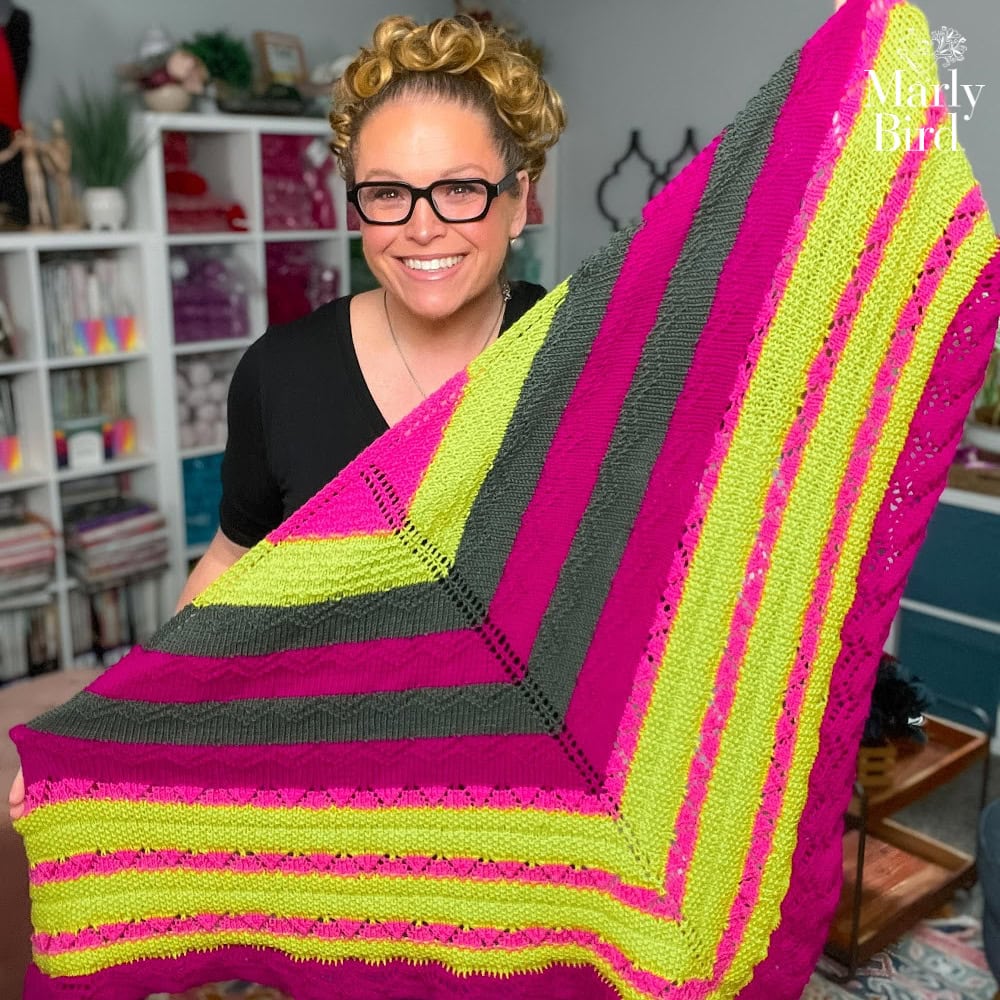
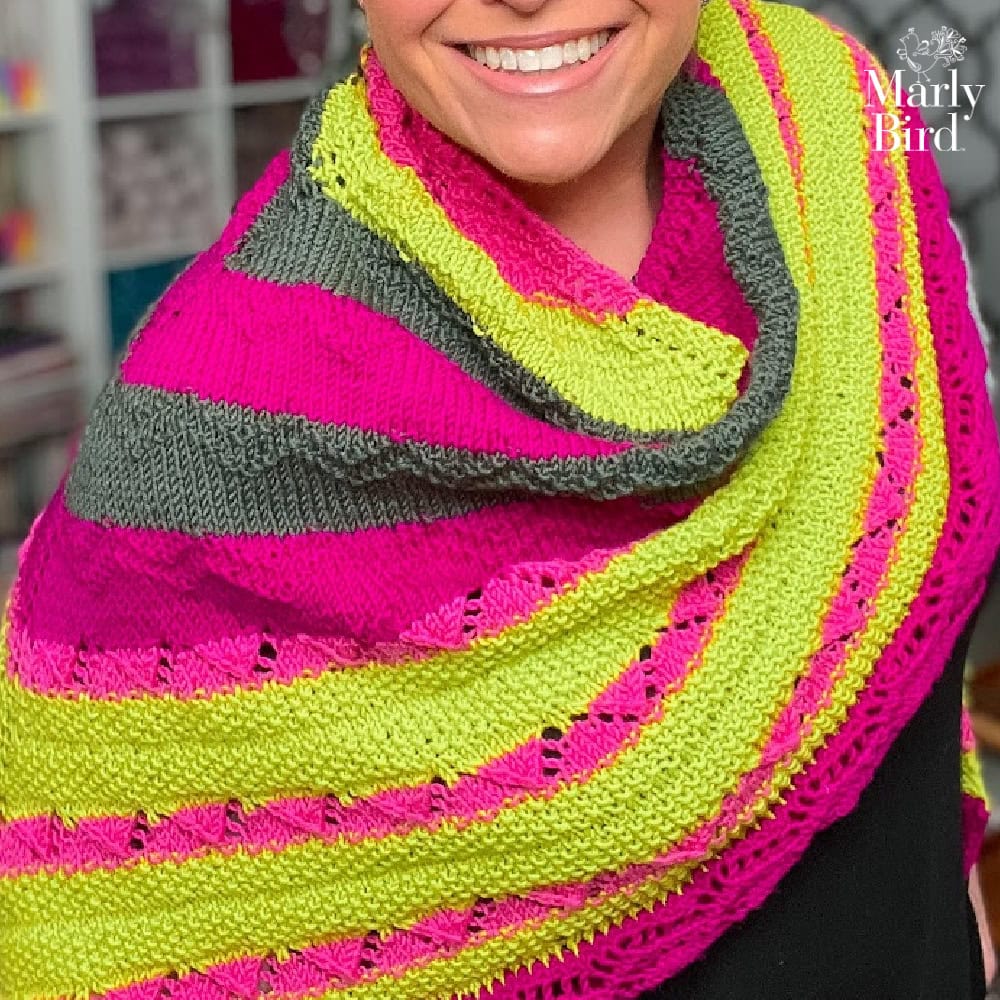
Smiling person models a knitted triangle shawl with bright pink, lime green, and gray stripes; colorful yarn shelves behind.

About This Knit Triangle Shawl

Mariposa is a true top-down triangle shawl worked from a traditional garter tab cast-on and shaped with consistent edge and center increases.

The triangular shaping remains the same throughout the body.
What changes is the internal stitch pattern.

This allows you to:

  • Build skill progressively
  • Maintain consistent shaping
  • Focus on texture without worrying about fit
  • Create dramatic wingspan with balanced proportions

If you’re curious about different shawl constructions, you may also enjoy:
👉 https://marlybird.com/blog/make-it-mine-knit-shawl/


7 Ways to Wear a Knit Shawl (Video Tutorial)

A quick knitting tutorial showing 7 different ways to wear a knit shawl using the Mari Shawl pattern by Marly Bird. This versatile knit accessory can be styled as a scarf, wrap, or layering piece. Includes a free knit shawl pattern and styling inspiration for knitters.


The Story Behind the Mariposa Shawl 🦋

Mariposa was part of the very first Tournament of Stitches in 2018.

Tournament of Stitches (TOS) is a month-long, skill-building make-along presented every two years. Participants choose their concentration level… from relaxed “Social Butterfly”, to TV knitting with “Netflix and Chill“, to soothing music for “Smooth Jazz”, and finally the ultimate focus concentration level of “Be Quiet, I’m Knitting”.

Mariposa represents the ultimate focused concentration level from that inaugural year.

Each section:

  • Maintains consistent triangle shaping
  • Introduces a different stitch pattern
  • Intentionally builds skill
  • Expands confidence
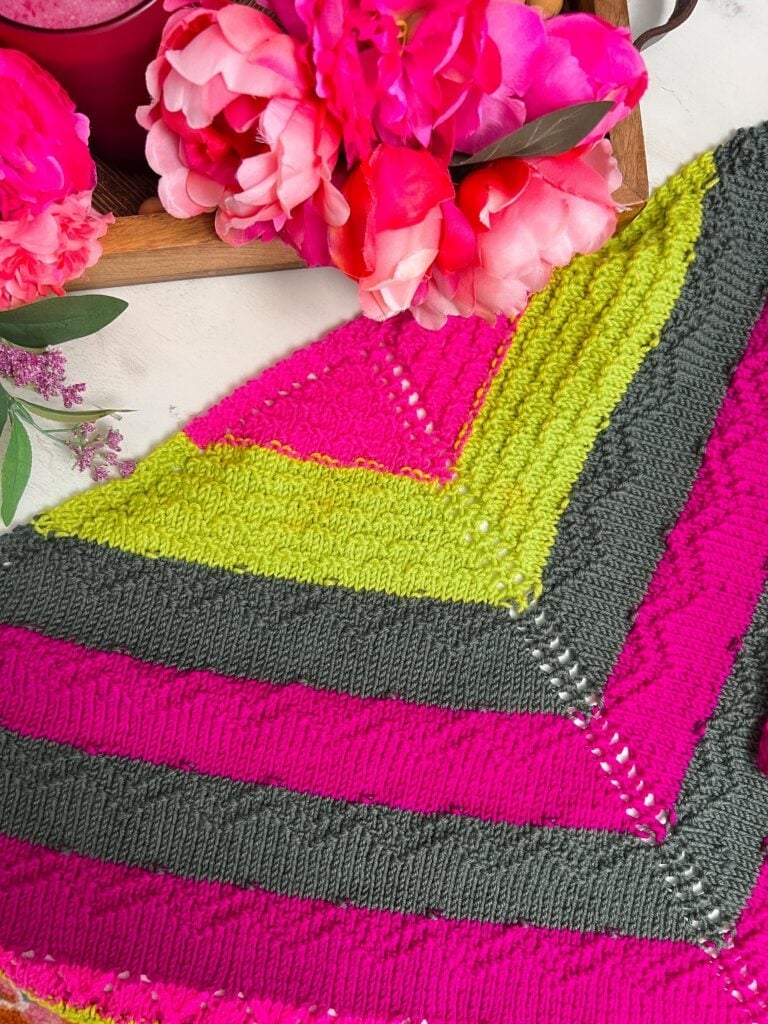
Striped shawl in pink, lime green, and gray yarn shows intricate stitch detail. Shawl is laid beside a tray of pink flowers.

The original sample was worked in a single color. Later, I explored a multi-color version… because you know I love options.

You can:

  • Knit it in one cohesive shade
  • Fade colors between sections
  • Use stash yarn creatively
  • Change colors more frequently than I did

This design was built to stretch your skills — not break your spirit.

Learn more about Tournament of Stitches here:
👉 https://marlybird.com/blog/tournament-of-stitches-mystery-make-along/


The Applied Border — Why It’s Different

The Mariposa border is worked perpendicular to the shawl body.

Instead of binding off and picking up later, you work stitches off the live shawl stitches as you knit the border.

This technique:

  • Requires attention to stitch placement
  • Requires comfort picking up and joining stitches
  • Creates a structured architectural finish
  • Elevates the final look dramatically

It isn’t complicated because it’s confusing.
It’s intermediate because it requires presence.


Worsted Weight Yarn Shawl – Too Big or Just Right?

I love knitting shawls in worsted weight yarn.

It works up faster.
It creates bold stitch definition.
It feels warm and cushy.
It becomes a true winter accessory.

This is not a delicate spring wrap.

This is a warm knit triangle shawl that wraps you up and says,
“Yes. I meant to make this dramatic.”

Too big?

Not at all.

Just right.


🧵 Yarn Details (Including Substitutions!)

Originally designed with Red Heart Chic Sheep by Marly Bird™, a 100% merino wool worsted-weight yarn.

Since Chic Sheep has been discontinued, excellent substitutes include:

• Malabrigo Rios
https://tidd.ly/49VZcW1

• Berroco Ultra Wool
https://tidd.ly/4pSjENv

• Swish Worsted
https://tidd.ly/4qL6Zxt

• Cascade 220 Superwash
https://tidd.ly/4afBG7B

• Madelinetosh Tosh Vintage
https://tidd.ly/4rgPp3P

When substituting, look for:

Strong stitch definition

Worsted weight (#4)

Merino wool or soft wool blend


🧶 Knitting Needles & Notions

Regarding the knitting needles needed for this knit shawl pattern: I suggest using longer circular knitting needles for this project to accommodate the number of stitches. It is not uncommon for triangle shawl knitters to start with a 24″ circular needle then transition to a longer 32″ circular needle when the stitches become too cramped on the previous size.

Especially when you are working with a worsted weight yarn for the shawl as it is thicker and takes up more space.

There are some shawl knitters who prefer to just begin with the longer needles an don’t mind the extra long cord length…but that does annoy others.

For that reason, I am recommending a US 9 (5.5mm) 24” [60 cm], 32″ [80 cm] circular or longer; or size to obtain accurate gauge.

As for the notions: These are items that many knitters have in their toolkit but it is important that they are listed just in case there happens to be something you don’t have. This is a list of all the notions I used to not only knit the shawl but to complete the finishing.

You can click any of the items to view what I recommend or check out my Amazon storefront and get ideas for other items.

  • Stitch markers
  • Tapestry needle 
  • Scissors
  • Tape measure
  • Notions Bag for Supplies
  • Leather tags
  • Leather rivets
  • Blocking Squares
  • Blocking Pins
  • Soaking Basin
  • Eucalan Wool Wash
⭐️ Marly Bird Amazon Storefront ⭐️

Shawl Gauge — Does It Matter?

Gauge for this knit shawl is 18 sts = 4” (10 cm) in stockinette stitch, unblocked

Because this is not a fitted garment, gauge is forgiving.

However, gauge matters if:

  • You want the exact finished size
  • You have limited yardage
  • You want border alignment to match
  • You want the same drape

Gauge is measured in stockinette stitch only.

Even though multiple stitch patterns are used, achieving gauge in stockinette ensures proportional accuracy throughout the design.

Don’t ignore gauge entirely… unless you want a tablecloth… or a bandana. 😉


Skill Expectations — Let’s Be Honest

This is not beginner-friendly.

You should feel confident with:

  • Yarn overs
  • Decreases (SSK, K2tog)
  • Reading stitch patterns
  • Counting stitches
  • Managing pattern repeats

There will be moments when distractions are not your friend.

And that’s okay.

Knitting is just sticks and string.

With patience, focus, and grace for yourself, you can absolutely knit this shawl.

Use lifelines.
Mark your repeats.
Trust your stitches.


Prefer the Ad-Free PDF?

If you prefer an uninterrupted experience, the ad-free PDF is available on:

Etsy
Shopify
Ravelry

Don’t forget to favorite this pattern on Ravelry and add it to your queue!

Favorite This Pattern on Ravelry - Marly Bird

BEFORE YOU BEGIN

This shawl requires focused counting during shaping and lace sections.

You will:

• Increase 4 stitches on designated rows
• Maintain a center stitch
• Track stitch counts carefully at section transitions
• Join the border as you go

I strongly recommend placing stitch markers exactly as instructed and inserting lifelines before major stitch pattern changes.

This is not a background-movie project. This is a “lean in and enjoy the rhythm” project.


Bright knit shawl in pink, yellow, and green chevrons; worsted weight yarn. Mariposa Chic Knit Triangle Shawl.

Join our Newsletter

Get Free Crochet & Knitting
Pattern Links & Coupons!
Hand-drawn bird with curling, detailed feathers and pink accents; cheerful pose showcases fine line and texture work.
>> Become An Insider <<
A woman with glasses and curly hair models a colorful crocheted scarf, showing textured stitches and vibrant yarn.

Mariposa Chic Knit Triangle Shawl Pattern Details

SKILL LEVEL

Strong Intermediate to Advanced

This pattern includes multiple stitch patterns, lace elements, shaping increases, and a joined border. Focus is required during shaping and lace sections.

Concentration Level
Smooth Jazz → BE QUIET I’M KNITTING 🎧


MEASUREMENTS

Finished Measurements
Wingspan: 70” [178 cm]
Depth: 34–35” [86–89 cm]

Measurements do not include border edging.
These are flexible depending on how large you block the piece.

A woman displays a knit shawl in pink, yellow, and gray stripes; textured worsted yarn. Yarn shelves appear in the background.

Gauge
18 sts = 4″ in stockinette stitch (unblocked)

Gauge taken in stockinette stitch only.

Although the shawl contains multiple stitch patterns, stockinette gauge will produce correct proportional sizing across the design.


MATERIALS

Yarn used in sample
Red Heart Chic Sheep by Marly Bird™  [Art. R170 100% Merino Wool available 3.5 oz (100 g), 186 yd (170 m) balls, CYC size 4 yarn];

  • 1 ball Fairy Tale
  • 1 ball Velvet
  • 2 balls Green Tea
  • 3 balls of Sangria
    Prefer the shawl is one color?
    • 7 balls of any one color

Needles
9 (5.5mm) 24” [60 cm] and 32″ [80 cm] circular or longer, or size to obtain gauge.

Notions

  • Stitch markers
  • Tapestry needle 
  • Scissors
  • Tape measure
  • Notions Bag for Supplies
  • Leather tags
  • Leather rivets
  • Blocking Squares
  • Blocking Pins
  • Soaking Basin
  • Eucalan Wool Wash
⭐️ Marly Bird Amazon Storefront ⭐️

ABBREVIATIONS

K – Knit

K2tog – Knit Two Together

P – Purl

Pm – Place Marker

RS – Right Side

Sk2p – Slip, Knit 2 Together, Pass (see Special Stitches)

Skp – Slip, Knit, Pass (see Special Stitches)

Slm – Slip Marker

St(s) – Stitch(es)

WS – Wrong Side

Yo – Yarn Over


SPECIAL STITCHES

⭐ Slip, Knit, Pass (Skp): Slip next stitch knitwise, knit next stitch, pass slipped stitch over knit stitch.

⭐ Slip, Knit 2 Together, Pass (Sk2p): Slip next stitch knitwise, knit next 2 stitches together, pass slipped stitch over knit stitch.


SPECIAL TECHNIQUES

Backwards Loop Cast-on Method

* Wrap yarn around left thumb from front to back and secure in palm with other fingers. Insert needle upward through strand on thumb. Slip loop from thumb onto needle, pulling yarn to tighten. Repeat from * for desired number of sts.


PATTERN STITCHES

Seed Stitch

Worked over an odd number of sts.

Row 1 (RS): K1, * p1, k1; repeat from * to end.

Row 2: Knit the purls and purl the knits.

Repeat Row 2 only for Seed st.

Seed st Chart: https://www.stitchfiddle.com/en/c/soqdhv-ap3dqx

Lace Pattern

Worked over a multiple of 8 sts plus 1.

Row 1 (RS): Knit.

Row 2: Purl.

Row 3: K1 * yo, skp, k3, k2tog, yo, k1; repeat from * to end.

Row 4: Purl.

Row 5: K1, * k1, yo, skp, k1, k2tog, yo, k2; repeat from * to end.

Row 6: Purl.

Row 7: K1, * k2, yo, sk2p, yo, k3; repeat from * to end.

Row 8: Purl.

Repeat Rows 1-8 for Lace Pattern.

Lace Pattern Chart: https://www.stitchfiddle.com/en/c/soqdhm-1s7we


SCHEMATIC 

Triangle shawl diagram showing a 70" (178 cm) wide base and 35" (89 cm) height, for knit shawl pattern planning.

CHARTS

Charts for this shawl are only available in the ad-free pdf.

Etsy
Shopify
Ravelry

Seed st Chart

Lace Pattern Chart

Section 1 Chart

Section 2 Chart

Section 3 Chart

Wavy Border Chart


VIDEO TUTORIALS

  • How to Knit the Traditional Garter Tab and Edging for a Shawl: https://youtu.be/jRsR5-W6GxU
  • How to Knit: https://youtu.be/M3brKFKg5Yc
  • How to Purl: https://youtu.be/LuDt-8jqh4g
  • How to Yarn Over Increase: https://vimeo.com/1006393234/bf73dfd688?fl=ls&fe=ec
  • Learn How to Knit Seed Stitch: https://youtu.be/fSNOUf_wSYM
  • Learn How to Fix Mistakes in Seed Stitch: https://youtu.be/x3HJZc6zjM
  • How to Knit Lace >> https://www.youtube.com/watch?v=0dmFleOAuH0 <<
  • How to Tink >> https://youtu.be/c7Gud7k4Y8k <<
  • How to Add a Lifeline: https://youtu.be/FiqYUE_aHAw
  • How to Bury Ends: https://youtu.be/8_NBGUKjO-E 
  • Wet Blocking Tips >> https://www.youtube.com/watch?v=b-0FRRfzC-c <<

CONSTRUCTION OVERVIEW

This shawl is worked:

  • Top-down
  • Beginning with a garter tab cast-on
  • Increased along both edges and center
  • Transitioning through multiple stitch pattern sections
  • Finished with a lengthwise joined lace border

NOTES 

  • Always slip stitches purlwise unless otherwise indicated.
  • Place markers as instructed, as they are critical for maintaining stitch counts.
  • Stitch count increases occur on designated rows.
  • Lifelines are highly recommended at section transitions (see Video Tutorials).
  • As stitch count grows, switch to longer circular needles for comfort.
  • Border is worked lengthwise and joined as you go.

COLOR SEQUENCE

Here is the color sequence used in the sample; feel free to use this or stripe as you wish:

Rows 1-20: Fairy Tale (A)

Rows 21-40: Green Tea (C)

Rows 41-56: Velvet (B)

Rows 57-72: Sangria (D)

Rows 73-88: Velvet (B)

Rows 89-104: Sangria (D)

Rows 105-110: Fairy Tale (A)

Rows 111-128: Green Tea (C)

Rows 129-134: Fairy Tale (A)

Rows 135-152: Green Tea (C)

Rows 153-158: Fairy Tale (A)

159-168: Green Tea (C)Wavy Border: Sangria (D)


Person models a bright pink, green, and gray knit shawl in a yarn-filled room; "Marly Bird" logo at top right.

GROW

To Unlock Exclusive Subscriber Content click the Box below and join for free by simply adding your email and creating a password! If you are having troubles, clear your cache or reset your password or login to the Grow Publisher Portal.

>> Learn More About Grow Here <<

I’m thrilled to share this amazing pattern with you, many patterns on my blog are absolutely free! I kindly request that you don’t copy and paste or distribute this pattern. Prefer an ad-free experience? Buy a digital PDF pattern for a small fee from one of my online stores for a seamless crafting journey. 

I appreciate your support and readership. You are the reason I can keep doing what I love and sharing it with others. So, thank you from the bottom of my yarn-loving heart! Disclosure: This post contains affiliate links, meaning I get a commission if you decide to make a purchase through my links at no cost to you.
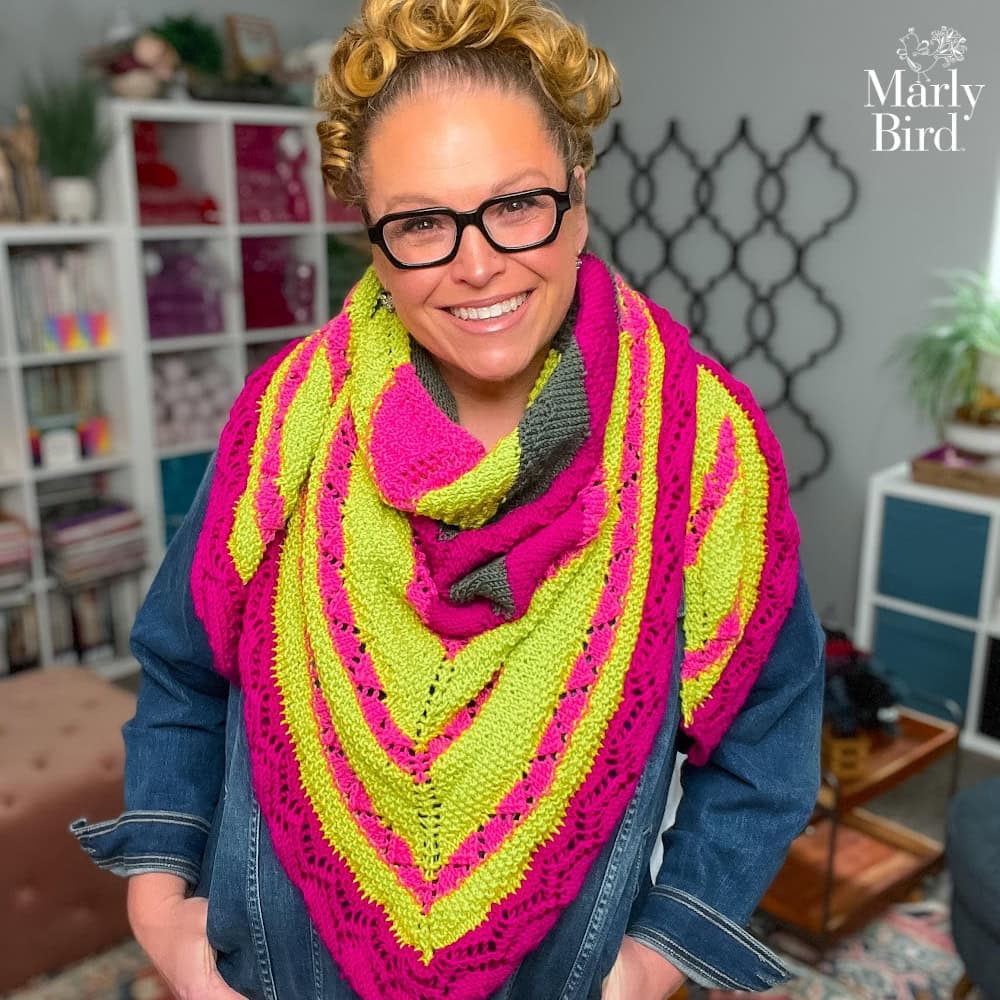
Bright, striped triangle shawl in neon pink, yellow, and green worsted yarn displayed on a smiling woman with glasses.

MARIPOSA CHIC KNIT TRIANGLE SHAWL PATTERN

BEGINNING TAB

Using Fairy Tale (A), cast on 3 sts, and knit 7 rows.

Turn work 90 degrees, pick up 3 sts along side edge, turn work 90 degrees, pick up 3 sts across cast on edge.

Count: 9 sts.

SHAWL BODY – SECTION 1: SETUP

Section 1

Row 1 (RS): Knit.

Row 2 (increase row, WS): K3, pm, yo, p1, yo, pm, k1, pm, yo, p1, yo, pm, k3.

Count: 13 sts (+4 sts)

Row 3: Knit.

Row 4: K3, slm yo, p to marker, yo, slm, k1, slm, yo, p to marker, yo, slm, k3.
Count: 17 sts (+4 sts)

Row 5: K3, slm, k1, p3, k1, slm, k1, slm, k1, p3, k1, slm, k3.

Row 6: K3, slm, yo, p1, k3, p1, yo, slm, k1, slm, yo, p1, k3, p1, yo, slm, k3.
Count: 21 sts (+4 sts)

Row 7: Knit

Row 8: K3, slm, yo, p to marker, yo, slm, k1, slm, yo, p to marker, yo, slm, k3.
Count: 25 sts (+4 sts)

Row 9: K3, slm, k1, * p3, k1; repeat from * to marker, slm, k1, slm, k1, * p3, k1; repeat from * to marker, slm, k3.

Row 10: K3, slm yo, p1, * k3, p1; repeat from * to marker, yo, slm, k1, slm, yo, p1, * k3, p1; repeat from * to marker, yo, slm, k3.
Count: 29 sts (+4 sts)

Row 11: Knit

Row 12: K3, slm, yo, p to marker, yo, slm, k1, slm, yo, p to marker, yo, slm, k3.
Count: 33 sts (+4 sts)

Rows 13-40: Repeat Rows 9-12 only 7 more times, changing to Green Tea (C) after Row 20.
Count: 89 sts (+56 sts)

SECTION 2: TEXTURE

Section 2

Note: It is highly recommended to place a lifeline (see Video Tutorials) before beginning the next section.

Change to Velvet (B).

Row 41: K3, slm, * p1, k7; repeat from * to 1 st before marker, p1, slm, k1, slm, * p1, k7; repeat from * to 1 st before marker, p1, slm, k3. 

Row 42 (increase row, WS): K3, slm, yo, p1, * k1, p5, k1, p1; repeat from * to marker, yo, slm, k1, slm, yo, p1, * k1, p5, k1, p1; repeat from * to marker, yo, slm, k3.
Count: 93 sts (+4 sts)

Row 43: K3, slm, k1, * k2, p1, k3, p1, k1; repeat from * to 2 sts before marker, k2, slm, k1, slm, k1, * k2, p1, k3, p1, k1; repeat from * to 2 sts before marker, k2, slm, k3. 

Row 44: K3, slm, yo, p2, * p2, k1, p1, k1, p3; repeat from * to 1 st before marker, p1, yo, slm, k1, slm, yo, p2, * p2, k1, p1, k1, p3; repeat from * to 1 st before marker, p1, yo, slm, k3.
Count: 97 sts (+4 sts)

Row 45: K3, slm, k2, * [p1, k3] twice; repeat from * to 3 sts before marker, p1, k2, slm, k1, slm, k2, * [p1, k3] twice; repeat from * to 3 sts before marker, p1, k2, slm, k3. 

Row 46: K3, slm, yo, p3, * k1, p5, k1, p1; repeat from * to 2 sts before marker, p2, yo, slm, k1, slm, yo, p3, * k1, p5, k1, p1; repeat from * to 2 sts before marker, p2, yo, slm, k3.
Count: 101 sts (+4 sts)

Row 47: K3, slm, k3, * k2, p1, k3, p1, k1; repeat from * to 4 sts before marker, k4, slm, k1, slm, k3, * k2, p1, k3, p1, k1; repeat from * to 4 sts before marker, k4, slm,  k3.

Row 48: K3, slm, yo, p4, * p2, k1, p1, k1, p3; repeat from * to 3 sts before marker, p3, yo, slm, k1, slm, yo, p4, * p2, k1, p1, k1, p3; repeat from * to 3 sts before marker, p3, yo, slm, k3.
Count: 105 sts (+4 sts)

Row 49: K3, slm, k4, * k4, p1, k3; repeat from * to 5 sts before marker, k5, slm, k1, slm, k4, * k4, p1, k3; repeat from * to 5 sts before marker, k5, slm, k3.

Row 50: K3, slm, yo, p to marker, yo, slm, k1, slm, yo, p to marker, yo, slm, k3.
Count: 109 sts (+4 sts)

Row 51: K3, slm, k to marker, slm, k1, slm, k to marker, slm, k3. 

Row 52: K3, slm, yo, p to marker, yo, slm, k1, slm, yo, p to marker, yo, slm, k3.
Count: 113 sts (+4 sts)

Row 53: K3, slm, k to marker, slm, k1, slm, k to marker, slm, k3.

Row 54: K3, slm, yo, p to marker, yo, slm, k1, slm, yo, p to marker, yo, slm, k3.
Count: 117 sts (+4 sts)

Row 55: K3, slm, k to marker, slm, k1, slm, k to marker, slm, k3.

Row 56: K3, slm, yo, p to marker, yo, slm, k1, slm, yo, p to marker, yo, slm, k3.
Count: 121 sts (+4 sts)

Change to Sangria (D).

Rows 57-102: Repeat Rows 41-56 twice more, then repeat Rows 41-54 only once more.

Be sure to change to Velvet (B) after Row 72, and back to Sangria (D) after Row 88.
Count: 213 sts (+92 sts)

Etsy
Shopify
Ravelry

SECTION 3: LACE AND SEED

Section 3

Row 103 (RS): Knit.

Row 104 (increase row, WS): K3, slm, yo, p to marker, yo, slm, k1, slm, yo, p to marker, yo, slm, k3.
Count: 217 sts (+4 sts)

Change to Fairy Tale (A).

Row 105 (establish Lace Pattern, RS): K3, slm, k1, * yo, skp, k3, k2tog, yo, k1; repeat from * to marker, slm, k1, slm, k1, * yo, skp, k3, k2tog, yo, k1; repeat from * to marker, slm, k3.

Row 106 (increase row, WS): K3, slm, yo, p to marker, yo, slm, k1, slm, yo, p to marker, yo, slm, k3.
Count: 221 sts (+4 sts)

Row 107 (RS): K3, slm, k1, * k2, yo, skp, k1, k2tog, yo, k1; repeat from * to 2 sts before marker, k2, slm, k1, slm, k1, * k2, yo, skp, k1, k2tog, yo, k1; repeat from * to 2 sts before marker, k2, slm, k3.

Row 108 (increase row, WS): K3, slm, yo, p to marker, yo, slm, k1, slm, yo, p to marker, yo, slm, k3.
Count: 225 sts (+4 sts)

Row 109 (RS): K3, slm, k2 * k3, yo, sk2p, yo, k2; repeat from * to last 3 sts before marker, k3, slm, k1, slm, k2 * k3, yo, sk2p, yo, k2; repeat from * to last 3 sts before marker, k3, slm, k3. 

Row 110 (increase row, WS): K3, slm, yo, p to marker, yo, slm, k1, slm, yo, p to marker, yo, slm, k3.
Count: 229 sts (+4 sts)

Change to Green Tea (C).

Row 111 (establish Seed st, RS): K3, slm, * k1, p1; repeat from * to 1 st before marker, k1, slm, k1, slm, * k1, p1; repeat from * to 1 st before marker k1, slm, k3. 

Row 112 (increase row, WS): K3, slm, yo, work in established Seed st (purl the knits and knit the purls) to marker, yo, slm, k1, slm, yo, work in established Seed st to marker, yo, slm, k3.
Count: 233 sts (+4 sts)

Rows 113 (RS): K3, slm, k1, work in established Seed st to 1 st before marker, k1, slm, k1, slm, k1, work in established Seed st to 1 st before marker, k1, slm, k3.

Rows 114 (increase row, WS): K3, slm, yo, p1, work in established Seed st to 1 st before marker, p1, yo, slm, k1, slm, yo, p1, work in established Seed st to 1 st before marker, p1, yo, slm, k3.
Count: 237 sts (+4 sts)

Row 115 (RS): K3, slm, work in established Seed st to marker, slm, k1, slm, work in established Seed st to marker, slm, k3.

Row 116 (increase row, WS): K3, slm, yo, work in established Seed st to marker, yo, slm, k1, slm, yo, work in established Seed st to marker, yo, slm, k3.

Count: 241 sts (+4 sts)

Row 117 (RS): Knit.

Row 118 (incerase row, WS): K3, slm, yo, p to marker, yo, slm, k1, slm, yo, p to marker, yo, slm, k3.

Count: 245 sts (+4 sts)

Row 119 (RS): K3, slm, work in established Seed st to marker, slm, k1, slm, work in established Seed st to marker, slm, k3.

Row 120 (increase row, WS): K3, slm, yo, work in established Seed st to marker, yo, slm, k1, slm, yo, work in established Seed st to marker, yo, slm, k3.

Count: 249 sts (+4 sts)

Rows 121 (RS): K3, slm, k1, work in established Seed st to 1 st before marker, k1, slm, k1, slm, k1, work in established Seed st to 1 st before marker, k1, slm, k3.

Rows 122 (increase row, WS): K3, slm, yo, p1, work in established Seed st to 1 st before marker, p1, yo, slm, k1, slm, yo, p1, work in established Seed st to 1 st before marker, p1, yo, slm, k3.

Count: 253 sts (+4 sts)

Row 123 (RS): K3, slm, work in established Seed st to marker, slm, k1, slm, work in established Seed st to marker, slm, k3.

Row 124 (increase row, WS): K3, slm, yo, work in established Seed st to marker, yo, slm, k1, slm, yo, work in established Seed st to marker, yo, slm, k3.

Count: 257 sts (+4 sts)

Rows 125 (RS): K3, slm, k1, work in established Seed st to 1 st before marker, k1, slm, k1, slm, k1, work in established Seed st to 1 st before marker, k1, slm, k3.

Row 126 (incerase row, WS): K3, slm, yo, p to marker, yo, slm, k1, slm, yo, p to marker, yo, slm, k3.

Count: 261 sts (+16 sts)

Rows 127-165: Repeat Rows 103-126 once more, then repeat Rows 103-117 only once more.

Be sure to change to Fairy Tale (A) after Row 128, then to Green Tea (C) after Row 134, then back to Fairy Tale (A) after Row 152, then back to Green Tea (C) after Row 158.

Count: 337 sts (+76 sts)

Continue with Green Tea.

Work 3 final rows in Stockinette st while continuing to increase as follows:

Row 166 (increase row, WS): K3, slm, yo, p to marker, yo, slm, k1, slm, yo, p to marker, yo, slm, k3.
Count: 341 sts (+4 sts)

Row 167 (RS): Knit.

Row 168 (increase row, WS): K3, slm, yo, p to marker, yo, slm, k1, slm, yo, p to marker, yo, slm, k3.
Count: 345 sts (+4 sts)

Etsy
Shopify
Ravelry

WAVY BORDER

Wavy Border is worked lengthwise over 13 sts and joined to the Shawl Body as you go using decreases. 

Wavy Border

Change to Sangria (D).

Cast on 13 additional sts using Backwards-Loop cast-on method (see Special Techniques).

Count: 13 edge sts

Count: 345 body sts

Row 1 (joining row, RS): K12, k2tog (1 st from cast on, 1 st from Shawl Body), turn work.

Count: 13 edge sts

Count: 344 body sts (-1 st)

Row 2 (WS): K2, p to last 2 sts, k2. 

Row 3 (joining row, RS): K12, k2tog, turn work.

Count: 13 edge sts

Count: 343 body sts (-1 st)

Row 4 (WS): K2, p to last 2 sts, k2. 

Row 5 (joining row, RS): K4, yo, k5, yo, k2tog, yo, k1, k2tog, turn work.

Count: 15 edge sts (+2 sts)

Count: 342 body sts (-1 st)

Row 6 (WS): K2, p to last 2 sts, k2. 

Row 7 (joining row, RS): K5, sk2p, k2, [yo, k2tog] twice, k2tog, turn work.

Count: 13 edge sts (-2 sts)

Count: 341 body sts (-1 st)

Row 8 (WS): K2, p to last 2 sts, k2. 

Row 9 (joining row, RS): K4, skp, k2, [yo, k2tog] twice, k2tog, turn work. 

Count: 12 edge sts (-1 st)

Count: 340 body sts (-1 st)

Row 10 (WS): K2, p to last 2 sts, k2. 

Row 11 (joining row, RS): K3, skp, k2, [yo, k2tog] twice, k2tog, turn work. 

Count: 11 edge sts (-1 st)

Count: 339 body sts (-1 st)

Row 12 (WS): K2, p to last 2 sts, k2. 

Row 13 (joining row, RS): K2, skp, k2, [yo, k2tog] twice, k2tog, turn work. 

Count: 10 edge sts (-1 st)

Count: 338 body sts (-1 st)

Row 14 (WS): K2, p to last 2 sts, k2. 

Row 15 (joining row, RS): K1, skp, k2, yo, k1, yo, k2tog, yo, k1, k2tog, turn work.
Count: 11 edge sts (+1 st)

Count: 337 body sts (-1 st)

Row 16 (WS): K2, p to last 2 sts, k2. 

Row 17 (joining row, RS): K4, yo, k3, yo, k2tog, yo, k1, k2tog, turn work.

Count: 13 edge sts (+2 st)

Count: 336 body sts (-1 st)

Repeat Rows 4-17 only until all Shawl Body sts have been worked into the edging.

Bind off all remaining sts. 

FINISHING

Weave in all loose ends.

Wash and Block

Person models a vibrant knit shawl in pink, yellow, and gray worsted yarn over denim; bookshelves and yarn in background.
Etsy
Shopify
Ravelry

🧼 How to Block Your Knit Triangle Shawl

Blocking transforms this shawl from “fresh off the needles” into a beautifully shaped triangle with crisp stitch definition and smooth drape.

Since this pattern uses a superwash merino wool, I recommend wet blocking rather than aggressive steam blocking. Superwash fibers respond beautifully to soaking and careful shaping.

Here’s how:

  1. Soak your shawl in lukewarm water with a wool wash for 15–20 minutes.
  2. Gently squeeze out excess water — do not wring.
  3. Roll in a towel to remove additional moisture.
  4. Lay flat and shape into a clean triangle.
  5. Pin the edges and border evenly to open up the lace and seed stitch sections.
  6. Allow to dry completely before unpinning.

Blocking helps:

  • Even out stitches
  • Define the lace motifs
  • Relax the seed stitch texture
  • Improve overall drape

If you’re unsure which method to use, read my full guide:
👉 Blocking Made Easy with Tools

And if you’re working specifically with superwash yarn, this comparison may help:
👉 Steam Blocking vs Wet Blocking for Superwash Yarn

⭐️ Must Have Blocking Supplies ⭐️

🧵 Styling Your Triangle Shawl

One of my favorite things about triangle shawls is versatility:

  • Wear it wrapped around your shoulders for warmth.
  • Style it bandana-style for modern flair.
  • Drape it loosely over a jacket for texture contrast.
  • Use bold colors to elevate a neutral outfit.

This shape works year-round depending on fiber choice.

Woman models a knit shawl with pink, lime green, and gray stripes; textured stitches; “Marly Bird” logo in corner.
Person models a vibrant knit shawl in pink, yellow, and gray worsted yarn over denim; bookshelves and yarn in background.
Person models a bright pink, green, and gray knit shawl in a yarn-filled room; "Marly Bird" logo at top right.
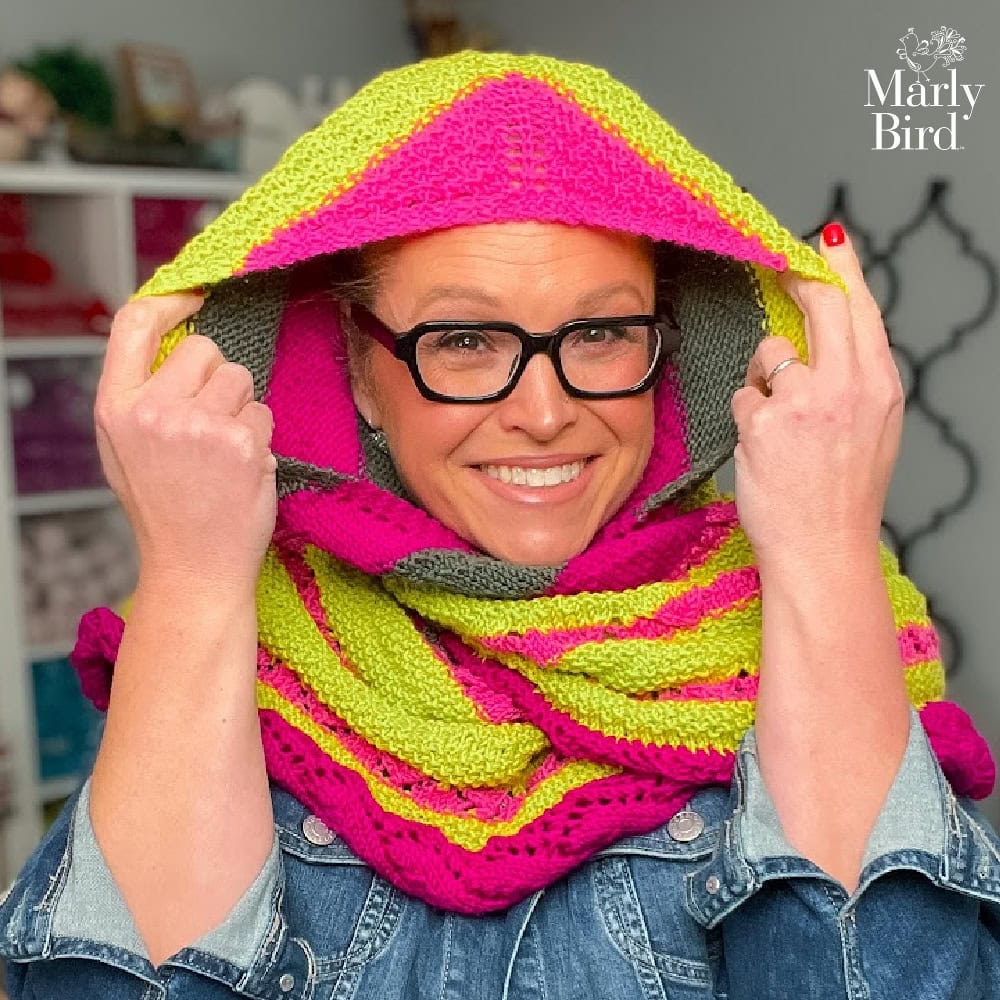
Person wearing a pink and yellow knitted hooded cowl, holding up the hood; yarn shelves in background, Marly Bird logo visible.
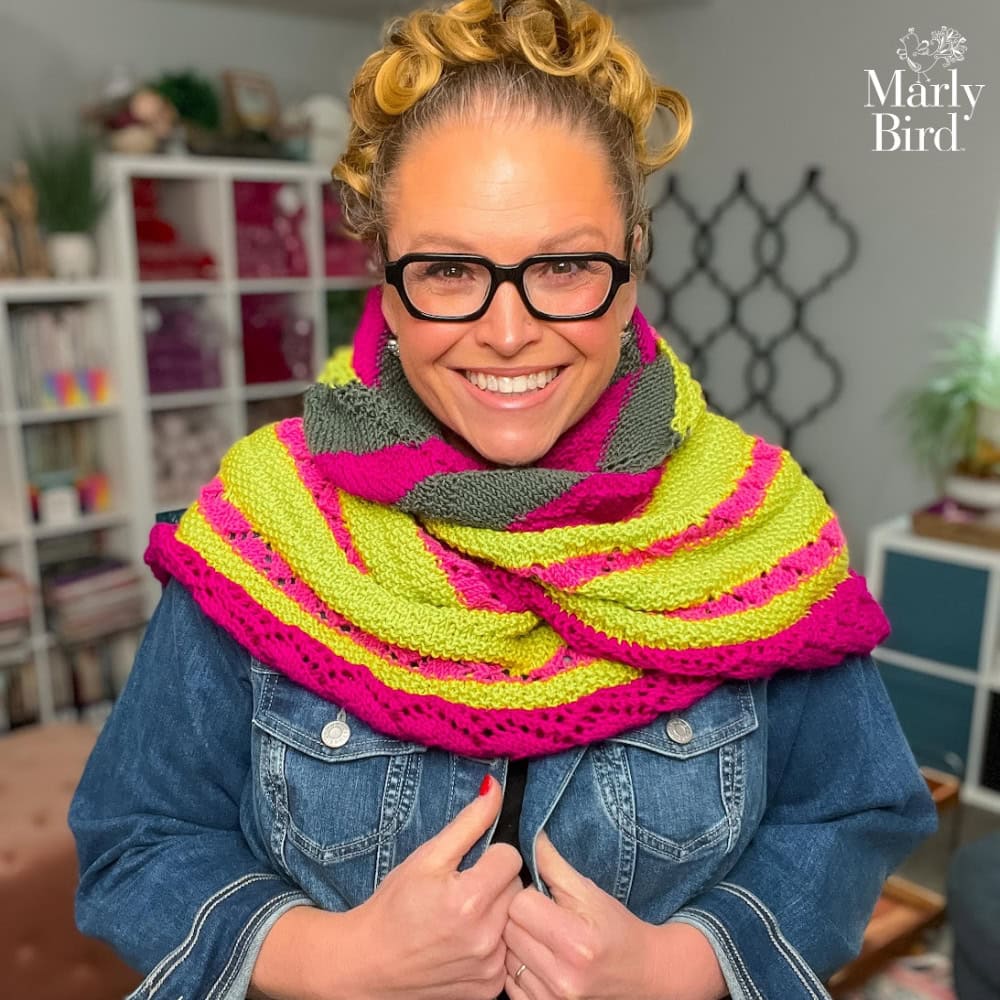
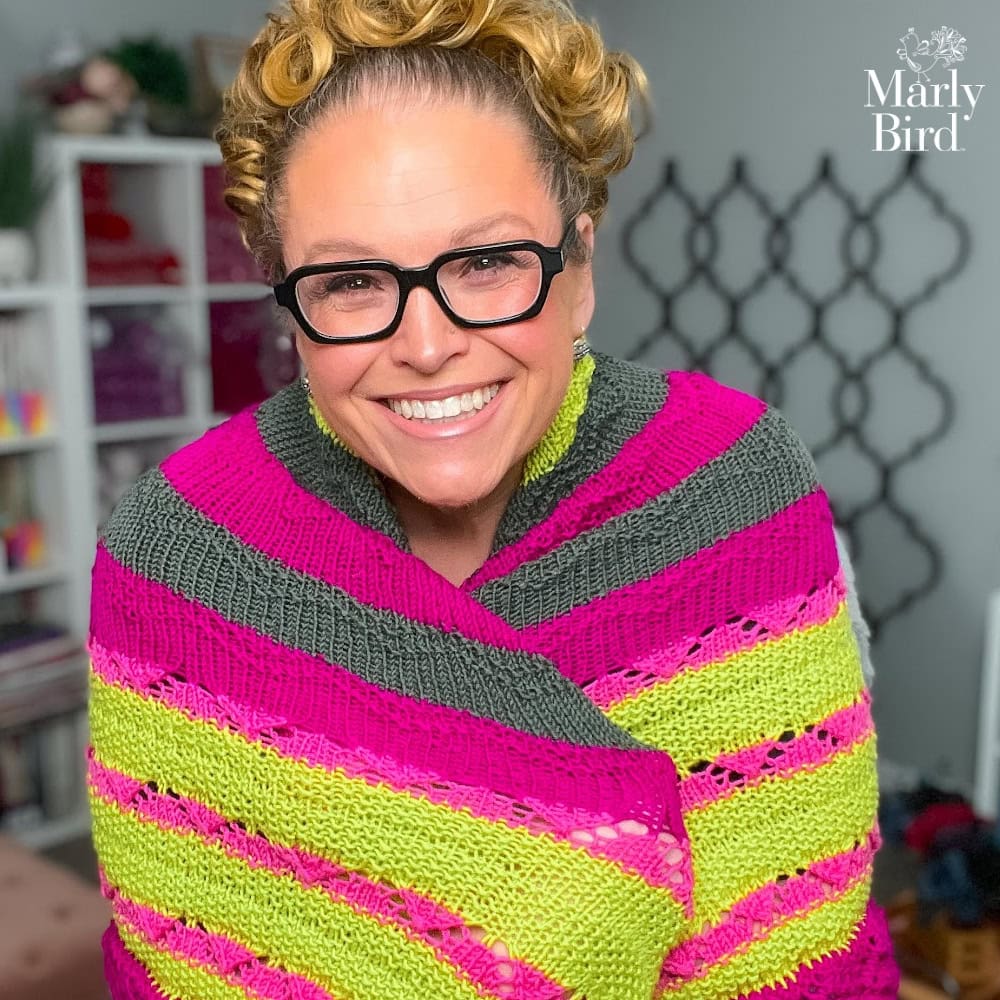
Person wearing a striped pink, gray, and green knit triangle shawl; visible stitch texture; yarn shelves in background.

🧶 Explore More Free Knit Shawl Patterns

If you love this design, be sure to explore my full collection:

👉 Marly Bird Knit Shawl Patterns

You might also enjoy:

  • Eowyn Cable Knit Shawl
  • Make It Mine Shawl
  • Pear Sorbet Shawlette
  • Stellar Stripes Shawl
  • Social Knitter Shawl
  • Uptown Chic Shawl
  • Crazy Stripes Crescent Shawl
  • Free Knit Summer Shawl Patterns

💖 Love This Pattern?

Blue starburst with red hearts, colorful “Favorite This on ravelry” text, and a small white peacock at the bottom.

Be sure to:

  • Favorite it on Ravelry
  • Add it to your queue
  • Share your finished project

I absolutely love seeing your makes!


Love This Concentration Level?

If you enjoyed the focused challenge of Mariposa, you may love:

  • Another “Shh! Be Quiet, I’m Knitting” Tournament of Stitches shawl
  • The Stitch Switch Vol. 2 collection
  • 2026 “Shh! Be Quiet” Shawl

With the full collection, you can mix and match stitch sections to create your own concentration-level shawl.

Four colorful shawls, knit and Tunisian crochet, displayed on mannequins and hangers; visible stitch texture and drape.

FAQ – Knit Triangle Shawl Pattern

Is this knit triangle shawl pattern free?

Yes. The full Mariposa pattern is available right here on this page… cast-on, stitch sections, applied border, the whole thing. If you’d rather knit from a clean printable copy, the ad-free PDF is available on Etsy, Shopify, and Ravelry.

Is this pattern beginner friendly?

No, this is an intermediate knit triangle shawl pattern. You’ll want to be comfortable with knit, purl, yarn-over increases, basic shaping, and reading written stitch patterns before you cast on. The four progressive stitch sections build skill as you go, but they do require focus… this is the original “Be Quiet, I’m Knitting” project for a reason.

Can I knit Mariposa in one color instead of multiple?

Absolutely. The original sample was knit in one color, and the texture really shines on a solid background. A multi-color version (like the photos here) lets each stitch section pop visually, but a single-color shawl shows off the textured stitch work in a more elegant, monochrome way. Both are gorgeous… pick what speaks to you.

Is this a good winter shawl?

Yes. The worsted weight yarn (CYCA #4) creates a warm, cushy fabric that’s ideal for layering over jackets, sweaters, or wraps. The wide triangle shape means you can wrap it close around your shoulders for warmth or drape it open for a bigger statement piece. It’s the kind of shawl that lives on the back of your reading chair from October to April.

Can I make Mariposa larger?

Yes. The simplest way to size up is to repeat additional body sections before beginning the applied border. Just keep in mind you’ll need extra yarn for both the larger body AND the longer border that has to wrap around the bigger triangle. Plan for at least one extra skein per added body repeat.

Does gauge matter if I don’t care about exact size?

Less critically… but yardage and border fit still depend on gauge. If you knit looser than the suggested gauge you’ll need more yarn than the pattern calls for, and a too-loose gauge can make the applied border ripple instead of lying flat. A quick gauge swatch will save you headaches later, even if you’re not chasing exact dimensions.

Can I substitute a non-merino yarn?

Yes, but choose a yarn with good stitch definition. The textured stitch sections are the star of this shawl, and a yarn that’s too soft or too fuzzy will hide the detail you worked so hard to knit. Stick to smooth worsted weight wool or wool blends… Malabrigo Rios, Berroco Ultra Wool, Cascade 220 Superwash, and Knit Picks Swish Worsted are all excellent substitutes for the discontinued Chic Sheep yarn.

Woman models a vibrant textured knit shawl in magenta, lime green, and gray; yarn shelves visible in the background.

Final Thoughts 💕

Mariposa isn’t just a shawl.

It’s a milestone.

It’s focused.
It’s textured.
It’s warm.
It’s intentional.

It asks for your attention.
It rewards you with beauty.

Now grab your needles.

Be quiet.

And knit. 🦋💕


❤️ Your BiCrafty Bestie,
Marly Bird
Marly Bird Bitmoji

❤️ Your BiCrafty Bestie,
Marly Bird
A cartoon avatar of a person with glasses and a brown bun smiles warmly. Their green shirt and black jacket add a stylish touch, while colorful hearts surround them like loving temperature blankets, stitching together an aura of love and positivity. -Marly Bird

Filed Under: Chic Sheep by Marly Bird Patterns, Free Patterns, Knit Shawl Patterns, Knitting, Marly Bird Premium Patterns, Our Free Patterns, Pattern Tagged With: free knit pattern, free shawl pattern, intermediate knitting, knit shawl, knit shawl pattern, knit triangle shawl, textured knit shawl, triangle shawl, worsted weight knit

Let's Be Social

Join the Marly's Minions Facebook group to share, ask questions, or chat about all of your yarn related crafts!

Join the group
Cartoon of a smiling woman with brown hair in a bun, glasses, black jacket and green shirt, waving next to large "hi" text.

Quick Links

The Pattern Shop

Our Free Patterns

Blog

Marly Bird House

Learn to Knit & Crochet

About

Giveaway Terms and Privacy Notice

Find Us Everywhere

Join the Newsletter

YouTube Channel

Marly's Minions FB Group

Etsy Store

Ravelry Store


AN ELITE CAFEMEDIA HOME/DIY PUBLISHER

Information from your device can be used to personalize your ad experience. Do not sell or share my personal information.

Privacy Policy   Terms   Marly Bird Legal Documents Copyright © 2026