Search
Close
  • The Pattern Shop
  • Our Free Patterns
    • Browse All Our Free Patterns
    • Our Free Knitting Patterns
    • Our Free Crochet Patterns
  • Blog
    • All Blog Posts
    • All Free Patterns
    • Dibble Dabble Inspiration
    • Giveaways
    • Make-Alongs
    • Product Reviews
    • Roundups
    • Tips, Tricks, Techniques for Knitting and Crochet
Stylized bird with pink and gray swirling tail above elegant โ€œMarlyโ€ text, logo for crochet accessories and home decor.
  • Marly Bird House
  • Learn to Knit & Crochet
    • Newbie? Start Here
    • Video Tutorials
    • Knitting Definitions
    • Crochet Definitions
    • Common Techniques
    • Size Charts for Knitting and Crochet Projects
  • About
ร—
  • The Pattern Shop
  • Free Patterns
  • Blog
  • Marly Bird House
  • Learn to Knit & Crochet
    • Newbie? Start Here
    • Video Tutorials
    • Knitting Definitions
    • Crochet Definitions
    • Common Techniques
    • Size Charts for Knitting and Crochet Projects
  • About
Stylized bird with pink and gray swirling tail above elegant โ€œMarlyโ€ text, logo for crochet accessories and home decor.
Search
Close

New Patterns NOW Available in Ad-Free PDF! Check out The Pattern Shop

Knit Lace Shawl || Free Knit Shawl With Hearts

June 16, 2026 By admin 1 Comment

Wrap yourself in this beautiful knit lace shawl with hearts โ€” the Warming Hearts Sofa Shawl! Perfect for keeping warm on a cool day, this lace knit shawl features a simple repeat to form a lace heart pattern. Stunning and stylish, it's the perfect accessory to have laying out to grab anytime you need a little extra warmth. Keep this shawl for yourself or gift it to someone you love.

Note: the original pattern used Red Heart Dreamy yarn, which has since been discontinued. I've listed plenty of yarn alternatives below so you can still make this gorgeous knit lace shawl with hearts! Work this knit lace shawl with me.

Knit lace shawl with hearts โ€” free knit shawl pattern

Affiliate Disclosure: This post contains affiliate links. To learn more please visit my privacy policy here๐Ÿ’–

What you Will Learn

Lace knitting doesn't have to be hard. Learn along with me everything that you need to know to have success in making this knit lace shawl with hearts pattern.

  • using circular needles with a flat project
  • knit seed stitch
  • knit two together
  • slip, slip, knit
  • reading a knitting chart
  • center double decrease
  • center treble decrease
  • bind off in pattern
Banner shows "Learn on YouTube" with YouTube logo, pink border, and hand-drawn bird sketch; text-focused, no crochet details.

Circular Needles for Flat Knitting

You may be wondering if you can really use circular needles for this flat knit shawl. The answer is YES!

Using circular needles allows you to get more stitches on your needles. Straight needles are limited to the length that you are able to find. The longer that your straight needles are the more strain you will be putting on your shoulders, neck, elbows and wrists.

Circular needles allow you to get a large number of stitches on your needles without straining. Work your pattern just as you would if they were straight needles, turning your project after each row.

Gauge for Shawl Patterns

Gauge is not typically our favorite part of knitting. Although it can make or break your finished project when it comes to a garment, there is some wiggle room when making a shawl.

Shawls have some flexibility when it comes to matching gauge. If your gauge is slightly off your shawl will still turn out beautiful. Why would you want to work a gauge swatch then for this project?

Working a gauge swatch will help to ensure that you don't run out of yarn. If your gauge is much larger than the designer intended you have the possibility of running out of yarn before finishing your shawl. Be sure to check your gauge to make sure that you are relatively close so that you will be able to finish your project.

This is especially important when substituting yarn โ€” since Red Heart Dreamy has been discontinued, you'll want to swatch your chosen alternative against the original gauge (15 sts and 20 rows = 4″/10 cm on US 10/6mm needles) before casting on for the full project.


Yarn Alternatives for This Knit Lace Shawl

Red Heart Dreamy was a beautifully soft, bulky (#5) 100% acrylic yarn โ€” perfect for this drapey, cozy shawl. Since it's no longer available, here are the best substitutes that will give you a similar look and feel. All of these are 100% acrylic, easy-care, and widely available in the US. Remember to always work a gauge swatch when substituting yarn!

Caron Latte Cakes

Best for cozy softness and subtle color transitions. Caron Latte Cakes is a wonderful option if you're looking for a shawl that's as comfortable to wear as it is beautiful to knit. The long color changes create effortless visual interest throughout the lace pattern, while the plush acrylic blend gives the finished shawl a soft, cozy feel. Available in a variety of gorgeous color combinations, this yarn can turn a simple lace design into a stunning accessory. As with any yarn substitution, be sure to knit a gauge swatch before starting your project.

Caron Cloud Cakes

Best for soft gradients and effortless color changes. Caron Cloud Cakes features long color transitions that create beautiful visual interest without changing yarns. Its lightweight, soft texture and generous yardage make it a great choice for lace shawls and wraps with lovely drape. Available from Michaels, it's perfect when you want a cozy project with stunning color effects straight from the cake. Check out this one too.

Caron Macchiato Cakes

Best Michaels option. Best for gorgeous gradients and cozy elegance. Caron Macchiato Cakes brings together beautiful color transitions and a soft, lofty feel that works wonderfully in lace shawls. The long color changes do all the work for you, creating eye-catching results with minimal effort. Plus, the acrylic-wool blend adds warmth and a gentle halo that gives your finished shawl an extra-special look and feel.


Video Tutorial

Through the video tutorial you will see that I am showing you a sample working one heart repeat. I will talk you through working each section of this repeat and what you would need to do to work the other panels of the shawl.

FREE Knit Shawl Pattern

Download this FREE knit shawl pattern from Yarnspirations.

Warming Hearts Sofa Shawl โ€” free knit lace shawl with hearts pattern from Yarnspirations

More Free Knit Shawl Patterns by Marly Bird

Love this knit lace shawl? I've got a whole collection of free knit shawl patterns for every skill level โ€” from beginner-friendly garter stitch to beautiful lace and cable designs. Here are some of my favorites:

  • Almond Brittle Knit Wrap โ€” Beginner-friendly bulky lace knit wrap with a stunning textural effect. A great next project after this one!
  • Shangri-La Knit Lace Shawl โ€” A delicate, airy free knit lace pattern that works up as either a scarf or shawl. Perfect for lace lovers.
  • Return to Me Boomerang Knit Shawl โ€” Easy cables and lace combined in a beautiful boomerang shape. One of my most popular shawl patterns!
  • Peak Serenity One Ball Knit Shawl โ€” A beginner-friendly shawl that uses just one skein of yarn. Quick, satisfying, and beautiful.
  • Lehabah Fire Sprite Shawl โ€” Inspired by the Crescent City series, this stunning crescent shawl is perfect for fans of fantasy knitting.
  • Eowyn Cable Knit Shawl โ€” A textured right-triangle shawl with beautiful cable details. Great for knitters ready to level up.
  • Blood of My Blood Outlander Shawl โ€” A richly textured shawl inspired by Outlander. Perfect for cozy knitting season!
  • Easy Beginner Garter Stitch Bias Knit Shawl โ€” If you're brand new to shawl knitting, start here! Simple garter stitch in a bias construction makes this one completely beginner-friendly.

โžก๏ธ See all free knit shawl patterns โ†’

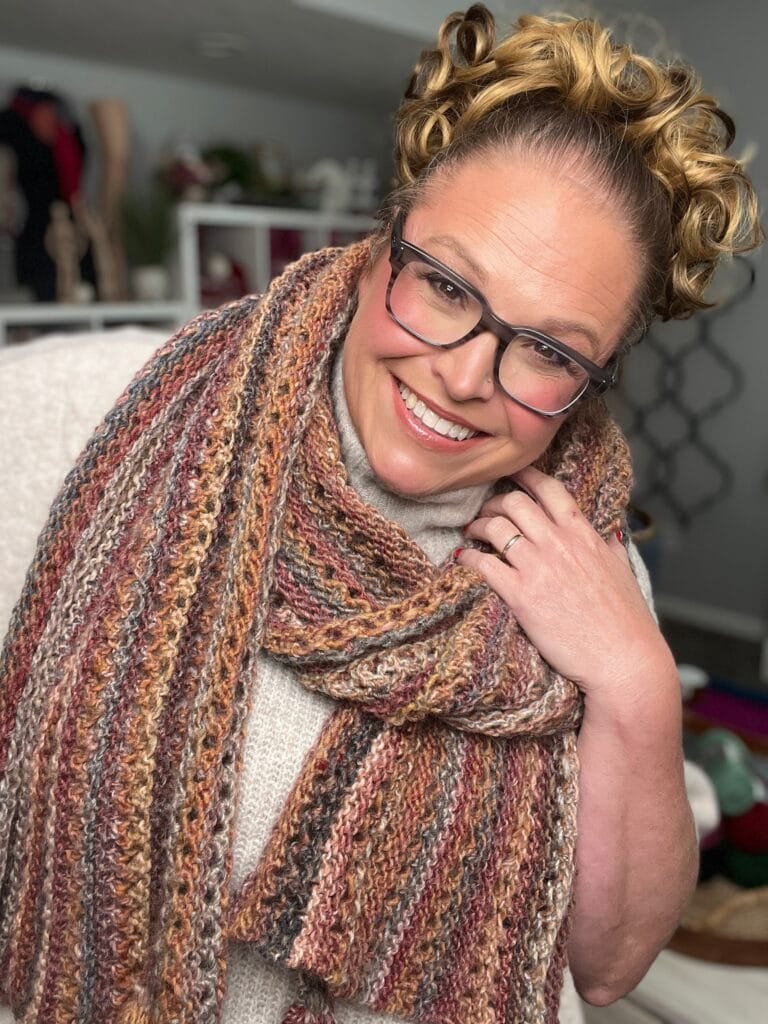
A woman models a cozy multicolored knit scarf with visible textured stitches, highlighting the scarfโ€™s soft, chunky yarn.
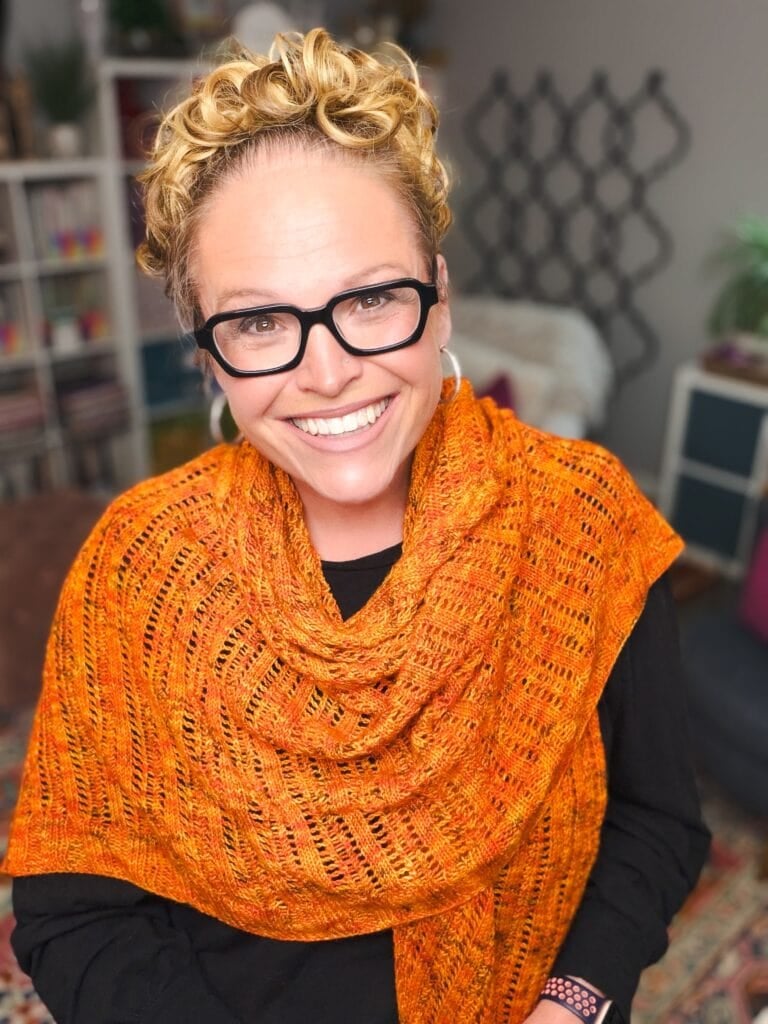
Person wearing a bright orange knitted Lehabah Fire Sprite Shawl with eyelet stitch detail over a black top in a colorful room.
A woman models a textured triangle knit shawl over black, in a cozy room with bookshelves and yarn in the background.
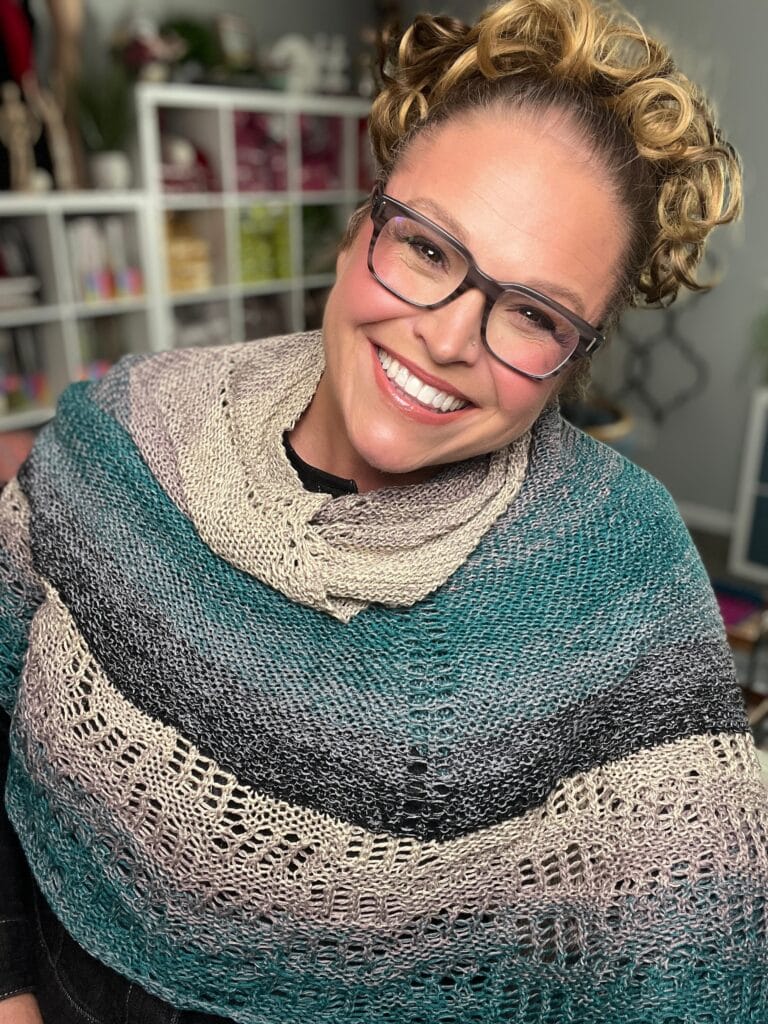
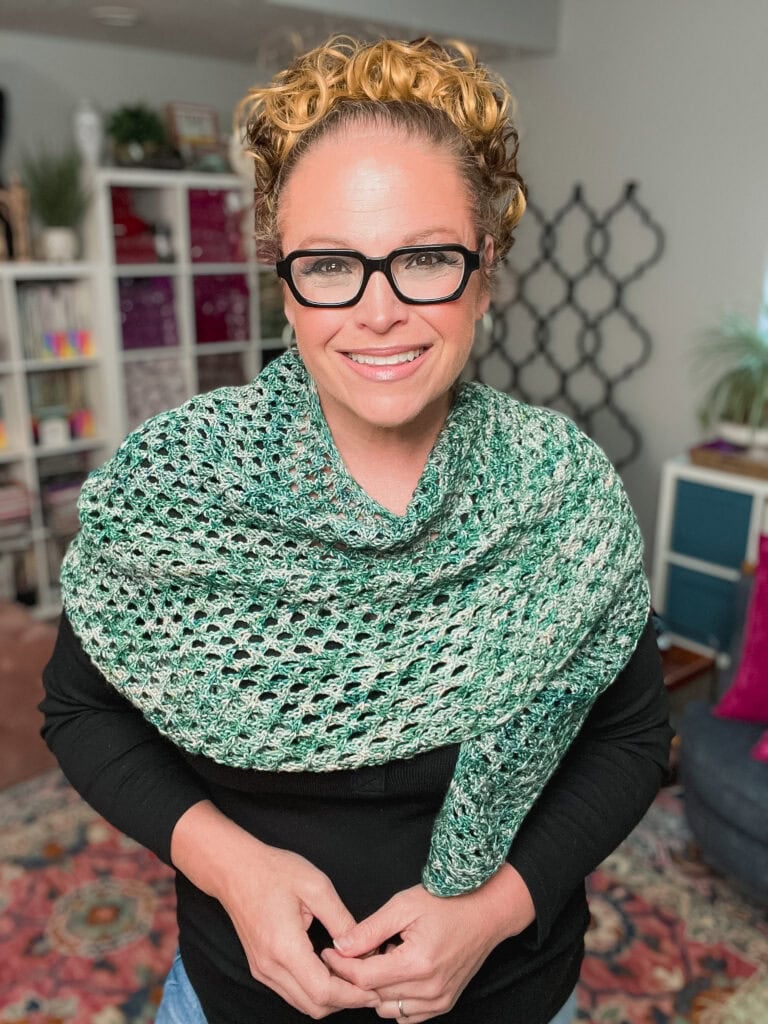
Teal, gray, and beige knit shawl with textured stitches, modeled indoors by a woman with curly hair and glasses.
Tilted Blocks Half Circle Knit Shawl
Green Boomerang Knit Shawl draped over shoulders, showing textured stitches and neat edges in a bright, creative space.
Return to Me Boomerang Shawl
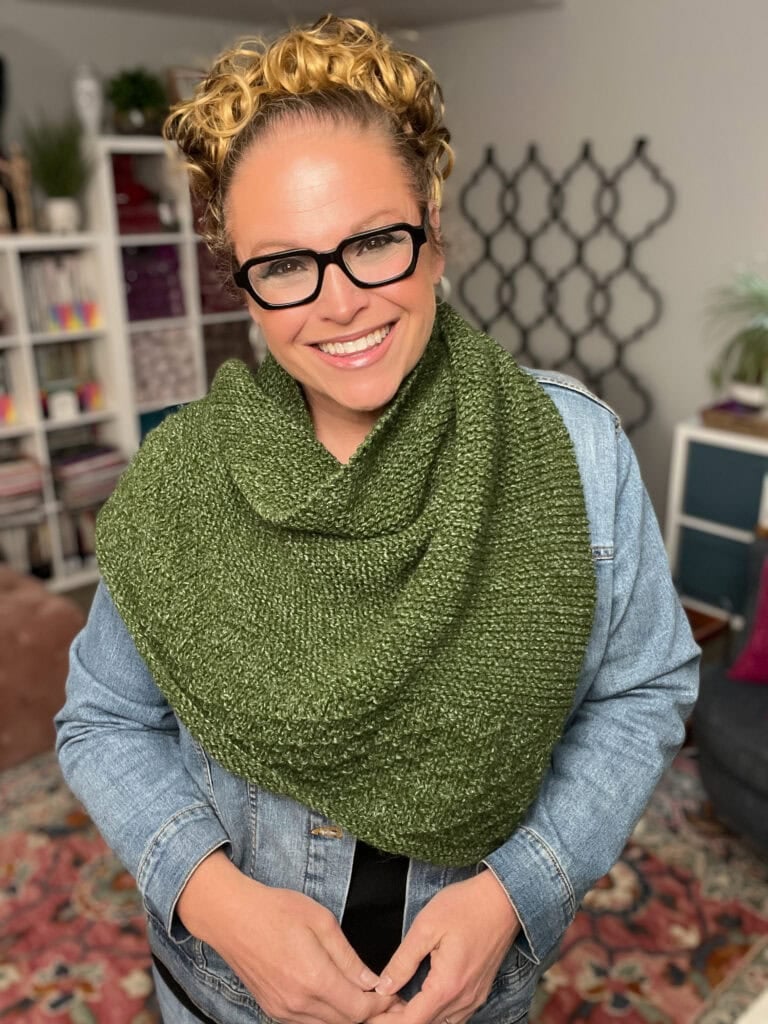
Person models a hand-knit green textured scarf indoors, with visible stitch detail; denim jacket and bookshelves behind.
Peak Serenity Knit Shawl
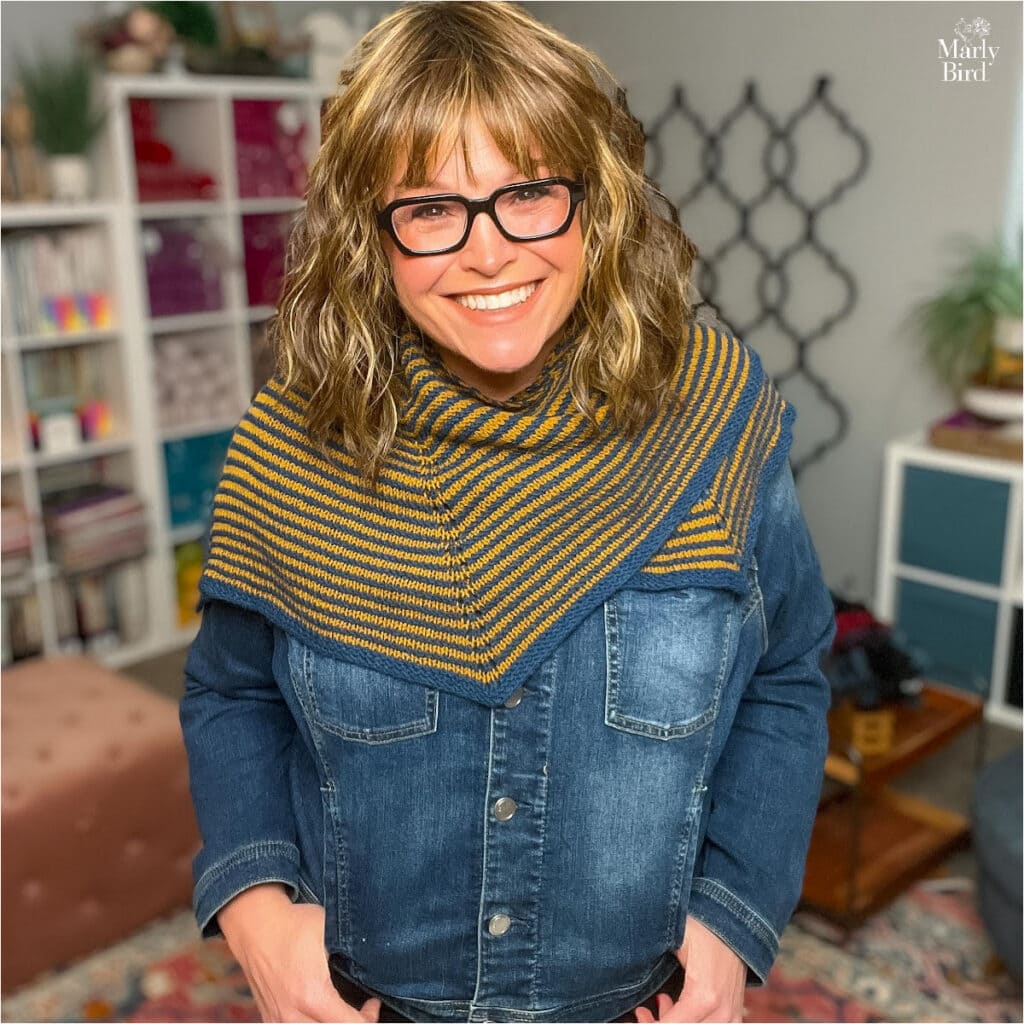
Blue and mustard striped knit shawl with textured stitches, draped over a denim jacket in a cozy craft room setting.
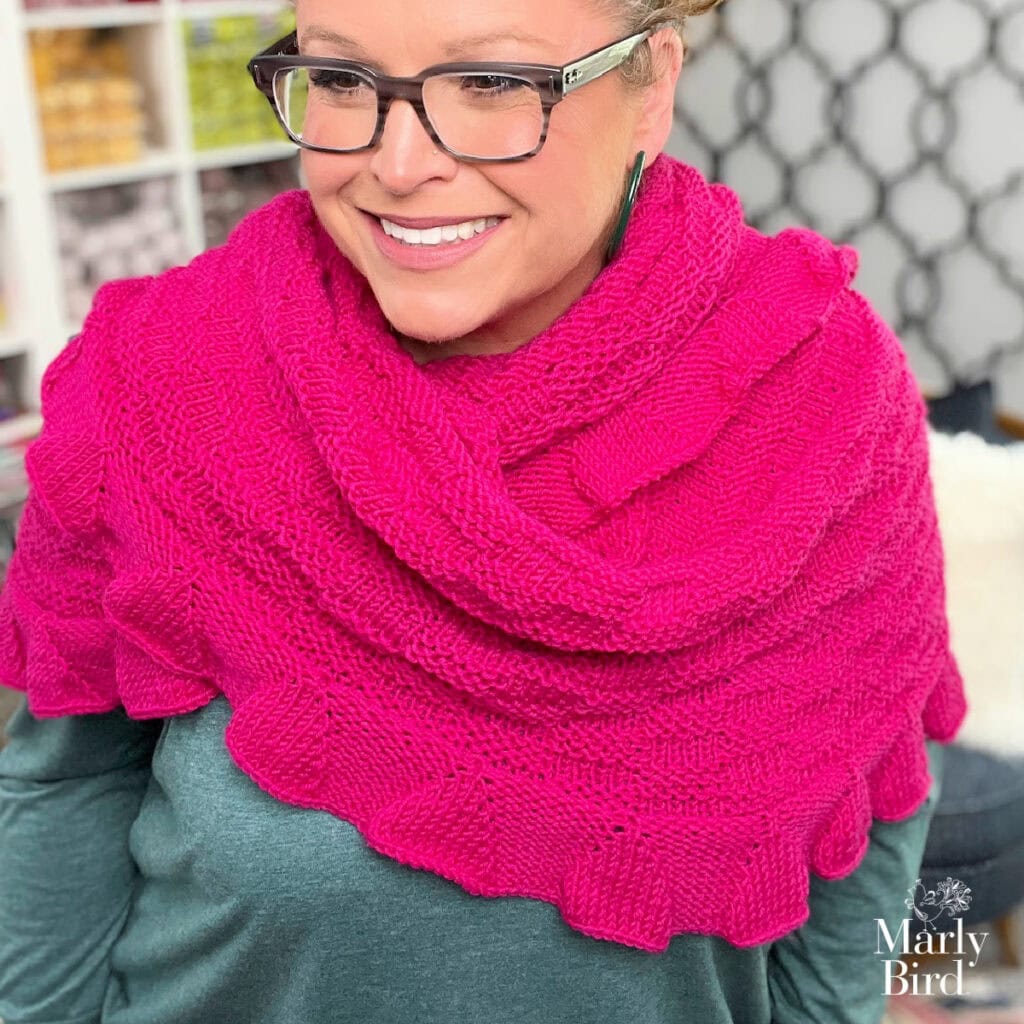
A woman models a bright pink knit shawl with ruffled edges and textured stitches, worn over a green top; yarn shelves behind her.
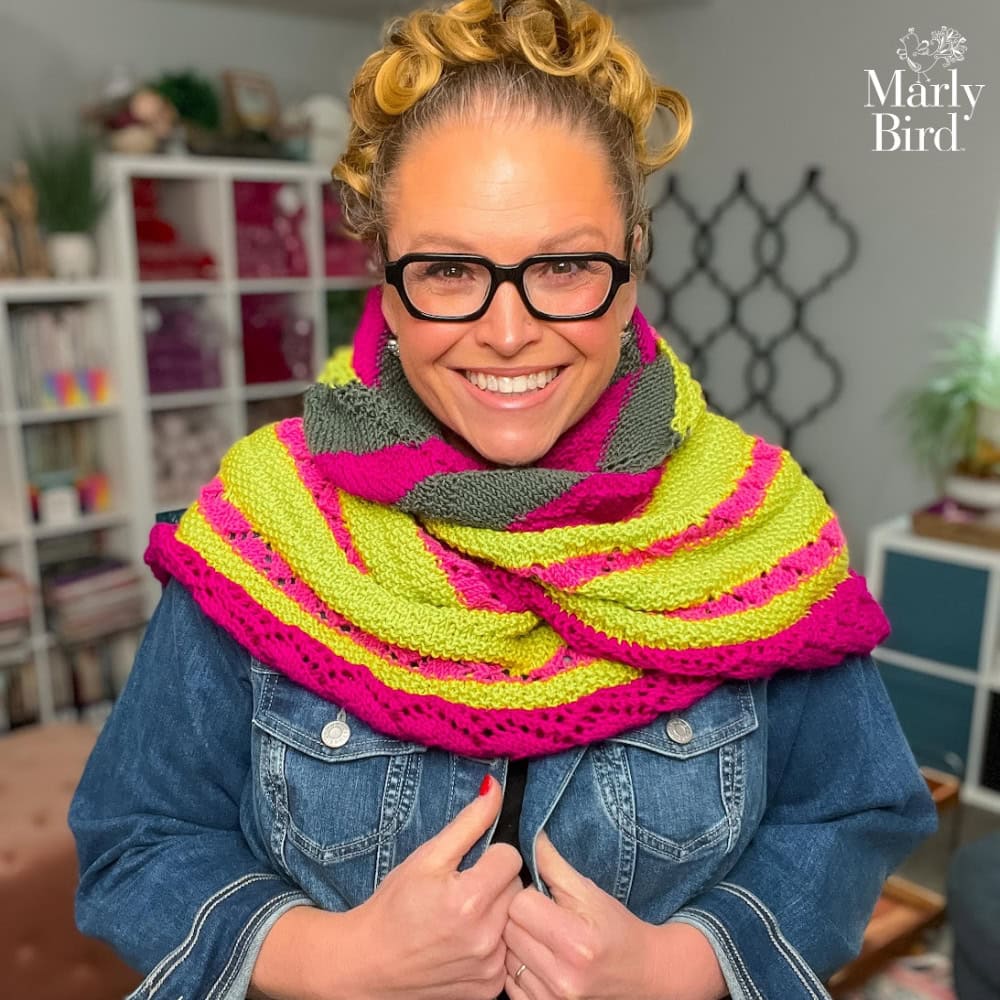
Woman models a knit shawl with pink, lime green, and gray stripes; textured stitches; โ€œMarly Birdโ€ logo in corner.
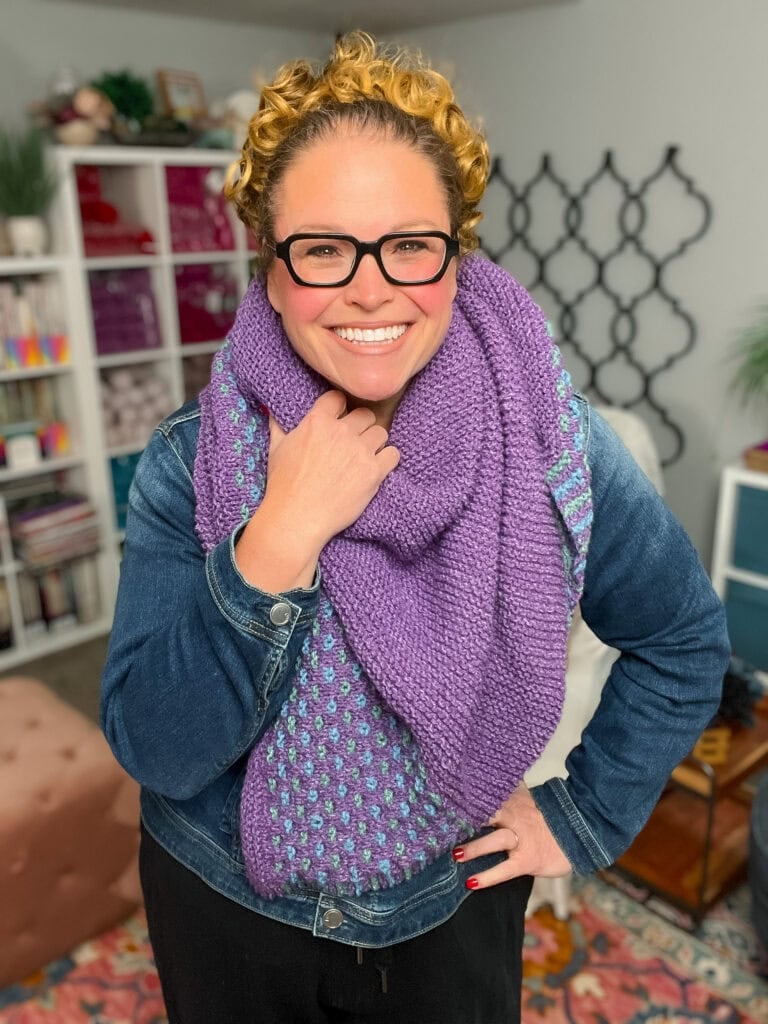
Person wearing a chunky, purple knit shawl with textured stitches over a denim jacket in a yarn-filled craft room.

Other Resources for Knit Shawls

  • Fixing mistakes in seed stitch
  • DIY stitch markers
  • Lifelines in knitting
  • Unknitting/Tinking
  • Free Knit Lace Shawl Patterns collection
  • All Free Knit Shawl Patterns by Marly Bird

Frequently Asked Questions

Can I really use circular needles for a flat project like this shawl?

Yes, you absolutely can! Circular needles are a lifesaver when you have a lot of stitches on your needles. They help prevent strain on your shoulders, neck, and wrists compared to long straight needles. Just turn your work after each row like you would with straight needles.

Do I really need to worry about gauge for this shawl?

Honestly, gauge is a little more flexible with shawls than with garments. If your gauge is a bit off, your shawl will probably still be beautiful. The main reason to check it is to make sure you have enough yarn โ€” you don't want to run out before you're done! This is especially important if you're substituting yarn.

What new knitting techniques will I learn with this pattern?

So here's the thing… this pattern is a great way to learn some fun new skills! You'll get to practice using circular needles for flat knitting, work with seed stitch, learn decreases like knit two together, slip slip knit, center double decrease, and center treble decrease. Plus, you'll learn how to read a knitting chart and bind off in pattern.

Where can I get the FREE pattern for this shawl?

You can snag the FREE knit shawl pattern over on Yarnspirations. Just click the link that says “FREE knit shawl pattern” and it will take you right there. It's such a lovely design, perfect for gifting or keeping!

Is there a video tutorial to help me if I get stuck?

Yes! I've got a video tutorial that walks you through working one heart repeat. It's super helpful to see it done step-by-step, and I'll explain how to work the other sections of the shawl as well. Grab your yarn and needles and let's knit together!

Red Heart Dreamy yarn is discontinued โ€” can I still make this shawl?

Absolutely yes! The pattern itself is still available for free on Yarnspirations. You just need to find a substitute yarn with a similar weight and gauge. Look for a bulky (#5) acrylic yarn that knits to approximately 15 sts per 4 inches on US size 10 (6mm) needles. Check out the “Yarn Alternatives” section above for specific recommendations that are easy to find in the US.

What is the best yarn substitute for Red Heart Dreamy?

The best US-accessible substitutes for Red Heart Dreamy are: Red Heart With Love (same brand, soft, widely available), Caron One Pound (great value, excellent yardage), Lion Brand Heartland (beautiful colorways), and Loops & Threads Impressions (available at Michaels). Any of these will work beautifully for this knit lace shawl โ€” just be sure to swatch to match the original gauge of 15 sts/20 rows = 4″ on US 10 needles.

Filed Under: Free Patterns, Knit Shawl Patterns, Knitting, Uncategorized, YouTube Video Tutorial

Corner to Corner Single Crochet Entrelac Square โ€” Free Pattern + Tutorial

June 6, 2026 By admin Leave a Comment

๐Ÿ“ Updated June 7, 2026: Full framework refresh… new standalone intro (CAL references removed), “What Is Single Crochet Entrelac?” education section added, materials updated (Chic Sheep by Marly Bird discontinued … current substitutes with affiliate links added), tips section for managing ends and blocking, internal entrelac cluster navigation, and expanded conversational FAQ.

Free Corner to Corner Single Crochet Entrelac Square Pattern (12″)

Entrelac has that gorgeous woven, lattice-like look that seems complicated but is actually built entirely from small rectangles layered on top of each other. This version uses single crochet… not Tunisian, which means you don't need a special long hook. Just the regular hook you already own. The finished square is 12 inches square, making it perfect for blankets, standalone art pieces, or a skill-builder project that looks way more impressive than it actually is. You'll definitely get compliments on this one.

Originally designed for the Wedding Blanket CAL, but this pattern stands completely on its own. Whether you're working through the full blanket or just want one gorgeous square for your collection… this one is for you.

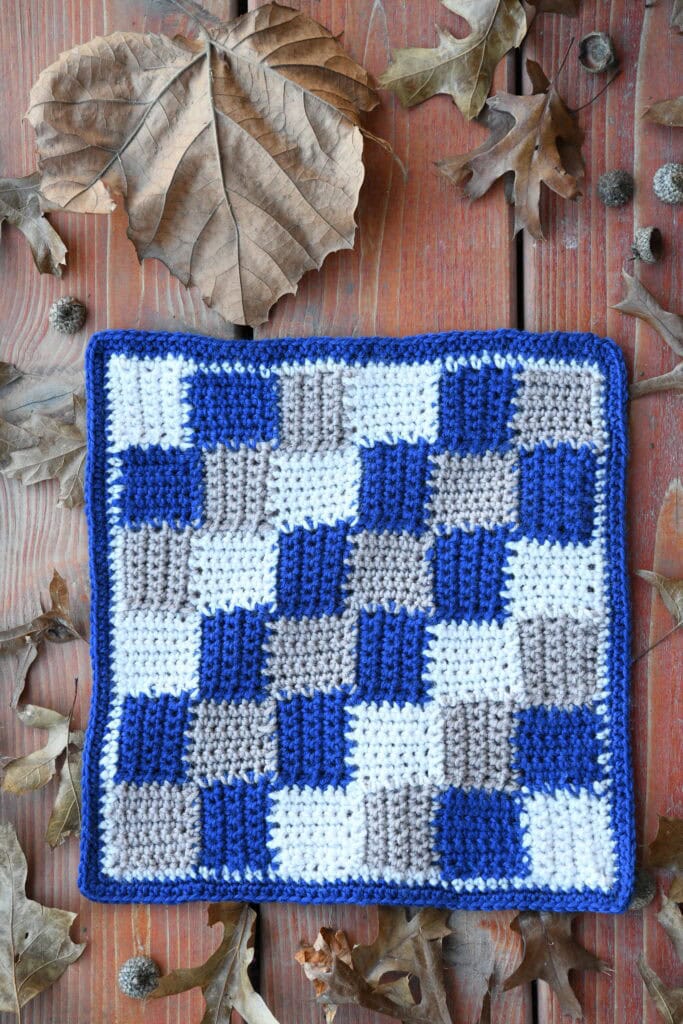
Single Crochet Entrelac square in blue, white, and gray yarn displayed on wood with textured checkerboard pattern.

What Is Single Crochet Entrelac?

Entrelac = building fabric from small squares and rectangles arranged diagonally, creating that woven or lattice look.

C2C (corner to corner) = building from one corner outward and then decreasing back, which gives you straight edges all around.

Single crochet vs. Tunisian entrelac: Most online tutorials use Tunisian, which requires a special long hook. Marly's version uses regular single crochet… the yarn, hook, and skills you already have. SC entrelac is softer and flatter than Tunisian, but equally beautiful. The main challenge is managing all the color changes and weaving in those ends, not the stitch itself.

โœ… Is This For You?

  • You know how to single crochet
  • You're comfortable changing colors
  • You don't mind weaving in ends (there are several)
  • You want a square that looks way more impressive than it actually is

Materials

  • Yarn: This pattern was originally written for Chic Sheep by Marly Bird (Merino Wool, DK weight). That yarn is discontinued. You can substitute with any DK weight yarn with good stitch definition… the pattern calls for 3 colors (A, B, C) in small amounts, so this is a great project for mini skeins or scraps. Suggested substitutes: Excellent substitutes that give you the same beautiful stitch definition:

    • Malabrigo Rios โ€” tidd.ly/49VZcW1

    • Berroco Ultra Wool โ€” tidd.ly/4pSjENv

    • Swish Worsted (Knit Picks) โ€” tidd.ly/4qL6Zxt

    • Cascade 220 Superwash โ€” tidd.ly/4afBG7B

    • Madelinetosh Tosh Vintage โ€” tidd.ly/4rgPp3P


    When substituting, look for: worsted weight (#4), strong stitch definition, merino wool or a soft wool blend. This is also a wonderful scraps and mini-skein project โ€” use small amounts of any smooth worsted that coordinates!

  • Hook: Size I/9 (5.5 mm)
  • Gauge: 4 squares = 4″ ร— 4″ [10 ร— 10 cm]. You can use any size hook to obtain the gauge. Just work a small swatch first.
  • Notions: Stitch markers (important… mark stitches between tiers as you go), scissors, tapestry needle
  • Finished size: 12″ ร— 12″ after blocking

Corner to Corner Single Crochet Entrelac Square Pattern

Materials:

  • 1 ball color A (Chic Sheep by Marly Birdโ„ข in Linen)
  • 1 ball color B (Chic Sheep by Marly Birdโ„ข in VIP)
  • 1 ball color C (Chic Sheep by Marly Birdโ„ข in Suede)
  • Scissors
  • Finishing needle

Tier 1

With Color A

Row 1 (RS): Chain 8, sc in 2nd chain from hook and in each chain across, turn … 7 sc.

Row 2 (WS): Ch 1, sc in each sc across, turn.

Row 3: Ch 1, sc in each sc across, turn.

Row 4: Ch 1, sc in each sc across, turn.

Row 5: Ch 1, sc in each sc across, turn.

Row 6: Ch 1, sc in each sc across, turn.

Row 7: Ch 1, sc in each sc across, change to color B in last sc of row and place marker in that stitch, turn.

Go ahead and cut color A leaving a 6″ tail to weave in later.

Tier 2

Square 1

With color B

Row 1 (WS): Chain 8, sc in 2nd chain from hook and in each of the next 5 ch, sc2tog (the last chain and the marked stitch on square from previous tier), slip stitch in next stitch on square from previous tier [note: the slipped stitch takes the place of the ch 1 we usually do after the turn], turn … 6 sc, 1 sc2tog.

Row 2 (RS): Sc in sc2tog, and in next 6 sc across, turn … 7 sc.

Row 3: Ch 1, sc in each of the next 6 sc, sc2tog (the last sc and the next stitch on square from previous tier), slip stitch in next stitch on square from previous tier, turn … 6 sc, 1 sc2tog.

Row 4: Sc in sc2tog, and in next 6 sc across, turn … 7 sc.

Row 5: Ch 1, sc in each of the next 6 sc, sc2tog (the last sc and the next stitch on square from previous tier), slip stitch in next stitch on square from previous tier, turn … 6 sc, 1 sc2tog.

Row 6: Sc in sc2tog, and in next 6 sc across, turn … 7 sc.

Row 7: Ch 1, sc in each of the next 6 sc, sc2tog (the last sc and the next stitch on square from previous tier) place a marker in that stitch, do not turn … 6 sc, 1 sc2tog.

Square 2

Working along the edge of the same square of previous tier

Row 1 (WS): Ch 1, 7 sc evenly along the edge, turn … 7 sc.

Row 2 (RS): Ch 1, sc in each sc across, turn … 7 sc.

Row 3: Ch 1, sc in each sc across, turn … 7 sc.

Row 4: Ch 1, sc in each sc across, turn … 7 sc.

Row 5: Ch 1, sc in each sc across, turn … 7 sc.

Row 6: Ch 1, sc in each sc across, turn … 7 sc.

Row 7: Ch 1, sc in each sc across, change to color C in last sc of row and place marker in that stitch, turn.

Go ahead and cut color B leaving a 6″ tail to weave in later.

Tier 3

Square 1

With color C

Row 1 (RS): Chain 8, sc in 2nd chain from hook and in each of the next 5 ch, sc2tog (the last chain and the marked stitch on square from previous tier), slip stitch in next stitch on square from previous tier [note: the slipped stitch takes the place of the ch 1 we usually do after the turn], turn … 6 sc, 1 sc2tog.

Row 2 (WS): Sc in sc2tog, and in next 6 sc across, turn … 7 sc.

Row 3: Ch 1, sc in each of the next 6 sc, sc2tog (the last sc and the next stitch on square from previous tier), slip stitch in next stitch on square from previous tier, turn … 6 sc, 1 sc2tog.

Row 4: Sc in sc2tog, and in next 6 sc across, turn … 7 sc.

Row 5: Ch 1, sc in each of the next 6 sc, sc2tog (the last sc and the next stitch on square from previous tier), slip stitch in next stitch on square from previous tier, turn … 6 sc, 1 sc2tog.

Row 6: Sc in sc2tog, and in next 6 sc across, turn … 7 sc.

Row 7: Ch 1, sc in each of the next 6 sc, sc2tog (the last sc and the next stitch on square from previous tier) place a marker in that stitch, do not turn … 6 sc, 1 sc2tog.

Square 2

Working along the edge of the same square of previous tier

Row 1 (RS): Ch 1, 6 sc evenly along the edge, sc2tog (the last sc and the marked stitch on square from previous tier), slip stitch in next stitch on square from previous tier, turn … 6 sc, 1 sc2tog.

Row 2 (WS): Sc in sc2tog, and in next 6 sc across, turn … 7 sc.

Row 3: Ch 1, sc in each of the next 6 sc, sc2tog (the last sc and the next stitch on square from previous tier), slip stitch in next stitch on square from previous tier, turn … 6 sc, 1 sc2tog.

Row 4: Sc in sc2tog, and in next 6 sc across, turn … 7 sc.

Row 5: Ch 1, sc in each of the next 6 sc, sc2tog (the last sc and the next stitch on square from previous tier), slip stitch in next stitch on square from previous tier, turn … 6 sc, 1 sc2tog.

Row 6: Sc in sc2tog, and in next 6 sc across, turn … 7 sc.

Row 7: Ch 1, sc in each of the next 6 sc, sc2tog (the last sc and the next stitch on square from previous tier) place a marker in that stitch, do not turn … 6 sc, 1 sc2tog.

Square 3

Working along the edge of the same square of previous tier

Row 1 (RS): Ch 1, 7 sc evenly along the edge, turn … 7 sc.

Row 2 (WS): Ch 1, sc in each sc across, turn … 7 sc.

Row 3: Ch 1, sc in each sc across, turn … 7 sc.

Row 4: Ch 1, sc in each sc across, turn … 7 sc.

Row 5: Ch 1, sc in each sc across, turn … 7 sc.

Row 6: Ch 1, sc in each sc across, turn … 7 sc.

Row 7: Ch 1, sc in each sc across, change to color A in last sc of row and place marker in that stitch, turn.

Go ahead and cut color C leaving a 6″ tail to weave in later.

Tier 4

Square 1

With color A

Row 1 (WS): Chain 8, sc in 2nd chain from hook and in each of the next 5 ch, sc2tog (the last chain and the marked stitch on square from previous tier), slip stitch in next stitch on square from previous tier [note: the slipped stitch takes the place of the ch 1 we usually do after the turn], turn … 6 sc, 1 sc2tog.

Row 2 (RS): Sc in sc2tog, and in next 6 sc across, turn … 7 sc.

Row 3: Ch 1, sc in each of the next 6 sc, sc2tog (the last sc and the next stitch on square from previous tier), slip stitch in next stitch on square from previous tier, turn … 6 sc, 1 sc2tog.

Row 4: Sc in sc2tog, and in next 6 sc across, turn … 7 sc.

Row 5: Ch 1, sc in each of the next 6 sc, sc2tog (the last sc and the next stitch on square from previous tier), slip stitch in next stitch on square from previous tier, turn … 6 sc, 1 sc2tog.

Row 6: Sc in sc2tog, and in next 6 sc across, turn … 7 sc.

Row 7: Ch 1, sc in each of the next 6 sc, sc2tog (the last sc and the next stitch on square from previous tier) place a marker in that stitch, do not turn … 6 sc, 1 sc2tog.

Squares 2 and 3

Working along the edge of the same square of previous tier

Row 1 (WS): Ch 1, 6 sc evenly along the edge, sc2tog (the last sc and the marked stitch on square from previous tier), slip stitch in next stitch on square from previous tier, turn … 6 sc, 1 sc2tog.

Row 2 (RS): Sc in sc2tog, and in next 6 sc across, turn … 7 sc.

Row 3: Ch 1, sc in each of the next 6 sc, sc2tog (the last sc and the next stitch on square from previous tier), slip stitch in next stitch on square from previous tier, turn … 6 sc, 1 sc2tog.

Row 4: Sc in sc2tog, and in next 6 sc across, turn … 7 sc.

Row 5: Ch 1, sc in each of the next 6 sc, sc2tog (the last sc and the next stitch on square from previous tier), slip stitch in next stitch on square from previous tier, turn … 6 sc, 1 sc2tog.

Row 6: Sc in sc2tog, and in next 6 sc across, turn … 7 sc.

Row 7: Ch 1, sc in each of the next 6 sc, sc2tog (the last sc and the next stitch on square from previous tier) place a marker in that stitch, do not turn … 6 sc, 1 sc2tog.

Square 4

Working along the edge of the same square of previous tier

Row 1 (WS): Ch 1, 7 sc evenly along the edge, turn … 7 sc.

Row 2 (RS): Ch 1, sc in each sc across, turn … 7 sc.

Row 3: Ch 1, sc in each sc across, turn … 7 sc.

Row 4: Ch 1, sc in each sc across, turn … 7 sc.

Row 5: Ch 1, sc in each sc across, turn … 7 sc.

Row 6: Ch 1, sc in each sc across, turn … 7 sc.

Row 7: Ch 1, sc in each sc across, change to color B in last sc of row and place marker in that stitch, turn.

Go ahead and cut color A leaving a 6″ tail to weave in later.

Tier 5

Square 1

With color B

Row 1 (RS): Chain 8, sc in 2nd chain from hook and in each of the next 5 ch, sc2tog (the last chain and the marked stitch on square from previous tier), slip stitch in next stitch on square from previous tier [note: the slipped stitch takes the place of the ch 1 we usually do after the turn], turn … 6 sc, 1 sc2tog.

Row 2 (WS): Sc in sc2tog, and in next 6 sc across, turn … 7 sc.

Row 3: Ch 1, sc in each of the next 6 sc, sc2tog (the last sc and the next stitch on square from previous tier), slip stitch in next stitch on square from previous tier, turn … 6 sc, 1 sc2tog.

Row 4: Sc in sc2tog, and in next 6 sc across, turn … 7 sc.

Row 5: Ch 1, sc in each of the next 6 sc, sc2tog (the last sc and the next stitch on square from previous tier), slip stitch in next stitch on square from previous tier, turn … 6 sc, 1 sc2tog.

Row 6: Sc in sc2tog, and in next 6 sc across, turn … 7 sc.

Row 7: Ch 1, sc in each of the next 6 sc, sc2tog (the last sc and the next stitch on square from previous tier) place a marker in that stitch, do not turn … 6 sc, 1 sc2tog.

Squares 2, 3, 4

Working along the edge of the same square of previous tier

Row 1 (RS): Ch 1, 6 sc evenly along the edge, sc2tog (the last sc and the marked stitch on square from previous tier), slip stitch in next stitch on square from previous tier, turn … 6 sc, 1 sc2tog.

Row 2 (WS): Sc in sc2tog, and in next 6 sc across, turn … 7 sc.

Row 3: Ch 1, sc in each of the next 6 sc, sc2tog (the last sc and the next stitch on square from previous tier), slip stitch in next stitch on square from previous tier, turn … 6 sc, 1 sc2tog.

Row 4: Sc in sc2tog, and in next 6 sc across, turn … 7 sc.

Row 5: Ch 1, sc in each of the next 6 sc, sc2tog (the last sc and the next stitch on square from previous tier), slip stitch in next stitch on square from previous tier, turn … 6 sc, 1 sc2tog.

Row 6: Sc in sc2tog, and in next 6 sc across, turn … 7 sc.

Row 7: Ch 1, sc in each of the next 6 sc, sc2tog (the last sc and the next stitch on square from previous tier) place a marker in that stitch, do not turn … 6 sc, 1 sc2tog.

Square 5

Working along the edge of the same square of previous tier

Row 1 (RS): Ch 1, 7 sc evenly along the edge, turn … 7 sc.

Row 2 (WS): Ch 1, sc in each sc across, turn … 7 sc.

Row 3: Ch 1, sc in each sc across, turn … 7 sc.

Row 4: Ch 1, sc in each sc across, turn … 7 sc.

Row 5: Ch 1, sc in each sc across, turn … 7 sc.

Row 6: Ch 1, sc in each sc across, turn … 7 sc.

Row 7: Ch 1, sc in each sc across, change to color C in last sc of row and place marker in that stitch, turn.

Go ahead and cut color B leaving a 6″ tail to weave in later.

Tier 6

Square 1

With color C

Row 1 (WS): Chain 8, sc in 2nd chain from hook and in each of the next 5 ch, sc2tog (the last chain and the marked stitch on square from previous tier), slip stitch in next stitch on square from previous tier [note: the slipped stitch takes the place of the ch 1 we usually do after the turn], turn … 6 sc, 1 sc2tog.

Row 2 (RS): Sc in sc2tog, and in next 6 sc across, turn … 7 sc.

Row 3: Ch 1, sc in each of the next 6 sc, sc2tog (the last sc and the next stitch on square from previous tier), slip stitch in next stitch on square from previous tier, turn … 6 sc, 1 sc2tog.

Row 4: Sc in sc2tog, and in next 6 sc across, turn … 7 sc.

Row 5: Ch 1, sc in each of the next 6 sc, sc2tog (the last sc and the next stitch on square from previous tier), slip stitch in next stitch on square from previous tier, turn … 6 sc, 1 sc2tog.

Row 6: Sc in sc2tog, and in next 6 sc across, turn … 7 sc.

Row 7: Ch 1, sc in each of the next 6 sc, sc2tog (the last sc and the next stitch on square from previous tier) place a marker in that stitch, do not turn … 6 sc, 1 sc2tog.

Squares 2, 3, 4, 5

Working along the edge of the same square of previous tier

Row 1 (WS): Ch 1, 6 sc evenly along the edge, sc2tog (the last sc and the marked stitch on square from previous tier), slip stitch in next stitch on square from previous tier, turn … 6 sc, 1 sc2tog.

Row 2 (RS): Sc in sc2tog, and in next 6 sc across, turn … 7 sc.

Row 3: Ch 1, sc in each of the next 6 sc, sc2tog (the last sc and the next stitch on square from previous tier), slip stitch in next stitch on square from previous tier, turn … 6 sc, 1 sc2tog.

Row 4: Sc in sc2tog, and in next 6 sc across, turn … 7 sc.

Row 5: Ch 1, sc in each of the next 6 sc, sc2tog (the last sc and the next stitch on square from previous tier), slip stitch in next stitch on square from previous tier, turn … 6 sc, 1 sc2tog.

Row 6: Sc in sc2tog, and in next 6 sc across, turn … 7 sc.

Row 7: Ch 1, sc in each of the next 6 sc, sc2tog (the last sc and the next stitch on square from previous tier) place a marker in that stitch, do not turn … 6 sc, 1 sc2tog.

Square 6

Working along the edge of the same square of previous tier

Row 1 (WS): Ch 1, 7 sc evenly along the edge, turn … 7 sc.

Row 2 (RS): Ch 1, sc in each sc across, turn … 7 sc.

Row 3: Ch 1, sc in each sc across, turn … 7 sc.

Row 4: Ch 1, sc in each sc across, turn … 7 sc.

Row 5: Ch 1, sc in each sc across, turn … 7 sc.

Row 6: Ch 1, sc in each sc across, turn … 7 sc.

Row 7: Ch 1, sc in each sc across
Fasten off color C leaving a 6″ tail to weave in later, turn … 7 sc.

The square is now as wide on the diagonal as it will get. Time to decrease one square per tier until we get to only 1 again.

Tier 7

Squares 1, 2, 3, 4

With color B

For square 1, join with a slip stitch in 8th stitch to begin row. This is the top of square 5 from the previous row. Starting here will decrease this row to 4 squares.

For squares 2, 3, 4, Working along the edge of the same square of previous tier

Row 1 (RS): Ch 1, 6 sc evenly along the edge, sc2tog (the last sc and the marked stitch on square from previous tier), slip stitch in next stitch on square from previous tier, turn … 6 sc, 1 sc2tog.

Row 2 (WS): Sc in sc2tog, and in next 6 sc across, turn … 7 sc.

Row 3: Ch 1, sc in each of the next 6 sc, sc2tog (the last sc and the next stitch on square from previous tier), slip stitch in next stitch on square from previous tier, turn … 6 sc, 1 sc2tog.

Row 4: Sc in sc2tog, and in next 6 sc across, turn … 7 sc.

Row 5: Ch 1, sc in each of the next 6 sc, sc2tog (the last sc and the next stitch on square from previous tier), slip stitch in next stitch on square from previous tier, turn … 6 sc, 1 sc2tog.

Row 6: Sc in sc2tog, and in next 6 sc across, turn … 7 sc.

Row 7: Ch 1, sc in each of the next 6 sc, sc2tog (the last sc and the next stitch on square from previous tier) place a marker in that stitch, do not turn … 6 sc, 1 sc2tog.

Square 5

Working along the edge of the same square of previous tier

Row 1 (RS): Ch 1, 7 sc evenly along the edge, turn … 7 sc.

Row 2 (WS): Ch 1, sc in each sc across, turn … 7 sc.

Row 3: Ch 1, sc in each sc across, turn … 7 sc.

Row 4: Ch 1, sc in each sc across, turn … 7 sc.

Row 5: Ch 1, sc in each sc across, turn … 7 sc.

Row 6: Ch 1, sc in each sc across, turn … 7 sc.

Row 7: Ch 1, sc in each sc across
Fasten off color B leaving a 6″ tail to weave in later, turn … 7 sc.

Tier 8

Squares 1, 2, 3

For square 1, join with a slip stitch in 8th stitch to begin row. This is the top of square 5 from the previous row. Starting here will decrease this row to 4 squares.

For squares 2, 3, 4, Working along the edge of the same square of previous tier

With color A

Row 1 (WS): Ch 1, 6 sc evenly along the edge, sc2tog (the last sc and the marked stitch on square from previous tier), slip stitch in next stitch on square from previous tier, turn … 6 sc, 1 sc2tog.

Row 2 (RS): Sc in sc2tog, and in next 6 sc across, turn … 7 sc.

Row 3: Ch 1, sc in each of the next 6 sc, sc2tog (the last sc and the next stitch on square from previous tier), slip stitch in next stitch on square from previous tier, turn … 6 sc, 1 sc2tog.

Row 4: Sc in sc2tog, and in next 6 sc across, turn … 7 sc.

Row 5: Ch 1, sc in each of the next 6 sc, sc2tog (the last sc and the next stitch on square from previous tier), slip stitch in next stitch on square from previous tier, turn … 6 sc, 1 sc2tog.

Row 6: Sc in sc2tog, and in next 6 sc across, turn … 7 sc.

Row 7: Ch 1, sc in each of the next 6 sc, sc2tog (the last sc and the next stitch on square from previous tier) place a marker in that stitch, do not turn … 6 sc, 1 sc2tog.

Square 4

Working along the edge of the same square of previous tier

Row 1 (WS): Ch 1, 7 sc evenly along the edge, turn … 7 sc.

Row 2 (RS): Ch 1, sc in each sc across, turn … 7 sc.

Row 3: Ch 1, sc in each sc across, turn … 7 sc.

Row 4: Ch 1, sc in each sc across, turn … 7 sc.

Row 5: Ch 1, sc in each sc across, turn … 7 sc.

Row 6: Ch 1, sc in each sc across, turn … 7 sc.

Row 7: Ch 1, sc in each sc across
Fasten off color A leaving a 6″ tail to weave in later, turn … 7 sc.

Tier 9

Squares 1, 2

With color C

For square 1, join with a slip stitch in 8th stitch to begin row. This is the top of square 5 from the previous row. Starting here will decrease this row to 4 squares.

For squares 2, 3, 4, Working along the edge of the same square of previous tier

Row 1 (RS): Ch 1, 6 sc evenly along the edge, sc2tog (the last sc and the marked stitch on square from previous tier), slip stitch in next stitch on square from previous tier, turn … 6 sc, 1 sc2tog.

Row 2 (WS): Sc in sc2tog, and in next 6 sc across, turn … 7 sc.

Row 3: Ch 1, sc in each of the next 6 sc, sc2tog (the last sc and the next stitch on square from previous tier), slip stitch in next stitch on square from previous tier, turn … 6 sc, 1 sc2tog.

Row 4: Sc in sc2tog, and in next 6 sc across, turn … 7 sc.

Row 5: Ch 1, sc in each of the next 6 sc, sc2tog (the last sc and the next stitch on square from previous tier), slip stitch in next stitch on square from previous tier, turn … 6 sc, 1 sc2tog.

Row 6: Sc in sc2tog, and in next 6 sc across, turn … 7 sc.

Row 7: Ch 1, sc in each of the next 6 sc, sc2tog (the last sc and the next stitch on square from previous tier) place a marker in that stitch, do not turn … 6 sc, 1 sc2tog.

Square 3

Working along the edge of the same square of previous tier

Row 1 (RS): Ch 1, 7 sc evenly along the edge, turn … 7 sc.

Row 2 (WS): Ch 1, sc in each sc across, turn … 7 sc.

Row 3: Ch 1, sc in each sc across, turn … 7 sc.

Row 4: Ch 1, sc in each sc across, turn … 7 sc.

Row 5: Ch 1, sc in each sc across, turn … 7 sc.

Row 6: Ch 1, sc in each sc across, turn … 7 sc.

Row 7: Ch 1, sc in each sc across
Fasten off color C leaving a 6″ tail to weave in later, turn … 7 sc.

Tier 10

Square 1

For square 1, join with a slip stitch in 8th stitch to begin row. This is the top of square 5 from the previous row. Starting here will decrease this row to 4 squares.

For squares 2, 3, 4, Working along the edge of the same square of previous tier

With color B

Row 1 (WS): Ch 1, 6 sc evenly along the edge, sc2tog (the last sc and the marked stitch on square from previous tier), slip stitch in next stitch on square from previous tier, turn … 6 sc, 1 sc2tog.

Row 2 (RS): Sc in sc2tog, and in next 6 sc across, turn … 7 sc.

Row 3: Ch 1, sc in each of the next 6 sc, sc2tog (the last sc and the next stitch on square from previous tier), slip stitch in next stitch on square from previous tier, turn … 6 sc, 1 sc2tog.

Row 4: Sc in sc2tog, and in next 6 sc across, turn … 7 sc.

Row 5: Ch 1, sc in each of the next 6 sc, sc2tog (the last sc and the next stitch on square from previous tier), slip stitch in next stitch on square from previous tier, turn … 6 sc, 1 sc2tog.

Row 6: Sc in sc2tog, and in next 6 sc across, turn … 7 sc.

Row 7: Ch 1, sc in each of the next 6 sc, sc2tog (the last sc and the next stitch on square from previous tier) place a marker in that stitch, do not turn … 6 sc, 1 sc2tog.

Square 2

Working along the edge of the same square of previous tier

Row 1 (WS): Ch 1, 7 sc evenly along the edge, turn … 7 sc.

Row 2 (RS): Ch 1, sc in each sc across, turn … 7 sc.

Row 3: Ch 1, sc in each sc across, turn … 7 sc.

Row 4: Ch 1, sc in each sc across, turn … 7 sc.

Row 5: Ch 1, sc in each sc across, turn … 7 sc.

Row 6: Ch 1, sc in each sc across, turn … 7 sc.

Row 7: Ch 1, sc in each sc across
Fasten off color B leaving a 6″ tail to weave in later, turn … 7 sc.

Tier 11

Square 1

For square 1, join with a slip stitch in 8th stitch to begin row. This is the top of square 5 from the previous row. Starting here will decrease this row to 4 squares.

With color A

Row 1 (WS): Ch 1, 6 sc evenly along the edge, sc2tog (the last sc and the marked stitch on square from previous tier), slip stitch in next stitch on square from previous tier, turn … 6 sc, 1 sc2tog.

Row 2 (RS): Sc in sc2tog, and in next 6 sc across, turn … 7 sc.

Row 3: Ch 1, sc in each of the next 6 sc, sc2tog (the last sc and the next stitch on square from previous tier), slip stitch in next stitch on square from previous tier, turn … 6 sc, 1 sc2tog.

Row 4: Sc in sc2tog, and in next 6 sc across, turn … 7 sc.

Row 5: Ch 1, sc in each of the next 6 sc, sc2tog (the last sc and the next stitch on square from previous tier), slip stitch in next stitch on square from previous tier, turn … 6 sc, 1 sc2tog.

Row 6: Sc in sc2tog, and in next 6 sc across, turn … 7 sc.

Row 7: Ch 1, sc in each of the next 6 sc, sc2tog (the last sc and the next stitch on square from previous tier) place a marker in that stitch, do not turn … 6 sc, 1 sc2tog.

Fasten off color A and your block is finished. Weave in your ends and block your square to 12″ x 12″. Attach your block to your blanket in the position you like best.


Tips for Making Your Entrelac Square

Managing Your Color Changes and Ends

Lots of color changes mean lots of ends. Weave in as you go, not at the end. Leave 6-8″ tails at each color change. Use your tapestry needle and weave into the back of nearby squares in different directions so you don't have a bulky spot.

Using Your Stitch Markers

Place markers in the last stitch of each tier as indicated in the pattern. Move markers as you go… don't try to remember where you are. The diagonal construction gets disorienting fast. Markers save you.

Blocking Makes a Big Difference

Single crochet entrelac can pull slightly. Wet blocking opens it up and evens out the diagonal joins. For a 12″ finished square, block to size. Unblocked it may measure slightly smaller and the texture won't be as even.

Color Combinations to Try

The 3-color rotating repeat (A… B… C… A) is built into the pattern, but you can use more colors if you want. More colors means more ends, so start with 3 for your first attempt. Gradient and ombre sets look stunning. And this is a great use for leftover sock or DK yarn.


What Can I Make With This Square?

  • Blanket: Use as many squares as you need. 5×5 = a generous lap blanket
  • Pillow cover: Two squares, seamed three sides
  • Wall hanging: One or two squares in bold colors
  • Wedding Blanket CAL: Part of the full blanket pattern

More Single Crochet Entrelac Projects to Try Next

  • Boysenberry Bramble Cowl … a cozy neck wrap that uses the same entrelac technique with a fun color play
  • Pieces of You Entrelac Wrap … a larger wrap project that really shows off the woven texture
  • 51 Free C2C Crochet Patterns … our huge collection of corner-to-corner patterns
  • Wedding Blanket CAL … the full blanket project this square is part of
Woman wears a hand-knit, textured Boysenberry Bramble Cowl indoors, with shelves of books and yarn in the background.
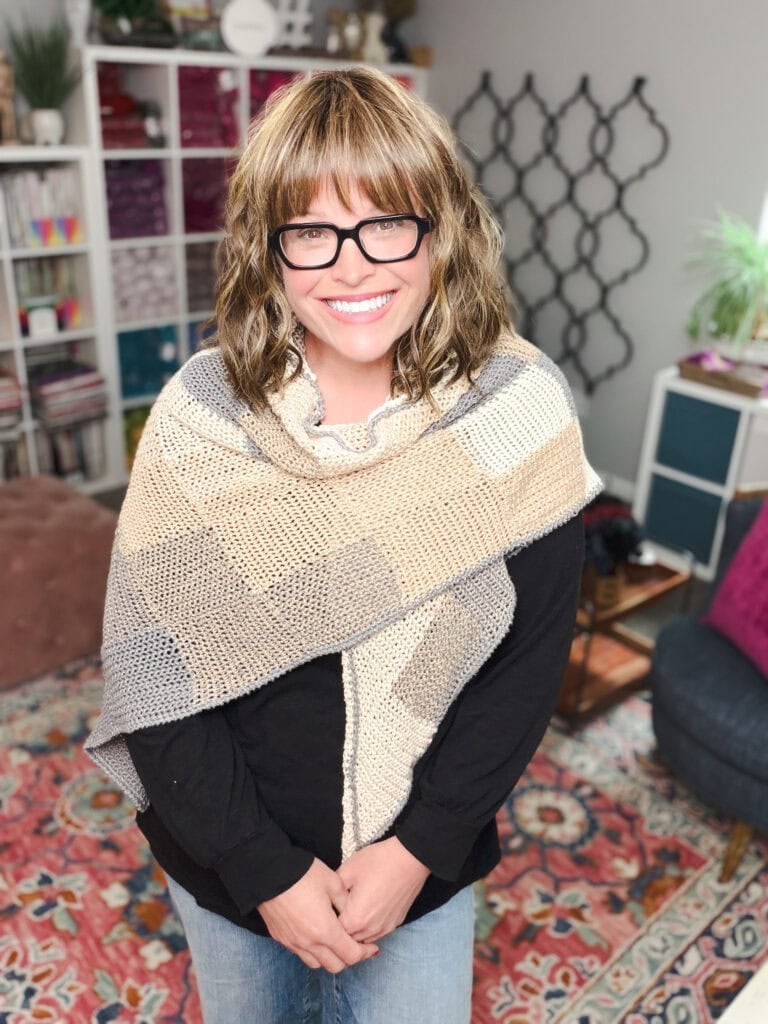
Woman models the beige and gray knit Pieces of You Wrap shawl, showing off its soft texture in a cozy, colorful room.
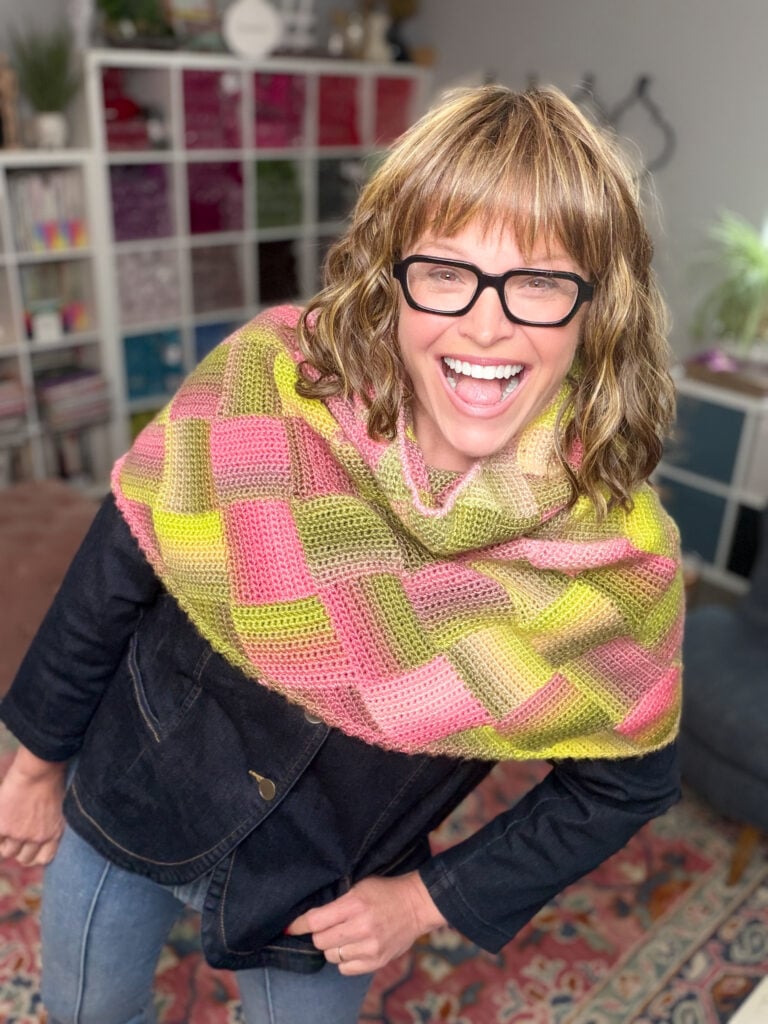
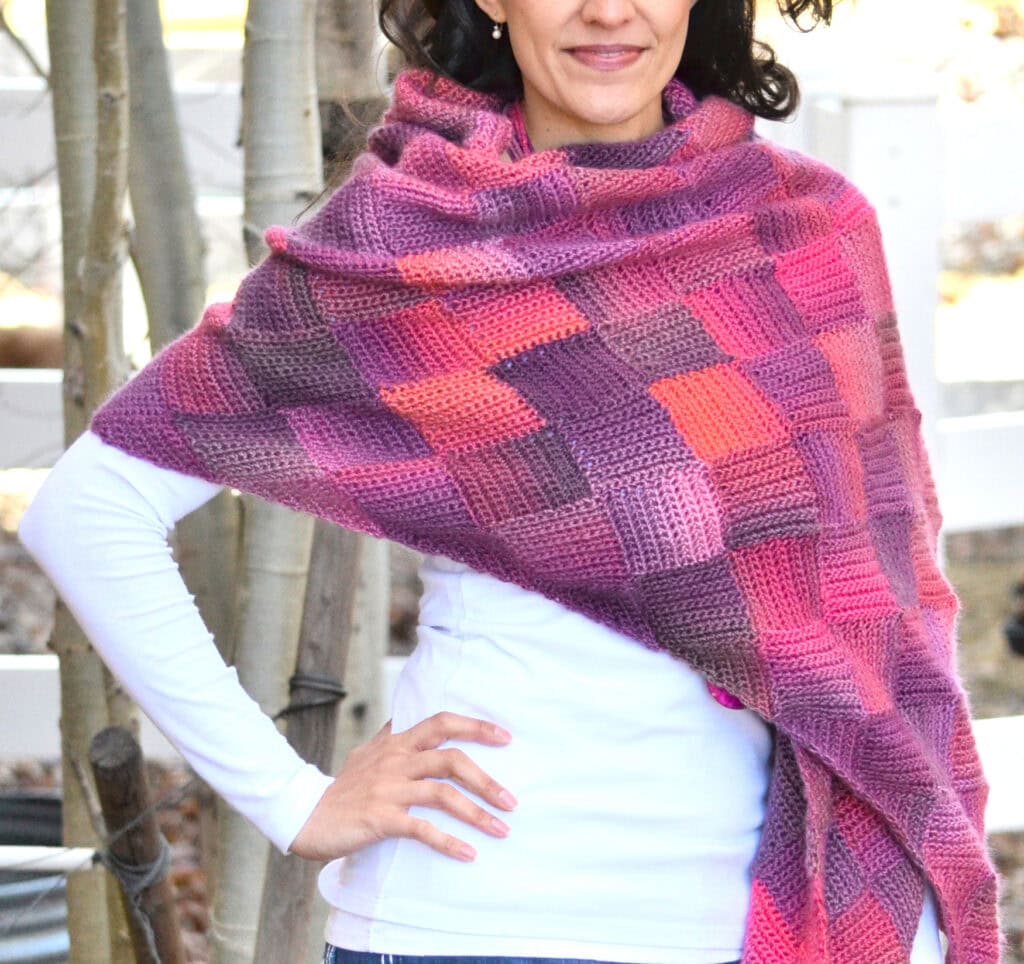
A woman models a vibrant entrelac crochet shawl in purples, pinks, and reds; detailed single crochet stitches are visible.
Wildberry Single Crochet Entrelac Wrap
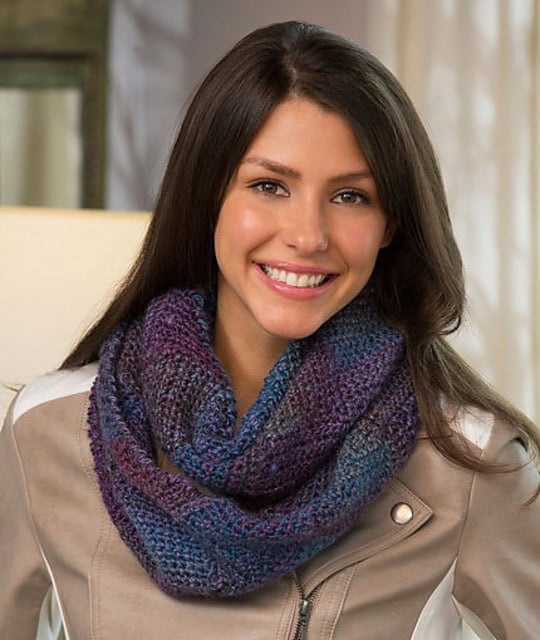
A woman models a crochet infinity scarf in purple and blue hues, showing its textured wrap pattern against a beige jacket.
Single Crochet Entrelac Cowl + Video

Frequently Asked Questions

What is the difference between C2C and entrelac crochet?

So here's the thing… C2C (corner to corner) and entrelac can look similar, but they build completely differently. C2C usually builds from one corner toward the center with diagonal increases, then decreases back. Entrelac builds in tiers, where each new tier of squares sits on top of the previous one, creating that woven effect. Both are beautiful. Both give straight edges. This pattern is C2C entrelac, which means we're using both techniques together.

Is single crochet entrelac hard?

Honestly… not as hard as it looks. The stitch itself (single crochet) is simple. The pattern is a lot of instructions, but once you work through the first tier, you see the repeat. The challenge isn't the stitch… it's managing color changes, keeping track of where you are on the diagonal, and weaving in ends. If you're comfortable with single crochet and color changes, you can do this.

What's the difference between Tunisian entrelac and this pattern?

Great question. Tunisian entrelac uses Tunisian stitches (yarn overs that stay on the hook) and requires a special long Tunisian hook. This pattern uses regular single crochet and regular hooks. The result is a slightly softer, flatter fabric. Both are stunning. Tunisian entrelac tends to be stiffer and more structured. Single crochet entrelac drapes a bit more.

Can I make this square bigger or smaller?

Yes, but you'll need to adjust the pattern. The finished size depends on your gauge and how many tiers you work. If you want a 16″ square instead of 12″, you'd add more tiers. If you want a smaller square, work fewer tiers. Just keep in mind that each tier adds width both ways, so the math gets a bit tricky. Start with this 12″ version first to get the hang of it, then try sizing.

How many ends will I have to weave in?

A lot. With 3 colors rotating through 11 tiers, you're cutting yarn and changing colors frequently. Our best advice… weave in ends as you go. Don't wait until the end. It's faster, easier, and you won't have a mountain of tails to deal with later.

What yarn works best for this pattern?

Any DK weight yarn with good stitch definition will work. The original was designed for Chic Sheep by Marly Bird (discontinued), but you can use Cascade Heritage, Berroco Vintage, KnitPicks Wool of the Andes, or any worsted to DK merino blend. Avoid very splitty yarns or very fluffy eyelash yarns… stitch definition is your friend for this pattern so the texture actually shows.

Final Thoughts on the Corner to Corner Single Crochet Entrelac Square

The C2C single crochet entrelac technique is one of those things that looks impossibly complex until you actually do it โ€” and then it clicks, and you realize the whole thing is just a series of small squares worked diagonally. That's genuinely the whole trick. Once your hands understand the rhythm of working into the side edges of each square, you'll be flying through this and wondering why it ever seemed intimidating.

The textured woven look you get from this technique is unlike anything else in crochet. It photographs beautifully, it feels substantial in the hand, and it works in almost any weight yarn you love. Whether you make one square as a standalone project or start dreaming about blankets and scarves made entirely of these โ€” that's a completely valid rabbit hole to fall into.

Give yourself grace on the first square. It's a learning square. By the second one, you'll wonder what all the fuss was about. Happy stitching! ๐Ÿงถ

โค๏ธ Your BiCrafty Bestie,
Marly Bird

A cartoon avatar of a person with glasses and a brown bun smiles warmly. Their green shirt and black jacket add a stylish touch, while colorful hearts surround them like loving temperature blankets, stitching together an aura of love and positivity. -Marly Bird

Filed Under: Crochet, Our Free Patterns

Crochet Spa Headband Pattern โ€” Free, Quick, and Perfect for Gift-Giving

June 4, 2026 By admin 1 Comment

The Crochet Spa Headband is a free quick crochet pattern designed by Marly Bird in worsted-weight cotton yarn. Finished size is 21.5″ circumference and 1.25″ wide, perfect for holding your hair back during facials, makeup application, and skincare routines. This is a beginner-friendly pattern that takes about 1 hour to complete, making it ideal for quick gifts or as a self-care project for your own beauty routine.

โœ๏ธ Last updated: June 2026 โ€” full framework rebuild with new pattern sections, care instructions, and expanded FAQ.

Honestly, this might be the most practical quick crochet project you'll make all year. You'll be making these in every cotton color in your stash… and then reaching out to yarn-loving friends asking for more colors to stock up on. They're that useful.

Hey, Bestie ๐Ÿ’›

*This post contains affiliate links. By clicking on one of these links and making a purchase, a portion will go to the blog. The price you pay will not change, and the small commission I receive helps me keep bringing you free content and giveaways on the blog. Thank you for your continued support.*

Free crochet spa headband pattern by Marly Bird in cotton yarn, ready for your skincare routine

โšก Quick Answer:

The Crochet Spa Headband is a free pattern that takes about 1 hour in worsted cotton with a size G hook. It's beginner-friendly, finished at 21.5″ around and 1.25″ wide, and uses a bumpy stitch texture that looks beautiful and feels great against your skin.

What You Will Love About This Pattern ๐Ÿ’–

๐Ÿ’š Quick and practical: Makes in just about an hour… perfect for that last-minute gift or a weekend afternoon project.

๐Ÿ’š Beginner-friendly stitch work: Uses single crochet and double crochet in a simple repeating pattern… no tricky techniques here.

๐Ÿ’š Uses yarn you probably already have: Any worsted-weight cotton yarn will work beautifully. This is the perfect stash-buster project.

๐Ÿ’š Perfect for gifting: Pairs beautifully with face cloths and a nice bar of soap for a thoughtful, handmade spa-day gift. Bridal showers, baby showers, Mother's Day, teacher gifts… it fits them all.

๐Ÿ’š The bumpy texture is addictively tactile: Your friends won't stop running their fingers over that bumpy road stitch pattern. It's that good.

Quick Pattern Overview

The spa headband has two main parts… the body (made first) and the i-cord band that wraps around and holds everything in place. The body is worked in rows using the bumpy road stitch… a simple single crochet and double crochet repeat that creates gorgeous texture and drape. The i-cord is made using either the knitting needle method or the pinch method… both give identical results, and the video tutorial walks you through both if you've never tried this technique before.

The finished size is perfectly snug… 21.5″ around with just a little gentle stretch, and the 1.25″ width sits comfortably on your forehead without being bulky. Marly made hers in a single teal color, but the bumpy pattern is textured enough that you could easily stripe colors to add even more visual interest.

Love the Pattern but Want an Ad-Free PDF? โญ

Get the ad-free, printable PDF version… plus email access to every free pattern on marlybird.com.

Join the BiCrafty Bestie Newsletter


Unsubscribe anytime. Powered by Kit.

Is This Crochet Spa Headband Right for You?

Skill level: Beginner. This pattern uses only chain stitch, single crochet, and double crochet. If you can chain, single crochet, and double crochet, you can make this headband. The i-cord might be new to you, but the video tutorial makes it clear and easy to follow.

Yarn preference: Worsted-weight cotton yarn is ideal here. Cotton breathes beautifully against skin and holds up wonderfully to frequent washing. Silk blends work too if you want extra luxury, but cotton is the classic choice for spa accessories.

Your speed: Love quick projects? This headband is your new best friend. One hour from yarn tail to finished gift… that's the energy we're bringing here.

Perfect if: You're shopping for spa-themed gifts, building your stash-busting project list, exploring i-cord techniques for the first time, or just want something practical for your own skincare routine that happens to look gorgeous.

Why Cotton Yarn is Perfect for Spa Accessories

So here's the thing about cotton yarn… it's the workhorse of functional accessories. Cotton breathes, doesn't hold onto moisture the way some animal fibers do, and gets softer and more beautiful every single time you wash it. That makes it absolutely ideal for something that's going directly against skin during facials or makeup routines.

For the spa headband specifically, the light weight and smooth texture of worsted cotton mean you get a headband that sits comfortably without slipping, won't irritate sensitive facial skin, and actually improves with wear and washing. This is a make-once-use-forever kind of project… the better quality yarn you choose, the longer it'll be a favorite.

Yarn & Materials

Yarn Weight: Worsted Weight / 4-Ply (CYCA #4)

Yardage Required: 100-110 yards

Recommended Yarn: Lily Sugar and Cream 100% Cotton (what Marly used in the sample photo). 2oz/56.7g per ball, 102 yards per ball. One ball is plenty.

Alternative Cotton Yarns:

YarnWeightYardageBest For
Red Heart HempathyWorsted186 yards per 100gHemp blend, ultra soft and breathable
Lily Sugar and Cream OriginalWorsted120 yards per 2.5ozBudget-friendly classic cotton
Lion Brand Cotton EaseWorsted207 yards per 100gCotton-acrylic blend, very durable

Hook: Size G/6 (4mm)

Optional For I-Cord: Size 7 (4.5mm) knitting needle (if you prefer the knitting needle method for the i-cord)

Notions: Yarn needle (for seaming), removable stitch marker (to hold stitches)

Crochet Spa Headband… Pattern Details

Finished Measurements

21.5″ (51.61cm) circumference / 1.25″ (3.175cm) wide

Gauge

9 stitch repeats = 10″ (25.4cm); 3 row repeats = 1″ (2.54cm) in Bumpy Road pattern. Gauge is not essential for this project since the finished size is flexible.

Special Abbreviations

CH โ€” chain / DC โ€” double crochet / Rep โ€” repeat / RS โ€” right side / SC โ€” single crochet / SC2tog โ€” single crochet two together / St(s) โ€” stitch(es) / WS โ€” wrong side

Pattern Notes

The stitch multiple is 4 (+2 for chain). Work row 1 in back bump of the chain stitch to create a nice edge. The body is made first, then the headband band is made along the side edge of the body. Make the i-cord a little bit smaller than head circumference to account for the stretch when wet.

Crochet Spa Headband… Pattern Instructions

Body

Chain 38

Row 1 (WS): Sc in 2nd ch from hook in the back bump of the ch and in each ch to end. Ch 1, turn โ€” 37 sc.

Row 2 (RS): (Sc, 3 dc) in first st, *skip next 3 sc, (sc, 3 dc) in next sc; rep from * to last 4 sts, skip 3 sc, sc in last sc. Ch 1, turn โ€” 9 (sc, 3 dc) sets, 1 sc.

Row 3 (WS): (Sc, 3 dc) in first st, *skip next 3 dc, (sc, 3 dc) in next sc; rep from * to last 4 sts, skip 3 dc, sc in last sc. Ch 1, turn.

Row 4 (RS): (Sc, 3 dc) in first st, *skip next 3 dc, (sc, 3 dc) in next sc; rep from * to last 4 sts, skip 3 dc, sc in last sc. Ch 1, do NOT turn.

Headband

Rotate body 90 degrees, continue working along the side edge of the body.

Row 1 (RS): 4 sc evenly along edge, slip stitch into 1st chain of foundation chain (counts as a stitch). Ch 1, turn โ€” 5 sts.

Row 2 (WS): Sc2tog, sc in next sc, sc2tog. Turn โ€” 3 sc.

Crochet I-Cord

Row 1 (RS): *Insert hook into sc, yo, pull up a loop; repeat from * in next two sc โ€” 4 loops on hook.

Watch the video tutorial below if you've never done a crochet i-cord before. You have two method options… the knitting needle method or the pinch method. Both give identical results, so pick whichever feels more natural to you!

Knitting Needle Method

Row 2: Transfer all the loops to the knitting needle, place a removable stitch marker in first loop (we will come back to this later), transfer 1 loop back to your hook, ch 1, transfer next loop to your hook, yarn over and pull up loop onto hook, transfer last loop onto your hook, yarn over and pull up loop onto hook โ€” 3 loops on hook.

Row 3: Transfer 2 loops onto the knitting needle, with last loop on hook, ch 1, transfer 1 loop back onto the hook, yarn over and pull up a loop onto the hook, transfer last loop back onto the hook, yarn over and pull up a loop onto the hook โ€” 3 loops on hook.

Repeat Row 3 until i-cord measures 11″ (27.94cm) or until the headband just about fits around the head slightly pulled; adjust as necessary.

Place last row of loops onto a stitch marker to hold while finishing.

Pinch Method

Row 2: Remove hook (yes, it is super odd feeling, but go with it! The loops will flop all over the place), place stitch marker in first loop and set aside (we will come back to this later), insert hook into second loop, yarn over (it is more like scooping then a true yarn over) and pull up loop onto hook, insert hook into next loop, yarn over and pull up loop onto hook, insert hook into last loop, yarn over and pull up loop onto hook โ€” 3 loops on hook.

Row 3: Pinch bottom of loops, remove hook (yes, we do this again), insert hook into first loop, yarn over (it is more like scooping then a true yarn over) and pull up loop onto hook, insert hook into next loop, yarn over and pull up loop onto hook, insert hook into last loop, yarn over and pull up loop onto hook โ€” 3 loops on hook.

Repeat Row 3 until i-cord measures 11″ (27.94cm) or until the headband just about fits around the head slightly pulled; adjust as necessary.

Place last row of loops onto stitch marker to hold while finishing.

Finishing

Place loop with stitch marker through it (the one we put on hold) onto hook. Looking at the back side of the i-cord where it appears to have long strands (from the last stitch of the i-cord to the first stitch) or ladders, insert hook under first long strand and draw through loop on hook, *hook next long strand (there is a long and short for each row, grab the long one), pull through loop on hook; repeat from * to the end of the i-cord. Place last loop on same stitch holder as last row of loops โ€” 4 loops on holder.

Place the 4 loops on hook with working yarn at hook edge, do not turn.

Row 1 (RS): Ch 1, *yarn over hook, draw through 2 loops on hook; repeat from * twice more. Ch 1, do not turn โ€” 1 loop on hook.

Row 2 (RS): 2 sc in first bump, sc in next bump, 2 sc in last bump โ€” 5 sc.

Fasten off leaving a 10″ (25.4cm) tail.

Thread the tail onto a tapestry needle and with the RS of the body and headband facing towards you, meet the side edge of the body not yet worked into to the final row of the headband. Seam together.

Video Tutorial

Watch the complete Bumpy Road Crochet Spa Headband video tutorial for a visual walkthrough of every step. The video is especially helpful if you've never tried the i-cord technique before… seeing it in action makes all the difference.

Care Instructions

Cotton yarn is wonderfully easy to care for. Machine wash your spa headband in warm water on a gentle cycle with like colors, then lay flat to dry or tumble dry on low heat (heat helps cotton soften even more over time). The bumpy texture won't snag or pill… it'll just get softer and more beautiful with every wash.


More Free Crochet Patterns You'll Love

Looking for more quick crochet gifts that pack a punch of practicality? Check out these fan-favorite patterns…

  • Free Crochet Dishcloths & Washcloths โ€” pair them with the spa headband for the ultimate self-care gift set
  • Free Crochet Patterns Library โ€” browse all of Marly's free patterns by difficulty and category
  • Quick & Easy Crochet Projects โ€” more one-hour wonders for your project list

Frequently Asked Questions

Can I make this headband for gifts?

Oh goodness yes! This crochet spa headband is such a thoughtful gift. You can make them in every color of cotton yarn you have in your stash. They make wonderful bridal shower gifts, baby shower gifts for mom, Mother's Day gifts, or just a special “just because” gift for a friend. Pair a few headbands with some cute face cloths and a nice bar of soap to make an absolutely gorgeous spa-themed gift set.

How long does this headband take to make?

Honestly… this entire crochet spa headband took Marly a little more than 1 hour to make. So yes, it's a super quick crochet gift that you can whip up in no time! If you're still learning the i-cord technique, you might want to budget about 90 minutes for your first one… but once you get the hang of it, you'll be flying through them.

What kind of yarn should I use for this headband?

So here's the thing… cotton yarn is absolutely the star here. Cotton breathes beautifully against skin, holds up wonderfully to frequent washing (it actually gets softer), and is perfect for anything touching your face. The sample was made in Lily Sugar and Cream, but any worsted-weight cotton yarn will work perfectly. You can also try cotton-blend yarns or even linen blends if you want to experiment.

What if I've never done an i-cord before?

Great question! The video tutorial walks you through both the knitting needle method and the pinch method step-by-step. You've got options, so pick whichever sounds more appealing to you. Both create the same beautiful elastic band that holds the headband snugly in place. The i-cord technique opens up SO many pattern possibilities once you've learned it… it's totally worth exploring.

Can I make this headband in a different size?

Yes! The size is super flexible because the i-cord band stretches. If you're making for someone with a smaller head, you can shorten the i-cord to about 10″ instead of 11″. For a larger head, extend it to 12″. Just test the fit as you go… you want the headband to sit snugly when gently stretched. Marly recommends making the i-cord a little bit smaller than actual head circumference to account for the stretch when wet.

Can I make this in a striped color pattern?

Absolutely! The bumpy road stitch pattern is textured enough that color changes really pop. You could stripe every 2-3 rows, or switch colors with each section (body, headband band, i-cord). Just cut and rejoin yarn as you switch colors, and weave in those ends as you go. The texture will keep the whole thing looking cohesive even with multiple colors.

What makes the bumpy road stitch pattern so special?

Honestly, it's the single crochet and double crochet combination. The single crochets create little anchor points, and the triple double crochets give texture and height. Together they create that beautiful bumpy surface that's both gorgeous to look at AND incredibly tactile to touch. This stitch pattern would work beautifully in other projects too… washcloths, amigurumi bases, garment panels… once you try it, you'll want to use it everywhere.

Final Thoughts

The Crochet Spa Headband is proof that sometimes the best gifts are the ones that are actually useful. This little pattern delivers beauty, practicality, and satisfaction… all in under an hour. Make a few in different colors, tuck them into spa gift sets, or keep one for yourself and rotate through them during your skincare routine. They're that good.

โค๏ธ Your BiCrafty Bestie,
Marly Bird

A cartoon avatar of a person with glasses and a brown bun smiles warmly. Their green shirt and black jacket add a stylish touch, while colorful hearts surround them like loving temperature blankets, stitching together an aura of love and positivity. -Marly Bird

Filed Under: Crochet, Our Free Patterns, Pattern, YouTube Video Tutorial

Easy Beginner Garter Stitch Bias Knit Shawl โ€” Free Knitting Pattern

June 1, 2026 By admin 12 Comments

Updated May 2026: This post has been refreshed with expanded content, a new yarn alternatives section, video tutorials, and an expanded FAQ.

The Easy Beginner Garter Stitch Bias Knit Shawl is a free knit shawl pattern by Marly Bird worked from a single corner outward in pure garter stitch. No purling, no charts, no complicated shaping… just a simple 2-row repeat that builds a beautiful diagonal drape all on its own. Any worsted or aran weight yarn works… and gauge does not matter. Keep going until your shawl is the size you love, then finish with the included garter edge bind-off.

If you have ever wondered how a shawl gets that gorgeous diagonal drape without any complicated shaping rows, this is it. This pattern uses a simple right-angle construction that starts from one corner and builds outward… the triangular shape creates itself as you go, and the result has that same beautiful diagonal look most knitters associate with bias knitting.

The only stitch you need is a knit stitch.
No purling.
No reading charts.
No counting complex repeats.

Just a satisfying 2-row pattern you will have memorized within the first few rows, worked in a self-striping or multi-color yarn that handles ALL the color changes for you. If you are a brand new knitter, this is one of the best first shawl patterns you will ever find. And if you are an experienced knitter looking for the perfect travel project… I see you, and this is it.

โšก Quick Answer: The Beginner Garter Stitch Bias Knit Shawl is a free knitting pattern worked entirely in garter stitch โ€” no purling, gauge doesn't matter, any worsted weight yarn works. The simple 2-row repeat grows on the bias for beautiful diagonal drape. Perfect first shawl for new knitters.
Four mannequins model a beginner garter stitch bias knit shawl in blue, purple, and white, each showcasing different drape styles.
๐Ÿงถ Affiliate Disclosure: This post contains affiliate links. If you purchase through them I may earn a small commission at no extra cost to youโ€ฆ and it helps support free patterns and content from my yarn-loving heart ๐Ÿ’› See my privacy policy here.

Hey, bestie ๐Ÿ’›

I designed this shawl a while back using Red Heart With Love Stripes… and it instantly became one of my most-recommended beginner knitting projects. The original yarn has since been discontinued, but here is the thing… this shawl is so forgiving that it works with practically ANY worsted or aran weight yarn you love. Multi-color, self-striping, ombrรฉ, cakes… all of it is fair game. And because gauge genuinely does not matter here, you can cast on with whatever yarn calls to you from your stash, keep knitting until the shawl feels big enough, and then work the garter edge bind-off. Done. It is that simple.

I have pulled together a whole list of stripy, colorful yarn options below… including some new favorites that are really affordable. Let's get into it.

Marly Bird's Easy Beginner Garter Stitch Bias Knit Shawl, a free knitting pattern for beginners showing the diagonal drape in a colorful self-striping yarn

What You Will Love About This Beginner Knit Shawl ๐Ÿ’–

๐Ÿงถ It is 100% garter stitch. The entire shawl… body AND the garter edge bind-off… is knit stitch only. No purling. Ever. If you can knit, you can make this shawl.

๐Ÿ“ Gauge does not matter. This is genuinely rare in knitting patterns, and it is a huge deal for beginners. Grab your worsted or aran weight yarn, grab your US 10 needles (or whatever size is recommended on the label), and start knitting. Keep going until the shawl is the size you want it to be. The stitch count really does not matter… you just work until it feels right, then do the bind-off.

โœˆ๏ธ This is the ultimate travel project. The 2-row repeat is so simple you will have it memorized after the first few rows. You can set it down mid-row, pick it up two weeks later on a plane, and never miss a beat. No charts to track. No complex stitch patterns to re-orient yourself to. Just knit.

๐ŸŒˆ Self-striping yarn does all the color work for you. No ends to weave in between color changes. The yarn does the design work… you just enjoy watching the stripes appear.

๐Ÿ“„ It is free right here on the blog. The full pattern lives free โฌ‡๏ธ below… thank you for supporting the site by reading through the ads!

๐ŸŽ“ Two video tutorials walk you through everything. Part 1 covers the cast-on, setup rows, and body. Part 2 covers the garter edge bind-off. You are never on your own with this one.

Colorful Garter Stitch Bias Shawls in purple, blue, white, and gray are draped on three mannequins, showing knit texture.

Quick Pattern Overview

๐Ÿงถ Craft: Knitting

๐ŸŽฏ Skill Level: Easy Beginner

๐Ÿ“ Finished Size (sample, after blocking): 88″ (223.5 cm) wingspan along increase edge / 56″ (142 cm) along straight edge / 47″ (119.5 cm) along bind-off edge. Because gauge does not matter with this pattern, your finished size will depend on your yarn and how long you knit. Keep going until it feels right!

๐Ÿชก Needles: US Size 10 (6 mm) 36″ circular knitting needle. The shawl is worked flat… circular needles are just used to hold the growing number of stitches comfortably as the shawl grows.

๐Ÿงต Yarn: Any worsted or aran weight yarn in a colorful, self-striping, ombrรฉ, or multi-color style. The original yarn (Red Heart With Love Stripes, Baroque Stripe) is discontinued. See the full yarn list below!

๐Ÿ“ Gauge: 14 sts and 28 rows = 4″ in Garter Stitch after blocking. But here is the beautiful thing about this pattern: gauge does not matter. Your shawl will just be a different finished size, and that is perfectly fine.

๐Ÿ—๏ธ Construction: Worked flat from one corner outward using right-angle construction. The shawl builds its triangle shape as you go, creating that gorgeous diagonal drape knitters love. Finished with a built-in garter edge bind-off that works directly onto the live stitches.


Is This Beginner Bias Knit Shawl Right for You?

This pattern is perfect for you if…

โœ… You are a brand new knitter who has learned the knit stitch and wants a real project (not just a dishcloth)

โœ… You want a shawl pattern where gauge does not matter and you cannot mess it up

โœ… You love colorful, self-striping yarn and want a pattern that shows it off

โœ… You need a portable travel project with a simple repeat you can memorize

โœ… You want to learn bias knitting in the most beginner-friendly way possible

This pattern might not be for you if…

โŒ You want a lace shawl with intricate stitch patterns (this is pure garter stitch)

โŒ You prefer patterns with exact finished measurements (this one is flexible by design)

โŒ You have never knitted before (learn the knit stitch first, then come back!)

Banner with โ€œBICRAFTY Knitting Bootcampโ€ text, cartoon bird, and decorative accents in yellow, pink, and blue.

Love Colorful Self-Striping Yarn? More Patterns to Try! ๐ŸŒˆ

One of the best things about self-striping and gradient yarn is that it works beautifully for SO many project types beyond shawls. Here are a few of my favorite patterns that absolutely shine in a stripy, colorful yarn…

  • ๐Ÿงฅ Know Your Worth Cocoon Cardigan … a gorgeous, easy-wear cocoon cardigan that shows off every stripe of a self-striping yarn beautifully
  • ๐Ÿงฅ Amanda Woods Knit Cocoon Cardigan … another cocoon-style knit that drapes beautifully and makes self-striping yarn the star
  • ๐Ÿฆบ Lorelai Knit Vest … a stylish layering vest that works up fast and looks stunning in a gradient or ombrรฉ yarn
  • ๐Ÿงฅ Shoop, Shoop, Shoop Knit Cardigan … a fan-favorite VIP pattern from Turkey Trot 2023 that is absolutely dreamy in a stripy colorway
Woman models a blue-green garter stitch shawl, showing its soft texture while seated on a wooden bench outdoors.
Bias Knit Scarf Pattern in Knitting for Dummies 3rd Edition – By Marly Bird

Bias Shawl vs. Right-Angle Construction โ€” What's the Difference?

You will often hear this shawl called a “bias shawl,” and that name has stuck because of how it looks… that beautiful diagonal drape is exactly what most knitters picture when they hear the word bias. But technically, true bias knitting works differently: it uses increases on one side and decreases on the other simultaneously, which creates a fabric that runs on the diagonal from corner to corner.

This shawl is actually a right-angle construction… you start at one corner, increase on one sides to build out the triangle, and the result has that same gorgeous diagonal appearance without the complexity of true bias knitting. That is what makes it perfect for beginners.

So if you found this post searching for a bias shawl… you are in the right place. The look is the same, the technique is simpler, and the garter stitch does all the heavy lifting.

โœจ Designer Tip: If you love the bias construction in this shawl, check out my collection of 20 Free Bias Knit Projects Made Corner-to-Corner… there are blankets, scarves, and more all using this same satisfying diagonal technique!
Collage showing a woman knitting outdoors, close hands working yarn, tools displayed, and plane wing over clouds above.

Your Perfect Travel Knitting Project

I hear from knitters all the time who are looking for the ideal travel project… something portable, easy to pick up and put down, and simple enough to work while watching TV or chatting with friends. This shawl checks every box.

โœˆ๏ธ Airport and airplane friendly. No charts to reference, no complex stitch patterns to track. Just knit.

๐ŸŽ’ Fits in any bag. One ball of yarn, one circular needle, one stitch marker. That is it. These are my favorite knitting bags for all projects!

๐Ÿ›‹๏ธ Perfect TV knitting. The 2-row repeat is so simple you can knit without looking down once you have it memorized. We call this a perfect Netflix and Chill knitting project ๐Ÿ“บ

โธ๏ธ Easy to set down and pick up. No complicated pattern to re-orient yourself to. Just find your marker and keep going.


Join our Newsletter

Get Free Crochet & Knitting
Pattern Links & Coupons!

Hand-drawn bird with curling, detailed feathers and pink accents; cheerful pose showcases fine line and texture work.
>> Become An Insider <<
A woman with glasses and curly hair models a colorful crocheted scarf, showing textured stitches and vibrant yarn.

Build Your Skills with This Shawl

Even though this is an easy beginner pattern, you will learn real knitting skills that transfer to more advanced projects:

๐Ÿ“š Kfb (knit front and back)… a basic increase that adds one stitch. You will use this constantly in garment knitting.

๐Ÿ“š K2tog (knit two together)… a basic decrease that removes one stitch. Another essential skill for shaped garments.

๐Ÿ“š Reading your knitting… because you are watching the bias shape develop, you will learn to “read” your fabric and understand what is happening structurally.

๐Ÿ“š The garter edge bind-off… a technique that finishes and binds off at the same time. This skill transfers to other edgings and finishing techniques.

๐Ÿ“š Blocking… the finishing step that transforms your knitting. You will learn why blocking matters and how to do it properly.

Want to level up your knitting skills even more? Check out the BiCrafty Bootcamp at Marly Bird House for structured lessons that take you from beginner to confident knitter.


Striped knit shawl in blue, purple, and white draped on a mannequin; skein of Red Heart With Love Stripes yarn below.

Yarn & Materials

Original Yarn (Discontinued)

The original sample was knit in Red Heart With Love Stripes in the colorway Baroque Stripe (E400-1978). This yarn has been discontinued, but the good news is that this shawl works beautifully with ANY worsted or aran weight yarn. The pattern is so forgiving that you can substitute freely.

Substitute Yarns

Here are my favorite substitutes, organized by where to find them:

From Herrschners (affiliate links)

  • ๐Ÿงถ Lion Brand Ferris Wheel… beautiful long color changes, great drape
  • ๐Ÿงถ Lion Brand Mandala… classic gradient yarn with tons of colorways
  • ๐Ÿงถ Lion Brand Mandala Gradient… similar to Mandala with softer color transitions
  • ๐Ÿงถ Red Heart Super Saver Stripes… budget-friendly and widely available
  • ๐Ÿงถ Herrschners Be Stripey… new and affordable, lots of colorways
  • ๐Ÿงถ Red Heart Super Easy Stripes… great for a LARGER shawl
  • ๐Ÿงถ Premier Puzzle Yarn… fun color combinations

From Michaels

  • ๐Ÿงถ Loops & Threads Impeccable Stripes… affordable and easy to find
  • ๐Ÿงถ Caron Macchiato Cakes… beautiful warm neutrals
  • ๐Ÿงถ Caron Blossom Cakes… gorgeous floral-inspired colorways (see my Caron Blossom Cakes post)
  • ๐Ÿงถ Caron Upside Down Cakes… fun, unexpected color combinations
  • ๐Ÿงถ Loops & Threads Soft Classic Ombre… soft gradient transitions
  • ๐Ÿงถ Loops & Threads Carousel Twist… bright, cheerful stripes
๐Ÿงน A note on fiber care: Most of the yarns on this list are acrylic or acrylic-blend worsted weights, which means they are machine washable. This is a huge bonus for a beginner project… no hand washing required, and the finished shawl can go right in the washing machine on a gentle cycle. That also makes this shawl an excellent gift choice, since acrylic holds up beautifully to regular laundering. If you choose a natural fiber yarn (wool, alpaca, etc.), hand wash gently and lay flat to dry.

Needles & Notions

  • ๐Ÿชก US Size 10 (6 mm) 36″ circular knitting needle… circular needles hold the growing stitch count comfortably as the shawl gets bigger. The shawl is worked flat (back and forth), not in the round. Shop circular needles at Jimmy Beans Wool or Knit Picks.
  • ๐Ÿ”ต Stitch markers (including at least one removable marker)
  • โœ‚๏ธ Scissors
  • ๐Ÿ“ Tape measure
  • ๐Ÿชก Tapestry needle (for weaving in ends)
  • ๐Ÿ‘œ Notions bag for supplies
  • ๐Ÿท๏ธ Leather tags + rivets (optional… for a polished finishing touch)

Video Tutorials

I have two full-length video tutorials for this pattern, plus links to individual technique tutorials for every skill used in the pattern. Watch these before you cast on and you will feel completely prepared.

๐ŸŽฅ Part 1: Getting Started… covers the cast on, setup rows, placing your stitch marker, and the beginning of the bias shaping. Watch this before you cast on your first stitch.

๐ŸŽฅ Part 2: The Garter Edge Bind-Off… a complete walkthrough of the garter edge bind-off section, including how to set it up, how to join your live stitches, and how to finish the shawl beautifully.

๐ŸŽฅ Get Fix It Help… a complete walkthrough of the common mistake fixes for your knitting. This is a video you will want to save and come back to.

Individual technique tutorials:

  • ๐ŸŽฅ Long Tail Cast On
  • ๐ŸŽฅ Knit Front and Back (kfb)
  • ๐ŸŽฅ Knit Two Together (k2tog)
Beginner Garter stitch bias knit shawl stripes in blue, purple, white, gray, and brown shown on a mannequin from three angles.

Easy Beginner Garter Stitch Bias Knit Shawl โ€” Pattern Details

Skill Level

Easy Beginner

Finished Measurements (Sample, After Blocking)

  • 88″ (223.5 cm) wingspan along the increase edge
  • 56″ (142 cm) along the straight edge
  • 47″ (119.5 cm) along the bind-off edge

Note: Because gauge does not matter with this pattern, your finished measurements will depend on your yarn weight and needle size. Work until your shawl feels like the right size for you, then work the garter edge bind-off.

Gauge

14 sts and 28 rows = 4″ (10 cm) in Garter Stitch after blocking

Gauge note: Gauge is not critical for this pattern. Your shawl will simply be a different finished size depending on your yarn and needles. Cast on and enjoy the process!

Materials

Yarn: Any worsted or aran weight yarn in a colorful, self-striping, ombrรฉ, or gradient colorway. See full yarn list above.

Original sample yarn: Red Heartยฎ With Loveยฎ Stripes, Baroque Stripe (E400-1978)… 2 skeins. Discontinued. Use any of the substitute yarns listed in the Yarn section above.

Needles: US Size 10 (6 mm) 36″ circular knitting needle. The shawl is worked flat. Circular needles are used simply to hold the growing number of stitches comfortably.

Notions: Stitch markers

Tapestry needle 

Scissors

Tape measure

Notions Bag for Supplies

Leather tags (optional)

Leather rivets (optional)

โญ๏ธ Marly Bird Amazon Storefront โญ๏ธ

Abbreviations

  • CO — cast on
  • k — knit
  • k2tog — knit 2 stitches together (right-leaning decrease)
  • k2togtbl — knit 2 stitches together through the back loops
  • kfb — knit into the front and back of the same stitch (increase)
  • RS — right side
  • SM — slip marker
  • st(s) — stitch(es)
  • WS — wrong side

Schematic

Asymmetrical shawl knit in striped garter stitch with blue, gray, and white hues; labeled measurements and start point shown.

Pattern Notes

Construction: This shawl is worked flat from one corner outward using garter stitch throughout. The shawl grows on the bias… meaning it grows diagonally instead of straight across like a traditional triangle shawl. Simple increases and decreases create the asymmetrical shape while keeping the knitting relaxing and easy to follow. After the desired size is reached, a decorative garter stitch bind-off is worked directly onto the live stitches. This edging finishes the shawl while binding off the remaining stitches at the same time.

Right Side and Wrong Side: Because the shawl is worked entirely in garter stitch, both sides look very similar. After completing the setup rows, place a removable marker on the Right Side of your work. This marker will help you keep track of which side is the front of the shawl as it grows.

Stitch Marker Placement: The stitch marker placed during the setup rows marks the shaping line of the shawl. Do not remove this marker. Whenever the pattern instructs you to “SM,” simply slip the marker from the left needle to the right needle without knitting it.

Joining a New Skein: To maintain the stripe sequence, begin the new skein at the same point in the color repeat whenever possible. Compare the colors at the end of the current skein to the beginning of the new skein and adjust as needed before joining.

Measuring Your Shawl: Measure the shawl periodically as you work. The sample shawl measures 88″ along the increase edge (wingspan) and 56″ along the straight edge. You may continue knitting beyond the sample measurements if you have sufficient yarn and would like a larger shawl. You can also stop earlier for a smaller shoulder shawl.

Understanding the Garter Edge Bind-Off: The garter edge bind-off is worked directly onto the live stitches of the shawl. During the bind-off process, one live shawl stitch is joined to the edging on every Wrong Side row. As you continue working, the number of live shawl stitches gradually decreases until all stitches have been incorporated into the edging. If it appears that your shawl stitches are disappearing… don't worry! That means you're doing it correctly.

โœจ Designer Tip: If you're new to knitting, place a removable stitch marker every 20 rows. These markers make it much easier to count rows and track your progress if you need to put the project down and come back later.

Join our Newsletter

Get Free Crochet & Knitting
Pattern Links & Coupons!

Hand-drawn bird with curling, detailed feathers and pink accents; cheerful pose showcases fine line and texture work.
>> Become An Insider <<
A woman with glasses and curly hair models a colorful crocheted scarf, showing textured stitches and vibrant yarn.

GROW

To Unlockย Exclusive Subscriber Contentย click the Box below and join for free by simply adding your email and creating a password! If you are having troubles, clear your cache or reset your password or login to the Grow Publisher Portal.

>> Learn More About Grow Here <<

I'm thrilled to share this amazing pattern with you, many patterns on my blog are absolutely free! I kindly request that you don't copy and paste or distribute this pattern. Prefer an ad-free experience? Buy a digital PDF pattern for a small fee from one of my online stores for a seamless crafting journey. 

I appreciate your support and readership. You are the reason I can keep doing what I love and sharing it with others. So, thank you from the bottom of my yarn-loving heart! Disclosure: This post contains affiliate links, meaning I get a commission if you decide to make a purchase through my links at no cost to you.

Easy Beginner Garter Stitch Bias Knit Shawl โ€” Pattern Instructions

Set-Up

Using the Long Tail Cast On, CO 2 sts.

Row 1 (WS): Kfb, k1. โ€” 3 sts

Row 2 (RS): Kfb, k1, kfb. โ€” 5 sts

Row 3 (WS): Kfb, place marker, knit to end. โ€” 6 sts
Place a removable marker on the Right Side of the work at the increased edge.

๐Ÿ’ก Need extra help? Watch the Part 1 video tutorial before continuing.

Body

Row 4 (RS): Knit to marker, SM, knit to last st, kfb in last st. โ€” 1 st increased

Row 5 (WS): Kfb, knit to 2 sts before marker, k2tog, SM, knit to end. โ€” stitch count remains unchanged

Repeat Rows 4 and 5: Continue repeating Rows 4 and 5 until the shawl measures approximately 88″ along the increase edge (wingspan) and 56″ along the straight edge… or your desired size, ending after completing a Right Side row.

โœจ Designer Tip: Leave enough yarn to complete the garter edge bind-off. If you are unsure, begin the bind-off when approximately 10% of your yarn remains.

Garter Edge Bind-Off

Ready to finish your shawl? Watch the Part 2 video tutorial for a complete walkthrough of this section.

Do not bind off the shawl body.

The garter edge bind-off is worked directly onto the live stitches and serves as both the decorative edging and the bind-off.

Setup Row (WS): CO 2 sts. Kfb, k2togtbl (working one cast-on stitch together with one live shawl stitch). โ€” 3 sts remain on needle

Row 1 (RS): Kfb, k1, kfb. โ€” 5 sts

Row 2 (WS): Knit 4, then k2togtbl using the final edging stitch and the next live shawl stitch.

Row 3 (RS): Knit 5.

Repeat Rows 2 and 3: Continue repeating Rows 2 and 3 until all remaining live shawl stitches have been incorporated into the edging. As you work, the edging stitch count remains the same while the number of live shawl stitches gradually decreases. When all shawl stitches have been joined to the edging, bind off all remaining stitches loosely.

Finishing

Weave in all ends. Wash the shawl according to the yarn label instructions. Lay the shawl flat on blocking mats or towels and gently shape it to your desired finished measurements. Allow the shawl to dry completely before removing pins.

Blocking helps smooth the garter stitch fabric, evens out the edges, and allows the shawl to reach its full size… it makes a noticeable difference, so don't skip it!


Blocking Tips

Blocking is the step that takes this shawl from “nice” to “wow.” Here is how to do it right:

๐Ÿงผ Wash it first. Fill a basin with cool water and a small amount of wool wash (or mild dish soap for acrylic yarns). Submerge the shawl and let it soak for 10-15 minutes. Do not agitate… just let the water do its work.

๐Ÿ’ง Remove gently. Lift the shawl out of the water (don't wring!) and press it gently against the sink to remove excess water. Roll it in a clean towel and press again. The shawl should feel damp but not dripping.

๐Ÿ“ Pin it out. Lay the shawl flat on blocking mats (or clean towels on a carpeted floor). Shape it to your desired measurements, gently stretching the edges. Pin the corners and along the edges to hold the shape while it dries.

โณ Let it dry completely. This usually takes 12-24 hours depending on the fiber content and your environment. Resist the urge to unpin it early… the shawl needs to be fully dry to hold its blocked shape.

โœจ Designer Tip: For acrylic yarns (like most of the substitutes on this list), you can also “kill” the yarn with steam for a permanent block. Hold a steam iron just above the pinned shawl (don't touch the iron to the yarn!) and let the steam penetrate the fabric. This sets the stitch definition permanently.

A woman wearing a chunky, multicolored knit scarf shows off textured stitches; shelves and plants visible behind her.
A person models a vibrant, textured Fire Sprite Shawl; knit stitches and bright colorwork are visible against bookshelves.
Woman modeling a blue textured triangle shawl over a navy shirt, showing stitch detail in a bright, cozy room.
Woman wearing oversized knit poncho with relaxed fit - great travel blanket
Person models a blue and yellow Tunisian crochet scarf with bold stripes, highlighting stitch texture and drape.
Make It Mine Triangle Shawl

More Free Knit Shawl Patterns You'll Love

Ready for your next shawl project? Here are some of my favorites from the marlybird.com collection… every level from beginner through intermediate is covered:

  • โœจ Almond Brittle Knit Wrap … beginner-friendly bulky lace, works up quickly
  • ๐Ÿ”ฅ Lehabah Fire Sprite Right Triangle Shawl … advanced beginner lace shawl with gorgeous columns of lace stitch
  • ๐Ÿ”๏ธ Eowyn Cable Knit Shawl … free cable knit shawl for when you are ready to tackle cables
  • ๐Ÿงญ Woobie Travel Poncho … another perfect travel knitting project, bulky and fast
  • ๐Ÿ“š Full Knit Shawl Patterns Collection … browse every free knit shawl on marlybird.com organized by shape, skill level, and season
Favorite This Pattern on Ravelry - Marly Bird

Favorite & Queue on Ravelry

Love this pattern? Save it to your Ravelry queue so you don't forget, and favorite it to help other knitters find it!

A smiling woman wears a purple striped knit shawl, showing its texture. Yarn and flowers highlight her love of knitting.

Frequently Asked Questions

Is this really a bias shawl?

Great question! Most knitters call this a “bias shawl” because of the gorgeous diagonal drape… and if that is what you searched for, you are in the right place. Technically, true bias knitting uses simultaneous increases and decreases to create fabric that runs on the diagonal. This shawl uses right-angle construction instead… you start at one corner, increase to build the triangle, and get that same beautiful diagonal look with simpler shaping. Same drape, easier technique!

Why does gauge not matter for this pattern?

Because this shawl is designed to be worked until it reaches your desired size, exact gauge is not critical. If your gauge is different from the pattern, your shawl will simply be a different finished size… but it will still work up beautifully. This makes it perfect for beginners who are still learning to achieve consistent tension.

Can I use a different weight yarn?

Absolutely! This pattern works with any yarn weight from DK to bulky. Just use the needle size recommended on your yarn label. A lighter weight yarn (like DK) will give you a lacier, lighter shawl. A heavier weight (like bulky) will give you a thicker, cozier wrap. Adjust your stopping point based on how much yarn you have.

How much yarn do I need?

The original sample used approximately 2 skeins (about 700 yards total) of worsted weight yarn. However, because you control the finished size, you can make this shawl with more or less yarn. If you want a smaller shoulder shawl, one skein might be enough. For a larger wrap, you may need 3 skeins or more.

What is the garter edge bind-off?

The garter edge bind-off is a technique that creates a decorative edging while simultaneously binding off the live stitches of your shawl. You cast on a few stitches for the edging, then work them back and forth while joining one live shawl stitch on each wrong side row. The result is a neat, finished edge with a subtle garter ridge detail.

Can I make this shawl bigger or smaller?

Yes! That is one of the best things about this pattern. Simply continue the body repeat until your shawl reaches the size you want, then work the garter edge bind-off. For a smaller shoulder shawl, stop when the wingspan measures about 60″. For a larger blanket-style wrap, keep going until it is 100″ or more.

Do I need to know how to purl for this pattern?

No! This entire shawl… including the decorative bind-off… is worked using only the knit stitch. If you can knit, you can make this shawl. You will also learn kfb (knit front and back) and k2tog (knit two together), but both are simple variations of the basic knit stitch.

Final Thoughts

This beginner garter stitch bias knit shawl holds a special place in my heart because it is exactly the kind of project I wish I had when I was learning to knit. No complicated techniques. No scary charts. No anxiety about gauge. Just the simple pleasure of watching garter stitch grow into something beautiful… row by row, stitch by stitch.

If this is your first shawl, I am so excited for you. And if you are an experienced knitter looking for something relaxing and portable… I think you will love it just as much. The bias construction creates such a satisfying drape, and watching those self-striping colors develop is genuinely addictive.

Tag me when you finish yours… I would love to see it! ๐Ÿ’›

โค๏ธ Your BiCrafty Bestie,
Marly Bird

A cartoon avatar of a person with glasses and a brown bun smiles warmly. Their green shirt and black jacket add a stylish touch, while colorful hearts surround them like loving temperature blankets, stitching together an aura of love and positivity. -Marly Bird

Filed Under: Our Free Patterns, Pattern Tagged With: beginner knit shawl, bias knitting, easy knit pattern, free knit pattern, free knitting pattern, garter stitch shawl, knit shawl, Marly Bird, shawl knitting pattern, travel knitting project, triangle shawl

Free Knit Lace Shawl Patterns

May 27, 2026 By admin Leave a Comment

๐Ÿ“ Updated 2026-05-27: Fully refreshed lineup with 11 free knit lace shawl patterns. Newly added: Tilted Blocks, Pear Sorbet, Shangri-La (just published!), Brontรซ, Almond Brittle, and Culebra Peak. Real yarn affiliate links throughout, plus a brand-new section featuring premium knit lace shawl patterns and the Stitch Switch Vol 2 collection. โค๏ธ Marly Bird

A free knit lace shawl pattern uses yarn overs paired with decreases to create open, decorative stitches in a shawl-shaped fabric. The best free knit lace shawl patterns are graded for every skill level, work in yarn weights from lace through bulky, and transform from scrunched-up stitches into ethereal, drapey wraps after a single proper blocking. This roundup features 11 free knit lace shawl patterns from Marly Bird (plus a curated list of premium lace designs)… triangle, right triangle, boomerang, half-hexagon, half-circle, and crescent shapes, fingering through bulky weight, beginner through advanced. Any shawl can be a lace shawl… the look changes dramatically based on the lace stitches you choose, the yarn weight you pick, and the gauge you knit at.

If you've been scrolling Ravelry and Pinterest hunting for a free knit lace shawl pattern that fits your skill level AND your yarn stash AND looks gorgeous when it's done… you're in the right place. This roundup pulls together 11 free knit lace shawl patterns from my own design library, ranging from easy garter-and-lace shawls beginners can absolutely tackle to a fingering-weight mosaic stretch project that'll keep advanced knitters happily occupied. Every single one is free here on the blog, and every single one shows you exactly what lace knitting can be.

Free knit lace shawl patterns by Marly Bird... a collage hero showing eleven free knit lace shawl designs in fingering, sport, worsted, and bulky weight yarn.

Hey, bestie ๐Ÿ’›

Lace shawls hold a special place in my heart. I've been teaching knitters how to read lace charts, conquer their first yarn-over, and fall in love with that magical “scrunched-to-stunning” blocking transformation since 2007 now… and honestly, watching a new knitter pin out her first lace shawl and see those holes open up never stops feeling like a tiny miracle. There's nothing else in knitting quite like it.

Whether you're knitting your very first lace shawl or your fortieth, these patterns will give you a beautiful project to wrap up in. Grab your favorite mug, pull up a chair, and let's find your next one.

๐Ÿงถ Affiliate Disclosure: This post contains affiliate links. If you purchase through them I may earn a small commission at no extra cost to you… and it helps support free patterns and content from my yarn-loving heart ๐Ÿ’› See my privacy policy here.
Several lace knit shawls in varied colors and patterns are modeled indoors and outdoors, showing stitch detail and drape.

What Makes a Free Knit Lace Shawl Pattern Great?

A free knit lace shawl pattern at its best gives you three things: an approachable on-ramp to lace knitting (yarn overs + decreases that form a clear, repeatable pattern), a shape that flatters how you actually wear shawls, and a finished fabric that opens up beautifully under a wet block. That's the whole magic. Lace looks impossibly intricate when it's finished, but the technique itself is mostly… knit, yarn over, knit two together, repeat. Once you understand the rhythm, you can knit anything.

And the absolute best part? Lace shawls are some of the most rewarding “value-per-skein” projects in knitting. A single skein of fingering weight yarn can become a wingspan-spanning showstopper. A handful of skeins of worsted creates a wrap your friends will ask you to make for them. It's the only craft skill that turns a $20 ball of yarn into something people stop you in the grocery store to compliment.

โœจ One thing knitters miss: ANY shawl can be made with lace stitches or in a lace-weight yarn. The same triangle, crescent, or rectangle “recipe” looks dramatically different depending on the lace pattern you choose and the gauge you knit at. A fingering-weight, US-7-needle version of a shawl floats and drapes like a cloud. The same shape worked in worsted on US-10 needles wraps thick and structured around your shoulders like a hug. Don't get hung up on the shawl pattern being labeled “lace”… pick a shape you love, add lace stitches you love (or knit it in lace-weight yarn), and you've got your own lace shawl.

What You'll Learn From This Roundup

This isn't just a list of links. By the end of this post you'll know:

  • ๐Ÿงถ Which lace shawl shape is right for you (triangle, right triangle, boomerang, half-hexagon, half-circle, and crescent… they wear very differently)
  • ๐Ÿ“ What yarn weight to choose for different drape and warmth (and why ANY shawl can become a lace shawl with the right yarn + stitch choices)
  • โœจ Why blocking matters so much (and how to do it without ruining anything)
  • ๐ŸŽฏ A pattern recommendation matched to your exact skill level… whether you've never done a yarn over before or you eat lace charts for breakfast
  • ๐Ÿ’› Which 11 free knit lace shawl patterns belong on your queue (plus a curated list of premium lace designs if you want to go deeper)

Lace Knitting 101: A Quick Primer

If lace knitting is new to you, here's everything you need to know in under 200 words.

The mechanics. Lace is made by pairing two simple actions: a yarn over (which adds a stitch + creates a deliberate hole) and a decrease (which removes a stitch and brings two strands together at an angle). The yarn over makes the open stitch you see. The decrease keeps the stitch count balanced so your fabric stays flat. That's it. Different combinations of yarn-overs and decreases create different patterns… leaves, diamonds, fans, waves, fish-tails, you name it.

Charts vs. written. Lace patterns come in two formats: charts (visual grids showing each stitch) and written line-by-line instructions. Most patterns include both. Once you can read a lace chart, you'll never go back… it's faster and easier to track than reading “k2, yo, k2tog, k1, ssk, yo, k2, k2” sixteen times.

Skill level honesty. Lace knitting requires you to be comfortable with: knit, purl, yarn over (yo), knit two together (k2tog), and slip-slip-knit (ssk). If you can do those five things, you can knit lace. Confident beginners do it all the time.

Blocking is non-negotiable. Unblocked lace looks like a sad, scrunched-up tangle. After a wet block, it transforms into the airy, ethereal piece you fell in love with on Pinterest. Always block your lace.

โœจ Designer Tip: If lace is brand new to you, start with a worsted-weight or bulky-weight lace shawl (Mariposa, Tilted Blocks, Almond Brittle). The bigger stitches make it much easier to see what's happening, fix mistakes when they happen, and finish the project quickly enough to actually enjoy the win. Move to fingering and lace weight on shawl #2 or #3.

11 Free Knit Lace Shawl Patterns

Patterns are organized to give you a mix of shapes, yarn weights, and skill levels. The newest design (Lehabah) leads, then we balance variety from there so you can find your match. A few of these (Brontรซ, Almond Brittle, Culebra Peak) are currently being prepped for the blog… I've included them here because they belong in this lineup and I want you to know what's coming.

1. Lehabah Fire Sprite Knit Shawl โญ: The Newest Lace Shawl on the Blog

Woman models the Lehabah Fire Sprite free knit lace shawl pattern in orange fingering weight yarn, showing asymmetrical right triangle shape and lace columns

If you make ONE shawl from this list, make it Lehabah. She is my newest knit lace shawl design and I am absolutely in love with how she came out.

Lehabah is an asymmetrical right triangle shawl worked in fingering weight yarn on US 5 needles, with simple columns of lace that open up gorgeously after blocking, an i-cord-style slipped edge that gives a polished finish, and a ribbed border that grounds the airy lace with structure. The whole thing is inspired by the fire sprite Lehabah from the Crescent City series… bright, fierce, and just the right amount of magical. Advanced beginners ready to level up will feel right at home here.

Quick Facts:

  • ๐ŸŽฏ Skill level: Advanced Beginner to Intermediate
  • ๐Ÿงถ Yarn weight: Fingering (CYCA #1)
  • ๐Ÿ“ Shape: Asymmetrical right triangle (increases on ONE edge)
  • ๐Ÿ“ Approximate size: Generous wingspan, perfect for wearing as a wrap or scarf

๐Ÿ‘‰ Get the free Lehabah Fire Sprite Knit Shawl pattern here

2. Blood of My Blood Knit Shawl: Outlander-Inspired Half-Hexagon

Model wears the Blood of My Blood free knit shawl pattern in red lace weight yarn, showing the half-hexagon shape with cables and lace

Blood of My Blood pairs intertwined cables with delicate lace in a stunning half-hexagon silhouette inspired by Claire and Jamie Fraser… yes, that Claire and Jamie. It is romantic, textural, and has serious wingspan (56ยฝ to 68 inches across, depending on size).

The half-hexagon construction creates angular edges rather than a smooth curve, so the shawl drapes with structure and intention. Lace weight yarn makes the cables float and the lace breathe. It's one of those projects that looks complicated on the needles but reads as pure poetry once it's blocked and on your shoulders.

Quick Facts:

  • ๐ŸŽฏ Skill level: Adventurous Beginner / Confident Beginner
  • ๐Ÿงถ Yarn weight: Lace (CYCA #0)
  • ๐Ÿ“ Shape: Half-hexagon (worked outward from center, angular edges… NOT a half-moon)
  • ๐Ÿ“ Approximate size: S/M/L with wingspans from 56ยฝ to 68 inches

๐Ÿ‘‰ Get the free Blood of My Blood Knit Shawl pattern

3. Asymmetrical Knit Lace Shawl: Garter + Lace Beginner Friendly

Free Asymmetrical Knit Lace Shawl pattern in teal, shown draped and flat to highlight the garter + lace stitch combination

This one is for the new lace knitter who wants a project that looks impressive but won't make her cry. The Asymmetrical Knit Lace Shawl pairs cozy garter stitch with a simple repeating lace pattern, all worked in an asymmetrical shape that drapes beautifully across the shoulders. The garter stitch sections give your brain a rest between lace rows… which is exactly what a brand-new lace knitter needs.

I included a video tutorial with this pattern too, because lace charts can feel intimidating when you're new. Watch me work through the stitches and you'll feel a hundred times more confident before you cast on.

Quick Facts:

  • ๐ŸŽฏ Skill level: Beginner-friendly (great first lace project)
  • ๐Ÿงถ Yarn weight: Worsted (works beautifully in Caron One Pound or any smooth worsted)
  • ๐Ÿ“ Shape: Asymmetrical (bias-worked, off-center triangle drape)
  • ๐Ÿ“ Approximate size: Wearable wrap size, customizable by yarn quantity

๐Ÿ‘‰ Get the free Asymmetrical Knit Lace Shawl pattern

4. Return to Me Boomerang Knit Shawl: Cables Meet Lace

Return to Me free boomerang knit shawl pattern in green sport weight yarn with easy cables and lace

Return to Me is the boomerang shawl that proved cables and lace were always meant to be together. The pattern features simple, easy-to-memorize cables paired with airy lace, all worked in sport weight merino with a built-in I-cord edge for that polished finish. The boomerang construction… shaping on TWO edges so the shawl curves into that classic bent-wing silhouette… means it drapes spectacularly on the shoulders.

Bonus: no essential gauge required. If you've ever frogged a shawl because your gauge was off by two stitches, you'll appreciate that.

Quick Facts:

  • ๐ŸŽฏ Skill level: Intermediate
  • ๐Ÿงถ Yarn weight: Sport (CYCA #2)
  • ๐Ÿ“ Shape: Asymmetrical boomerang (shaping on TWO edges)
  • ๐Ÿ“ Approximate size: Generous shoulder-wrap drape

๐Ÿ‘‰ Get the free Return to Me Boomerang Knit Shawl pattern

5. Mariposa Textured Shawl: Classic Triangle, Worsted Weight

Mariposa free knit triangle shawl pattern in worsted weight yarn, showing textured lace spine and applied border

Mariposa is a free intermediate knit triangle shawl in worsted weight yarn featuring a lace spine that runs straight down the center back, surrounded by gentle textured stitches that frame the lace without competing with it. The applied border keeps the edges crisp.

This is one of my favorites for confident beginners ready to take on their first “real” lace project. The worsted weight makes every stitch readable, so when something goes wrong you can actually see it (and fix it) without a magnifying glass.

Quick Facts:

  • ๐ŸŽฏ Skill level: Intermediate
  • ๐Ÿงถ Yarn weight: Worsted (CYCA #4)
  • ๐Ÿ“ Shape: Traditional triangle (symmetric, worked top-down)
  • ๐Ÿ“ Approximate size: Wearable shawl wingspan

๐Ÿ‘‰ Get the free Mariposa Textured Shawl pattern

6. Tilted Blocks Knit Lace Shawl: Half-Circle, Textured Lace

Teal, gray, and beige Tilted Blocks half-circle knit lace shawl with textured block stitches, modeled indoors by a woman with curly hair and glasses.
Tilted Blocks Half-Circle Knit Lace Shawl

The Tilted Blocks Knit Lace Shawl is a half-circle garter-stitch shawl with tilted, offset blocks of texture and lace that march across the body like little staircases. It is the perfect “I want to learn something new” project for a confident beginner… the half-circle shape teaches you short-row construction (a brand new skill if you've only done triangles), and the tilted block motif is repetitive enough that it becomes meditative once you get into the rhythm.

The half-circle drape wraps around the shoulders beautifully and stays put without slipping… no constant readjusting like some triangle shawls require. If you're tired of pointed-bottom triangles falling off your shoulders all night, this shape is your fix. Pair it with a long color-fade yarn like It's a Wrap Rainbow and you'll get a shawl that becomes your everyday go-to accessory.

Quick Facts:

  • ๐ŸŽฏ Skill level: Confident Beginner
  • ๐Ÿงถ Yarn: DK or worsted weight color-fade yarn (It's a Wrap Rainbow recommended)
  • ๐Ÿ“ Shape: Half-circle (worked top-down with short-row shaping)
  • ๐Ÿ“ Finished size: 38″ down center line
  • ๐Ÿชก Needles: US 8 (5 mm)

๐Ÿ‘‰ Get the free Tilted Blocks Knit Lace Shawl pattern here (Note: a refreshed blog version is coming soon… when it goes live this URL will redirect automatically.)

7. Pear Sorbet Knit Lace Shawl: Fingering Weight Shawlette

Pear Sorbet free knit lace shawlette in light green fingering weight yarn, displayed on a mannequin showing the lace center panel and stockinette body.

Pear Sorbet is a fingering-weight knit lace shawlette with a gorgeous lace center panel running down the spine and gentle stockinette wings spreading out from either side. It is the perfect “I have one beautiful hand-dyed skein and I don't know what to do with it” pattern… one skein of fingering weight is all you need.

This one was originally designed in Drew Emborsky's “Inappropriate” yarn (a 90% merino, 10% nylon fingering blend), but it shines in any smooth fingering. The garter tab cast-on gives you that classic top-down shawl construction, and the side increases are simple yarn-overs framing the lace center panel.

Quick Facts:

  • ๐ŸŽฏ Skill level: Advanced Beginner (comfortable with knit, purl, increase, decrease)
  • ๐Ÿงถ Yarn weight: Fingering (CYCA #1)… ~440 yds of a smooth fingering wool blend
  • ๐Ÿ“ Shape: Traditional triangle (garter tab cast-on, top-down, lace center panel)
  • ๐Ÿ“ Needles: US 7 (4.5 mm) 36″ circular

๐Ÿ‘‰ Get the free Pear Sorbet Knit Lace Shawl pattern

8. Shangri-La Knit Lace Shawl / Scarf: Airy Openwork

Shangri-La free knit lace shawl scarf in light gray fingering weight yarn, draping over a dark top with delicate openwork stitches and texture clearly visible.

Shangri-La is a flexible knit lace design that works as both a long scarf and a wrap-around shawl, depending on how you style it. The all-over openwork lace pattern creates that ethereal, “barely-there” fabric that drapes weightlessly around the neck or shoulders, and a smooth fingering or sport weight yarn keeps the fabric soft enough to wrap and tie however you want.

This is the design for the knitter who wants something genuinely lacy from edge to edge… no big stockinette panels, no chunky garter borders, just lace all the way through. Bonus: because it can be styled both ways, it's the most “versatile drawer staple” piece in this whole roundup.

Quick Facts:

  • ๐ŸŽฏ Skill level: Intermediate
  • ๐Ÿงถ Yarn weight: Fingering or sport, smooth-ply for crisp lace definition
  • ๐Ÿ“ Shape: Rectangular scarf / wrap-style shawl
  • ๐Ÿ“ Approximate size: Long scarf dimensions; wraps comfortably as a shawl

๐Ÿ‘‰ Get the free Shangri-La Knit Lace Scarf / Shawl pattern here

9. Brontรซ Knit Lace Shawl: Romantic, Jewel-Tone Drape

Brontรซ knit lace shawl in dark green jewel-tone yarn, modeled by a woman over a black dress by a window, showing delicate openwork stitch detail and drape.

Brontรซ is a romantic knit lace shawl I designed for the reader-knitter in all of us… a piece that feels like it belongs in a candlelit library with a worn-in copy of Jane Eyre. Worked in jewel-tone yarn, the all-over lace pattern creates a dramatic, draping fabric that wraps with old-world elegance.

This one is currently being prepped for the blog. I'll have the full free pattern, video tutorial support, and yarn recommendations all live very soon… pop your email into the newsletter signup below and I'll send it straight to you when it goes live.

Quick Facts:

  • ๐ŸŽฏ Skill level: Intermediate
  • ๐Ÿงถ Yarn weight: Fingering or lace
  • ๐Ÿ“ Shape: Triangle
  • ๐Ÿ“ Status: Free pattern coming soon to the blog

๐Ÿ‘‰ Brontรซ Knit Lace Shawl... free pattern blog post coming soon! Join the newsletter below and I'll send it to your inbox when it's live.

10. Almond Brittle Knit Lace Wrap: Bulky, Fast, and Easy

Almond Brittle free knit lace wrap in bulky weight yarn, draped to show the lace band stitch pattern and tassel corners.

If you've been intimidated by lace because it always seems to mean tiny needles and 80 hours of knitting, Almond Brittle is going to change your mind. This is a rectangular knit lace wrap worked in bulky weight yarn on US 10 needles, using a simple lace band stitch pattern that alternates garter stitch rows with single rows of yarn-overs and decreases. Tassels on each corner finish it off with playful texture.

The whole project measures 80 inches wide by 18 inches deep when finished… that's full wrap-yourself-up-in-it dimensions. And because it's bulky weight, you'll fly through it. This is the lace wrap I recommend to anyone who has said “I want to try lace but I don't have months for it.” You'll finish in a week or two of evening knitting.

Quick Facts:

  • ๐ŸŽฏ Skill level: Easy
  • ๐Ÿงถ Yarn weight: Bulky (CYCA #5)… 2 cakes of Caron Macchiato Cakes (80% acrylic, 20% wool, 481 yds / 440 m per cake)
  • ๐Ÿ“ Shape: Rectangular wrap with tassel corners
  • ๐Ÿ“ Finished size: 80″ wide ร— 18″ deep [203 cm ร— 45.5 cm]
  • ๐Ÿชก Needles: US 10 (6 mm) 60″ circular

๐Ÿ‘‰ Almond Brittle Knit Wrap… free blog post coming soon! In the meantime you can favorite the design on Ravelry here.

11. Culebra Peak Knit Lace Shawl: Mountain-Inspired Openwork

Culebra Peak knit lace shawl, showing mountain-inspired openwork lace pattern and gentle triangle drape.

Culebra Peak is a knit lace shawlette named for the Colorado 14er, with a border-lace pattern that echoes the angular ridgelines you see climbing toward the summit. The original design was worked in luxurious Bijou Basin Ranch “Lhasa Wilderness” (a yak and bamboo blend) on US 7 needles. The pattern is being refreshed right now and will post as a free pattern here on the blog in the coming weeks… I'm including her in this roundup because she absolutely belongs in your “future cast-on” list.

Mountain-inspired border lace motifs, a wide-and-shallow shawlette drape, and the kind of stitch architecture that rewards a careful knitter. Pop your email into the newsletter signup below and I'll send the free pattern to you the moment the refresh is live.

Quick Facts:

  • ๐ŸŽฏ Skill level: Easy (border-lace repeat with short-row shaping)
  • ๐Ÿงถ Original yarn: Bijou Basin Ranch Lhasa Wilderness (75% yak / 25% bamboo, 180 yds per skein)… 2 skeins
  • ๐Ÿ“ Shape: Rectangular shawlette with border-lace edge + short-row tapering
  • ๐Ÿ“ Finished size: 66ยฝ” wide ร— 12″ deep
  • ๐Ÿชก Needles: US 7 (4.5 mm)

๐Ÿ‘‰ Culebra Peak Knit Lace Shawl… refreshed free pattern coming soon to the blog! Join the newsletter below and I'll send it to you the day it goes live.


Premium Knit Lace Shawl Patterns (and Lace Pieces) by Marly Bird

I've been designing knit and crochet patterns since 2007, and there are some lace designs I'm especially proud of that live as premium patterns rather than free blog patterns. If you've worked through the free roundup above and you want more of my lace work, these are the next ones to add to your queue. (Yes, even the duster and the shrug… the same lace skills translate beautifully to garments.)

  • ๐Ÿ’Ž Kat Pashmina Knit Shawl… a gorgeous lace knit shawl that's also part of BiCrafty Stitch Nite inside Marly Bird House. Pattern + video tutorial in one bundle.
  • ๐Ÿ’Ž Belo Casamento Knit Lace Shrug… not technically a shawl, but a knit lace shrug worked with the same yarn-over + decrease vocabulary you'd use in a shawl. The pattern uses silk + merino wool lace weight yarn, so the finished shrug is light as air but still cozy. Available as a premium PDF on Etsy, with a free version of the pattern also available on my site at the Belo Casamento Knit Lace Shrug page.

The Stitch Switch Vol 2 Knit Shawl Collection

The Stitch Switch Vol 2 series is one of my favorite premium knit lace projects: a curated collection of three knit shawls that share a foundation construction but each spotlight a different lace motif, so you can build your own “shawl wardrobe” using the same skill set. You can grab the whole collection or pick the individual lace shawl pattern that catches your eye.

๐Ÿ‘‰ Stitch Switch Vol 2: Knit Shawl Collection on Ravelry (3-pattern bundle)

  • ๐Ÿ’Ž Akoya Pearl Knit Lace Shawl… a pearl-inspired lace motif. One of the three patterns in the Stitch Switch Vol 2 collection.
  • ๐Ÿ’Ž Carbonado Diamond Knit Lace Shawl… a diamond-faceted lace motif with a structural, geometric feel. The bold, graphic one in the trio.
  • ๐Ÿ’Ž Diamonds and Pearls Knit Lace Shawl… combines both motifs for a single, richly textured statement shawl. The showstopper of the collection.

๐Ÿ‘‰ You can also browse the full Marly Bird Ravelry Store for every published pattern in one place.

A Lace Knit Piece That Could Easily Become a Shawl

Violet Knit Duster: free knit lace duster pattern by Marly Bird, modeled in purple yarn showing the all-over lace stitch pattern and long open-front silhouette.

The Violet Knit Duster isn't a shawl… but it is one of my favorite knit lace designs, and the lace pattern + construction would translate beautifully into a rectangular wrap or shawl if you wanted to play designer. Marly Bird's free Violet Knit Duster pattern is on the blog, and if you want the premium video-tutorial version, you can grab the bundled video pattern on Etsy here.

This is the principle I want you to internalize: any shape, any garment, becomes a “lace” piece when you swap in lace stitches and the right yarn. The Violet Duster lace panel would work just as gorgeously as a shoulder wrap.


How to Pick the Right Lace Shawl for You

With 11 free knit lace shawl patterns to choose from, here's how I'd think about narrowing down.

If you're new to lace: Start with the Asymmetrical Knit Lace Shawl (beginner with a video tutorial) or Almond Brittle (bulky weight, the easiest way to “see” lace stitches as you work them). Worsted or bulky weight is your friend. Bigger stitches = easier reading + faster reward.

If you've done one or two lace shawls: Move to Mariposa or Tilted Blocks. All worsted, all intermediate. You'll learn how a lace spine works, how to read longer charts, and how short-row half-circle construction differs from a top-down triangle.

If you're an intermediate knitter ready for fingering weight: Lehabah, Pear Sorbet, and (when it goes live) Culebra Peak are all your answer. Fingering yarn opens up the lace beautifully, and these three patterns teach you different construction approaches: right triangle, garter-tab top-down triangle, and mountain-inspired motif knitting.

If you're advanced and want to be challenged: Blood of My Blood (lace weight + cables + half-hexagon), Return to Me (cables + lace + boomerang), or Shangri-La (all-over lace, rectangular wrap). All three will keep you happily occupied.

If you want all-the-way wraparound coverage: Pick Tilted Blocks (half-circle, sits on the shoulders without slipping), Almond Brittle (80-inch rectangular wrap), or a larger triangle.

Budgeting yardage: Fingering and lace weight lace shawls typically use 400-800 yards. Worsted weight shawls usually need 600-1,000 yards. Bulky wraps like Almond Brittle run about 800-1,000 yards across 2 cakes. ALWAYS check the specific pattern's yardage and buy a little extra… blocking and dye lots are the two surprises that bite knitters most.


Colorful yarn skeins in a wooden tray, with tools and floral accents nearby; shelves of yarn visible in the background.

Yarn for Knit Lace Shawls

The right yarn makes lace bloom. The wrong yarn makes it sad. Here's what to look for, and the specific yarns I keep coming back to (with affiliate links so you can grab them).

Smooth, plied yarns over fuzzy, single-ply yarns. A smooth ply lets every lace stitch show clearly. Fuzzy yarn (like mohair or brushed alpaca) softens the definition… beautiful in some contexts, but for your first few lace projects, pick smooth.

Wool, wool blends, or merino are your best friends. They block out beautifully (which is what gives lace its airy, open look). Acrylic and cotton work too, but they don't block the way wool does. If you choose acrylic, set realistic expectations: you'll get a beautiful shawl, but the lace won't open quite as dramatically.

And remember: any shawl pattern can be made into a “lace shawl” by swapping the yarn weight, gauge, or stitch pattern. The same shape worked in fingering-weight merino on US 5 needles versus bulky acrylic on US 10 needles produces two completely different finished pieces. Don't be afraid to substitute.


Marly's Favorite Yarns for Knit Lace Shawls

  • ๐Ÿงถ KnitPicks Gloss Lace… 70% merino / 30% silk lace weight. My top pick for true lace-weight shawls like Blood of My Blood. The silk gives stitches a gorgeous sheen and the merino blocks open beautifully.
  • ๐Ÿงถ KnitPicks Gloss Fingering… same merino/silk blend in fingering weight. Perfect for Lehabah, Pear Sorbet, or the future free Culebra Peak.
  • ๐Ÿงถ Malabrigo Sock… kettle-dyed merino fingering. The semi-solid hand-dyed colors make lace look painterly. Pair this with Pear Sorbet or Lehabah.
  • ๐Ÿงถ Malabrigo Rios… kettle-dyed superwash merino in worsted weight. Best choice when you want a “luxury” feel on a worsted shawl like Mariposa or Tilted Blocks.
  • ๐Ÿงถ KnitPicks Stroll Fingering Sock Yarn… budget-friendly superwash merino/nylon fingering. Comes in dozens of colors. Excellent first-lace-shawl yarn for Lehabah or Pear Sorbet.
  • ๐Ÿงถ Cascade Heritage… 75% merino / 25% nylon fingering. Smooth, strong, blocks like a dream. A great Lehabah substitute.
  • ๐Ÿงถ Cascade Heritage Silk… 85% merino / 15% silk fingering. The silk halo on this one is gorgeous for lace.
  • ๐Ÿงถ KnitPicks Capretta Superwash Fingering… merino/cashmere/nylon blend. The cashmere makes the lace SO soft. Splurge yarn for a special lace shawl.
  • ๐Ÿงถ Berroco Ultra Alpaca Light… wool/alpaca DK weight. The alpaca content gives a soft drape that's gorgeous for the boomerang and triangle shawls in DK weight.
  • ๐Ÿงถ KnitPicks Wool of the Andes Worsted… 100% Peruvian highland wool worsted. The classic budget-friendly wool. Perfect for Mariposa, Tilted Blocks, or Asymmetrical Knit Lace Shawl.
  • ๐Ÿงถ WeCrochet Mighty Stitch Worsted… 80% acrylic / 20% wool. Best of both worlds: machine-washable acrylic body with enough wool to actually block. Great for everyday lace wraps.
  • ๐Ÿงถ Red Heart Soft… 100% acrylic worsted. If you want a fully washable, kid-safe, budget-friendly lace wrap, this is your yarn. Won't block as dramatically as wool but produces a beautiful, durable shawl.
โœจ Designer Tip: Whatever yarn you choose, always make a swatch and BLOCK the swatch before you commit to a whole shawl. The yarn you fell in love with on the ball might behave completely differently when wet-blocked. Better to find out on a swatch than on hour 30 of your project.
โญ๏ธ Marly Bird Amazon Storefront โญ๏ธ

Want More Free Knit Shawl Patterns? Join the Newsletter

I drop new free knit shawl patterns on the blog regularly… join my newsletter and I'll send the next one straight to your inbox, along with behind-the-design stories, yarn sale alerts, and the occasional bonus tutorial.

Join our Newsletter

Get Free Crochet & Knitting
Pattern Links & Coupons!

Hand-drawn bird with curling, detailed feathers and pink accents; cheerful pose showcases fine line and texture work.
>> Become An Insider <<
A woman with glasses and curly hair models a colorful crocheted scarf, showing textured stitches and vibrant yarn.

Other Knit Shawl Patterns You'll Love

Want to explore shawls beyond lace? Start here:

  • ๐Ÿ“š Knit Shawl Patterns: Free Designs for Every Shape, Season & Skill Level… the master hub for every free knit shawl pattern on the blog, organized by shape and skill level
  • ๐ŸŒณ Eowyn Free Cable Knit Shawl Pattern… textured right triangle with cables (less lace, more cable goodness)
  • ๐Ÿ’• Crazy Stripes Easy Knit Crescent Shawl… bold stripes + box mosaic stitches in a crescent silhouette
  • ๐ŸŒŸ Top 20 Knit Prayer Shawl Patterns… bigger, warmer, meditative shawls

Want to Go Deeper With Knit Shawls? Join Marly Bird House

If you're falling in love with lace knitting and you want guided instruction, video walkthroughs, and a community of knitters cheering you on… Marly Bird House is my online education home. The Kat Pashmina Knit Shawl above is part of our BiCrafty Stitch Nite program in there, along with full courses, deep-dive workshops on shawl construction, and live coaching where I walk you through the WHY behind every technique. Come check it out and grab a free preview.


About Marly Bird

About Marly Bird
Marly Bird is a professional yarn artist and designer who has been teaching both knitting and crochet since 2007. She's the creator of the BiCrafty method… the only approach that teaches both crafts together. Follow her work at marlybird.com.
Lace Knit Shawl Patterns FAQ banner introducing the frequently asked questions section of Marly Bird's free knit lace shawl roundup.

Frequently Asked Questions

What is a knit lace shawl?

So here's the thing… a knit lace shawl is a shawl made using lace knitting techniques, primarily yarn overs paired with decreases to create deliberate, decorative holes in a patterned fabric. Lace shawls can be made in any yarn weight, from delicate lace and fingering through bulky weight, and they come in many shapes (triangle, right triangle, crescent, half-hexagon, boomerang, half-circle, hexagon, rectangular). What unifies them is the openwork stitch construction and the dramatic transformation that happens when they're blocked.

Can any shawl be made into a lace shawl?

Honestly, yes. Any shawl pattern can be made with lace stitches OR knit in a lace-weight yarn, and the look will be dramatically different depending on the yarn and gauge you use. A triangle shawl recipe worked in fingering-weight merino on US 5 needles drapes like a cloud. The exact same triangle worked in worsted wool on US 10 needles becomes a thick, cozy wrap. Swap out a plain stitch section for a lace pattern stitch and suddenly you've got a “lace shawl.” Don't get hung up on the pattern label… pick the shape you love, then play with yarn weight and stitch choices to get the lace shawl you want.

Are knit lace shawls hard to make?

Not as hard as they look. If you can knit, purl, do a yarn over (yo), knit two together (k2tog), and slip-slip-knit (ssk), you can knit lace. Most patterns include a chart, written instructions, and stitch counts on every row so you can verify your work as you go. Worsted and bulky weight lace shawls (like Mariposa or Almond Brittle) are particularly approachable for new lace knitters because the bigger stitches are easier to read and fix.

What yarn is best for a knit lace shawl?

Smooth, plied yarns in wool, wool blends, or merino make the most beautiful lace shawls because they block out crisply and show every stitch. Fingering weight (CYCA #1) and lace weight (CYCA #0) yield the most delicate, ethereal lace, while DK (CYCA #3), worsted (CYCA #4), and bulky (CYCA #5) create graphic, bold openwork that's easier to learn on. Avoid fuzzy single-ply yarns and pure cotton for your first lace projects… the stitches won't show as clearly.

Do you have to block a lace shawl?

Yes. Always. Blocking is what transforms a knit lace shawl from a scrunched-up tangle into the airy, drapey piece you envisioned. To wet-block a lace shawl: soak it in lukewarm water with a splash of wool wash for 20 minutes, gently squeeze out excess water (do not wring), lay it flat on blocking mats, and pin it out to its intended dimensions. Let it dry completely (12-24 hours) before unpinning. Blocking can increase a shawl's wingspan by 20-30 percent and opens the yarn-over holes into the lace pattern you fell in love with.

What's the difference between a right triangle, boomerang, and traditional triangle shawl?

A right triangle shawl has increases on ONE edge only. The shawl grows asymmetrically and creates a long, drapey diagonal line when worn. Lehabah is a right triangle. A boomerang shawl has shaping on TWO edges (typically increases on one side and a curved or spine treatment on the other), producing that distinctive long, swooping bent-wing curve. Return to Me is a boomerang. A traditional triangle shawl is symmetric, with increases worked on both sides AND along the center spine, creating a balanced point at the bottom center. Mariposa, Pear Sorbet, and (likely) Brontรซ and Culebra Peak are traditional triangles. Half-circle shawls like Tilted Blocks sit on the shoulders without slipping because the curved edge hugs the body. Rectangular wraps like Almond Brittle and Shangri-La offer the most versatile drape… you can scarf-tie them, throw them shoulder-style, or wrap once around like a stole. Different constructions wear very differently… pick the shape that matches how you actually drape a shawl.

How long does it take to knit a lace shawl?

A worsted weight knit lace shawl typically takes 25-50 hours of knitting depending on size, stitch complexity, and your speed. Bulky weight wraps like Almond Brittle finish in 15-25 hours. Fingering weight shawls usually run 40-80 hours, and lace weight projects can take 60-120+ hours. Most knitters finish a bulky wrap in 1-2 weeks, a worsted shawl in 2-4 weeks of evening knitting, a fingering weight shawl in 4-8 weeks, and a lace weight project in 2-3 months. Lifelines (a contrast thread run through a row of stitches you know is correct) help enormously on longer projects… they save you from frogging back further than necessary if you make a mistake.

What size needles do I use for lace knitting?

Great question… lace knitting traditionally uses needles 1-2 sizes LARGER than the yarn's recommended needle. The bigger needles create the open, airy fabric lace is known for. For fingering weight lace, US 5-7 is common. For DK and sport, US 7-9. For worsted, US 8-10. For bulky weight (Almond Brittle territory), US 10-11. Always check the specific pattern's recommendation, swatch, and adjust… your tension matters more than the number on the needles.

Can a beginner knit a lace shawl?

Absolutely. Start with a bulky or worsted weight pattern that pairs simple lace with stretches of garter stitch or stockinette so your brain gets rest between lace rows. The Asymmetrical Knit Lace Shawl and Almond Brittle Knit Wrap are both designed to be approachable for confident beginners. Look for patterns that include video tutorials (several on this list do), use a lifeline on your first few attempts, and remember: blocking will hide a multitude of sins. Your first lace shawl will not be perfect. It will be beautiful.

The Lehabah Fire Sprite Shawl in green, purple, and blue features bold colorwork and textured stitches.

Final Thoughts

Eleven free knit lace shawl patterns… triangle, right triangle, boomerang, half-hexagon, half-circle, rectangular, and crescent shapes, fingering through bulky weight, beginner through advanced. Every one of them free, right here on the blog (or coming free very soon). Plus a curated set of premium lace designs (Kat Pashmina, the Stitch Switch Vol 2 collection, Belo Casamento, Violet Duster) if you want even more. That's the kind of yarn-loving generosity I want this corner of the internet to be known for.

If you're going to make ONE this season, my honest recommendation: start with Lehabah. The lace columns, the asymmetrical right-triangle drape, the polished i-cord edge… she's the design I'm most excited about right now, and she's free for you.

Know a knitter who'd love this roundup? Share it with them on Facebook… knitting friends make the best blocking buddies! ๐Ÿ’›

โค๏ธ Your BiCrafty Bestie,
Marly Bird

A cartoon avatar of a person with glasses and a brown bun smiles warmly. Their green shirt and black jacket add a stylish touch, while colorful hearts surround them like loving temperature blankets, stitching together an aura of love and positivity. -Marly Bird

Filed Under: Free Patterns Tagged With: BiCrafty, free knit lace shawl, free knit shawl pattern, knit boomerang shawl, knit lace pattern, knit lace shawl, knit shawl, knit shawl patterns, knit triangle shawl, lace knitting, Marly Bird, shawl pattern roundup

Toe-Up Knit Socks & Toe-Up Crochet Socks: Free Patterns + German Short Rows

April 30, 2026 By admin 7 Comments

๐Ÿ“ Updated April 30, 2026: Refreshed from a 2020 sock-along event into an evergreen Toe-Up Sock Hub. Both knit and crochet toe-up sock patterns are still available free, with new standalone pattern posts, refreshed framework, expanded internal linking to all 14+ Marly Bird sock patterns, and a free German Short Rows worksheet for sock heel customization.

The Toe-Up Sock Hub is your starting point for learning toe-up sock construction in both knit and crochet. Designed by Marly Bird (knit version) and Rohn Strong (crochet version), these free toe-up sock patterns include step-by-step video tutorials, multiple sizes, and a German short row heel for the smoothest, most comfortable fit. Plus a free downloadable worksheet for customizing the heel diagonal to your foot.

Hey, bestie ๐Ÿ’›

If you've been wanting to try toe-up sock construction, you are in the perfect place. This is the original sock-along that introduced thousands of knitters and crocheters to toe-up socks back in 2020, and it's still one of the most-loved sock resources on the blog. The video tutorials still get traffic. The patterns are still free. And the techniques (Judy's Magic Cast-on, German short row heels) are timeless.

Here's what's new: each pattern now has its own dedicated, framework-fresh standalone post too. So whether you want the full overview of toe-up construction (you're in the right place), or you just want to dive straight into the pattern (links below), you're covered.

This post contains affiliate links. If you purchase through them, I may earn a small commission at no extra cost to you… and it helps keep these free patterns coming straight from my yarn-loving heart to yours. ๐Ÿ’›


Get the Free Patterns

Both patterns are FREE here on the blog, with full step-by-step video tutorials. Pick your craft:

  • ๐Ÿงฆ My First Toe-Up Knit Socks โ€” Free knit pattern with Judy's Magic Cast-on, German short row heel, and 6 sizes. Designed by Marly Bird.
  • ๐Ÿงถ My First Toe-Up Crochet Socks by Rohn Strong โ€” original 2020 free crochet pattern. (An updated standalone version is in progress; for now, the 2020 lesson pages below have the complete pattern.)

Free German Short Rows Worksheet for Custom Heel Fit

If you have a higher instep, larger heel diagonal, or wider ankles than the standard sizing, you don't have to abandon toe-up socks. I made a free downloadable customization worksheet that walks you through the math to adjust the heel diagonal so the sock fits YOUR foot perfectly.

๐Ÿ‘‰ Get the free Customize Sock Heel Diagonal worksheet here


Why Toe-Up Sock Construction?

Toe-up socks have a lot of advantages over the more traditional cuff-down construction:

  • Try them on as you go. The fit is built into the construction. You can stop at any point and slip the sock on to check.
  • Use up every yard of yarn. Once the foot and heel are done, just keep knitting the leg until you're almost out. No more “I have 30 yards left, can I finish this leg?” anxiety.
  • No Kitchener stitch needed. The toe-up construction means you bind off at the cuff with a stretchy bind-off. Cuff-down requires Kitchener-stitching the toe shut at the end โ€” toe-up skips that.
  • German short row heels work beautifully. The smoothest, prettiest, no-holes heel construction lives natively in toe-up sock patterns.

If you've never made socks before, both toe-up AND cuff-down are great starting points. They're just different. For my full breakdown of sock-knitting techniques and skill-building patterns, see my Ultimate Guide to Knit Socks.

โœจ Designer Tip: If you're brand new to socks, start with the knit toe-up pattern. The video tutorials walk you through Judy's Magic Cast-on (toe), the foot, the German short row heel, the leg, and the stretchy bind-off (cuff). One pair and you'll have all the major sock techniques in your hands. Hands-down the fastest way to “get” sock knitting.

Yarn & Materials for Toe-Up Socks

Yarn: Both patterns are written for Patons Kroy Socks (75% washable wool / 25% nylon, sock-weight, 166 yds/50g). Any sock-weight (CYCA #1 super fine) yarn with similar yardage works.

  • Knit pattern: 2 (2, 2, 2, 3, 3) balls
  • Crochet pattern: 3 (3, 3, 4, 4, 4) balls (crochet uses more yarn)

For knit: US 2 (2.75 mm) circular needles. For crochet: US 2.5 mm crochet hook. Plus tapestry needle, stitch markers, scissors.

I shop my KnitPicks needles for sock knitting because the size 2 tips are sharp enough for the tight gauge.

Yarn Substitutes & Stash Options

Patons Kroy is a great workhorse sock yarn, but it's far from your only option. Any sock-weight (CYCA #1 super fine) yarn with around 400+ yards per 100 g will work for both the knit and crochet patterns. For socks you'll actually wear, look for a wool/nylon blend… the nylon adds the durability your heels need.
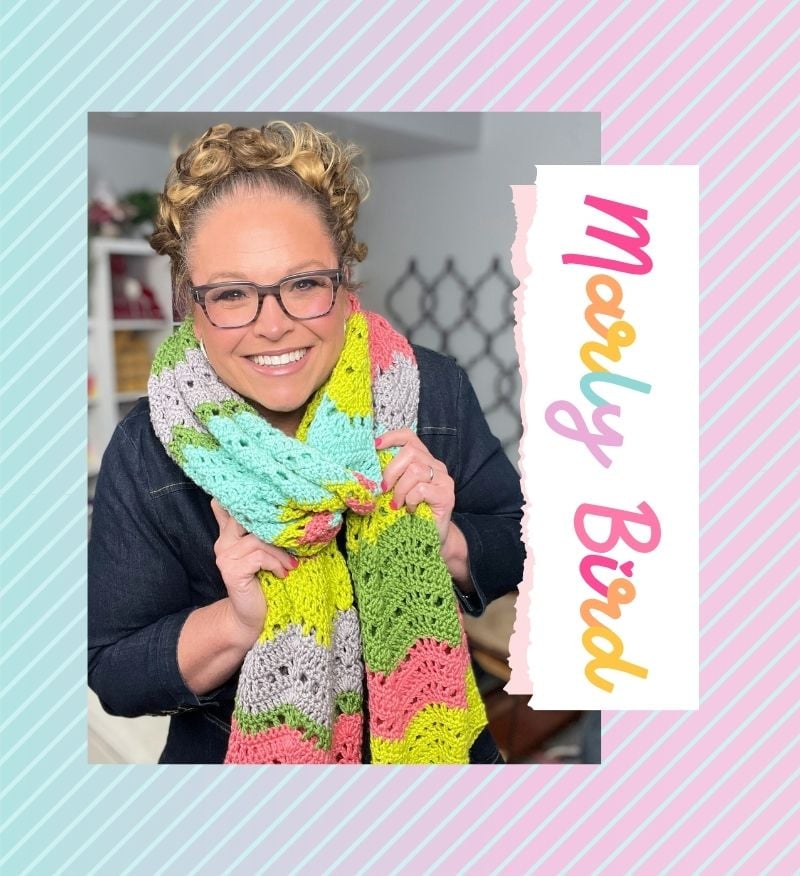
A few favorite sock yarn substitutes:

  • ๐Ÿงถ KnitPicks Stroll Fingering (75% superwash merino / 25% nylon, 231 yds / 50 g)… the WeCrochet/KnitPicks workhorse sock yarn. Same fiber blend as Patons Kroy, in solids, tonals, hand-dyed, and self-striping. Affordable and machine washable.
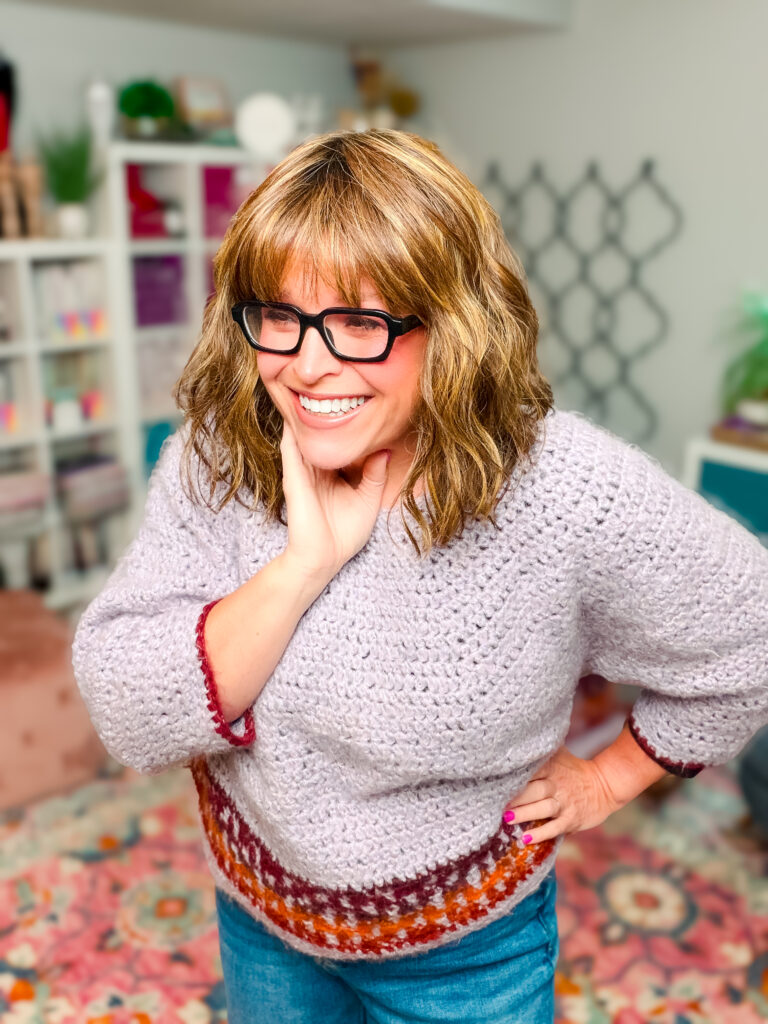
  • ๐Ÿงถ KnitPicks Hawthorne Fingering (80% superwash merino / 20% nylon, 357 yds / 100 g)… slightly more luxurious from the same family, available in solids and hand-painted multi-color skeins.
  • ๐Ÿงถ KnitPicks Capretta Superwash Fingering (80% superwash merino / 10% nylon / 10% cashmere, 230 yds / 50 g)… a splurge sock with cashmere softness. Still has 10% nylon for durability.
  • ๐ŸŒˆ KnitPicks Felici Sock Yarn… the classic self-striping sock yarn. Stripes are pre-planned in the skein for beautifully patterned socks without fussing with multiple yarn balls.
  • โœจ KnitPicks Static Sock Yarn… fun effect sock yarn that creates an organic speckled/static look as you knit or crochet.
  • ๐Ÿฆ‹ Malabrigo Sock Yarn… hand-dyed luxury sock yarn from Malabrigo. Saturated, jewel-tone colorways that make your socks feel like art on your feet.
  • ๐ŸŽจ Madelinetosh Tosh Sock Yarn… cult-favorite indie hand-dyed sock yarn known for gorgeous tonal colorways and a buttery soft hand-feel.
  • ๐Ÿงถ Berroco Vintage Sock… fingering-weight wool blend with nylon. Machine washable, durable, comes in a wide range of solids and heathers.
  • ๐Ÿงบ Stash yarn? Any indie hand-dyed sock yarn (Hedgehog Fibres, Spincycle, SweetGeorgia, Knerd String, Must Stash, etc.), Lion Brand Sock-Ease, or Regia Sock will work beautifully. Speckled and self-striping yarns look especially fun in the simple stockinette knit pattern or single crochet crochet pattern.

Want to browse the full KnitPicks sock-yarn lineup? Shop all KnitPicks sock yarn here.

For more sock yarn project ideas beyond socks, see my What To Crochet With Sock Yarn guide.

โญ๏ธ Marly Bird Amazon Storefront โญ๏ธ

The Original 2020 Sock-Along Lessons (Still Free)

The original 2020 sock-along released the patterns in three weekly parts, each with its own lesson page and video. These lesson pages are still live for anyone who wants the lesson-by-lesson experience or wants to reference a specific section:

Knit Toe-Up Sock โ€” Original 2020 Lesson Pages

  • Part 1: Cast-On, Toe, and Foot
  • Part 2: German Short Row Heel
  • Part 3: Leg and Cuff

Crochet Toe-Up Sock โ€” Original 2020 Lesson Pages

  • Part 1: Toe and Foot
  • Part 2: Heel
  • Part 3: Leg and Cuff

For the standalone full-pattern experience (recommended for new readers), use the new pattern post links at the top of this hub.


More Free Sock Patterns by Marly Bird

Once you've nailed your first toe-up pair, here's the rest of the Marly Bird sock library:

Free Knit Sock Patterns

  • My First Knit Socks (cuff-down)… if you want to learn cuff-down construction next
  • Marly Knit Socks… cuff-down with heel flap, ribbed cuff, eyelet leg
  • Hint of Hazelnut Knit Socks… colorful mini-skein vertical colorwork
  • Heartstrings Stranded Colorwork Socks… DK-weight stranded colorwork
  • Hygge Stripe Socks… worsted-weight beginner socks
  • Appalachian Cozy Up Thigh-High Knit Socks… continuous cables toe to thigh

Free Crochet Sock Patterns

  • How to Crochet Socks + 5 Free Crocheted Sock Patterns… the comprehensive crochet sock starter guide
  • Beginner Crochet Socks… your first crochet sock pattern
  • 10 Free Crochet Sock Patterns… Yarnspirations roundup of additional crochet socks

Sock Knitting Resources & Tutorials

  • The Ultimate Guide to Knit Socks… master sock-knitting tutorial
  • Sock Knitting Tools & Supplies… what you actually need to knit socks
  • Cheerful Cable Slipper Socks Tutorial… easy slipper sock alternative

Join our Newsletter

Get Free Crochet & Knitting
Pattern Links & Coupons!

Hand-drawn bird with curling, detailed feathers and pink accents; cheerful pose showcases fine line and texture work.
>> Become An Insider <<
A woman with glasses and curly hair models a colorful crocheted scarf, showing textured stitches and vibrant yarn.

Want to Master Sock Construction? Sock Workshops at Marly Bird House

If you want hands-on coaching, advanced techniques, multiple full sock patterns, and an 86-page sock ebook with sizing charts and stitch dictionary… my Marly Bird House sock workshops are the comprehensive deep-dive:

  • ๐Ÿงฆ Classic and Colorful Crochet Socks Workshop… 9 crochet sock patterns + 86-page ebook + 25 hours of video tutorials. The comprehensive crochet sock course.
  • ๐Ÿ“š The Crochet Sock Stitch Dictionary, Vol. 1… 20 stitches you can swap into any crochet sock pattern
  • ๐ŸŒฟ Tranquility Knit Socks & Tranquility Crochet Socks… mindfulness-paced sock courses available at Marly Bird House
  • ๐Ÿงด Aromatherapy Knit Socks & Aromatherapy Crochet Socks… self-care meets sock making

Browse all sock courses at Marly Bird House.


Watch the Original 2020 Sock-Along Announcement Video

This is the original announcement video that kicked off the 2020 Sock-Along. Even though the live event ended, the video is still genuinely useful for understanding the why and how of toe-up sock construction:

Knit and Crochet Toe-Up Socks Video Tutorial - Free Digital Pattern - Marly Bird

Frequently Asked Questions

What's the difference between toe-up and cuff-down sock construction?

Toe-up starts at the toe with Judy's Magic Cast-on, works the foot up, turns the heel, knits the leg, and binds off at the cuff. Cuff-down starts at the cuff, works the leg down, turns the heel, knits the foot, and grafts the toe shut with Kitchener stitch. Toe-up's main advantages: try them on as you go, use up every yard of yarn. Cuff-down's main advantages: classic heel flap construction, no Kitchener stitch needed at the end (the cuff IS the bind-off).

Do I need a special yarn for toe-up socks?

No special yarn… any sock-weight (CYCA #1 super fine) yarn works. Look for around 400+ yards per 100 grams. A wool/nylon blend gives you the best durability for actual wear. Hand-dyed indie sock yarn works beautifully here.

Are German short rows hard?

Honestly, no โ€” they're actually easier to memorize than wrap-and-turn short rows once you get the rhythm. The video tutorials walk you through every motion. By the end of one sock, you'll have it. And the heel comes out smoother and more polished than W&T heels every time.

What if I have a high instep or wide ankles?

Use my free Customize Sock Heel Diagonal worksheet. It walks you through the math step-by-step to adjust the pattern for your specific foot measurements. Free, downloadable, and the key to perfect-fitting socks.

Can a beginner make these socks?

Yes! Both knit and crochet versions are written for adventurous beginners. If you can knit/crochet basic stitches, work in the round, and watch a video to learn a new technique, you can make a pair of toe-up socks.

Where can I get the ad-free PDF?

The ad-free knit pattern PDF is available on Ravelry. The crochet pattern is being updated by Robyn Chachula and the new standalone version will be available soon.


๐Ÿ’ฌ Final Thoughts

Toe-up socks were the construction that made me fall in love with sock knitting. The 2020 sock-along introduced thousands of you to toe-up socks for the first time, and your finished pairs still show up on Instagram regularly. I love seeing them.

If you're new here and just discovering this hub: welcome. Pick your craft (knit or crochet), grab the pattern, watch the videos, and cast on. You've got this.

Tag your finished pairs @themarlybird with #mmmdi and #marlybird… I want to see every pair. ๐Ÿงฆ๐Ÿ’–

Love, Your BiCrafty Bestie, Marly Bird

Marly Bird Bitmoji with rainbow hearts

Filed Under: Crochet, Knitting, Make-Alongs, Pattern, Uncategorized, YouTube Video Tutorial

  • « Previous Page
  • 1
  • 2
  • 3
  • 4
  • …
  • 122
  • Next Page »

Let's Be Social

Join the Marly's Minions Facebook group to share, ask questions, or chat about all of your yarn related crafts!

Join the group
Cartoon of a smiling woman with brown hair in a bun, glasses, black jacket and green shirt, waving next to large "hi" text.

Quick Links

The Pattern Shop

Our Free Patterns

Blog

Marly Bird House

Learn to Knit & Crochet

About

Giveaway Terms and Privacy Notice

Find Us Everywhere

Join the Newsletter

YouTube Channel

Marly's Minions FB Group

Etsy Store

Ravelry Store


AN ELITE CAFEMEDIA HOME/DIY PUBLISHER

Information from your device can be used to personalize your ad experience. Do not sell or share my personal information.

Privacy Policyย  ย Termsย  ย Marly Bird Legal Documents Copyright © 2026