Free Knit Sock Pattern – Marly Knit Socks by Marly Bird
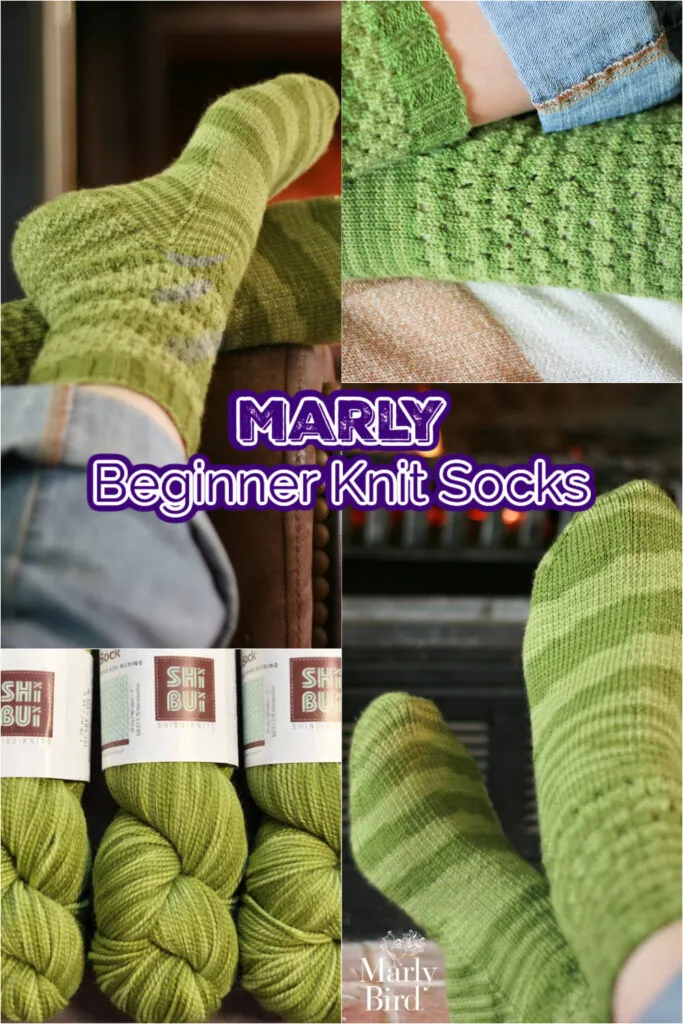
There’s just something magical about knitting socks. 🧦 They’re portable, practical, and once you get the hang of them… totally addictive. The Marly Knit Socks are one of my early sock designs, and they’re still a favorite because they hit that sweet spot between classic sock construction and just enough texture to keep things interesting.
Affiliate Disclosure: This post contains affiliate links. To learn more please visit my privacy policy here💖
This free knit sock pattern walks you through a traditional top-down sock with a ribbed cuff, eyelet leg, heel flap and gusset, and a smooth stockinette foot finished with a tidy Kitchener stitch toe. If you’ve been sock-curious or want to build confidence with heel construction, you’re in the right place.
What You Will Love About This Pattern
- 🧦 Classic top-down sock construction you can use again and again (perfect if you’ve knit something like the Skyline Ribbed Knit Socks and want to expand your skills)
- 👣 Heel flap + gusset for a comfy, customizable fit—an essential technique also used in my My First Knit Socks pattern
- ✨ Simple eyelet leg pattern that adds interest without stress
- 🎥 Linked video tutorials for key techniques
- 📏 Sizes included for Small, Medium, and Large feet
Special Features & Design Details
The Marly Knit Socks combine tried-and-true sock anatomy with thoughtful design choices:
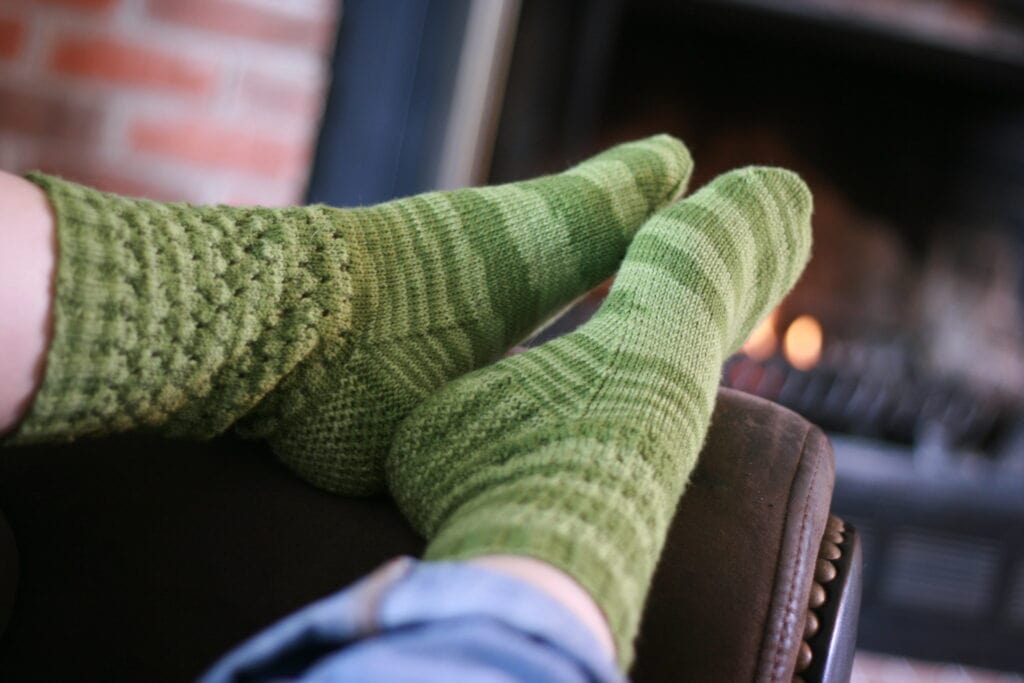
- 2×2 ribbed cuff for stretch and stay-put comfort
- Eyelet leg pattern worked in the round (don’t worry—it’s beginner-friendly!)
- Eye of Partridge heel flap with a garter stitch border for durability
- Traditional gusset decreases to shape the foot comfortably
- Smooth stockinette foot—perfect for cozy wear inside shoes
✨ Designer Tip: When working the eyelet pattern, it’s better to be slightly snug than too loose. This keeps the fabric looking crisp and wearable.
Sizing, Fit, Yarn & Gauge
- Sizes: Small (Medium, Large)
- Foot Circumference: 7 (8, 9) inches / 18 (20.5, 23) cm
Understanding Sock Fit (Why Gauge Really Matters)
Socks are meant to fit snugly, which means they rely on negative ease. That’s a fancy way of saying the sock is slightly smaller than your foot so it stretches to fit.
Because of this, gauge matters more in socks than almost any other project. A sock that’s even a little too loose can slip, bunch, or wear out faster.
The heel flap and gusset construction in this pattern helps accommodate different instep heights, making these socks comfortable and forgiving for many foot shapes.
Suggested Yarn:
Fingering weight sock yarn (CYCA size 1). A wool/nylon blend is recommended for durability.
Join our Newsletter
Get Free Crochet & Knitting
Pattern Links & Coupons!

Choosing the Best Yarn for Knit Socks
For socks that last, look for yarns that include:
- Wool for warmth, elasticity, and comfort
- Nylon or polyamide for strength and abrasion resistance
Avoid yarns with no elasticity (like cotton) for your first pair—they tend to stretch out and won’t bounce back the way wool does.
Gauge of the Marly Knit Socks: 28 sts = 4” (10 cm) in eyelet pattern. But the yarn you choose should be used for a gauge swatch to see if you like the fabric that is created when knit at this gauge.
Is This Sock Pattern Right for You?
If you’ve been eyeing sock knitting but wondering whether this pattern is the right place to start, let me put your mind at ease.
The Marly Knit Socks are ideal if you:
- Are comfortable knitting and purling in the round
- Want to learn classic sock construction that applies to many patterns
- Are ready to try a heel flap and gusset with clear guidance
- Appreciate video support when learning new techniques
If you’re brand new to socks and want extra hand-holding, pairing this pattern with my My First Knit Socks Make-Along is a fantastic way to build confidence (more on that below).
Skill Level & Techniques You’ll Practice
This pattern is great for advanced beginners who are ready to learn sock fundamentals or knitters wanting a reliable go-to sock recipe. If you’re brand new to sock knitting, I recommend starting with my full beginner guide on how to knit socks before diving in.
You’ll practice:
- Knitting in the round on DPNs
- Yarn overs and basic decreases
- Heel flap and gusset construction (a building block you’ll see again in patterns like the Heartstrings Knit Socks)
- Turning a heel
- Kitchener stitch for seamless toes
The pattern includes video tutorial links for techniques like the No Cuss Cast On, SSK, K2tog, adding a lifeline, and grafting the toe—so you’re never stuck guessing.

Needle Options
Socks can be knit using a few different needle setups, and every sock knitter eventually develops a favorite. For this pattern, though, I want to be very clear and encouraging:
👉 The Marly Knit Socks pattern is written for double-pointed needles (DPNs).
Here’s a quick breakdown of the most common sock needle options:
- Double-Pointed Needles (DPNs):
This is the classic sock-knitting method and the one used in this pattern. You’ll typically work with four or five needles, dividing the stitches evenly. Yes, DPNs can feel a little scary at first—but I promise, they are not as hard as they look.With my No Cuss Cast On and a few simple habits (like keeping the first two stitches of each needle extra snug to prevent ladders), DPNs become incredibly reliable and portable.🎥 I highly recommend watching my No Cuss Cast On video here:
- Magic Loop (Long Circular Needle):
Some knitters prefer using one long circular needle to knit socks using the magic loop method. While this pattern isn’t written for magic loop, experienced knitters can adapt the stitch distribution if they’re comfortable doing so. - Two Circular Needles:
Another popular option that splits stitches across two circular needles. Like magic loop, this requires some personal adaptation since the instructions assume DPNs.
✨ Designer Tip: If DPNs have intimidated you in the past, this pattern is a great place to make peace with them. Between the structured construction and my video support, you’ll be surprised how quickly your confidence grows.
Styling & Wear Ideas
These socks are perfect for:
- Lounging at home with your favorite mug ☕ (very Treat Your Feet vibes—hello Treat Your Feet Sock Make-Along!)
- Slipping into boots or sneakers
- Gifting (hand-knit socks = instant hero status)
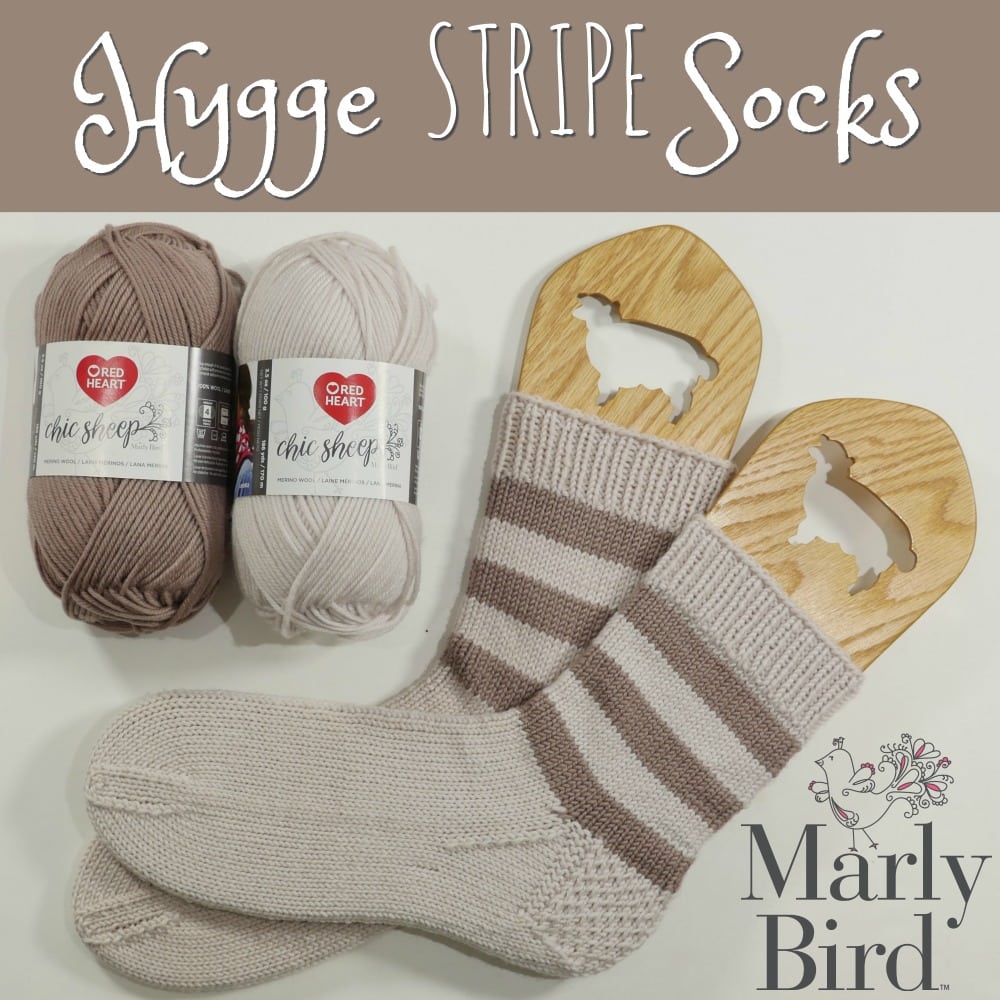
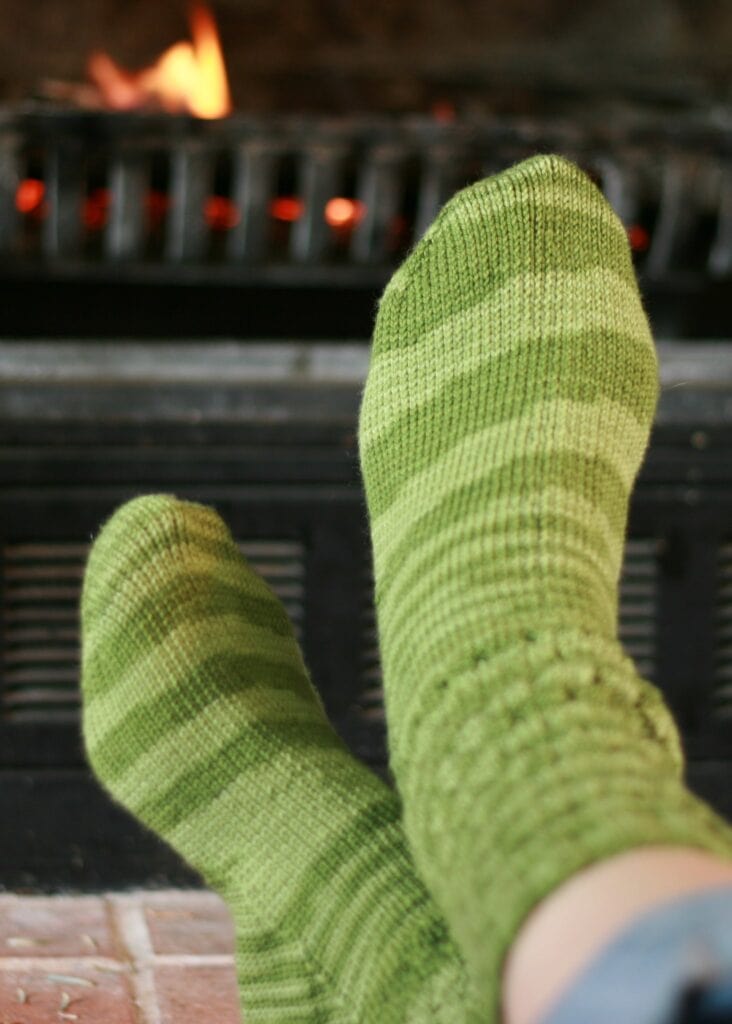
They look especially lovely in hand-dyed yarns that show off subtle color pooling—but solid colors work beautifully too. If you love playful colorwork or stripes, be sure to check out my Hygge Stripe Socks.
Top-Down vs Toe-Up Socks (Which Should You Try First?)
One of the biggest questions knitters have is whether to knit socks top-down or toe-up—and the truth is, there’s no wrong answer.
Top-down socks (like Marly Knit Socks):
- Start at the cuff and work toward the toe
- Use a traditional heel flap and gusset
- Make it easy to try on as you go
I usually start all my first time sock knitters with top down socks and with double pointed needles. After they have made their first pair of sock that way, I then encourage them to make toe up socks with two circulars.
Toe-up socks:
- Start at the toe and work upward
- Allow you to use every bit of yarn
- Often pair well with short-row heels
If you’re curious about toe-up socks, I also have a full toe-up beginner series available to explore when you’re ready.
My First Knit Socks Make-Along (A Must-Watch Resource)
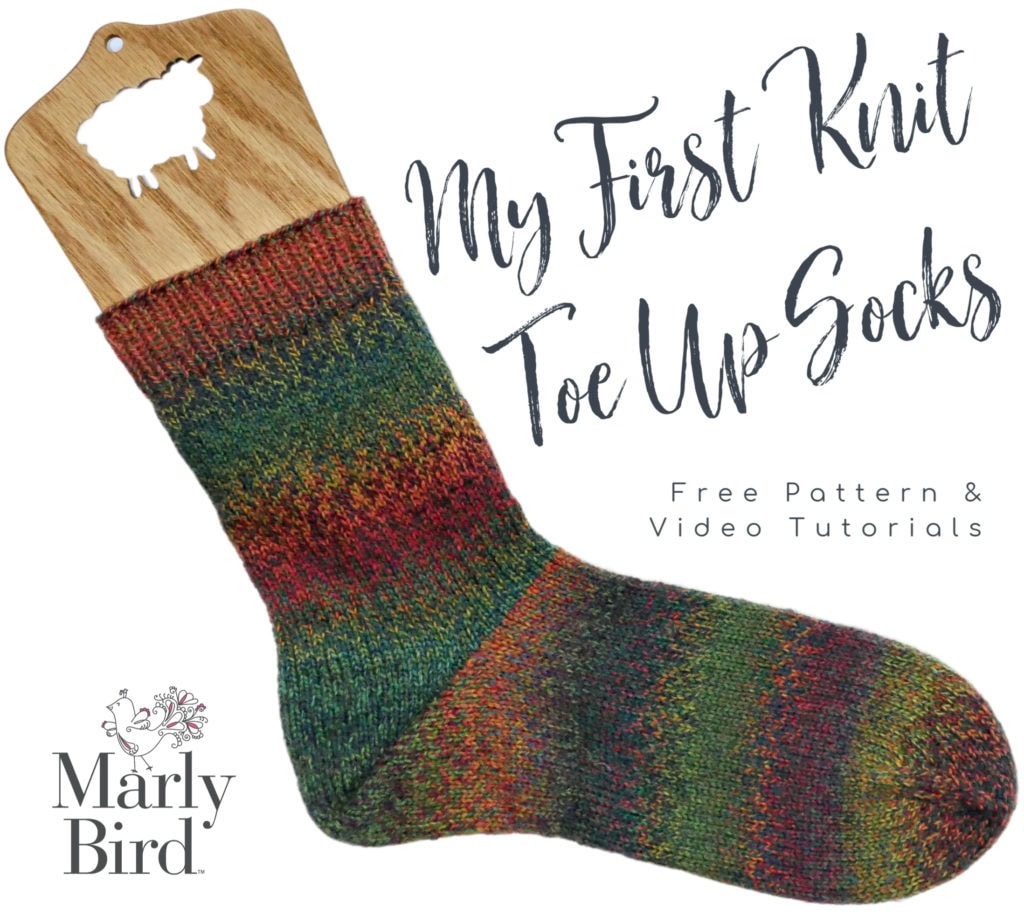
If you want even more hand-holding and encouragement as you learn to knit socks, I have to tell you about my My First Knit Socks Make-Along.
This video series is one of the most popular sock-knitting series on my YouTube channel, and for good reason—it walks knitters step by step through the entire sock-making process with real-time tips, troubleshooting, and lots of reassurance.
🧦 Why knitters love this series:
- Clear, beginner-friendly explanations
- Full sock construction from cast-on to Kitchener stitch
- Confidence-building pacing (no rushing!)
- Perfect companion to patterns like Marly Knit Socks
🎥 Watch the top-down My First Knit Socks playlist here:
https://www.youtube.com/playlist?list=PLCtrs9o46Za6XMulGtnAJEMHj1oBl2g1Y

The coordinating My First Knit Socks pattern is free and available through Yarnspirations.
Prefer Toe-Up Socks?
If toe-up construction is more your style, I’ve also created a Toe-Up My First Sock experience.
🎥 Watch the toe-up sock playlist here:
https://www.youtube.com/playlist?list=PLCtrs9o46Za5YgBsu2svdPvTJZuMzUuqa


Marly Beginner Knit Sock Pattern Details
Suggested Yarn
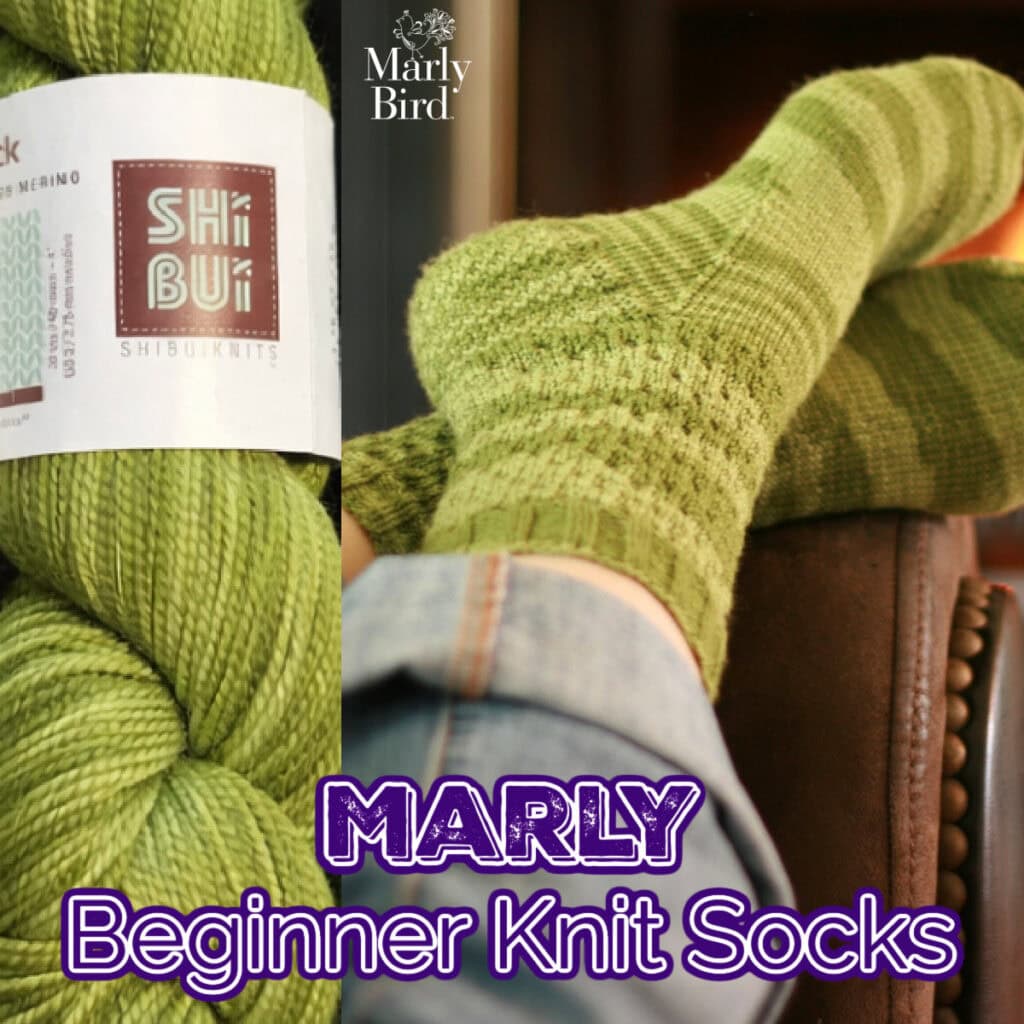
- KnitPicks “Hawthorn”; 80% Fine Superwash Highland Wool, 20% Polyamide (Nylon); 357 yds [xxx m] / 100g [xxx ounces]; CYCA size 1 Fingering — 1 (1, 2) hanks
Sample Yarn
- Shibui Knits “Sock”; 100% merino; 191 yd [175 m] / 50 g [1.76 ounces]; CYCA size 1 Fingering — Color Wasabi 2 (2, 3 balls) discontinued
Needles
- Set of five DPN’s size US 2 (2.75 mm); or size to obtain correct gauge (recommend Signature Needle Arts)
Notions
Finished Measurements
- To Fit Foot Circumference: 7 (8, 9)” / 18 (20.5, 23) cm
To Fit Sizes
- S (M, L)
Gauge
- 28 sts = 4” (10 cm) in Eyelet pattern
- It is better to have the eyelet pattern a bit snug vs. too loose!
Abbreviations
- BEG – Beginning
- EST – Establish(ed)
- K – Knit
- LHN – Left Hand Needle
- P – Purl
- PAT – Pattern
- NDL – Needle
- P2TOG – Purl 2 Together
- PU & K – Pick Up & Knit
- RHN – Right Hand Needle
- RS – Right Side
- REM – Remaining
- RND(S) – Round(s)
- ST(S) – Stitch(es)
- WS – Wrong Side
- WYIB – With Yarn In Back
- SL – Slip
Video Tutorials
- No Cuss Cast On – https://youtu.be/0d6i5bRL52A
- Knit – https://youtu.be/nkzVGuaksR8
- Purl – https://youtu.be/TsPqLvRmOow
- SSK – https://youtu.be/sjT0hKT5SD8?t=1074
- K2tog – https://youtu.be/JrHqDYb2ss8?t=346
- Yarn Over – https://youtu.be/sjT0hKT5SD8?t=602
- Add a Lifeline – https://youtu.be/FiqYUE_aHAw
- UnKnit / Tink – https://youtu.be/c7Gud7k4Y8k
- Bury Ends – https://youtu.be/B_NBGUKjO-E
- Kitchener Stitch – https://youtu.be/IGxJ7wccHGA
Special Stitches & Pattern Stitches
k2tog
Knit 2 sts together (1st decreased).
Knitwise: insert RHN into st on LHN as if to knit.
p2tog
Purl 2 sts together (1st decreased).
Purlwise: insert RHN into st on LHN as if to purl.
slip
Slip a stitch as if to purl unless otherwise noted.
ssk
Slip 2 sts, 1 at a time, knitwise to the RHN; return sts to LHN in turned position and knit them together through the back loops (1st decreased).
Kitchener Stitch
Step 1: Bring threaded tapestry needle through first st on front needle as if to knit and slip this st off needle.
Step 2: Bring threaded tapestry needle through next st on front needle as if to purl and leave st on needle.
Step 3: Bring threaded tapestry needle through first st on back needle as if to purl and slip this st off needle.
Step 4: Bring threaded tapestry needle through next st on back needle as if to knit and leave st on needle.
Repeat Steps 1–4 until no sts remain on needles.
2 x 2 Rib in the Round (multiple of 4 sts)
- Rnd 1 (RS): *K2, p2; rep from * to end.
- Rnd 2: Knit the knit sts and purl the purl sts as they face you.
Repeat rnd 2 for 2 x 2 Ribbing pat.
Eyelet Pattern in the Round (multiple of 4 sts)
- Rnd 1 (RS): Knit.
- Rnd 2: *K2tog, yo, k2; rep from * to end of rnd.
- Rnd 3: Knit.
- Rnd 4: *K2, k2tog, yo; rep from * to end of rnd.
Repeat these 4 rnds for Eyelet pat.
Eye of Partridge Heel with 3 Garter St Border
- Rows 1 and 3 (WS): K3, purl.
- Row 2 (RS): P3, *k1, sl1 wyib, repeat from * to last 3 sts, k3.
- Row 4 (RS): P3, *sl1 wyib, k1, repeat from * to last 3 sts, k3.
Repeat these 4 rows for Eye of Partridge Heel.
Notes
- Pattern is written for double pointed needles. Using a set of 5 double points will help eliminate ladders at the connection points.
- Highly recommend reviewing the No Cuss Cast On for a sure fire way to cast on to the double points.
- Pattern could easily be made using two circulars by an accomplished knitter.
- The instructions are written for smallest size. If changes are necessary for larger sizes the instructions will be written thus ( ). When only one number is given, it applies to all sizes.
- Pattern includes written instructions and pattern chart for eyelet pattern and heel stitches.
- When working on gauge for eyelet pattern, it is better to err on the side of a bit snug vs. too loose.
Distributing Stitches on Double-Pointed Needles (DPNs)
When beginning the sock, stitches are typically divided evenly across four working double-pointed needles, with a fifth needle used to knit. For example, if you have 56 stitches, you might place 14 stitches on each of four needles. Arrange the needles so they form a square or triangle, making sure the cast-on edge is not twisted before joining to work in the round. Some knitters find it helpful to imagine the needles as the four sides of a sock tube, with each needle holding one section of stitches. A simple diagram or photo showing this layout can help first-time sock knitters visualize the setup and feel more confident before joining.
Measuring Foot Length Before Knitting the Foot
Before starting the foot section, measure the length of the foot from the back of the heel to the tip of the longest toe. When knitting socks top-down, the foot is usually worked until it measures approximately 1 to 1½ inches (2.5–4 cm) shorter than the total foot length to allow room for the toe shaping. Measuring the foot ahead of time is especially helpful when knitting for someone else, as it allows you to customize the length and avoid socks that are too short or too long.
Preventing Ladders Between Needles
Ladders—loose vertical gaps that can appear between needles—are common when knitting in the round with DPNs, especially for newer sock knitters. To help prevent ladders, keep the first two stitches on each needle worked slightly snug. Periodically adjusting where the needle transitions occur by shifting a few stitches from one needle to another can also help distribute tension more evenly. Using a set of five DPNs instead of four may further reduce laddering by spreading stitches across more needles.

GROW
To Unlock Exclusive Subscriber Content click the Box below and join for free by simply adding your email and creating a password! If you are having troubles, clear your cache or reset your password or login to the Grow Publisher Portal.
>> Learn More About Grow Here <<
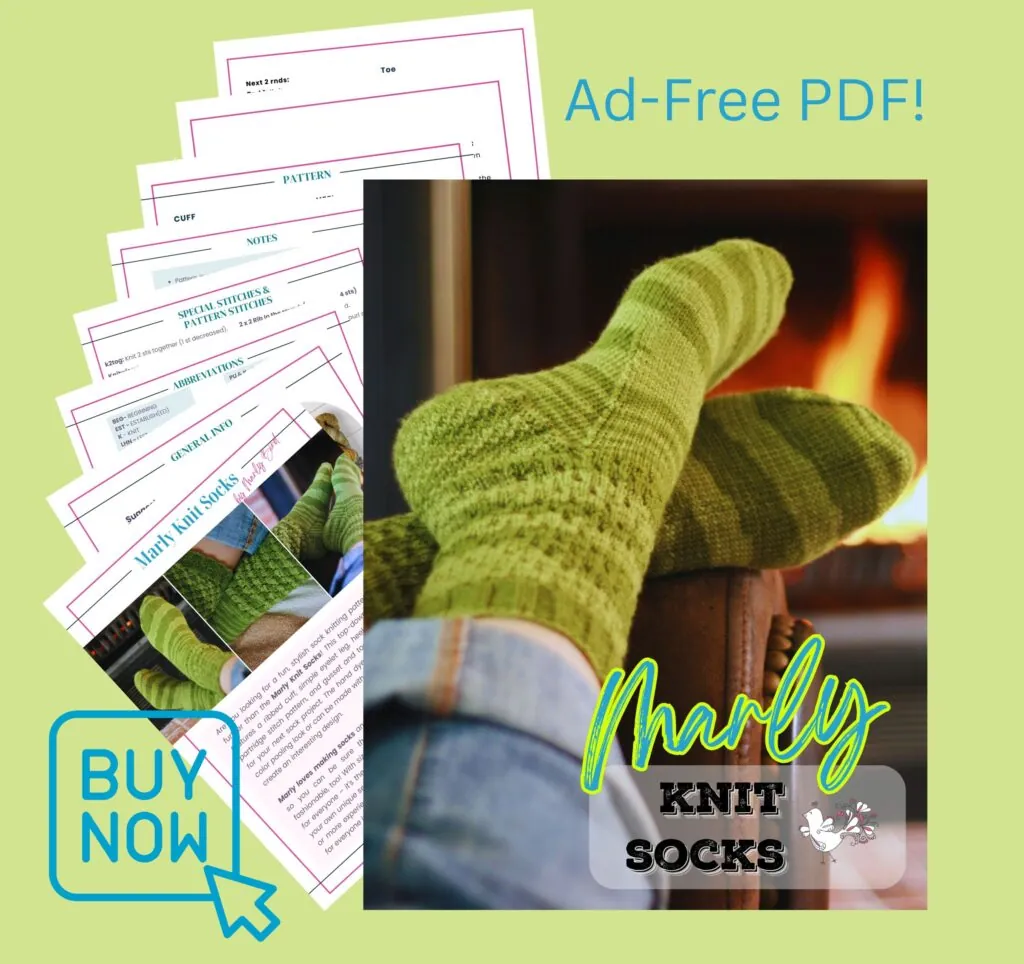
I'm thrilled to share this amazing pattern with you, many patterns on my blog are absolutely free! I kindly request that you don't copy and paste or distribute this pattern. Prefer an ad-free experience? Buy a digital PDF pattern for a small fee from one of my online stores for a seamless crafting journey.
I appreciate your support and readership. You are the reason I can keep doing what I love and sharing it with others. So, thank you from the bottom of my yarn-loving heart! Disclosure: This post contains affiliate links, meaning I get a commission if you decide to make a purchase through my links at no cost to you.
Marly Knit Sock Pattern – Beginner Knit Friendly
Cuff
Using long tail CO 56 (64, 72) sts divided evenly on 4 DPN’s – 14 (16, 18) sts per ndl. Join in the rnd being careful not to twist cast on edge. Knit one rnd. Begin 2 x 2 Ribbing pat (see pattern stitches) and work until cuff measures 1 1/2” (4 cm).
Leg
Work in Eyelet pat (see pattern stitches) across all sts in rnd. Continue in pattern until leg measures 6 (7, 8)” [15.25 (18, 20.5) cm] ending with a pat row 3.
Heel
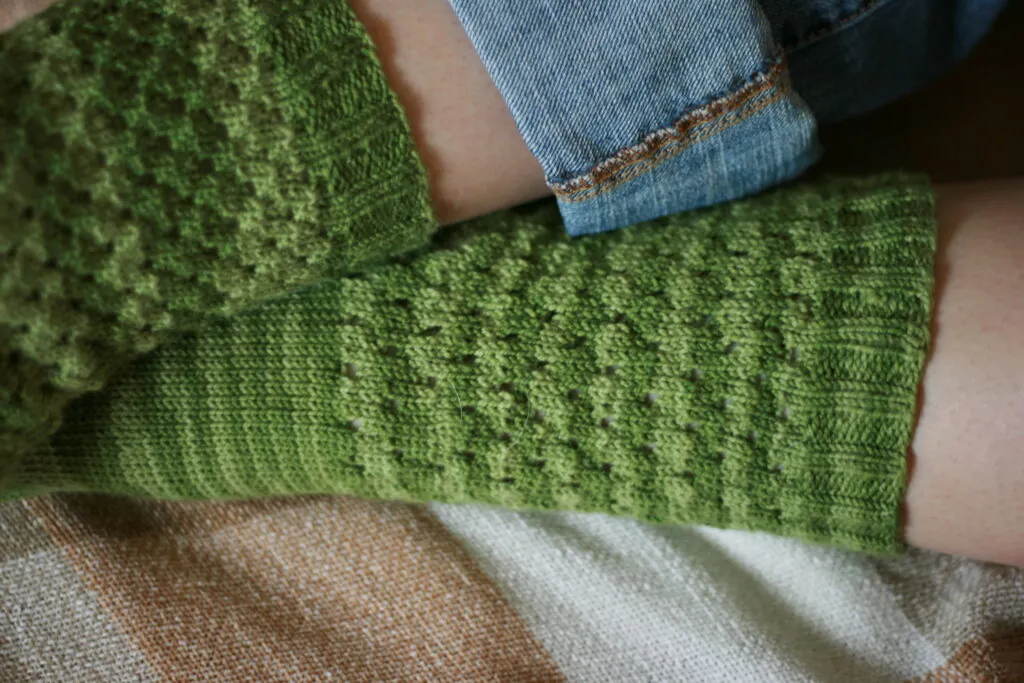
Slip all sts from ndl #4 onto ndl #3 for heel. Heel flap is worked back and forth across the 28 (32, 36) sts on ndl #3.
Turn work so wrong side is facing, and work heel flap across ndl #3 in Eye of Partridge pattern stitch with Garter Stitch border (also see chart):
- Rows 1 and 3 (WS): K3, purl.
- Row 2 (RS): P3, *k1, sl1 wyib, repeat from * to last 3 sts, k3.
- Row 4 (RS): P3, *sl1 wyib, k1, repeat from * to last 3 sts, k3.
Repeat rows 1–4 6 (7, 8) more times – 28 (32, 36) rows total. The heel flap should be about square.
Turn Heel
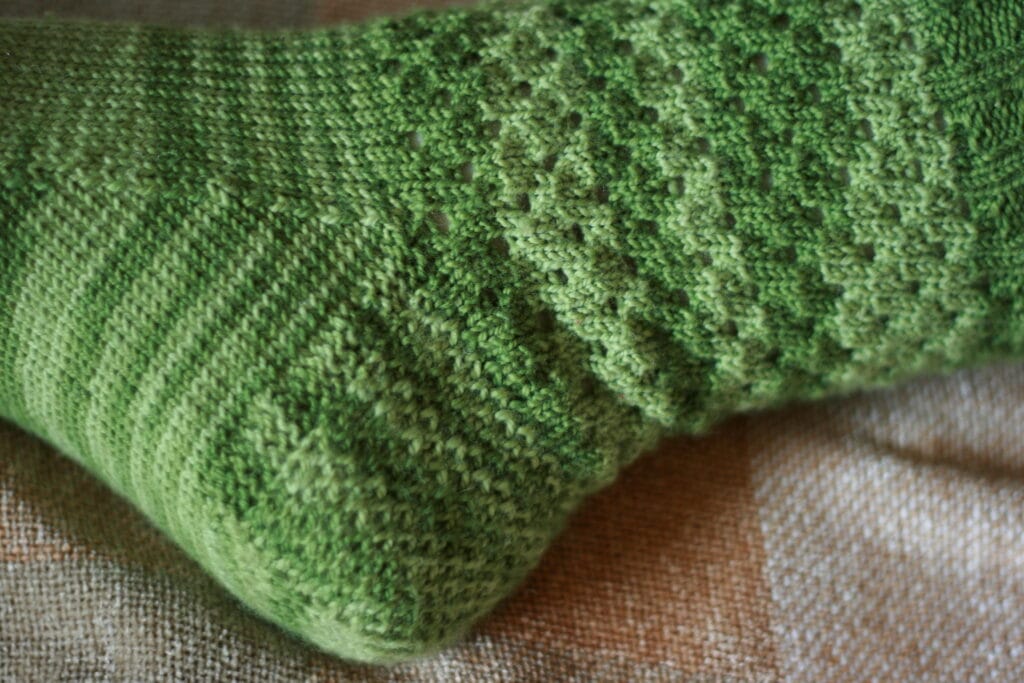
- Row 1 (WS): Sl1, p14 (16, 18) p2tog, p1.
- Row 2: Sl1, k3, k2tog, k1.
- Row 3: Sl1, p4, p2tog, p1.
- Row 4: Sl1, k5, k2tog, k1.
Continue in this manner, working 1 more stitch on each row, until 16 (18, 20) sts remain on ndl, ending with a RS row.
Gusset
Using a new needle and with RS facing, pu & k 14 (16, 18) sts down left side edge of heel flap and 1 extra st at top of gusset – this is the new ndl #1.
Using a new needle, knit across the next 14 (16, 18) sts – this is the new ndl #2.
Using a new needle, knit across the next 14 (16, 18) sts – this is the new ndl #3.
Using a new needle, pu & k 1 st at top of gusset, then 14 (16, 18) sts up right side edge of heel flap and with same needle knit next 8 (9, 10) sts of heel flap – this is the new ndl #4.
This is the new starting point for the rounds. There are still 8 (9, 10) sts remaining on the ndl from the heel; slip the remaining stitches on the heel to ndl #1. Begin to work in rounds.
Next 2 Rnds
- Rnd 1: Knit.
- Rnd 2: Ndl #1 – k to last 3 sts, k2tog, k1; ndl #2 and #3 – knit; ndl #4 – k1, ssk, k to end.
Repeat rnds 1 and 2 until 56 (64, 72) sts total remain.
Foot
Work in Stockinette st (k every rnd) until sock measures 1 1/2” (4 cm) from desired length to toe.
Toe
- Rnd 1: Ndl #1 – k to last 3 sts, k2tog, k1; ndl #2 – k1, ssk, k to end; ndl #3 – k to last 3 sts, k2tog, k1; ndl #4 – k1, ssk, k to end.
- Rnd 2: Knit.
Repeat rnds 1 and 2 until 16 (16, 20) sts remain.
Finishing
Graft toe sts using Kitchener stitch. Weave in all loose ends. Wash sock in a wool wash then lay flat to dry.
Love It? Save It on Ravelry 💖
If you’re excited about this pattern, be sure to favorite it on Ravelry, add it to your queue, and share your finished socks with the community!

More Sock Patterns You Might Enjoy
If you loved knitting these socks, you’ll find even more inspiration in my roundups and sock collections, including:
- 10 Free Knit Sock Patterns for your next cast-on
- Classic and beginner-friendly options like My First Knit Socks
- Fun texture and color ideas in the Heartstrings Knit Socks
- A beautifully textured option with subtle detail in the Hint of Hazelnut Knit Socks
- A bold, confidence-boosting statement piece with the Thigh-High Knit Sock Pattern
- A modern textured sock design like the Alex Seersucker Knit Socks
✨ Designer Tip: Both the Thigh-High Knit Socks and Alex Seersucker Knit Socks are part of the BiCrafty Stitch Nite Collection, available exclusively inside the Marly Bird House, where you’ll find guided projects, community support, and skill-building fun.

Frequently Asked Questions
Are these socks good for first-time sock knitters?
Yes! If you’re comfortable knitting in the round and ready to learn heel construction, this is a great first beginner knit sock pattern.
Can I use a different sock yarn?
Absolutely. Any fingering weight sock yarn will work—just be sure to check gauge.
Can I knit these with circular needles?
Yes, experienced knitters can adapt the pattern for magic loop or two circs.
Final Thoughts
The Marly Knit Socks are proof that classic never goes out of style. Whether you’re knitting your very first pair or adding another cozy set to your drawer, this pattern gives you solid skills and a sock you’ll actually want to wear.
Happy sock knitting! 🧦✨
❤️ Your BiCrafty Bestie,
Marly Bird

Categories: Free Patterns, Knitting, Marly Bird Premium Patterns, Our Free Patterns, Pattern