Heartstrings Stranded Colorwork Socks – FREE KNIT SOCK PATTERN
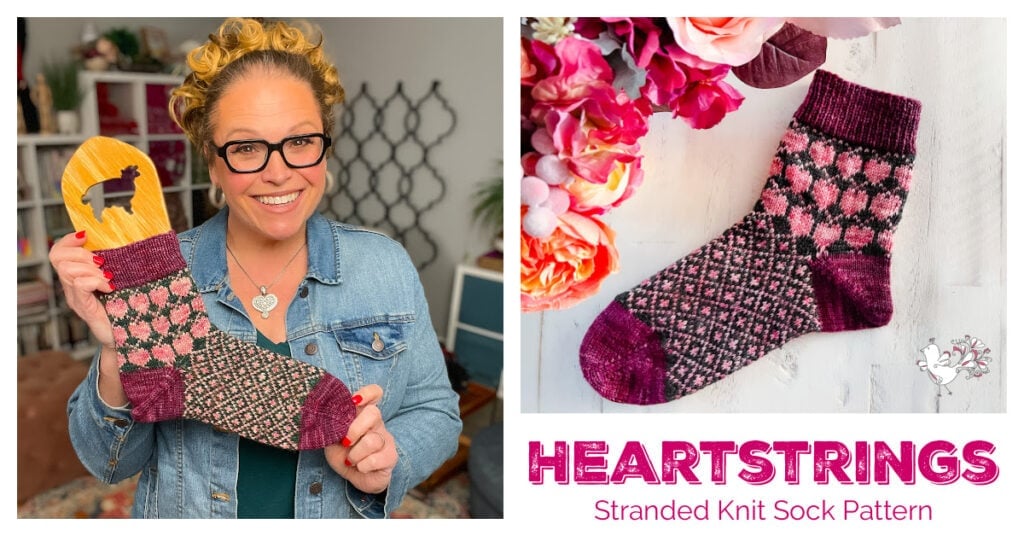
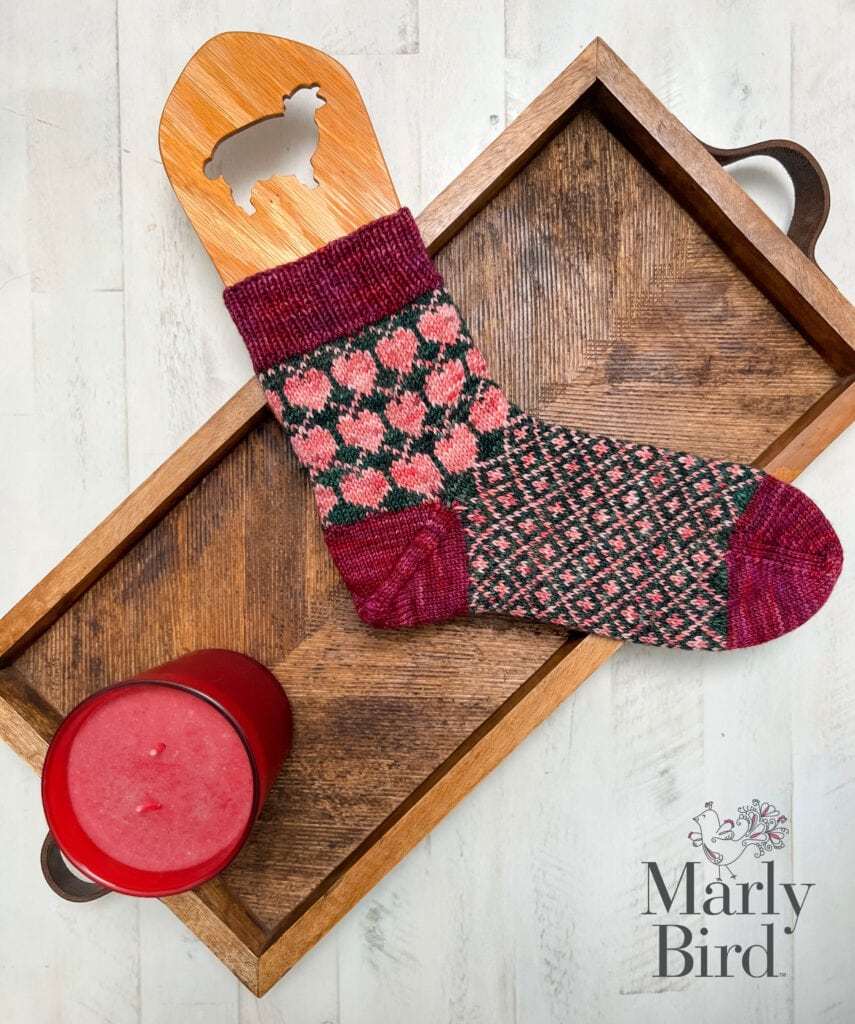
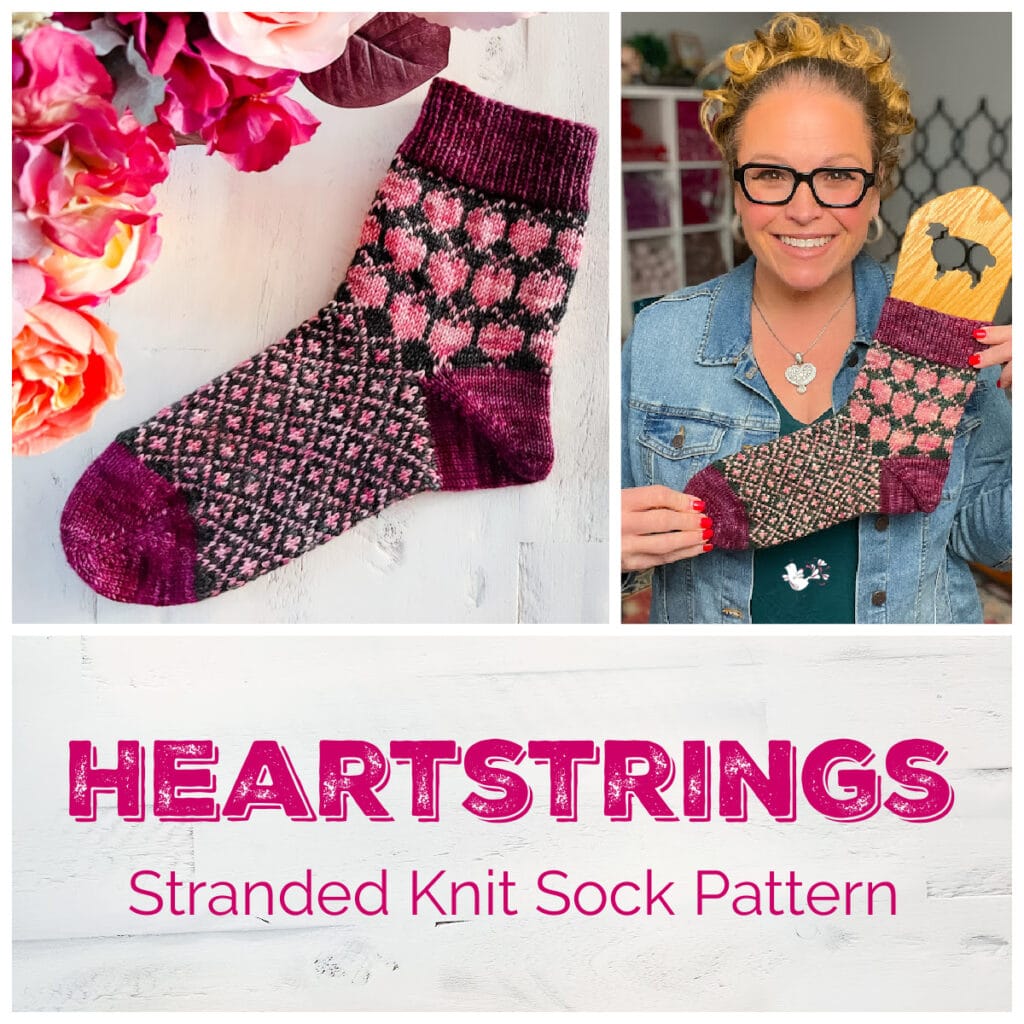
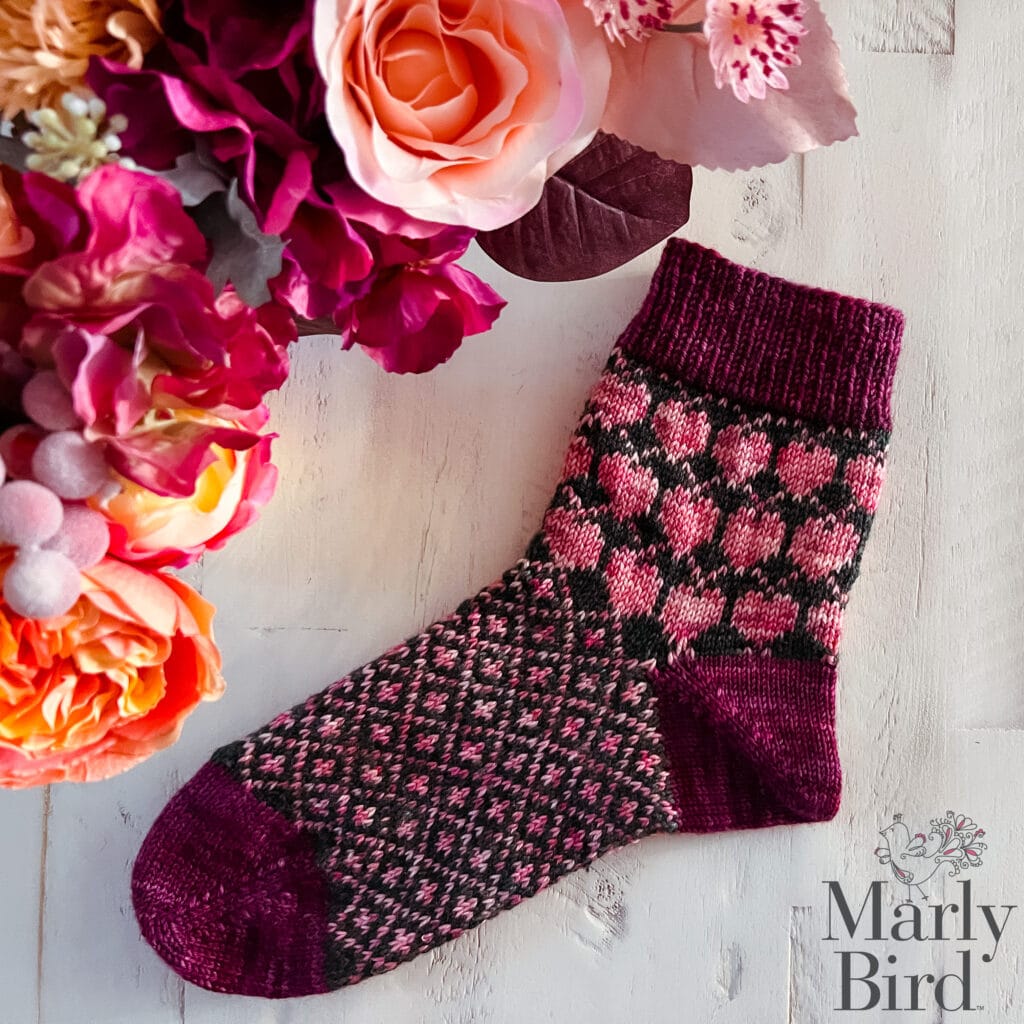
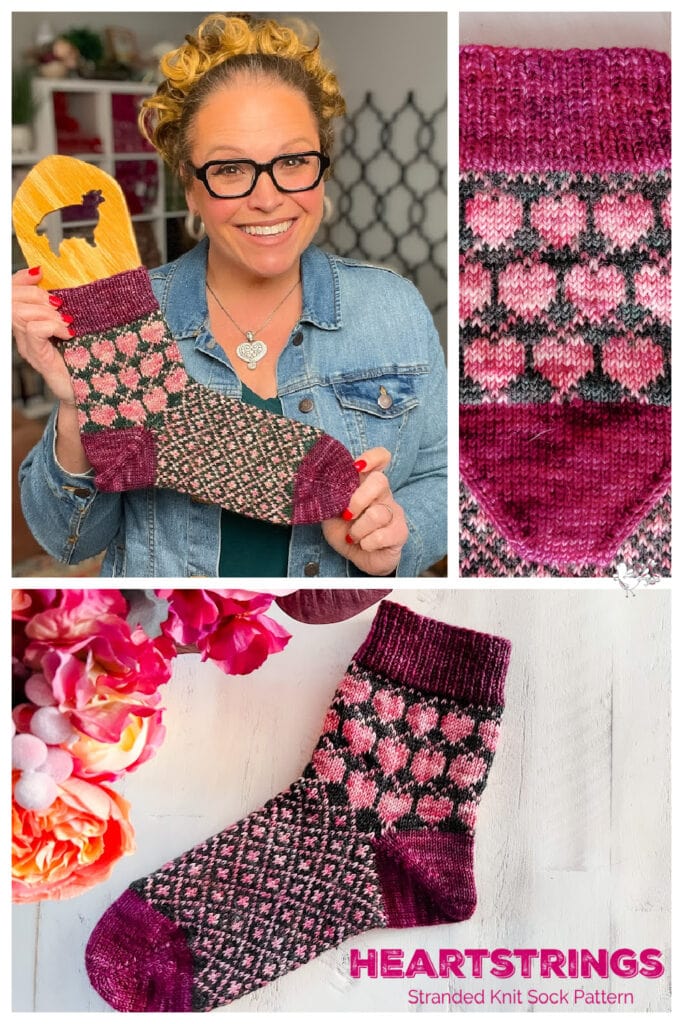
If you’ve been craving a stranded colorwork sock pattern that actually lets you flex your skills, say hello to the Heartstrings Socks.
These DK weight socks were originally available only inside my Camp Colorwork course in the Marly Bird House. So many of you asked for more intermediate and advanced sock patterns that I decided it was time to bring Heartstrings out into the wild as a free pattern on MarlyBird.com.
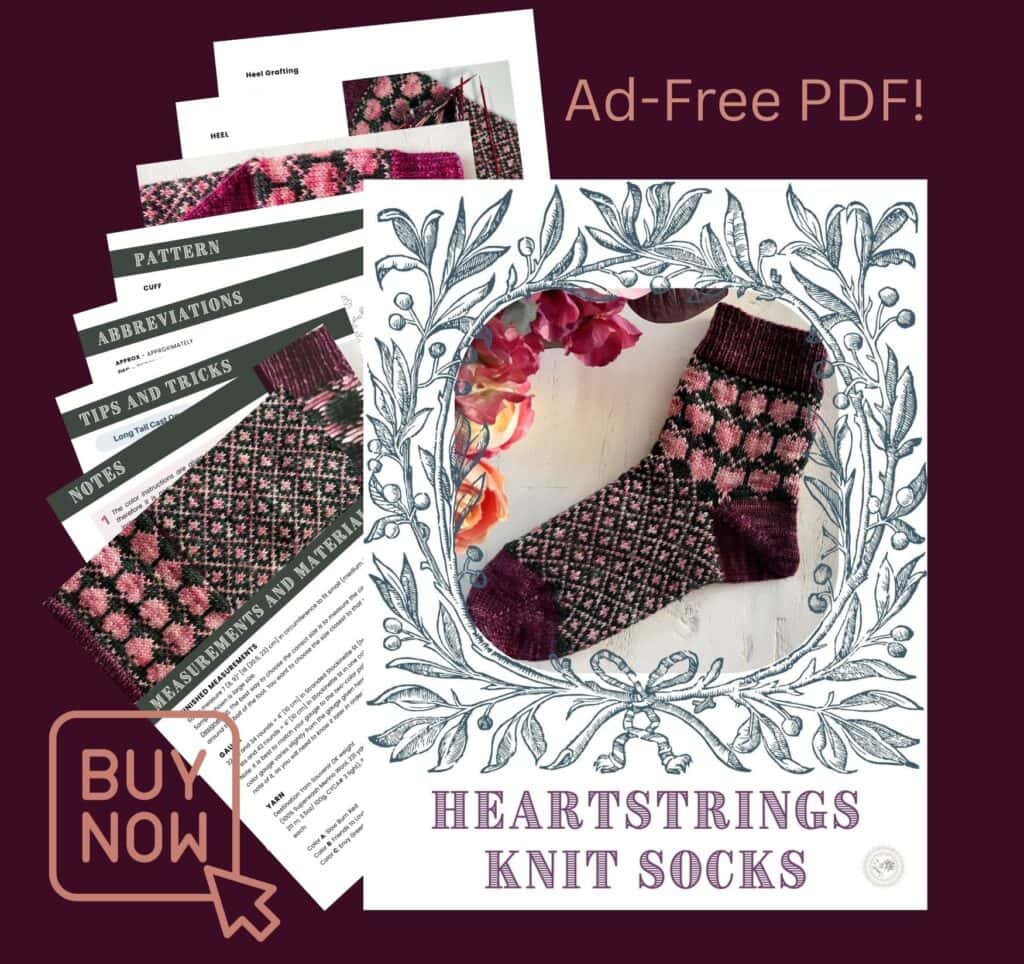
You’ll also be able to grab an ad-free, printable PDF if you love keeping your sock patterns in a binder or on your tablet, but the full written pattern will be available here to knit from for free.
Heartstrings is all about romance, rhythm, and really satisfying colorwork. Inspired by the idea of regency love letters, the motifs echo hearts, flourishes, and that slow, thoughtful kind of love that shows up in rows and rows of tiny stitches.
Affiliate Disclosure: This post contains affiliate links. To learn more please visit my privacy policy here💖
ABOUT THE HEARTSTRINGS SOCKS
These are top-down, stranded colorwork socks knit in the round with a forethought (afterthought-style) heel and a wedge toe, written for three adult sizes.
The fabric is worked in stranded stockinette using DK weight yarn, which means:
- The socks feel cozy and substantial on the foot.
- The colorwork is easier to manage than it would be in tiny fingering weight.
- You can really see and enjoy the motifs as you knit.
The pattern includes:
- Three sizes: Small, Medium, Large
- Clear instructions for the forethought heel
- A stranded leg and foot, with a solid toe and heel
- Designer tips built into the notes so you can adjust length and heel depth
Skill level: Intermediate
These are perfect if you’re comfortable with sock basics and ready to level up your colorwork.
WHAT YOU’LL LOVE ABOUT THESE SOCKS
Here’s why I think Heartstrings is going to land in your “knit these again” pile:
- DK weight stranded colorwork: You get that classic colorwork look with fewer stitches per round and a cozier fabric.
- Thoughtful motifs: Inspired by regency-style romance, these socks have heart-like shapes and ornamental rhythm without feeling too literal or cutesy.
- Customizable options: With multiple colorwork motifs and three sizes, you can really make them your own.
- Forethought heel: If you like clean lines and a great fit, this heel style is incredibly satisfying.
- Technique builder: You’ll practice stranded knitting, color dominance, forethought heel construction, and toe grafting all in one project.
If you’ve been wanting to move beyond plain vanilla socks and really play with colorwork, Heartstrings is a fantastic next step.
PATTERN DETAILS AT A GLANCE
Skill Level
Intermediate
To Fit Sizes
Small, Medium, Large
Finished Measurements
Socks measure approximately 7 (8, 9) inches / 18 (20.5, 23) cm in circumference.
Sample shown is Large size.
Designer Tip:
The best way to choose your size is to measure the circumference around the ball of the foot. Choose the size closest to that measurement for a snug, comfortable fit.
Gauge
32 sts and 34 rounds = 4 inches / 10 cm in stranded stockinette stitch (two-color knitting).
28 sts and 42 rounds = 4 inches / 10 cm in stockinette stitch in one color.
Note: It’s best to match your gauge to the stranded stockinette gauge. If your one-color gauge varies slightly, that’s ok. Just make a note of it, because you’ll need that number when you customize the foot length.
Yarn
Destination Yarn Souvenir DK Weight
100% Superwash Merino Wool
231 yds / 211 m, 3.5 oz / 100 g, CYCA #3 light
Color A: Slow Burn Red – approximately 1.75 oz / 50 g
Color B: Friends to Lovers Peach – approximately 1.75 oz / 50 g
Color C: Envy Green – approximately 1.75 oz / 50 g
Needles
US 2 (2.75 mm) set of double-pointed needles, or size needed to obtain gauge.
Notions
Removable stitch markers
Scrap yarn (for the forethought heel) or Stitch Saver (I love this stuff!)
Tapestry needle
Abbreviations
Approx – approximately
Dec – decrease
K – knit
K2tog – knit two together
P – purl
RS – right side
Sl – slip
Ssk – slip, slip, knit (see Special Stitches)
St st – stockinette stitch (knit on RS and purl on WS)
St(s) – stitch(es)
WS – wrong side
Special Stitch
Ssk (Slip, Slip, Knit): Slip 2 stitches, one at a time, as if to knit. Insert left hand needle into the front of these two stitches and knit them together from this position (1 stitch decreased).
VIDEO SUPPORT FOR KEY TECHNIQUES
You can pair this pattern with some of my favorite technique videos:
Long Tail Cast On >> Click Here for Video Help <<
No Cuss Cast On >> Click Here for Video Help <<
Duplicate Stitch >> Click Here for Video Help <<
Weave in Floats >> Click Here for Video Help <<
Kitchener Stitch >> Click Here for Video Help <<
Bury Ends >> Click Here for Video Help <<
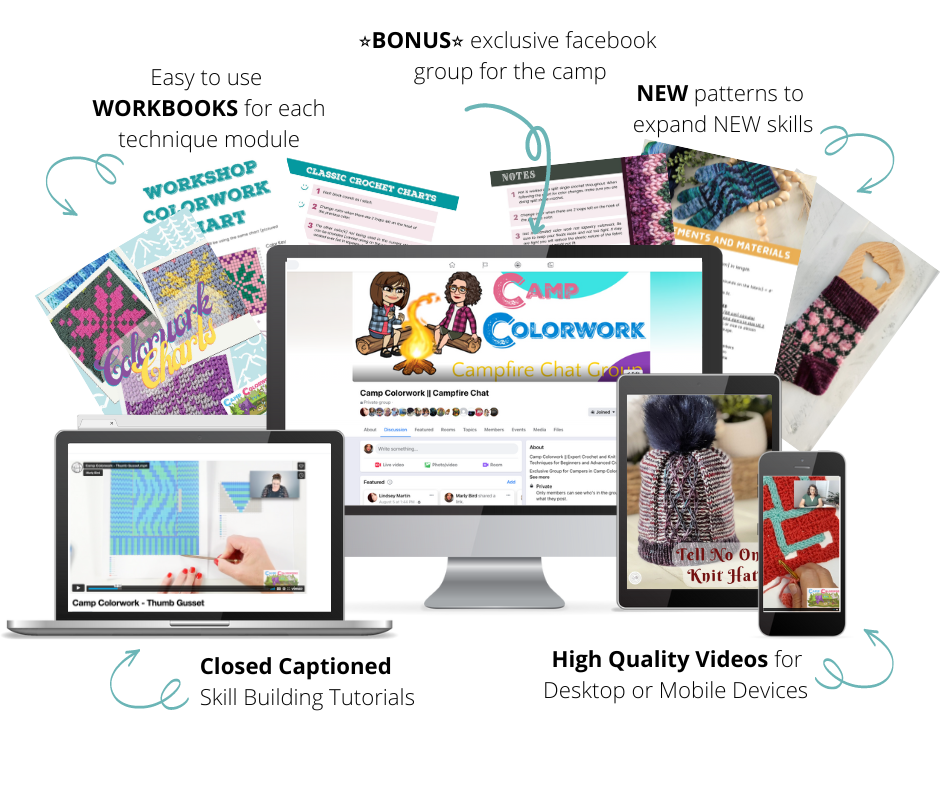
If you’d love someone (hi, it’s me 👋) to walk you through every step of these Heartstrings socks with video tutorials, you’re going to want to check out Camp Colorwork inside the Marly Bird House.
STRANDED KNITTING TIPS FOR HEARTSTRINGS
These socks are all about stranded colorwork. Let’s talk about how to make that experience happy instead of stressful.
FLOAT TENSION
In stranded knitting, you’re carrying unused colors across the back of the work as floats. If you pull those floats too tight:
- The sock shrinks in circumference.
- The leg and foot feel tight or “hard.”
- The fabric can pucker.
Tips for better floats:
- Spread your stitches out on the right-hand needle as you carry the float so it has enough length.
- Don’t yank the yarn when changing colors; let it rest.
- Try the inside-out trick (next section) if small circumferences are giving you trouble.
KNITTING INSIDE OUT TO HELP YOUR FLOATS
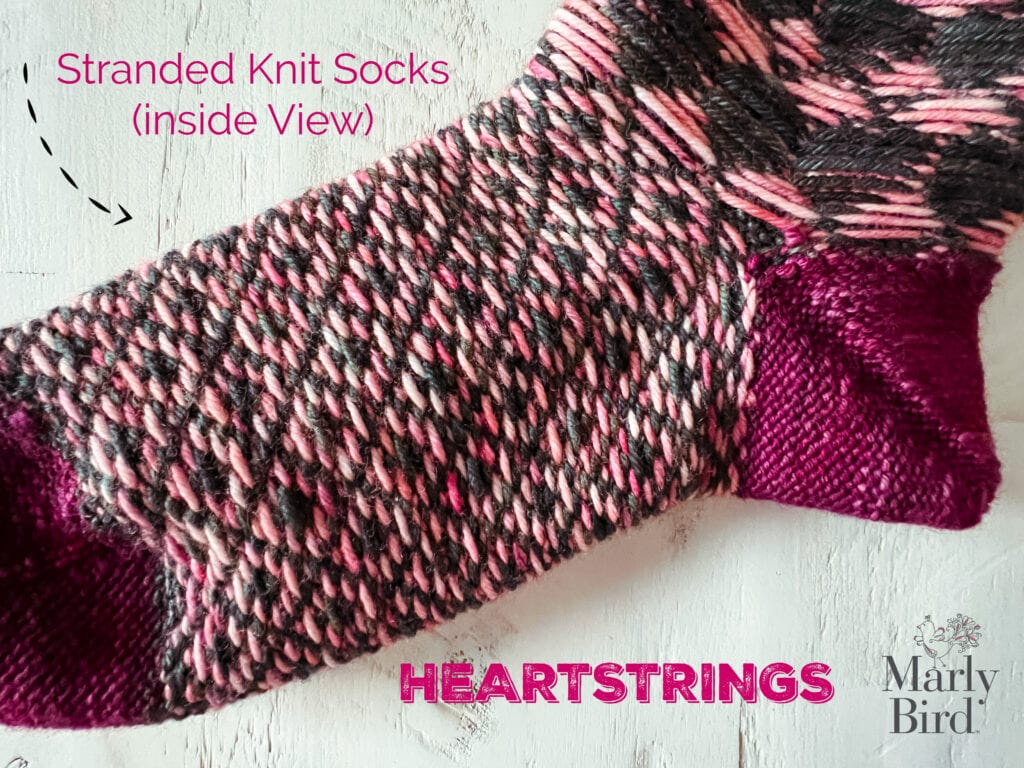
Designer Tip: When working stranded colorwork on small circumferences, I like to knit the sock inside out for the leg and foot.
Here’s why it helps:
- When the sock is inside out, the circumference you’re knitting around is slightly larger than the needle circle.
- The floats travel around the outside curve of the tube, which naturally gives them a little more length.
- It becomes physically harder to pull your floats too tight.
You still follow the chart exactly the same way. You’re just flipping the tube so the wrong side faces you while you work the colorwork section. When it’s time to knit the heel and toe, you turn the sock right side out again so it’s easier to see decreases and shaping.
COLOR DOMINANCE AND WHY IT MATTERS
In stranded knitting, one color will always appear a little more prominent. That’s called color dominance. The yarn that is held in the dominant position tends to pop forward visually.
General rule:
- The yarn strand that travels the longer path behind the work (often the one held in your left hand for two-handed knitting) is the dominant color.
For Heartstrings, that means:
- Decide which color is your motif color and which is your background color.
- Keep the motif color in the dominant position for the entire sock.
- Don’t switch which hand holds which yarn halfway through, or your motifs may start to look uneven.
If your motifs look “muddy,” check both your color contrast and your yarn dominance.
WEAVING IN FLOATS
These socks are knit in DK weight, so even slightly longer floats can be okay, especially in the leg. But if you’re not comfortable with long floats, you can weave them in.
Designer Tip from the pattern notes:
Weave the floats if one stretches over more than 5 stitches, if you’re not comfortable with longer floats on your socks.
GAUGE IN STRANDED COLORWORK
Your stranded gauge will almost always be tighter than your one-color gauge. That’s why the pattern gives two gauges and emphasizes the stranded one.
Best practice:
- Knit your gauge swatch in the round, using stranded stockinette with two colors, in the same yarn you’ll use for the socks.
- Block the swatch the same way you’ll block your finished socks.
- Measure after blocking and adjust your needle size if needed.
If your one-color gauge is slightly different, that’s okay. Just note it for when you customize foot length.
CHOOSING COLORS FOR HEARTSTRINGS
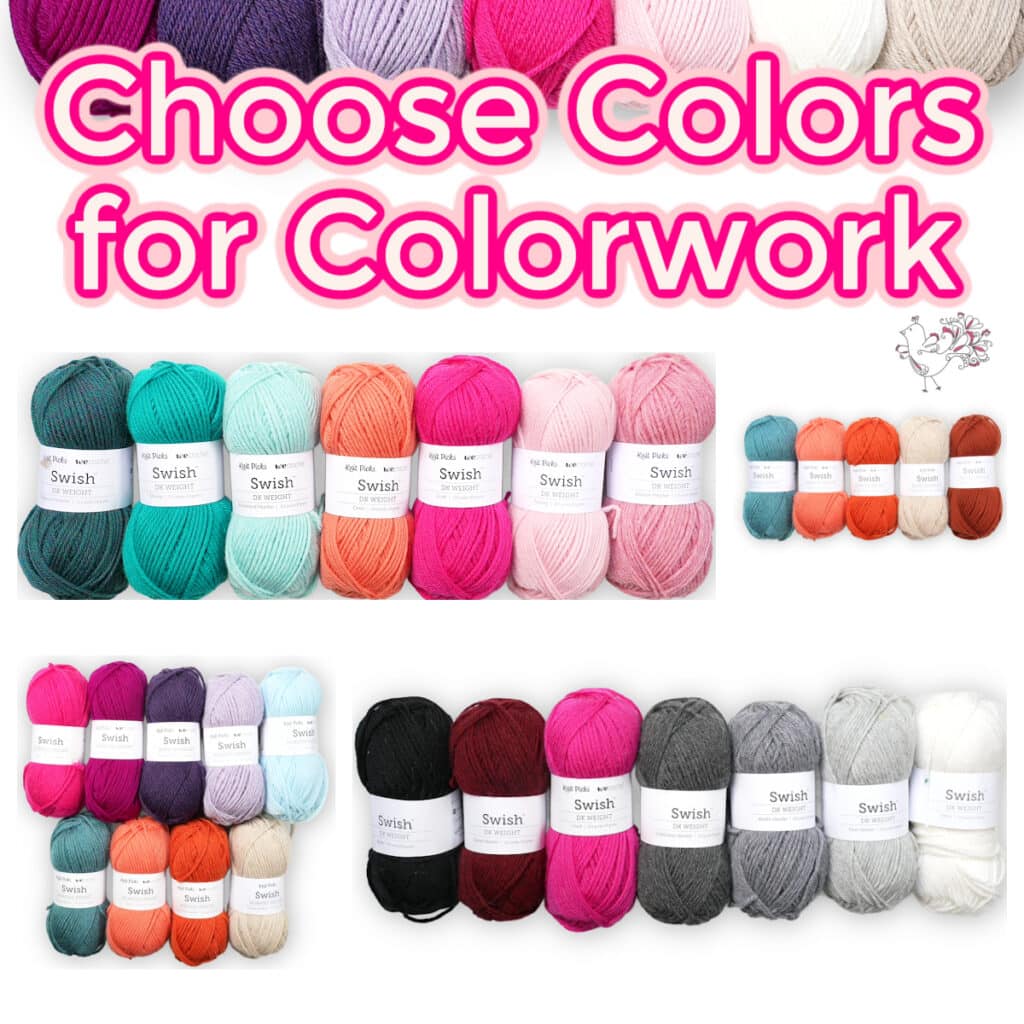
Heartstrings is designed for three colors: A, B, and C.
Things to think about:
Contrast
Make sure your motif color has enough contrast with your background color. A medium or dark background with a lighter motif works beautifully, but high contrast is the real key.
Value
Try looking at your yarns in black and white (you can snap a quick phone photo and apply a grayscale filter). If they all turn into the same gray, they may blend together in the colorwork.
Mood
The original uses romantic, slightly moody tones to echo the regency love letter inspiration. You can go:
- Classic: deep red, cream, and soft gold
- Modern: charcoal, blush, and neon pop
- Cozy: forest, heather gray, and plum
Most importantly: pick colors that make you happy every time you look at your feet. If you would like to read more about choosing colors, here is a great blog post for you.
Join our Newsletter
Get Free Crochet & Knitting
Pattern Links & Coupons!

WHAT NEEDLES WORK BEST FOR SOCKS LIKE THIS?
The pattern is written for double-pointed needles (DPNs) in size US 2 (2.75 mm), but you can absolutely use your favorite sock-knitting method.
Options that work well:
- Double-pointed needles – great control, easy to manage the colorwork in quarters.
- Magic loop – one long circular needle, ideal if you don’t love juggling multiple needles.
- Two circulars – good for knitters who like even distribution and easy transitions.
Whichever you choose:
- Make sure you’re comfortable managing the stranded colorwork without laddering between needles.
- Keep the round beginning location consistent, especially for the forethought heel placement.
- If you switch methods partway through, double-check your stitch counts and markers.
The best needles are the ones you’re not fighting with.
ABOUT THE FORETHOUGHT HEEL
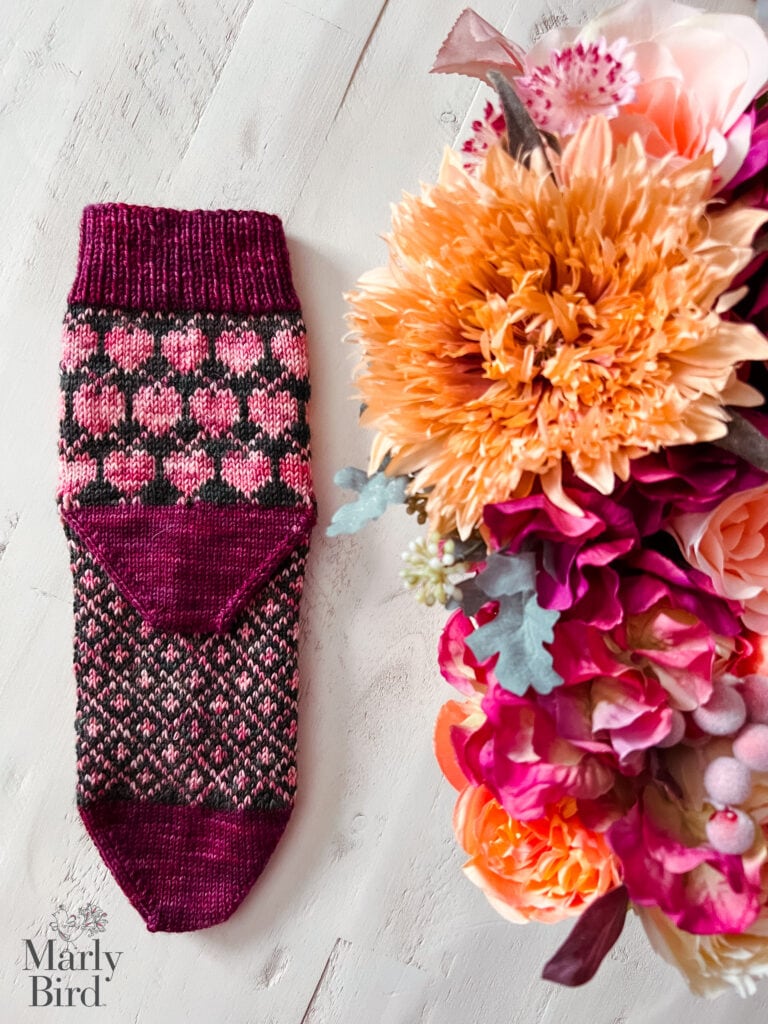
These socks use a forethought heel technique. You knit past where the heel will be, using waste yarn to “hold the place,” and then come back later to work the heel in that space.
Highlights:
- It keeps the leg colorwork uninterrupted.
- It’s easy to replace a worn-out heel later if needed.
- You can tweak the heel depth by adding a few extra rounds before beginning the decreases.
Designer Tip from the notes:
To get a slightly larger heel diagonal measurement, add a few rounds of knitting to the heel before beginning the heel decreases. Add an extra 2 stitches for every extra round you add.
Camp Colorwork: Step-by-Step Help for Heartstrings
If you’d love someone (hi, it’s me 👋) to walk you through every step of these Heartstrings socks, you’re going to want to check out Camp Colorwork inside the Marly Bird House.
Heartstrings actually has its own dedicated module inside the course, so you’re not just getting a pattern—you’re getting a full, guided experience.
What You’ll Learn for the Heartstrings Socks
Inside Camp Colorwork, there is a module focused on these very socks, where I walk you through:
- Casting on and setting up for top-down socks
- Working stranded colorwork in the round (including the knit-it-inside-out trick for better floats)
- Managing multiple colors and keeping your tension even
- Understanding and using color dominance so your motifs really pop
- Placing and working the forethought/afterthought-style heel
- Shaping and grafting the toe with Kitchener stitch
- Finishing details like weaving in ends, closing tiny gaps, and blocking
It’s like having me sitting on the couch knitting with you… without me stealing your good stitch markers. 😇
What’s Inside Camp Colorwork (Beyond Heartstrings)
Camp Colorwork is my flagship colorwork course in the Marly Bird House. Heartstrings is just one star in a much bigger constellation of training that helps you feel confident with:
- Reading and working from colorwork charts
- Choosing colors that play well together and don’t go muddy
- Managing floats so your fabric doesn’t pucker
- Knitting stranded colorwork in the round on hats, cowls, socks, and more
- Troubleshooting common issues like tight fabric, uneven tension, and floppy or lost motifs
If you’re loving the look of Heartstrings but want big sister Marly there to cheer you on and show you exactly what to do, Camp Colorwork is where you’ll get that support.
Special CAMP COLORWORK Discount
Because you’re here for the Heartstrings socks, you can get 25% off the entire Camp Colorwork course when you use the code HEART at checkout.
- Ready to enroll into Camp Colorwork directly with the coupon:
➡️ https://marlybird.thrivecart.com/camp-colorwork/?coupon=HEART
Want to read more about what’s inside first?
Learn more at: https://campcolorwork.com
If you’re ready to really level up your stranded knitting—and let Heartstrings be just the beginning—Camp Colorwork is your cozy, colorful next step. 🧶💗
FREE HEARTSTRINGS STRANDED COLORWORK SOCK PATTERN
SKILL LEVEL
Intermediate
MEASUREMENTS
To Fit Sizes
Small, Medium, Large
Finished Measurements
Socks measure 7 (8, 9)” [18 (20.5, 23) cm] in circumference.
Sample shown is large size.
Designer Tip: The best way to choose the correct size is to measure the circumference around the ball of the foot. You want to choose the size closest to that measurement.
Gauge
32 sts and 34 rounds = 4″ [10 cm] in Stranded Stockinette St (two-color knitting).
28 sts and 42 rounds = 4″ [10 cm] in Stockinette St in one color.
Note: It is best to match your gauge to the two-color pattern gauge given. If your one-color gauge varies slightly from the gauge given here, that’s ok; just be sure to make a note of it, as you will need to know it later in order to customize the foot-length.
MATERIALS
Yarn
Color A: Slow Burn Red – 1¾ oz / 50g
Color B: Friends to Lovers Peach – 1¾ oz / 50g
Color C: Envy Green – 1¾ oz / 50g
Needle
U.S. 2 [2.75 mm] set of double pointed needles, or size required for gauge.
Notions
Removable stitch markers, scrap yarn, tapestry needle.
ABBREVIATIONS
Approx – Approximately
Dec – Decrease
K – Knit
K2tog – Knit two together
P – Purl
RS – Right side
Sl – Slip
Ssk – Slip, slip, knit (see Special Stitches)
St st – Stockinette Stitch (knit on RS and purl on WS)
St(s) – Stitches
WS – Wrong side

SPECIAL STITCHES
Ssk (Slip, Slip, Knit): Slip 2 stitches, one at a time, as if to knit. Insert left hand needle into the front of these two stitches and knit them together from this position (1 stitch decreased)
VIDEO TUTORIALS FOR SPECIAL TECHNIQUES
Long Tail Cast On >> Click Here for Video Help <<
No Cuss Cast On >> Click Here for Video Help <<
Duplicate Stitch >> Click Here for Video Help <<
Weave in Floats >> Click Here for Video Help <<
Kitchener Stitch >> Click Here for Video Help <<
Bury Ends >> Click Here for Video Help <<
NOTES
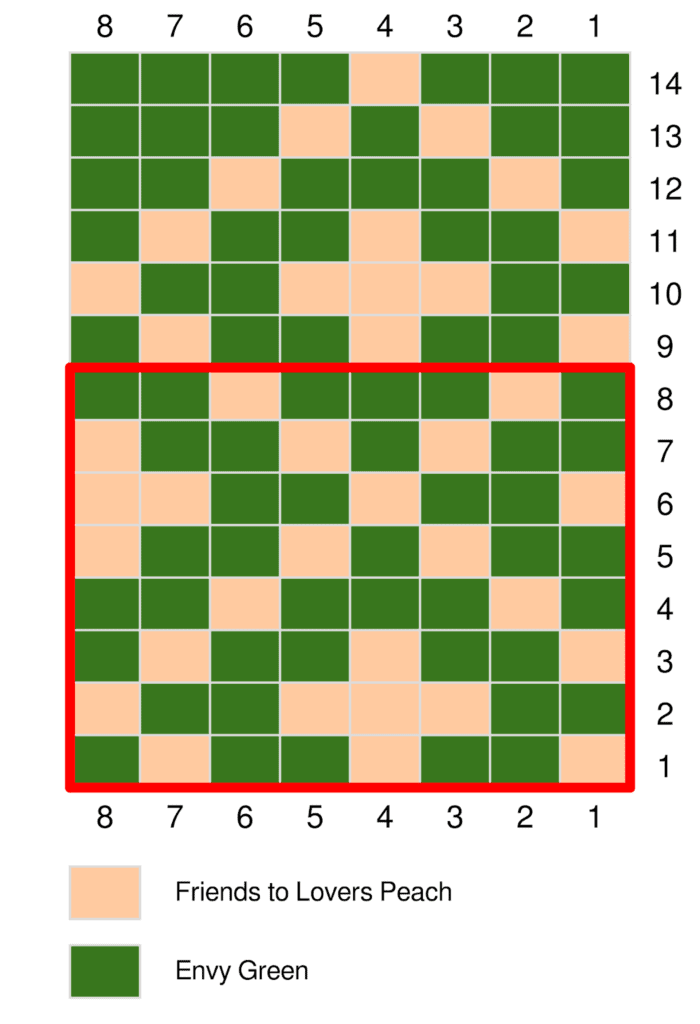
- The color instructions are given in an 8-stitch repeat, therefore it is necessary to repeat each row of chart instructions until all stitches of the round are used.
- Use stranded knitting technique to knit the foot and leg.
- Use caution when floating the unused colors on the wrong side of the sock. If you pull them too tight the sock will not fit!
- Designer Tip: when using stranded knitting on a small circumference, I recommend knitting inside out so the floats are on the outside of the sock until it is turned right side out to knit the toe and heel.
- Weave the floats if one stretches over more than 5 stitches *if you are not comfortable with longer floats on your socks.
- These socks use a forethought heel technique to preplan where the heel will be placed.
- Designer Tip: to get a slightly larger heel diagonal measurement, add a few rounds of knitting to the heel before beginning the heel decreases.

GROW
To Unlock Exclusive Subscriber Content click the Box below and join for free by simply adding your email and creating a password! If you are having troubles, clear your cache or reset your password or login to the Grow Publisher Portal.
>> Learn More About Grow Here <<
I'm thrilled to share this amazing pattern with you, many patterns on my blog are absolutely free! I kindly request that you don't copy and paste or distribute this pattern. Prefer an ad-free experience? Buy a digital PDF pattern for a small fee from one of my online stores for a seamless crafting journey.
I appreciate your support and readership. You are the reason I can keep doing what I love and sharing it with others. So, thank you from the bottom of my yarn-loving heart! Disclosure: This post contains affiliate links, meaning I get a commission if you decide to make a purchase through my links at no cost to you.
Heartstrings Knit Sock Pattern
CUFF
With color A:
Using the long-tail cast on method, cast on 56 (64, 72) sts.
Divide the sts evenly onto 4 double pointed needles – 14 (16, 18) sts on each needle.
Round 1: * K1, p1; repeat from * to the end of the round.
Repeat round 1 until Cuff measures approx 2” [5 cm].
Cut color A.
With color C:
Next Round: Knit.
LEG
Continue in Stranded Stockinette technique following the colorwork chart for Leg through Round 32.
Colorwork Chart

Forethought Heel Prep
When making stranded knit socks it is important to decide where you want the color jog seam to appear. I prefer to have it on the inside of the sock vs the front or back. That requires the heel placement specifically for the left and right sock.
Most sock patterns instruct to only work 1 row for the forethought heel but I find it easier to pick up for the heel with 3 rows.
Left Sock Only
Round 33: Work following the color chart across the first 28 (32, 36) sts, then slip those sts back onto the left hand needle(s).
Drop working yarn. With waste yarn the same weight as yarn used on sock, knit the same 28 (32, 36) sts just slipped, turn, p28 (32, 36), turn, k28 (32, 36).
Cut waste yarn.
Continue following the color chart with working yarns across last 28 (32, 36 sts) to complete the round.
Continue to Foot.
Right Sock Only
Round 33: Work following the color chart across 56 (64, 72) sts, then slip the last 28 (32, 36) sts worked back onto the left hand needle(s).
Drop working yarn. With waste yarn the same weight as yarn used on sock, knit the same 28 (32, 36) sts just slipped, turn, p28 (32, 36), turn, k28 (32, 36).
Cut waste yarn.
Continue to Foot.
FOOT
Continue in Stranded Stockinette technique following the color chart for Foot until Foot measures approx 5” [12.7 cm] shorter than desired final length.
Designer Tip: Why 5” [12.7 cm] shorter? Because the heel is approx 2½” [6.35 cm] and the toe is 2½” [6.35 cm]. Thus, the Foot color-section length should be less 5” [12.7 cm] than the desired final length.
Rounds 1-8 of the Foot chart are the pattern repeat.
Rounds 9-14 of the chart are the final six rounds before the toe, and measure approx ¾” [2 cm].
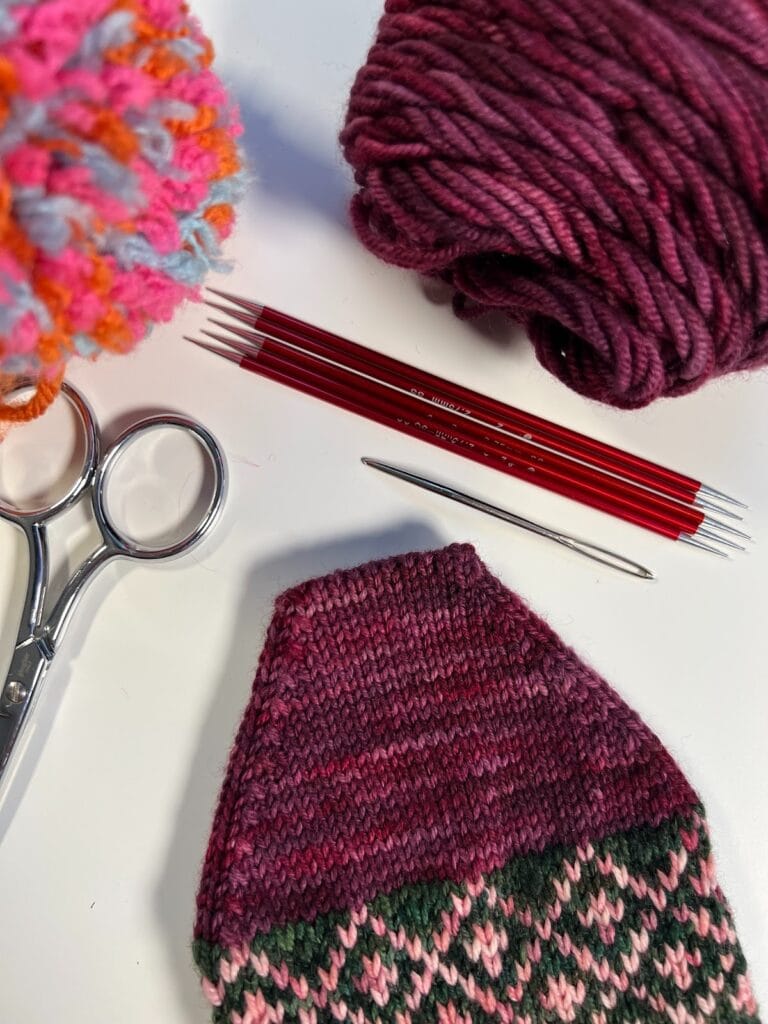
Cut colors B and C.
❇︎If you have been working your sock inside-out, it should now be turned right-side out, with RS facing you and WS facing the inside of the sock.
Continue with color A only as follows:
Round 1: K28 (32, 36), place removable marker into the fabric between sts, k28 (32, 36), place another marker as before.
Round 2 (dec round): * K1, k2tog, k to 3 sts before marker, ssk, k1; repeat from * once more — 4 sts dec’d, 24 (38, 32) sts remain.
Round 3: Knit around.
Repeat rounds 2 and 3 only until 16 (20, 24) sts total remain.
Toe Grafting
Graft Toe sts together using Kitchener Stitch as follows (also see Video Tutorials):
Arrange sts so the 8 (10, 12) instep sts are on one needle, and the 8 (10, 12) sole sts are on another needle.
Hold both needles together in your left hand, with yarn tail on the first stitch on the back needle.
Cut a long tail from the working yarn (about 4 times the width of the fabric to be joined), and thread tail into yarn needle.
Step 1: Insert yarn needle purlwise into first st on front needle and pull it through, leaving st on the knitting needle.
Step 2: Insert yarn needle knitwise into first st on the back needle and pull it through, leaving st on the knitting needle.
Step 3: Insert yarn needle knitwise into first st on front needle and pull it through, then drop this st off knitting needle.
Step 4: Insert yarn needle purlwise into first st on front needle and pull it through, leaving st on the knitting needle.
Step 5: Insert yarn needle purlwise into first st on the back needle and pull it through, then drop this st off knitting needle.
Step 6: Insert yarn needle knitwise into first st on the back needle and pull it through, leaving st on the knitting needle.
Repeat steps 3-6 only, pausing to pull sts taut and neaten the seam after every couple of inches. Be sure to always pause after a step 6 so as to not lose your place.
When 2 sts remain, work step 3, then step 5, then fasten off.
HEEL
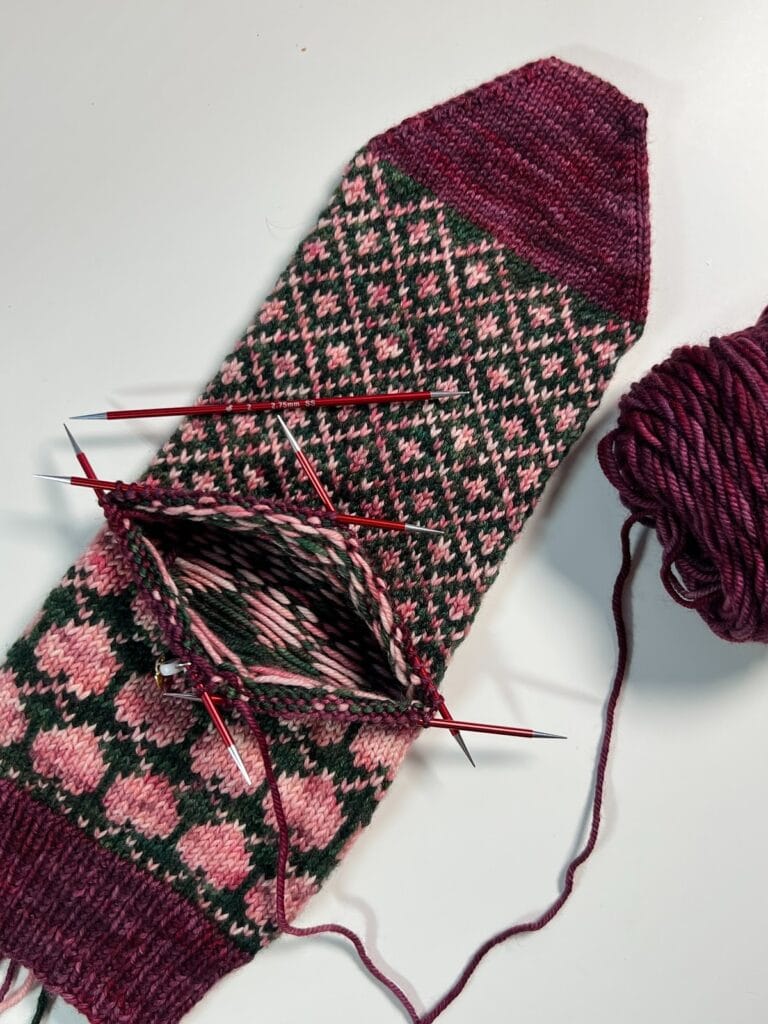
Working on the right side of the sock, from right to left in the round directly below the waste yarn for the heel, insert the top of the needle under the right leg of each of the 28 (32, 36) sts.
With another needle, work the same process on the stitches directly above the waste yarn for the heel. Insert the tip of the needle under the right leg of each of the 28 (32, 36) stitches in the round above the waste yarn.
There are now 56 (64, 72) stitches on the two needles.
Remove the waste yarn starting at the stitch at the top left so it will unravel cleanly.
Don’t worry about picking up extra stitches at the gap. We will close the holes at the gap with the beginning and finishing tails of the heel.
Arrange the sts evenly on 4 double-pointed needles – 14 (16, 18) sts on each needle.
❇︎ If the sock is too snug at the instep/heel diagonal, add a few rounds and a few stitches to the heel before beginning the decrease rounds. Add an extra 2 stitches for every extra round you add. This will add more stitches and overall rounds to your heel and allow for a larger heel diagonal.
With color A:
Round 1: K28 (32, 36), place removable marker into the fabric between sts, k28 (32, 36), place another marker as before.
Round 2 (dec round): * K1, k2tog, k to 3 sts before marker, ssk, k1; repeat from * once more — 4 sts dec’d, 24 (28, 32) sts remain.
Round 3: Knit.
Repeat round 2 and 3 until 16 (20, 24) sts total remain on the needles.
Heel Grafting
Graft Heel sts together using Kitchener stitch as follows (also see Video Tutorials):
Arrange sts so the 8 (10, 12) back of leg sts are on one needle, and the 8 (10, 12) foot sts are on another needle.
Hold both needles together in your left hand, with yarn tail on the first stitch on the back needle.
Cut a long tail from the working yarn (about 4 times the width of the fabric to be joined), and thread tail into yarn needle.
Step 1: Insert yarn needle purlwise into first st on front needle and pull it through, leaving st on the knitting needle.
Step 2: Insert yarn needle knitwise into first st on the back needle and pull it through, leaving st on the knitting needle.
Step 3: Insert yarn needle knitwise into first st on front needle and pull it through, then drop this st off knitting needle.
Step 4: Insert yarn needle purlwise into first st on front needle and pull it through, leaving st on the knitting needle.
Step 5: Insert yarn needle purlwise into first st on the back needle and pull it through, then drop this st off knitting needle.
Step 6: Insert yarn needle knitwise into first st on the back needle and pull it through, leaving st on the knitting needle.
Repeat steps 3-6 only, pausing to pull sts taut and neaten the seam after every couple of inches. Be sure to always pause after a step 6 so as to not lose your place.
When 2 sts remain, work step 3, then step 5, then fasten off.
FINISHING
Use duplicate stitch to close any gap or hole (see Video Tutorials).
Weave in all loose ends.



MORE SOCK PATTERNS TO LOVE
If Heartstrings has you hooked on sock knitting and you’re ready for more, here are some of my other sock patterns and workshops you can check out:
⭐️ Aromatherapy Sock Knit Workshop
https://marlybird.thrivecart.com/aromatherapy-sock-knit-workshop/
⭐️ Tranquility Sock Knit
https://marlybird.thrivecart.com/tranquility-sock-knit/
⭐️ Meditation Sock Knit
https://marlybird.thrivecart.com/meditation-sock-knit/
⭐️ Alex Seersucker Knit Socks
https://shop.marlybird.com/products/alex-seersucker-knit-socks
⭐️Appalachian Cozy Up Thigh High Sock Pattern
https://shop.marlybird.com/products/appalachian-cozy-up-thigh-high-sock-pattern
Both Alex and Appalachian are Part of the BiCrafty Stitch Nite Collection:
https://www.marlybirdhouse.com/products/courses/view/1148503
⭐️ Marly Knit Socks
https://shop.marlybird.com/products/marly-knit-socks
If you’re still building your foundational knitting skills, you might also like my BiCrafty Bootcamp – Knitting resources on MarlyBird.com:
https://marlybird.com/blog/knitting-lessons-for-crocheters/
FAQ – HEARTSTRINGS STRANDED COLORWORK SOCKS
Is this a good first stranded sock pattern?
If you are brand new to knitting and to colorwork, Heartstrings might feel like a lot. But if you are:
- Comfortable knitting in the round
- Have made at least one simple pair of socks or a colorwork hat or cowl
- Ready to slow down and follow a chart
Then yes, Heartstrings can be a great first stranded sock pattern. The DK weight yarn, clear repeats, and forethought heel make it approachable while still feeling like a special project.
Do I have to knit these on double-pointed needles?
No. The pattern is written for DPNs, but you can use magic loop, two circulars, or short circulars (switching to DPNs or magic loop for the heel and toe).
Just make sure you:
- Keep the round beginning in the same place
- Work the chart repeats in order
- Don’t accidentally shift your forethought heel placement when changing needle setups
Why do you recommend knitting the colorwork inside out?
On a small tube like a sock, it is very easy to pull floats too tight. When you knit the colorwork section inside out:
- The fabric curves around the needle instead of hugging it tightly.
- Your floats naturally get a little more length.
- It is harder to accidentally strangle the sock with tight floats.
You still follow the chart exactly the same way. You have just turned the tube so the wrong side is facing you while you work.
How important is color dominance in these socks?
Very important if you want the motifs to pop.
In stranded knitting, the color held in the dominant position (often the yarn in your left hand for two-handed colorwork) will stand out more.
For Heartstrings:
- Decide which color is your motif color and which is your background.
- Keep the motif color in the dominant position for the entire sock.
- Do not swap which hand holds which yarn halfway through.
If the motifs look flat or muddy, check both your color contrast and your color dominance.
Can I substitute a different yarn?
Yes, as long as you choose a yarn that matches the gauge and general behavior of the original:
- Weight: DK or light (#3)
- Fiber: A wool or wool blend with good bounce and memory is best for stranded socks.
- Structure: A smooth, plied yarn with good stitch definition.
If you choose a non-wool or very slippery yarn, the socks may not hold their shape as well over time.
Whatever you choose, knit a stranded gauge swatch in the round and block it before committing to size.
Do I need to block my socks?
You can wear them straight off the needles, but blocking will:
- Even out your stranded stitches and floats
- Smooth minor tension issues
- Help the fabric relax into its final size
For superwash yarns, a gentle wet block or soak-and-squeeze block works well. If you want to dig deeper into steam blocking versus wet blocking for superwash yarns, you can read more here:
https://marlybird.com/blog/steam-blocking-vs-wet-blocking-superwash-yarn-prism-make-along-part-10/
Are these socks travel friendly?
Yes. Once you are comfortable with the chart, Heartstrings makes a nice travel or TV project, especially in the ribbing, simpler chart sections, and heel or toe.
If you are wondering about taking your sock knitting on a plane, you can read my post here:
“Can I Take Knitting Needles on an Airplane?”
https://marlybird.com/blog/can-i-take-knitting-needles-on-an-airplane/
FINAL THOUGHTS
Heartstrings is one of those patterns that really lets you feel like a sock knitter.
You are working at a comfortable DK gauge, playing with stranded colorwork, planning a forethought heel, and paying attention to fit and gauge in a way that truly pays off when you slide that first finished sock on.
I’m thrilled to be able to share this pattern for free on MarlyBird.com after its time as a Camp Colorwork exclusive, and I hope it gives you the confidence to tackle even more colorwork socks in the future.
Whether you knit one pair in romantic reds or a whole drawer full of Heartstrings in all your favorite colors, I hope these socks feel like a love letter to your own knitting skills every time you wear them. 🧶💕
❤️ Your BiCrafty Bestie,
Marly Bird

Categories: Free Patterns, Knitting, Marly Bird Premium Patterns, Our Free Patterns, Pattern, Uncategorized