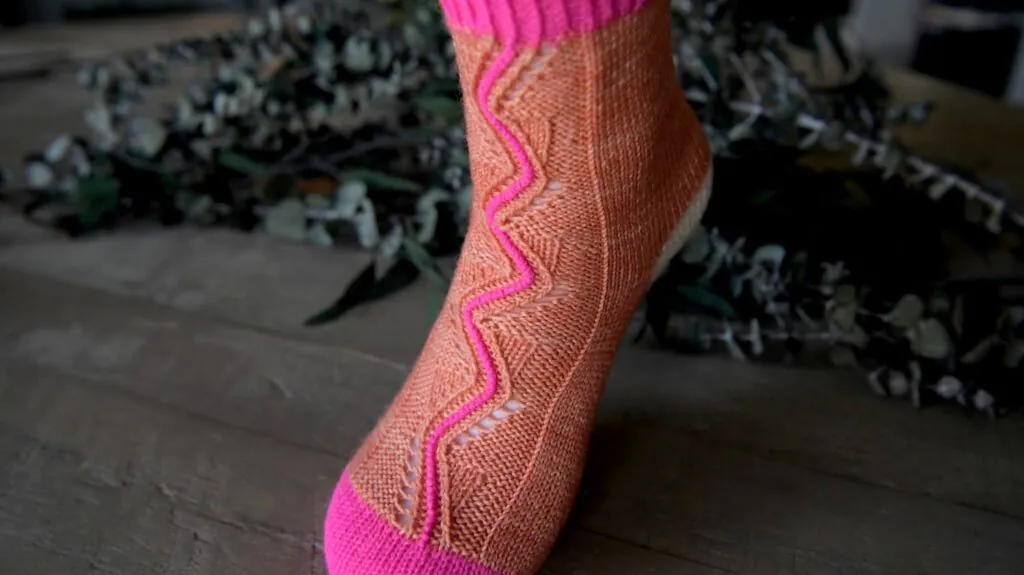
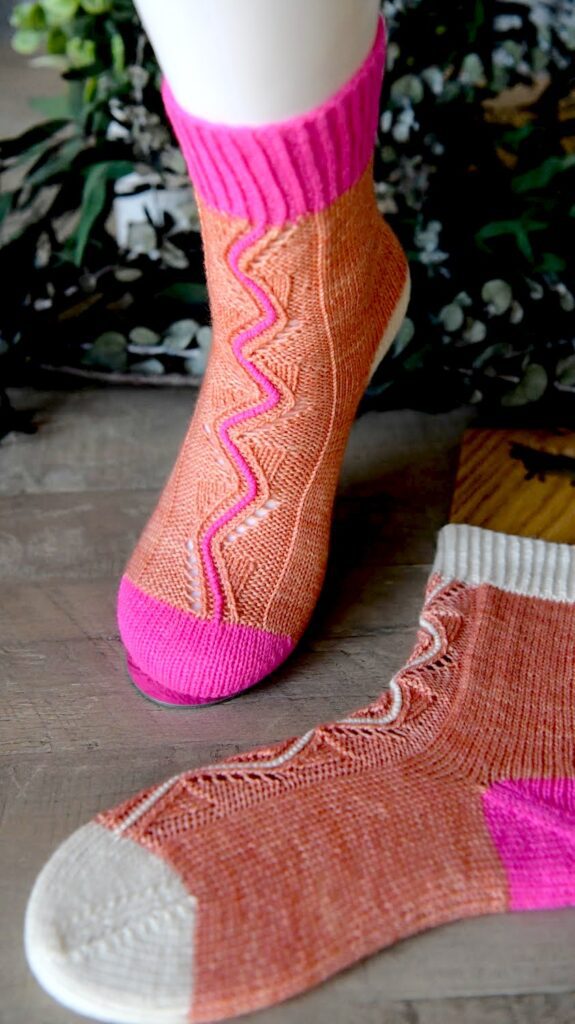
Some designs start with a sketch. Others start with a feeling — or in this case, a moment of inspiration that turned into a color story I couldn’t stop thinking about.
The Hint of Hazelnut Socks are playful, bold, and surprisingly approachable, designed to help knitters use those mini skeins we all collect while building confidence with vertical colorwork. These socks are a celebration of color, curiosity, and the joy of trying something just a little different.
If you’ve ever looked at a set of mini skeins and wondered “What should I actually make with these?” — this pattern is for you.
Quick Pattern Overview
The Hint of Hazelnut Socks are knit socks featuring vertical colorwork stripes paired with a solid contrast yarn. Designed to be eye-catching without being overwhelming, these socks are a great way to experiment with color while still creating a wearable, everyday project.
In this post, you’ll learn:
Why vertical colorwork is easier than it looks
How this sock pattern works beautifully with mini skeins
Yarn ideas for both indie and commercial sock yarns
Tips for knitting socks as a portable (but engaging) project
Affiliate Disclosure:This post contains affiliate links. To learn more please visit my privacy policy here💖
Vertical Colorwork Socks (Without the Stress)
Vertical striping creates a bold visual impact, but it doesn’t require complicated charts or advanced colorwork techniques. Instead, the color changes happen in a predictable rhythm that allows you to focus on consistency rather than complexity.
This pattern was inspired by a color palette that stopped me in my tracks — proof that great design ideas can come from anywhere (yes, even something as simple as a coffee creamer bottle). The end result is a sock that feels intentional, modern, and fun to knit.
What You Will Love About This Pattern
Free knit sock pattern with striking vertical colorwork
Perfect for using mini skeins from advent calendars or kits
Designed for knitters ready to explore color confidently
Works well with a solid sock yarn base
Creates socks that are fun to knit and even more fun to wear
✨ Designer Tip: If you’ve never used mini skeins in socks before, this pattern is a fantastic place to start — the colorwork feels playful, not intimidating.
“Sometimes the best designs come from curiosity — what happens if I try this?”
Marly Bird
Design, Fit, and Construction Details
The Hint of Hazelnut Socks are designed with comfort and wearability in mind. The vertical colorwork adds visual interest without affecting stretch, and the solid contrast yarn helps anchor the design so the socks remain practical for everyday use.
These socks are worked using familiar sock construction methods, making them a great project for knitters who are comfortable knitting socks and ready to level up their color confidence.
Yarn Ideas & Mini Skein Pairings
One of the best things about this pattern is how beautifully it works with mini skeins. Many knitters collect mini skeins through advent calendars, mystery make-alongs, or special sets — and sometimes the included project just doesn’t click.
This pattern gives those minis a new purpose.
Mini Skein + Full Skein Pairing Ideas
Pair a colorful mini set with a coordinating solid sock yarn for the best results.
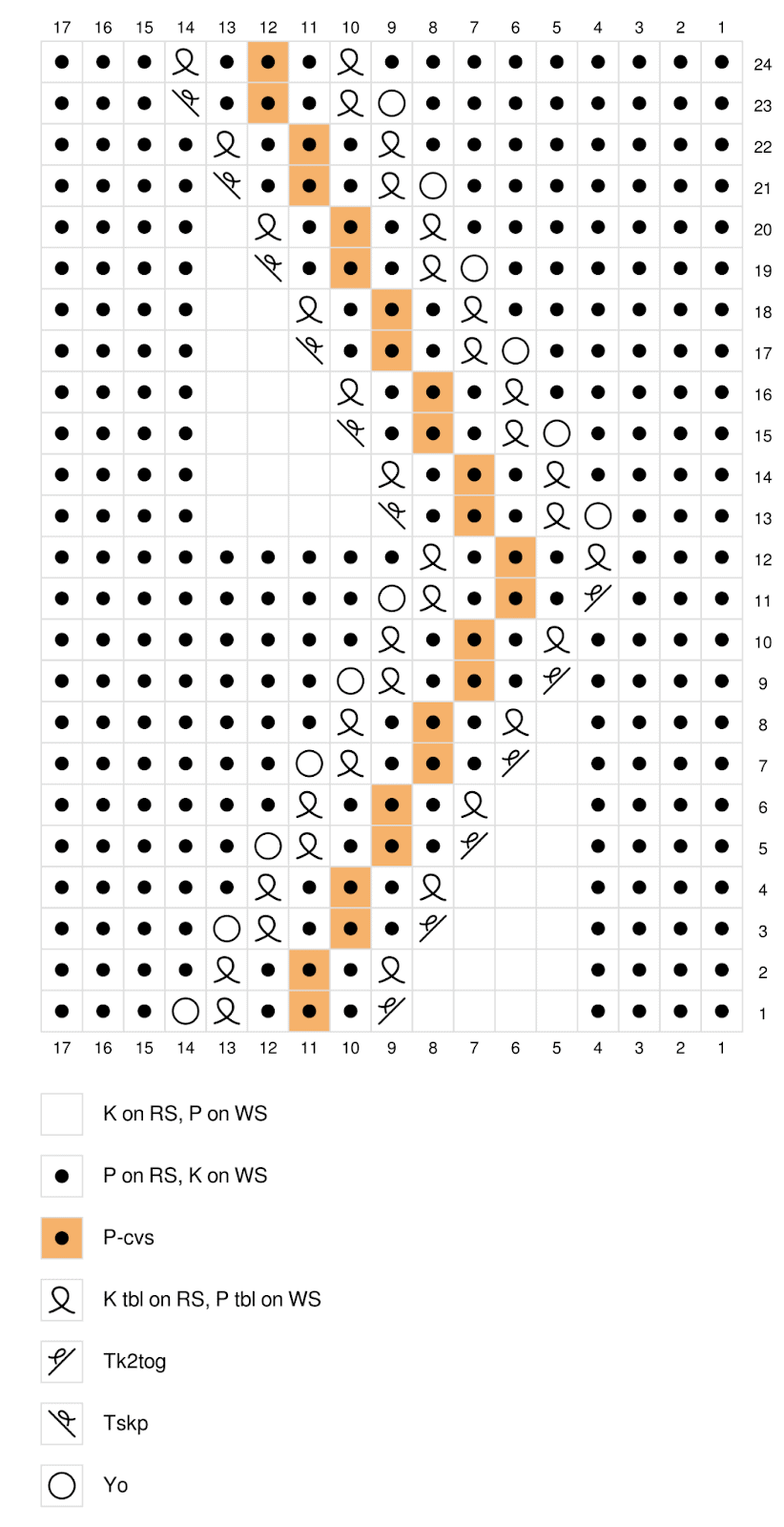
TK2tog (Twisted Knit 2 Together): Slip 2 stitches purlwise, insert tip of left needle into the front leg of first stitch from front to back and and slip it back onto left needle (stitch is now twisted), slip next stitch purlwise back onto left needle, knit two together.
Tskp (Twisted Knit-Slip-Pass): Slip one stitch purlwise, knit next stitch, pass slipped stitch over knit stitch.
Ssk (Slip, Slip, Knit): Slip 2 stitches, one at a time, as if to knit. Insert left hand needle into the front of these two stitches and knit them together from this position (1 stitch decreased)
SPECIAL TECHNIQUES
CVS (Contrasting Vertical Strand): Use the designated contrasting color when working the next stitch as written. If p-cvs then purl the stitch, if k-cvs then knit the stitch. When working a CVS st, be sure the MC strand is held off to the left. Then reach in from right to grab the dangling CVS strand, work the stitch, then leave it behind off to the right. Return to MC. No need to twist the colors as is done when working intarsia; one color simply wraps over the other color.
Directions are for size S; changes for sizes M, & L are in parentheses. When only one number is given then that number applies to all sizes.
CVS & Lace pattern is worked down the front of the sock and top of foot.
These socks use a forethought heel technique to preplan where the heel will be placed.
Designer Tip: to get a slightly larger heel diagonal measurement, add a few rounds of knitting to the heel before beginning the heel decreases.
CVS requires yarn management. Each CVS column requires approx. 10” [20.5 cm] of yarn for 1” [2.54 cm] of knitting. It is best to use the yarn bobbins or butterfly yarn management skill (see video tutorial for help) to keep that one strand of yarn out of the way.
GROW
To Unlock Exclusive Subscriber Content click the Box below and join for free by simply adding your email and creating a password! If you are having troubles, clear your cache or reset your password or login to the Grow Publisher Portal.
I'm thrilled to share this amazing pattern with you, many patterns on my blog are absolutely free! I kindly request that you don't copy and paste or distribute this pattern. Prefer an ad-free experience? Buy a digital PDF pattern for a small fee from one of my online stores for a seamless crafting journey.
I appreciate your support and readership. You are the reason I can keep doing what I love and sharing it with others. So, thank you from the bottom of my yarn-loving heart! Disclosure: This post contains affiliate links, meaning I get a commission if you decide to make a purchase through my links at no cost to you.
HINT OF HAZELNUT SOCKS PATTERN INSTRUCTIONS
CUFF
With A, cast on 56 (64, 72) sts using the long-tail cast on method (see Video Tutorials)
Divide the sts evenly onto 4 double pointed needles – 14 (16, 18) sts on each needle.
Join round and mark first st.
Round 1: * P1, k1 tbl; repeat from * to the end of the round.
Repeat Round 1 until Cuff measures 2” [5 cm].
Cut color A.
LEG
With MC and using A as CVS:
Set-Up Round: K20 (24, 28), pm, work Row 1 of CVS & Lace Pattern over next 17 sts, pm, knit to end of round.
Next Round: K to marker, slm, work in established CVS & Lace Pattern over next 17 sts, slm, k to end of round.
Repeat the last round to desired length, ending after a Round 12 or 24 of CVS and Lace Pattern.
Next Round (partial round): Work as established across first 42 (48, 54) sts of the round.
FORETHOUGHT HEEL PREP
Most sock patterns instruct to only work 1 row for the forethought heel but I find it easier to pick up for the heel with 3 rows.
Next Row: Knit across the first 28 (32, 36)Sole sts. Slip those sts just knit back to the left hand needle, or slide them to the other end of the circular needle. Drop working yarn. With waste yarn the same weight as working yarn:
(RS): Knit the same 28 (32, 36) sts just slipped, turn,
(WS): P28 (32, 36), turn,
(RS): K28 (32, 36).
Cut waste yarn.
Continue to Foot and work with MC and color A again.
FOOT
Continue in established CVS & Lace pattern, and Stockinette st for remaining sts, until Foot measures 4 (4½, 5)” [10 (11.5 12.5) cm] shorter than desired final length and ending after a Round 12 or 24 of CVS & Lace Pattern (not mandatory).
Cut MC and discontinue use of the CVS.
TOE
Continue with color A only as follows:
Round 1: K28 (32, 36), place removable marker into the fabric between sts, k28 (32, 36), place another marker as before.
Round 2 (dec round): * K1, k2tog, k to 3 sts before marker, ssk, k1; repeat from * once more — 24 (28, 32) sts remain.
Round 3: Knit around.
Repeat rounds 2 and 3 only until 16 (20, 24) sts total remain.
Toe Grafting
Graft Toe sts together using Kitchener Stitch as follows (also see Video Tutorials):
Arrange sts so the 8 (10, 12) instep sts are on one needle, and the 8 (10, 12) sole sts are on another needle.
Hold both needles together in your left hand, with yarn tail on the first stitch on the back needle.
Cut a long tail from the working yarn (about 4 times the width of the fabric to be joined), and thread tail into yarn needle.
Step 1: Insert yarn needle purlwise into first st on front needle and pull it through, leaving st on the knitting needle.
Step 2: Insert yarn needle knitwise into first st on the back needle and pull it through, leaving st on the knitting needle.
Step 3: Insert yarn needle knitwise into first st on front needle and pull it through, then drop this st off knitting needle.
Step 4: Insert yarn needle purlwise into first st on front needle and pull it through, leaving st on the knitting needle.
Step 5: Insert yarn needle purlwise into first st on the back needle and pull it through, then drop this st off knitting needle.
Step 6: Insert yarn needle knitwise into first st on the back needle and pull it through, leaving st on the knitting needle.
Repeat steps 3-6 only, pausing to pull sts taut and neaten the seam after every couple of inches. Be sure to always pause after a step 6 so as to not lose your place.
When 2 sts remain, work step 3, then step 5, then fasten off.
HEEL
With RS facing, from right to left in the round directly below the waste yarn for the heel, insert the top of the needle under the right leg of each of the 28 (32, 36) sts.
With another needle, work the same process on the stitches directly above the waste yarn for the heel. Insert the tip of the needle under the right leg of each of the 28 (32, 36) stitches in the round above the waste yarn.
There are now 56 (64, 72) sts on the two needles.
Remove the waste yarn starting at the st at the top left so it will unravel cleanly.
Don’t worry about picking up extra stitches at the gap. We will close the holes at the gap with the beginning and finishing tails of the heel.
Note: If the sock is too snug at the instep/heel diagonal, add a few rounds and a few sts to the heel before beginning the decrease rounds. Add an extra 2 stitches for every extra round you add. This will allow for a larger heel diagonal.
With B:
Round 1: K28 (32, 36), place removable marker into the fabric between sts, k28 (32, 36), place another marker as before.
Round 2 (dec round): * K1, k2tog, k to 3 sts before marker, ssk, k1; repeat from * once more — 24 (28, 32) sts.
Round 3: Knit.
Repeat round 2 and 3 until 16 (20, 24) sts total remain on the needles.
Heel Grafting
Graft Heel sts together using Kitchener stitch, same way as Toe sts.
FINISHING
Use duplicate stitch to close any gap or hole (see Video Tutorials).
Weave in all loose ends.
Socks as a Portable Project (With a Realistic Note)
Socks are one of the most loved portable knitting projects — small, lightweight, and easy to toss into a bag. While the Hint of Hazelnut Socks do require a bit more attention due to the colorwork, they’re still a great on-the-go project when you want something engaging.
A little focus goes a long way here, and the results are worth it.
Do you like lace patterns for socks? Check out this knit lace blog post with multiple links you must have!
Staying Organized While Knitting Socks
Keeping your yarn tidy makes sock knitting even more enjoyable, especially when working with multiple colors.
Is this sock pattern beginner-friendly? This pattern is best for knitters who are already comfortable knitting socks and want to try colorwork.
Do I need a full mini skein for each color? No. This pattern is designed to make excellent use of mini skeins without needing large amounts.
Can I use a sock yarn without nylon? Yes. Nylon is optional. If desired, you can add reinforcing yarn, but it’s not required.
Will the vertical colorwork affect stretch? No. The construction allows the socks to stretch comfortably for everyday wear.
How long does it take to knit a pair? Time varies, but many knitters find these socks engaging enough to keep momentum steady.
Are these socks good for gifts? Absolutely. The bold colorwork makes them feel special and handmade.
Can I simplify the color palette? Yes. Using fewer or more subtle colors creates a different but equally beautiful effect.
Are these socks good for travel knitting? They can be — just keep your yarn organized and be mindful of color changes.
Final Thoughts
The Hint of Hazelnut Socks are a joyful reminder that creativity doesn’t have to be complicated. With a handful of mini skeins, a solid base yarn, and a willingness to play with color, you can create socks that feel personal, modern, and truly handmade.
If you knit a pair, be sure to save the pattern, share your colors, and tell me what inspired your palette. #marlybird #mmmdi
Marly is a knitwear and crochet designer (and yarn addict) that is here to help you learn how to knit and crochet in a way that's fun and approachable.