Ridgeway Crochet Cowl – Turkey Trot 2025- Day 4
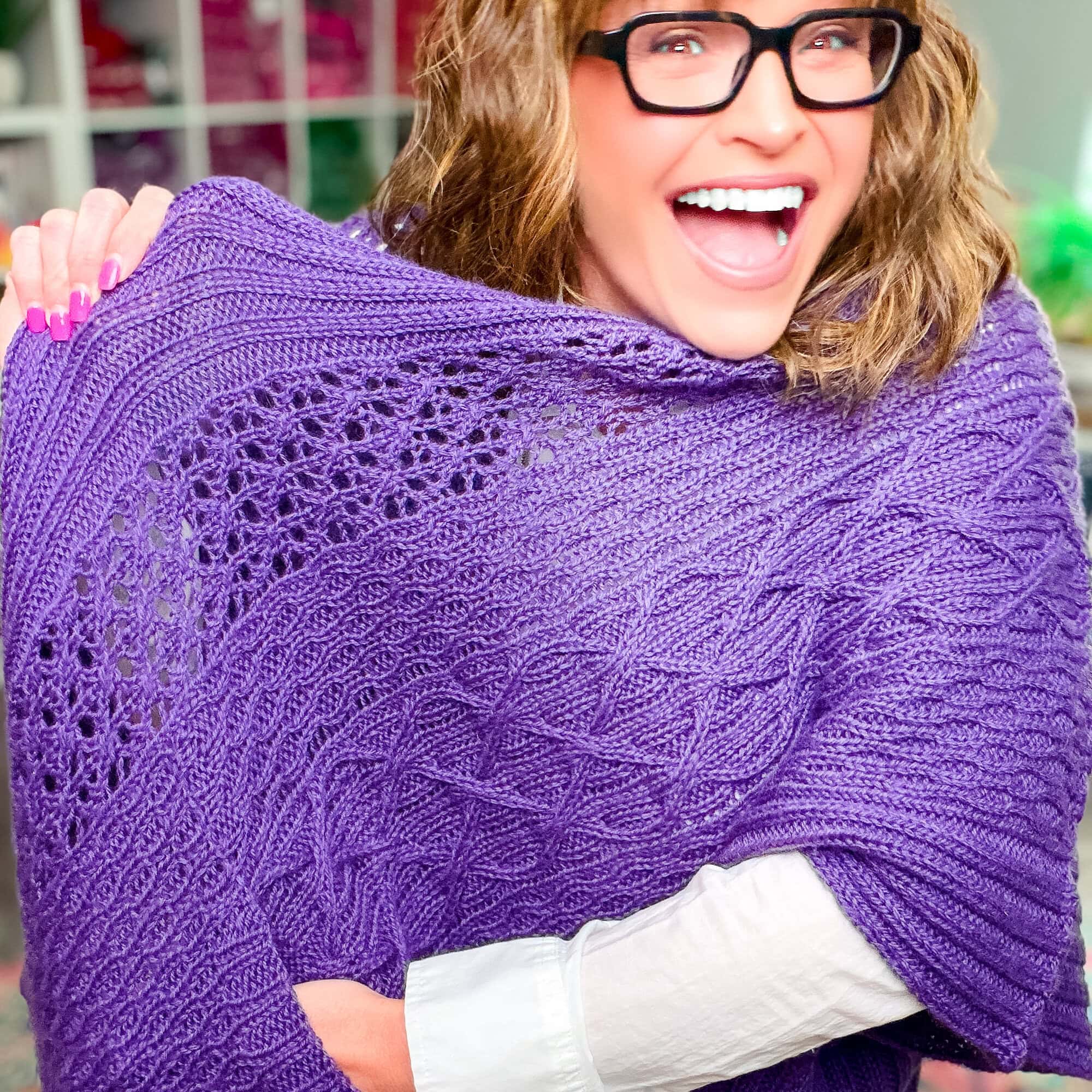
Hello, Turkey Trot crochet crew! You’ve officially reached Day 4 of the Ridgeway Crochet Cowl, and today is where your hard work turns into a finished, wearable, stunning piece.
If Days 1–3 were all about building that gorgeous triangle and letting the stitch pattern shine, Day 4 is the glow-up:
we add edging, clean up the lines, and wet block the triangle so it drapes like a dream.
Affiliate Disclosure: This post contains affiliate links. To learn more please visit my privacy policy here💖
Need to find the next day later (or want to double-check where you are)? The Turkey Trot hub always has the full schedule and links:
https://marlybird.com/blog/7th-annual-marly-bird-turkey-trot-make-along-2025/
Finishing Time! Edging + Wet Blocking for a Polished Cowl ✨🧶
You’re finishing the triangular shawl portion of your cowl with:
- Edging that stabilizes the fabric, defines the triangle, and gives the whole piece a professional finish.
- Wet blocking to open up the stitches, even out tension, and bring out the full beauty of the texture.
This is the part where your project goes from “wow, that’s pretty” to “WAIT… you made that?!” 😍
Before You Start: A Couple of Friendly Notes
- Edging is not just decoration. It sharpens the triangle shape, smooths any little wiggles, and makes the fabric behave.
- Blocking is part of the pattern. The stitch motifs don’t fully “wake up” until they’ve had a bath and a stretch. Trust me on this one.
- Take your time. Finishing is where a handmade piece really becomes heirloom-level.
Day 4 Finishing Instructions
Designed by Robyn Chachula for Marlybird.com
SKILL LEVEL
Intermediate
MEASUREMENTS
Finished Measurements
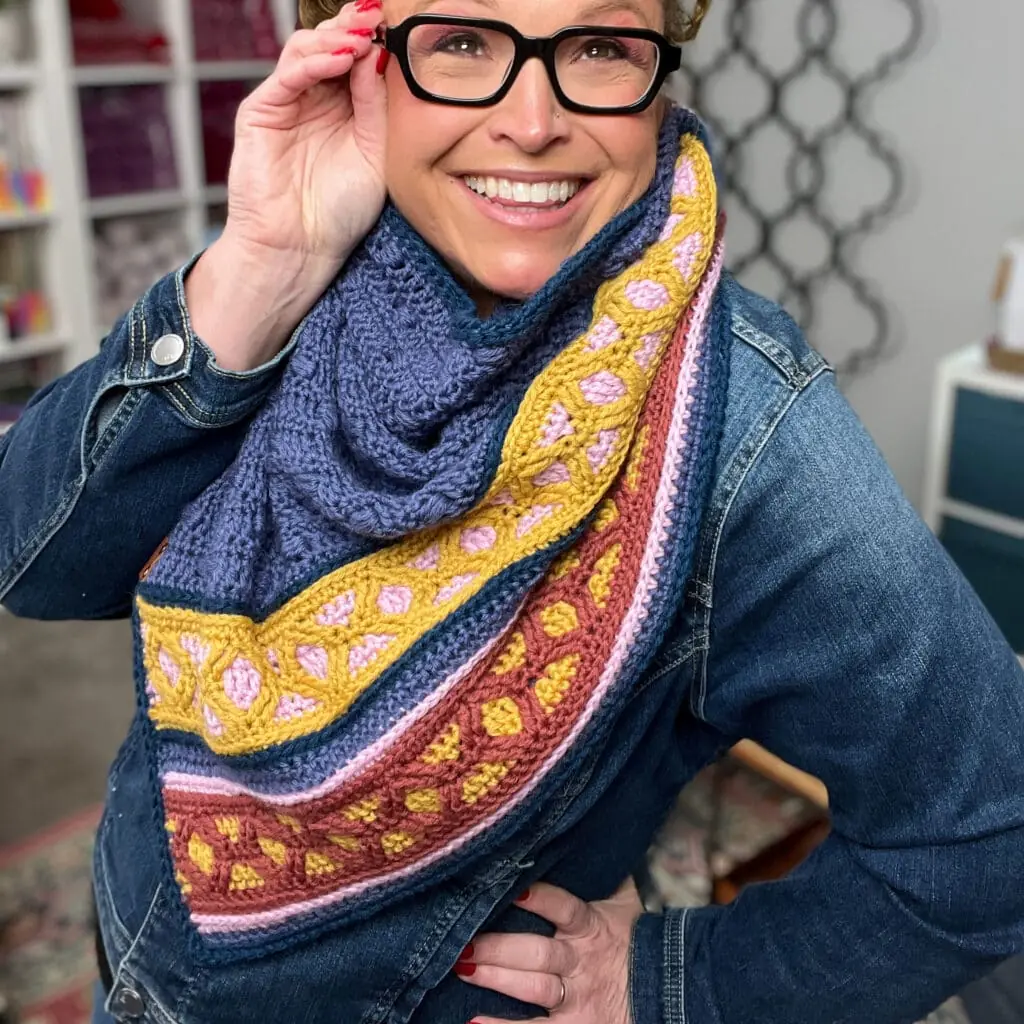
Triangular Shawl is 29.5” [75 cm] wide by 35.5” [90 cm] long,
Cowl is 6” [15 cm] deep.
Gauge
15 sts by 10 rows= 4.25” [11 cm] by 4.5” [11.5 cm] in BLOCKED body stitch pattern; use any size hook to obtain the gauge.
16 sts= 4.5” [11.5 cm] in BLOCKED mosaic stitch pattern
MATERIALS
Crochet Yarn
Universal Yarn, Deluxe Worsted (100% wool, 220 yds / 200 m, 3.5 oz/ 100 g, CYCA# 4 worsted)
Color A: #14007 Indigo, 2 hanks
Color B: #12144 Starfish, 25g
Color C: #12281 Clay, 25g
Color D: #12174 Ginseng, 25g
Color E: #12278 Mallard, 35g
Crochet Hook
Size I/9 [5.5 mm]
Notions
- Stitch Markers
- Tapestry Needle
- Scissors
- Tape Measure
- Wet Blocking Supplies (wool wash, towels, blocking mat, rust proof pins)
ABBREVIATIONS
BLO – Back Loop Only
Ch – Chain(s)
Dc – Double Crochet
FP – Front Post
Hdc – Half Double Crochet
PM – Place Marker
RS – Right Side
Sc – Single Crochet
Sl st – Slip Stitch
Sp(s) – Space(s)
St(s) – Stitch(es)
Tch – Turning Chain
Tr – Treble Crochet
WS – Wrong Side
SPECIAL STITCHES
⭐️3 Half Double Crochet Cluster (3 hdc-cl): *Yarn over hook, insert hook around the vertical leg (“the post”) of previous st, yarn over and pull up a loop; repeat from * twice more around same post, yarn over and draw through all 7 loops on hook.
⭐️Double Crochet 2 Together (Dc2tog): *Yarn over hook, insert hook into indicated st, yarn over and pull up a loop, yarn over and draw through 2 loops on hook; repeat from * in next indicated st, yarn over and draw through all 3 loops on hook. (1 st decreased)
⭐️ Foundation Single Crochet (fsc):
First fsc: Ch 2, insert hook into 2nd ch from hook, yarn over and pull up a loop, yarn over and draw through 1 loop on hook (forming a chain), yarn over and draw through 2 loops on hook (forming the single crochet)
Next fsc: Insert hook into base of previous stitch (in the “chain” space), yarn over and pull up a loop, yarn over and draw through 1 loop on hook (forming a chain), yarn over and draw through 2 loops on hook (forming the next single crochet). Repeat directions for desired amount of sts.
⭐️Half Double Crochet 2 Together (Hdc2tog): Yarn over hook, insert hook into indicated st, yarn over and pull up a loop, yarn over hook, insert hook into next indicated st, yarn over and pull up a loop, yarn over and draw through all 4 loops on hook. (1 st decreased)
⭐️Reverse Single Crochet (reverse sc): Also known as a Crab Stitch; working from left to right, insert hook from front to back in next stitch to the right, yarn over and pull up a loop, yarn over and draw through 2 loops on hook.
⭐️ Single Crochet 2 Together (sc2tog): *Insert hook into indicated stitch, yarn over and pull up a loop; repeat from * in next stitch indicated, yarn over and draw through all 3 loops on hook. (1 st decreased)
⭐️ Stacked Double Crochet (Stacked Dc): (Do not ch 1 prior to making the first sc) Sc in first stitch, insert hook in between two legs of the base, yarn over and pull up a loop, yarn over and draw through 2 loops on hook.
⭐️Standing Half Double Crochet 2 Together (Standing Hdc2tog): With slip knot on hook, yarn over hook (use finger to hold yarn over in place), insert hook into indicated st, yarn over and pull up a loop, yarn over hook, insert hook into next indicated st, yarn over and pull up a loop, yarn over and draw through all 4 loops on hook. (1 st decreased)
⭐️Third Loop: Also known as middle or back bar. Horizontal strand located under the top 2 loops.. When working from the WS, the third loop is on the front side of the fabric facing you. When working from the RS, the third loop is on the back side of the fabric away from you.
⭐️Treble Crochet 2 Together (tr2tog): *Yarn over hook twice, insert hook into indicated st, yarn over and pull up a loop, [yarn over and draw through 2 loops on hook] twice; repeat from * in next indicated st, yarn over and draw through all 3 loops on hook. (1 st decreased)
NOTES
- You can substitute chains and single crochets for the set-up row of foundation single crochets
- The triangular shawl portion decreases on one edge only.
- Cowl is worked in turned rounds with the dc rounds on the RS.
- You can substitute joining your new color with a sl st, ch 1, and hdc2tog instead of a standing hdc2tog.
- You can substitute a ch 3 instead of a stacked dc.
VIDEO TIPS
- How to Wind Yarn >> Click Here for Video Help <<
- Foundation Single Crochet >> Click Here for Video Help <<
- How to Bury Ends >> Click Here for Video Help <<
- Stacked Double Crochet >> Click Here for Video Help <<
➡️ Click here to watch on YouTube
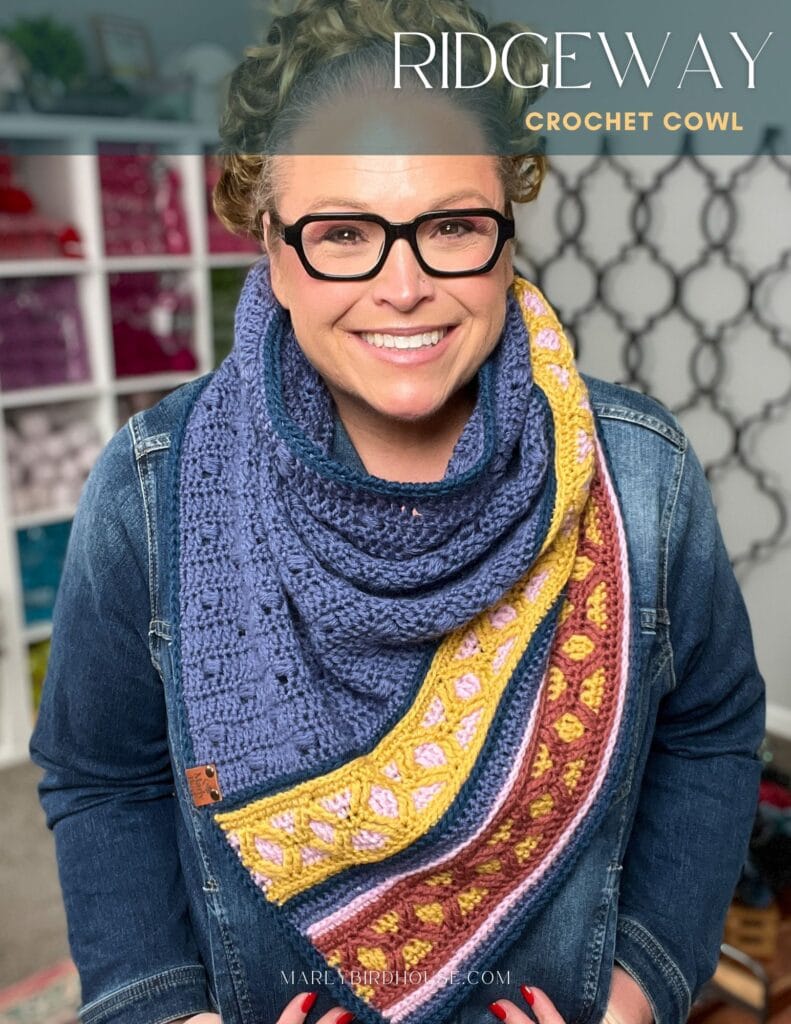
RIDGEWAY CROCHET COWL PATTERN
FINISHING
Edging
Round 1: With color A, join yarn to diagonal edge of triangular shawl with sc (working around row ends), sc evenly across edge to corner, 3 sc in corner, sc evenly down edge of shawl to first foundation sc, 3 sc in first foundation sc, sc in each foundation sc across to last, 3 sc in last foundation sc, sc evenly across diagonal edge to first sc, sl st to join, fasten off and weave in ends. Do not turn.
Row 2: Join color E to corner with sl st, sl st in each sc across straight edge and foundation edge (not along diagonal edge), do not turn.
Row 3: Reverse sc in each sc (same sc as sl st are worked) across foundation and straight edge. Fasten off weave in ends.
Wet Block Triangular Shawl
1.Soak with Care:
Fill a basin or sink with lukewarm water. Add a wool wash or lanolin-rich soap to condition the yarn (optional but lovely). Let your project soak for 15–20 minutes.
2. Handle with Kindness:
Support the full weight of your project when lifting from water. Press out water gently—do not wring or twist. Get as much water out as possible.
3. Towel Time:
Lay your project flat on a towel. Roll it up burrito-style to press out more moisture. Repeat with a second or third dry towel if necessary—it should be damp, not dripping.
4. Shape with Intention:
Lay your piece flat on a blocking board or clean surface. Pin to finished size.
5. Let It Dry:
Allow to air dry completely in a well-ventilated area. Avoid direct sunlight to prevent fading. A nearby fan can help speed up the process, but don’t rush it.
How to Make Your Edging Look Chef’s Kiss
Your edging is worked around the full triangle and the foundation edge, so a few easy habits will keep it smooth:
- Aim for “even,” not “exact.”
You’re working around row ends, so your goal is a consistent rhythm — not a perfect count on each side. - Corners matter.
Those 3 sc corners are the hinge points that keep your triangle crisp and not curl-happy. - Reverse single crochet = tidy finish.
That last edging row adds a subtle corded edge that looks intentional and holds shape beautifully.
Blocking: Where the Magic Pops
Blocking is especially important for this Ridgeway fabric because it:
- relaxes any tension differences from color changes
- opens up the texture
- sharpens your triangle shape
- improves drape (aka: makes it feel luxe when you wear it)
You don’t need to stretch aggressively — just shape to measurements and let the wool do its thing.
FAQ: Ridgeway Crochet Cowl Day 4
➡️ Do I have to block this triangle?
Yes, please. The stitch pattern and overall drape look their best after wet blocking, especially with a wool yarn like Deluxe Worsted.
➡️ How do I know if my edging is even enough?
Lay it flat. If the edges don’t ripple or pull tight, you nailed it. “Even” is about feel and shape, not a strict stitch count.
➡️ Why are we not edging along the diagonal in Row 2?
Row 2 is meant to reinforce only the straight and foundation edges, keeping the diagonal flexible and drapey.
➡️ My reverse sc feels tight. Is that normal?
Totally. Reverse sc naturally firms up the edge. Just keep your tension relaxed and your hook moving smoothly.
➡️ When do we turn this into a cowl?
That’s Day 5! Head back to the Turkey Trot hub to find the next link when it’s live:
https://marlybird.com/blog/7th-annual-marly-bird-turkey-trot-make-along-2025/
You did it — your triangle is finished and ready to become a cowl. Take a moment to admire that texture and those clean edges. You’re so close to wearing this beauty.
— Robyn Chachula, Unicorn Wrangler 🦄