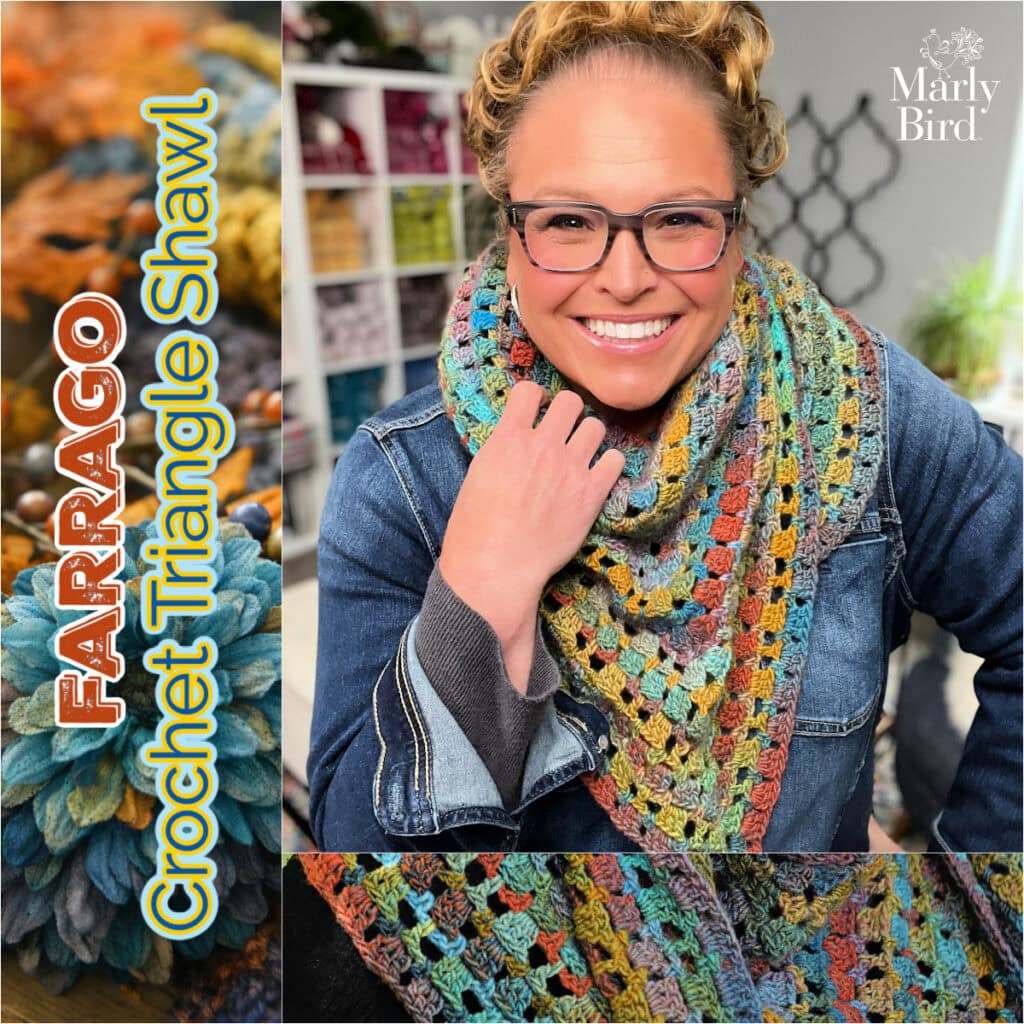
The Farrago Crochet Shawl is definitely that third kind. This free crochet shawl pattern is textured, rhythmic, and incredibly satisfying to work—perfect for cozy evenings, long rows, and that “just one more row” feeling.
Quick Pattern Overview
The Farrago Crochet Shawl is a classic triangle shawl worked from the top down using a mix of double crochet, half double crochet, treble crochet, and chain spaces. The stitch pattern creates a beautiful blend of structure and openness that drapes like a dream.
In this post, you’ll learn:
How triangle shawl construction works
Why repeating sections are so relaxing
How stitch diagrams support visual learners
Easy ways to adjust size and drape
Helpful tips for finishing your shawl
Why This Shawl Feels So Good to Make
The word Farrago means a mixture—and that’s exactly what this shawl delivers. Structured stitches meet airy spaces, giving you texture without heaviness and warmth without bulk.
The repeating sections make it easy to find your flow, while the stitch diagram is there if you like seeing the pattern laid out visually.
Affiliate Disclosure:This post contains affiliate links. To learn more please visit my privacy policy here💖
What You Will Love About This Pattern 💖
Free crochet shawl pattern (here on the blog)
Classic triangle shape
Relaxing, repeating rows
Stitch diagram included
Easy size adjustments
Beautiful drape with worsted-weight yarn
✨ Designer Tip: Shawls are the perfect playground for stitch patterns—no fitting stress, just pure stitchy joy.
Take a few minutes to read through the pattern before starting. Even if you don’t understand every instruction right away, reading the pattern once from top to bottom will help you see how the rows repeat and how the shawl grows. Many questions answer themselves once you see the big picture.
This shawl is worked from the top center outward in rows. You’ll begin at the very top point of the triangle and increase on every row to create the shape. The shawl gets wider and deeper at the same time, which is what creates that classic triangular look.
The corner space is the key to the whole pattern. Every row includes a corner made by working (3 double crochet, chain 3, 3 double crochet) into the same space. This is what forms the center point of the shawl. ✨ Tip: Place a stitch marker in the corner chain-3 space and move it up each row. This makes it much easier to stay oriented.
The pattern uses a repeating row sequence. After the setup rows, you’ll repeat the same group of rows over and over. Once you’ve completed a full repeat a couple of times, you may notice that the pattern starts to feel familiar and rhythmic — that’s a good sign!
Turning chains matter. Turning chains are not just there to get you to the right height — they often count as stitches or create spaces that you work into on the next row. Pay close attention to whether the pattern says to work into the turning chain or into a chain space.
Focus on where stitches go, not just how many there are. Many stitches are worked into chain spaces instead of individual stitches. If your stitch count seems off, check that you’re placing stitches into the correct spaces before pulling anything out.
Exact gauge is not critical for a shawl. Because this is not a fitted garment, being slightly off gauge won’t ruin the project. What matters most is that you like the fabric you’re creating. If it feels too stiff, go up a hook size. If it feels too loose, go down a hook size.
You can make the shawl larger or smaller. To adjust the size, simply work more or fewer repeats of the repeating rows. Always stop after completing a full repeat so the edges stay neat and balanced.
Row counts are more reliable than measurements while working. Measuring a shawl while it’s unblocked can be misleading. Counting rows and repeats will give you a more accurate sense of progress.
Blocking is not optional for this design. Blocking opens up the stitch pattern, smooths edges, and gives the shawl its final shape. Your shawl may look slightly bunched or uneven before blocking — that’s completely normal.
BEGINNER TIPS FOR SUCCESS
✨ Designer Tip: Use lifelines if you’re nervous. Running a scrap piece of yarn through the stitches at the end of a repeat gives you a safe place to rip back to if needed.
✨ Designer Tip: Mark the right side. If the pattern has a right and wrong side, place a removable stitch marker on the right side so you always know which side you’re working on.
✨ Designer Tip: Count at the end of each row. Taking 10 seconds to count stitches or pattern repeats at the end of a row can save you a lot of time later.
✨ Designer Tip: Don’t be afraid to frog. Everyone pulls out stitches — even designers. Frogging is part of the process, not a failure.
✨ Designer Tip: Use smooth yarn while learning. If this is your first shawl, smooth or lightly variegated yarn makes it easier to see stitches and spot mistakes.
✨ Designer Tip: Relax into the rhythm. Once the pattern repeat clicks, this shawl becomes a great “sit and stitch” project. Just pause at row changes to stay on track.
To Unlock Exclusive Subscriber Content click the Box below and join for free by simply adding your email and creating a password! If you are having troubles, clear your cache or reset your password or login to the Grow Publisher Portal.
I’m thrilled to share this amazing pattern with you, many patterns on my blog are absolutely free! I kindly request that you don’t copy and paste or distribute this pattern. Prefer an ad-free experience? Buy a digital PDF pattern for a small fee from one of my online stores for a seamless crafting journey.
I appreciate your support and readership. You are the reason I can keep doing what I love and sharing it with others. So, thank you from the bottom of my yarn-loving heart! Disclosure: This post contains affiliate links, meaning I get a commission if you decide to make a purchase through my links at no cost to you.
Row 1: Ch 5, (3 dc, ch 3, 3 dc, ch 1, tr) in ring, pull ring closed, turn.
Row 2: Ch 4, sc in ch-1 sp, ch 3, (sc, ch 3, sc) in ch-3 sp, ch 3, (sc, ch 1, hdc) in tch-sp, turn.– 3 ch-3 sps.
Row 3: Ch 5, 3 dc in ch-1 sp, 3 dc in next ch-3 sp, (3 dc, ch 3, 3 dc) in corner ch-3 sp (optional: place marker in ch-3 sp just made to mark corner), 3 dc in next ch-3 sp, (3 dc, ch 1, tr) in tch-sp, turn.– 6 groups of 3 dc.
Row 4: Ch 4, sc in ch-1 sp, [ch 3, sc between next 2 groups of 3dc] repeat to corner, ch 3, (sc, ch 3, sc) in corner ch-3 sp (optional: move marker to ch-3 just made to mark corner), [ch 3, sc between next 2 groups of 3dc] repeat to last 3dc group, ch 3, (sc, ch 1, hdc) in tch-sp, turn. —7 ch-3 sps.
Row 5: Ch 5, 3 dc in ch-1 sp, [ch 1, dc in next ch-3 sp, ch 1, 3 dc in next ch-3 sp] repeat to 1 ch-3 sp before corner, ch 1, dc in next ch-3 sp, ch 1, (3 dc, ch 3, 3 dc) in corner ch-3 sp (optional: move marker to ch-5 sp just made to mark corner), [ch 1, dc in next ch-3 sp, ch 1, 3 dc in next ch-3 sp] repeat to last ch-3 sp, ch 1, dc in last ch-3 sp, ch 1, (3 dc, ch 1, tr) in tch-sp, turn. — 9 ch-1 sps.
Row 6: Ch 4, [sc in next ch-1 sp, ch 3] repeat to corner, (sc, ch 3, sc) in corner ch-3 sp (optional: move marker to ch-3 sp just made to mark corner), [ch 3, sc in next ch-1 sp] repeat to tch-sp, ch 3, (sc, ch 1, hdc) in tch-sp, turn.–11 ch-3 sps.
Row 7: Ch 5, 3 dc in ch-1 sp, 3 dc in each ch-3 sp to corner, (3 dc, ch 3, 3 dc) in corner ch-3 sp (optional: move marker to ch-3 sp just made to mark corner), 3 dc in each ch-3 sp to tch-sp, (3 dc, ch 1, tr) in tch-sp, turn.– 14 groups of 3 dc.
“My edges look uneven — is that normal?” Yes! Shawl edges often look wobbly before blocking. As long as you’re following the pattern and placing stitches correctly, blocking will straighten everything out.
“I lost track of my repeat — what should I do?” Stop, place a stitch marker where you are, and compare your work to the last completed row. Look for the corner space and work outward from there.
“Can I change yarn?” Absolutely. Just choose a yarn with similar weight and drape, and check that you like the fabric with your chosen hook.
FREQUENTLY ASKED QUESTIONS (FAQ)
Is this pattern suitable for beginners? This pattern is best for adventurous beginners who are comfortable with basic crochet stitches like double crochet and working in rows. If this is your first shawl, take your time, read through the Notes, and don’t be afraid to pause and check your work as you go.
Do I need to get exact gauge for this shawl? No — exact gauge is not critical for a shawl. What matters most is that you like the fabric you’re creating. If your stitches feel too tight or stiff, try a larger hook. If the fabric feels too loose, go down a hook size.
How do I know if I’m placing stitches in the right spot? Many stitches in this pattern are worked into chain spaces rather than into individual stitches. Focus on where the pattern tells you to place stitches, especially around the corner space, instead of counting every stitch.
What if my stitch count doesn’t match? First, check that you didn’t miss or add stitches at the beginning or end of the row, especially around the turning chain. If the mistake is only a stitch or two and the fabric still looks correct, it’s often safe to continue.
Can I make the shawl larger or smaller? Yes! To adjust the size, simply work more or fewer repeats of the repeating rows. Always finish after completing a full repeat so the stitch pattern stays balanced and the edges remain neat.
Do I have to block the shawl? Yes — blocking is highly recommended. Blocking opens up the stitch pattern, smooths the edges, and helps the shawl drape properly. The shawl will look noticeably better after blocking.
What is the best way to block this shawl? Wet blocking works best for this design. Soak the shawl in lukewarm water with a gentle wool wash, gently squeeze out excess water, then lay it flat and pin it to shape. Allow it to dry completely.
My edges look uneven — did I do something wrong? Uneven edges are very common before blocking, especially on triangular shawls. As long as you followed the pattern and maintained the corner increases, blocking will even everything out.
Can I substitute a different yarn? Absolutely. Any yarn with similar weight and good drape will work. Smooth yarns highlight stitch definition, while color-changing yarns emphasize movement in the fabric.
How long does this shawl take to make? This varies by experience level and available stitching time. Many crocheters find it’s a great project to work on over several relaxed sessions, especially once the repeat becomes familiar.
Helpful Skills & Tutorials
If this is your first triangle shawl—or your first time working from a chart—you’re in good hands. The pattern references:
The Farrago Crochet Shawl is calm, cozy, and deeply satisfying—exactly the kind of project that reminds you why you love crochet in the first place. If you enjoy texture, rhythm, and a little me-time with your hook, this shawl belongs on your list.
In the blog it calls for 2 of roll with it, but where the actual directions begin it calls for 3. Which is correct? I want to make sure I have enough and it’s the same dye lot
Marly is a knitwear and crochet designer (and yarn addict) that is here to help you learn how to knit and crochet in a way that's fun and approachable.



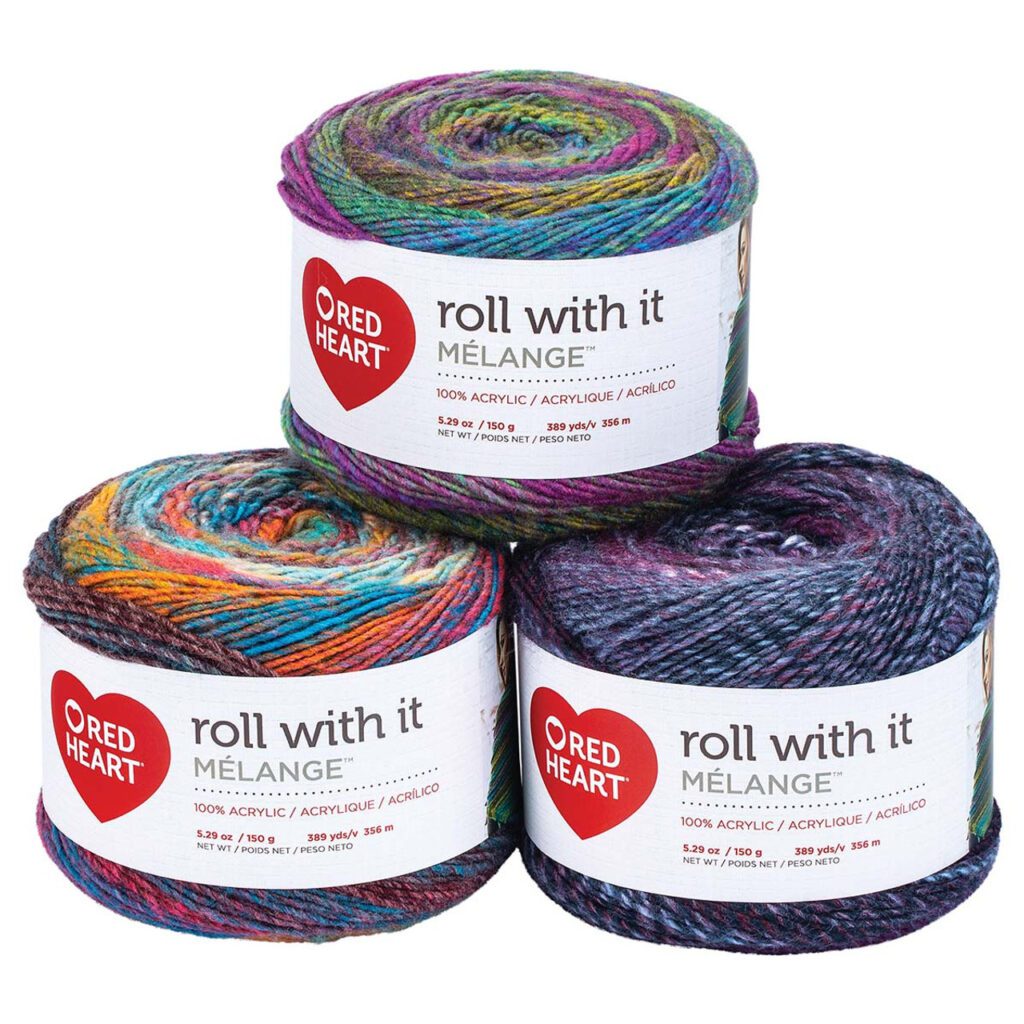








In the blog it calls for 2 of roll with it, but where the actual directions begin it calls for 3. Which is correct? I want to make sure I have enough and it’s the same dye lot
Sorry about that, I didn’t catch that I accidentally typed 2 instead of 3 in the first section. It is 3 total balls needed for the sample size