Tournament of Stitches 2026 || Knitting || Netflix and Chill Play 6 of 6

The free event includes access to the Netflix & Chill concentration level, which features relaxing stitch patterns that are easy to memorize and enjoyable to work.
These stitches are designed to be:
• rhythmic
• beginner-friendly
• relaxing to stitch
They’re perfect for crafting while watching your favorite show, chatting with friends, or simply enjoying a peaceful stitching session.
You can fully participate in the event using this concentration and still learn new stitches while stitching alongside the community.
But if you want to explore even more stitch techniques, there is also an optional upgrade available.
The VIP Advantage: Stitching With Your Mood
The VIP upgrade inside Marly Bird House unlocks all concentration levels.

This allows you to choose your stitching experience each week.
Feeling relaxed?
Work a Netflix & Chill stitch.
Feeling creative?
Try a Smooth Jazz pattern.
Feeling focused?
Dive into Shhh, Be Quiet!
This flexibility is what makes Tournament of Stitches so unique… and it’s why the finished projects are always so beautiful.
Play #6 – Netflix & Chill (Edging)
You made it to the final play… and now it’s time to finish strong. 😎🧶
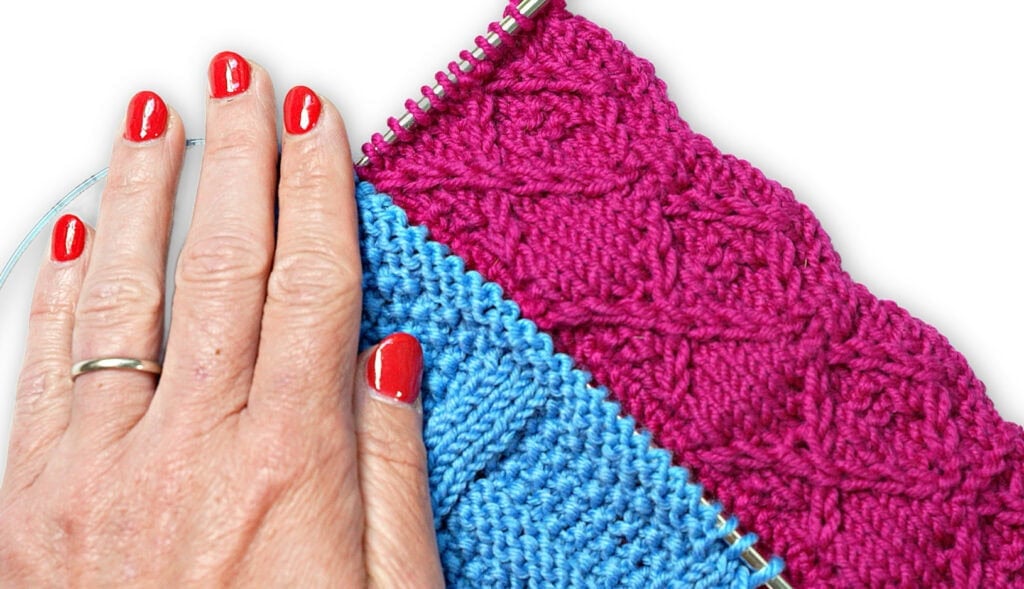
In Play #6, you’ll complete your shawl with a beautiful textured diamond and twist edging that adds the perfect polished touch to your project.
This section walks you through shaping the edge using simple increases and decreases, giving your shawl a professional finish while still keeping things relaxed and approachable.
Take your time, enjoy the process, and get ready…
Because this is the moment where you look at your shawl and say:
“Yep… I made that.” 💛
Designed by Marly Bird
SKILL LEVEL
Intermediate
GAUGE
18 sts = 4” [10 cm] in Stockinette st before blocking.
MATERIALS
Yarn
Malabrigo Yarn, Rios (100% Superwash Merino Wool, 210 yds / 192 m, 3½ oz/ 100 g, CYCA# 4 worsted)
7 balls: Frank Ochre (035)
Needles
U.S. 9 [5.5mm] 24” [60 cm] and 32″ [80 cm] circular or longer, or size to obtain gauge. Note: Shawl is worked back and forth in rows. Circular needles are used to accommodate the large number of sts as the shawl gets larger.
Notions
ABBREVIATIONS
K – Knit
K2tog – Knit Two Together
LT – Left Twist (see Special Stitches)
M1kR – Make 1 Knitwise Right (see Special Stitches)
P – Purl
RS – Right Side
RT – Right Twist (see Special Stitches)
Sl – Slip
St(s) – Stitch(es)
WS – Wrong Side
Wyif – With Yarn in Front
SPECIAL STITCHES
⭐ Left Twist (LT): Skip one stitch, knit next stitch through the back loop without dropping it off the needle, knit the skipped stitch, then drop both stitches from the right needle together.
⭐ Right Twist (RT): Skip one stitch, knit next stitch without dropping it off the needle, knit the skipped st, then drop both stitches from the right needle together.
⭐ Make 1 Knitwise Right (M1kR): With tip of left needle, pick up the horizontal strand between stitches from back to front. Knit this strand, twisting it into a loop in the process – 1 stitch increased.
CHARTS
Play 6 Chart: https://www.stitchfiddle.com/en/c/solip4-feju9a
Play 6 Chart, wide version: https://www.stitchfiddle.com/en/c/sobgjs-j638y4
VIDEO TUTORIALS
- Long-Tail Cast-on >> https://www.youtube.com/watch?v=vEGwt4cedLM <<
- Fixing Long Tail Cast-on >> https://youtube.com/shorts/ZlvKpqAqMrc <<
- Purl Stitch (Continental) >> https://www.youtube.com/watch?v=LuDt-8jqh4g <<
- Knit Stitch (Continental) >> https://www.youtube.com/watch?v=M3brKFKg5Yc <<
- How to Knit the Traditional Garter Tab and Edging for a Shawl >> https://youtu.be/jRsR5-W6GxU <<
- How to Tink >> https://youtu.be/c7Gud7k4Y8k <<
- How to Add a Lifeline (3 ways) >> https://youtu.be/FiqYUE_aHAw <<
- How to Bury Ends >> https://www.youtube.com/watch?v=8_NBGUKjO-E <<
- Wet Blocking Tips >> https://www.youtube.com/watch?v=b-0FRRfzC-c <<
- Netflix & Chill Play #6 >> https://youtu.be/XU9cWr1seRc <<
Click Here to Watch Play #6 Video on YouTube
CONSTRUCTION OVERVIEW
This shawl is worked:
- Top-down
- Beginning with a garter tab cast-on
- Increased along both wingspan edges and center
- Transitioning through multiple stitch pattern sections
- Finished with a lengthwise-knitted border
NOTES
- Always slip sts purlwise unless otherwise indicated.
- Place markers as instructed, as they are critical for maintaining stitch counts.
- Stitch count increases occur on designated rows.
- Lifelines are highly recommended at section transitions (see Video Tutorials).
- As stitch count grows, switch to longer circular needles for comfort.
- Border is worked lengthwise and joined as you go.
✨ Before You Begin Play Six
Alright, my friend—before you jump into this next section, let’s take a quick moment to set you up for success. 💛
- You should be working directly from the stitches you completed at the end of Play Five. Do not restart or rework anything—just continue right where you left off.
- Take a second to confirm your stitch count. This is super important! If your stitch count is off here, it can throw off the rest of the pattern.
- Highly recommended: Add a lifeline before you begin this play.
Think of it as your knitting safety net—if something feels off later, you’ll be so glad it’s there!- Also, do not put the lifeline through the stitch markers!
✨ Designer Tip: A lifeline now can save you from ripping back later. Future you will thank you 😉 Once everything checks out, you’re ready to keep stitching—let’s go!

NETFLIX AND CHILL PLAY #6 Pattern
PLAY 6: SLIPPED TWISTS BORDER
Play 6 Chart: https://www.stitchfiddle.com/en/c/solip4-feju9a
Play 6 Chart, wide version: https://www.stitchfiddle.com/en/c/sobgjs-j638y4
Note: It is highly recommended to place a lifeline (see Video Tutorials) before beginning each play in order to save the work you have so far and protect it from dropped stitches.
Count at end of play 5: 425 sts.
Slipped Twists Border is worked lengthwise over 14 sts and joined to the Shawl Body as you go using decreases.
The number of Border sts changes as the outer edge is shaped; the number of Body sts decreases by 1 after each join.
Start Here –> Cast on 14 additional sts using Backwards-Loop cast-on method (see Special Techniques).
Count: 14 Border sts
Count: 425 Body sts
Row 1 (joining row, RS): K13, k2tog (1 st from cast on, 1 st from Shawl Body), turn work.
Count: 14 Border sts
Count: 424 Body sts (-1 st)
Row 2 (WS): P1, k1, p6, k2, p3, sl 1 wyif.
Row 3 (joining row, RS): K2, M1kR, k1, RT ▶️, ◀️ LT, k4, RT ▶️, k2tog, turn work.
Count: 15 Border sts (+1 st)
Count: 423 Body sts (-1 st)
Row 4 (WS): P2, sl 1 wyif, p4, sl 1 wyif, p2, sl 1 wyif, p3, sl 1 wyif.
Row 5 (joining row, RS): K2, M1kR, k1, RT ▶️, k2, ◀️ LT, k2, RT ▶️, k1, k2tog, turn work.
Count: 16 Border sts (+1 st)
Count: 422 Body sts (-1 st)
Row 6 (WS): P3, sl 1 wyif, p2, sl 1 wyif, p4, sl 1 wyif, p3, sl 1 wyif.
Row 7 (joining row, RS): K2, M1kR, k1, RT ▶️, k4, ◀️ LT, RT ▶️, k2, k2tog, turn work.
Count: 17 Border sts (+1 st)
Count: 421 Body sts (-1 st)
Row 8 (WS): P1, k1, p2, sl 2 wyif, p2, k2, p2, sl 1 wyif, p3, sl 1 wyif.
Row 9 (joining row, RS): K3, ◀️ LT, k6, ◀️ LT, k3, k2tog, turn work.
Count: 17 Border sts
Count: 420 Body sts (-1 st)
Row 10 (WS): P1, k1, p2, sl 2 wyif, p2, k2, p2, sl 1 wyif, p3, sl 1 wyif.
Row 11 (joining row, RS): K1, k2tog, k1, ◀️ LT, k4, RT ▶️, ◀️ LT, k2, k2tog, turn work.
Count: 16 Border sts (-1 st)
Count: 419 Body sts (-1 st)
Row 12 (WS): P3, sl 1 wyif, p2, sl 1 wyif, p4, sl 1 wyif, p3, sl 1 wyif.
Row 13 (joining row, RS): K1, k2tog, k1, ◀️ LT, k2, RT ▶️, k2, ◀️ LT, k1, k2tog, turn work.
Count: 15 Border sts (-1 st)
Count: 418 Body sts (-1 st)
Row 14 (WS): P2, sl 1 wyif, p4, sl 1 wyif, p2, sl 1 wyif, p3, sl 1 wyif.
Row 15 (joining row, RS): K1, k2tog, k1, ◀️ LT, RT ▶️, k4, ◀️ LT, k2tog, turn work.
Count: 14 Border sts (-1 st)
Count: 417 Body sts (-1 st)
Row 16 (WS): P1, k1, p6, k2, p3, sl 1 wyif.
Repeat Rows 1-16 52 more times, then repeat Row 1 only once more.
Count: 14 edge sts
Count: 0 Body sts.
Bind off remaining 14 sts.
SLIPPED TWISTS BORDER (WIDE VERSION)
Play 6 Chart, wide version: https://www.stitchfiddle.com/en/c/sobgjs-j638y4
Note: Use this version to make the Border as wide and dramatic as you like, keeping in mind that this will require significantly more yarn than the original version.
Note: It is highly recommended to place a lifeline (see Video Tutorials) before beginning each play in order to save the work you have so far and protect it from dropped stitches.
Count at end of play 5: 425 sts.
Slipped Twists Border (wide version) is worked lengthwise over a multiple of 8 sts plus 6, and joined to the Shawl Body as you go using decreases.
The number of Border sts changes as the outer edge is shaped; the number of Body sts decreases by 1 after each join.
Cast on desired number of sts (in multiples of 8 sts plus 6) using the Backwards-Loop cast-on method (see Special Techniques).
Row 1 (joining row, RS): K to last Border st, k2tog (1 st from cast on, 1 st from Shawl Body), turn work.
Count: 424 Body sts (-1 st)
Row 2 (WS): P1, * k1, p6, k1; repeat from * to last 5 sts, k1, p3, sl 1 wyif.
Row 3 (joining row, RS): K2, M1kR, k1, RT ▶️, * ◀️ LT, k4, RT ▶️; repeat from * to last Border st, k2tog, turn work.
Count: +1 Border sts
Count: 423 Body sts (-1 st)
Row 4 (WS): P1, * p1, sl 1 wyif, p4, sl 1 wyif, p1; repeat from * to last 6 sts, p1, sl 1 wyif, p3, sl 1 wyif.
Row 5 (joining row, RS): K2, M1kR, k1, RT ▶️, k1, * k1, ◀️ LT, k2, RT ▶️, k1; repeat from * to last Border st, k2tog, turn work.
Count: +1 Border sts
Count: 422 Body sts (-1 st)
Row 6 (WS): P1, * [p2, sl 1 wyif] twice, p2; repeat from * to last 7 sts, p2, sl 1 wyif, p3, sl 1 wyif.
Row 7 (joining row, RS): K2, M1kR, k1, RT ▶️, k2, * k2, ◀️ LT, RT ▶️, k2; repeat from * to last Border st, k2tog, turn work.
Count: +1 Border sts
Count: 421 Body sts (-1 st)
Row 8 (WS): P1, * k1, p2, sl 2 wyif, p2, k1; repeat from * to last 8 sts, k1, p2, sl 1 wyif, p3, sl 1 wyif.
Row 9 (joining row, RS): * K3, ◀️ LT, k3; repeat from * to last Border st, k2tog, turn work.
Count: 420 Body sts (-1 st)
Row 10 (WS): P1, * k1, p2, sl 2 wyif, p2, k1; repeat from * to last 8 sts, k1, p2, sl 1 wyif, p3, sl 1 wyif.
Row 11 (joining row, RS): K1, k2tog, k1, ◀️ LT, k2, * k2, RT ▶️, ◀️ LT, k2; repeat from * to last Border st, k2tog, turn work.
Count: -1 Border sts
Count: 419 Body sts (-1 st)
Row 12 (WS): P1, * [p2, sl 1 wyif] twice, p2; repeat from * to last 7 sts, p2, sl 1 wyif, p3, sl 1 wyif.
Row 13 (joining row, RS): K1, k2tog, k1, ◀️ LT, k1, * k1, RT ▶️, k2, ◀️ LT, k1; repeat from * to last Border st, k2tog, turn work.
Count: -1 Border sts
Count: 418 Body sts (-1 st)
Row 14 (WS): P1, * p1, sl 1 wyif, p4, sl 1 wyif, p1; repeat from * to last 6 sts, p1, sl 1 wyif, p3, sl 1 wyif.
Row 15 (joining row, RS): K1, k2tog, k1, ◀️ LT, * RT ▶️, k4, ◀️ LT; repeat from * to last Border st, k2tog, turn work.
Count: -1 Border sts
Count: 417 Body sts (-1 st)
Row 16 (WS): P1, * k1, p6, k1; repeat from * to last 5 sts, k1, p3, sl 1 wyif.
Repeat Rows 1-16 52 more times, then repeat Row 1 only once more.
Count: 0 Body sts.
Bind off all remaining sts.