REVERSED Tournament of Stitches 2026 || Knitting || Netflix and Chill Play 2 of 6

The free event includes access to the Netflix & Chill concentration level, which features relaxing stitch patterns that are easy to memorize and enjoyable to work.
These stitches are designed to be:
• rhythmic
• beginner-friendly
• relaxing to stitch
They’re perfect for crafting while watching your favorite show, chatting with friends, or simply enjoying a peaceful stitching session.
You can fully participate in the event using this concentration and still learn new stitches while stitching alongside the community.
But if you want to explore even more stitch techniques, there is also an optional upgrade available.
The VIP Advantage: Stitching With Your Mood
The VIP upgrade inside Marly Bird House unlocks all concentration levels.

This allows you to choose your stitching experience each week.
Feeling relaxed?
Work a Netflix & Chill stitch.
Feeling creative?
Try a Smooth Jazz pattern.
Feeling focused?
Dive into Shhh, Be Quiet!
This flexibility is what makes Tournament of Stitches so unique… and it’s why the finished projects are always so beautiful.
REVERSED Play #2 – Netflix & Chill (Knit)
Let’s Keep It Chill … With a Twist 😎🧶
Ready to keep those relaxed vibes going… but maybe you noticed something?
Did you find yourself loving the wrong side of your fabric just a little bit more than the right side? 👀
You’re not alone… and you’re in luck!
For this version of Play #2 – Shooting Squares, we’ve reversed the chart and written instructions so you can create a completely different look using the same stitch pattern.
Same Stitch… Totally Different Look
The Shooting Squares stitch is one of those fun patterns where the fabric can look just as beautiful—sometimes even more interesting—on the reverse side.
So instead of making you flip your project and guess your way through it, we’ve done the work for you.
This version gives you:
✔ Reversed chart instructions
✔ Rewritten rows to match the reverse fabric
✔ A fresh take on the same geometric design
It’s like getting a second design option built right into the same play. ✨
Why Try the Reversed Version?
This is a great opportunity to:
🧶 Explore how stitch patterns behave differently
🧶 Customize your shawl to match your style
🧶 Create a more subtle or unexpected texture
🧶 Make your project truly one-of-a-kind
And honestly… it’s just plain fun to see how different the same stitches can look when viewed from another perspective.
Keep It Chill 😎
This is still your Netflix & Chill concentration, so don’t overthink it.
You’re still working a relaxed, approachable stitch pattern… just with a little creative twist.
So whether you stick with the original or go for the reversed version…
You’re still doing exactly what this event is all about:
✨ learning
✨ experimenting
✨ enjoying your stitches
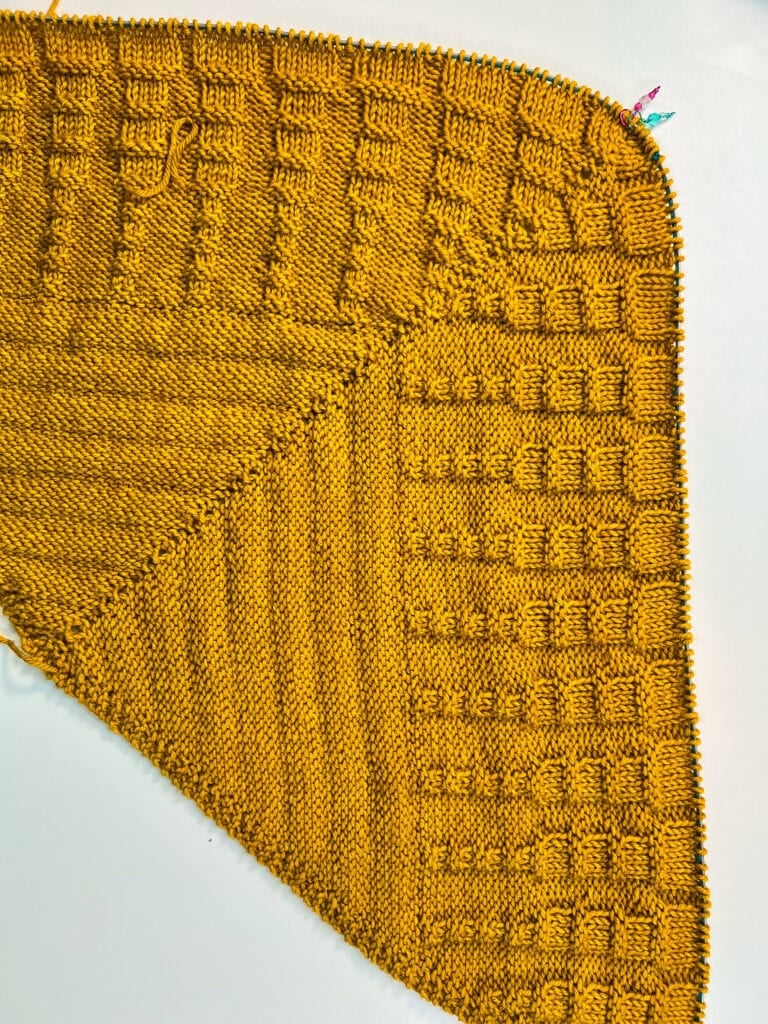
Designed by Marly Bird
SKILL LEVEL
Intermediate
GAUGE
18 sts = 4” [10 cm] in Stockinette st before blocking.
MATERIALS
Yarn
Malabrigo Yarn, Rios (100% Superwash Merino Wool, 210 yds / 192 m, 3½ oz/ 100 g, CYCA# 4 worsted)
7 balls: Frank Ochre (035)
Needles
U.S. 9 [5.5mm] 24” [60 cm] and 32″ [80 cm] circular or longer, or size to obtain gauge. Note: Shawl is worked back and forth in rows. Circular needles are used to accommodate the large number of sts as the shawl gets larger.
Notions
- Removable Stitch Markers
- Tapestry needle
- Scissors
- Tape measure
- Stitch Saver Cord
- Notions Bag for Supplies
- Blocking Squares
- Blocking Pins
- Soaking Basin
- Eucalan Wool Wash
- Blocking Wires (ideal for lace work)
- Ball Winder and Swift
ABBREVIATIONS
K – Knit
P – Purl
RS – Right Side
Slm – Slip Marker
St(s) – Stitch(es)
WS – Wrong Side
SPECIAL INCREASES
⭐ (K1, p1) in next st:
Note: This is not the same as a knit-front-back increase.
Knit front leg of next st but do not drop it off the left needle, bring yarn to front between the needles, purl front leg of same st, then drop off (1 st increased).
⭐ (K1, p1, k1) in next st:
Knit front leg of next st but do not drop it off the left needle, bring yarn to front between the needles, purl front leg of same st but do not drop it off, bring yarn to back between the needles, knit front leg of same st again, then drop off (2 sts increased).
⭐ (P1, k1) in next st:
Purl in front leg of next st but do not drop it off the left needle, bring yarn to back between the needles, knit front leg of same st, then drop off (1 st increased).
PATTERN STITCHES
Shooting Squares
Worked over a multiple of 8 sts plus 2.
Small Squares Section:
Row 1 (RS): Purl.
Row 2: Knit.
Row 3: P4, * k2, p6; repeat from * to last 6 sts , k2, p4.
Row 4: K4, p2, * k6, p2; repeat from * to last 4 sts, k4.
Repeat Rows 1-4 for Small Squares section of Shooting Squares.
Medium Squares Section:
Row 1 (RS): Purl.
Row 2: Knit.
Row 3: P3, * k4, p4; repeat from * to last 7 sts, k4, p3.
Row 4: K3, p4, * k4, p4; repeat from * to last 3 sts, k3.
Row 5: P3, * k4, p4; repeat from * to last 7 sts, k4, p3.
Row 6: K3, p4, * k4, p4; repeat from * to last 3 sts, k3.
Repeat Rows 1-6 for Medium Squares section of Shooting Squares.
Large Squares Section:
Row 1 (RS): Purl.
Row 2: Knit.
Row 3: P2, * k6, p2; repeat from * to end.
Row 4: K2, * p6, k2; repeat from * to end.
Row 5: P2, * k6, p2; repeat from * to end.
Row 6: K2, * p6, k2; repeat from * to end.
Row 7: P2, * k6, p2; repeat from * to end.
Row 8: K2, * p6, k2; repeat from * to end.
Repeat Rows 1-8 for Large Squares section of Shooting Squares.Reversed Shooting Squares Chart: https://www.stitchfiddle.com/en/c/sogpvv-gt78jn
CHARTS
Reversed Play 2 Chart: https://www.stitchfiddle.com/en/c/sogpq1-h90j8a
Reversed Condensed Play 2 Chart: https://www.stitchfiddle.com/en/c/sogpv7-hd5528
Reversed Shooting Squares Chart: https://www.stitchfiddle.com/en/c/sogpvv-gt78jn
VIDEO TUTORIALS
- How to Knit the Traditional Garter Tab and Edging for a Shawl: https://youtu.be/jRsR5-W6GxU
- How to Knit: https://youtu.be/M3brKFKg5Yc
- How to Purl: https://youtu.be/LuDt-8jqh4g
- How to Tink >> https://youtu.be/c7Gud7k4Y8k <<
- How to Add a Lifeline: https://youtu.be/FiqYUE_aHAw
- How to Bury Ends: https://youtu.be/8_NBGUKjO-E
- Wet Blocking Tips >> https://www.youtube.com/watch?v=b-0FRRfzC-c <<
Click Here to watch Play 2 Video on YouTube
CONSTRUCTION OVERVIEW
This shawl is worked:
- Top-down
- Beginning with a garter tab cast-on
- Increased along both wingspan edges and center
- Transitioning through multiple stitch pattern sections
NOTES
- Always slip sts purlwise unless otherwise indicated.
- Place markers as instructed, as they are critical for maintaining stitch counts.
- Stitch count increases occur on designated rows.
- Lifelines are highly recommended at section transitions (see Video Tutorials).
- As stitch count grows, switch to longer circular needles for comfort.
✨ Before You Begin Play Two
Alright, my friend—before you jump into this next section, let’s take a quick moment to set you up for success. 💛
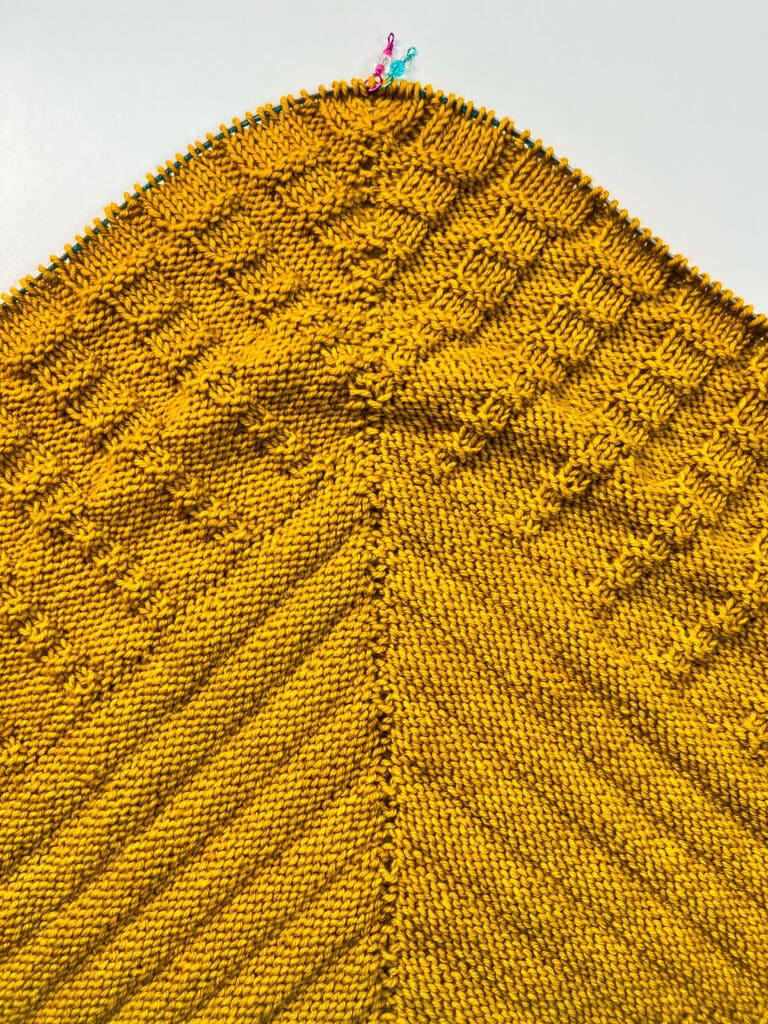
- You should be working directly from the stitches you completed at the end of Play One. Do not restart or rework anything—just continue right where you left off.
- Take a second to confirm your stitch count. This is super important! If your stitch count is off here, it can throw off the rest of the pattern.
- Highly recommended: Add a lifeline before you begin this play.
Think of it as your knitting safety net—if something feels off later, you’ll be so glad it’s there!- Also, do not put the lifeline through the stitch markers!
✨ Designer Tip: A lifeline now can save you from ripping back later. Future you will thank you 😉 Once everything checks out, you’re ready to keep stitching—let’s go!

REVERSED NETFLIX AND CHILL SHAWL PATTERN || Play #2
PLAY 2: SHOOTING SQUARES
Reversed Play 2 Chart: https://www.stitchfiddle.com/en/c/sogpq1-h90j8a
Reversed Condensed Play 2 Chart: https://www.stitchfiddle.com/en/c/sogpv7-hd5528
Row 65 (RS): K2, slm, k1, p to marker, slm, k1, slm, p to last st before marker, k1, slm, k2.
Row 66 (increase row, WS): K2, slm, (k1, p1) in next st, k to marker, slm, (k1, p1, k1) in center st, slm, k to 1 st before marker, (p1, k1) in next st, slm, k2.
Move center markers 1 st inward each.
Count: 141 sts (+4 sts)
Row 67 (RS): K2, slm, k1, p4, * k2, p6; repeat from * to last 7 sts before marker, k2, p5, slm, k1, slm, p5, k2, * p6, k2; repeat from * to last 5 sts before marker, p4, k1, slm, k2.
Row 68 (increase row, WS): K2, slm, (k1, p1) in next st, k4, * p2, k6; repeat from * to last 7 sts before marker, p2, k5, slm, (k1, p1, k1) in center st, slm, k5, p2, * k6, p2; repeat from * to last 5 sts before marker, k4, (p1, k1) in next st, slm, k2.
Move center markers 1 st inward each.
Count: 145 sts (+4 sts)
Row 69 (RS): K2, slm, k1, p to marker, slm, k1, slm, p to last st before marker, k1, slm, k2.
Row 70 (increase row, WS): K2, slm, (k1, p1) in next st, k to marker, slm, (k1, p1, k1) in center st, slm, k to 1 st before marker, (p1, k1) in next st, slm, k2.
Move center markers 1 st inward each.
Count: 149 sts (+4 sts)
Row 71 (RS): K2, slm, k1, p6, * k2, p6; repeat from * to last st before marker, k1, slm, k1, slm, k1, * p6, k2; repeat from * to last 7 sts before marker, p6, k1, slm, k2.
Row 72 (increase row, WS): K2, slm, (k1, p1) in next st, k6, * p2, k6; repeat from * to last st before marker, p1, slm, (k1, p1, k1) in center st, slm, p1, * k6, p2; repeat from * to last 7 sts before marker, k6, (p1, k1) in next st, slm, k2.
Move center markers 1 st inward each.
Count: 153 sts (+4 sts)
Row 73 (RS): K2, slm, k1, p to marker, slm, k1, slm, p to last st before marker, k1, slm, k2.
Row 74 (increase row, WS): K2, slm, (k1, p1) in next st, k to marker, slm, (k1, p1, k1) in center st, slm, k to 1 st before marker, (p1, k1) in next st, slm, k2.
Move center markers 1 st inward each.
Count: 157 sts (+4 sts)
Row 75 (RS): K2, slm, k1, * k2, p6; repeat from * to last 3 sts before marker, k2, p1, slm, k1, slm, p1, k2, * p6, k2; repeat from * to last st before marker, k1, slm, k2.
Row 76 (increase row, WS): K2, slm, (k1, p1) in next st, * p2, k6; repeat from * to last 3 sts before marker, p2, k1, slm, (k1, p1, k1) in next st, slm, k1, p2, * k6, p2; repeat from * to last st before marker, (p1, k1) in next st, slm, k2.
Move center markers 1 st inward each.
Count: 161 sts (+4 sts)
Row 77 (RS): K2, slm, k1, p to marker, slm, k1, slm, p to last st before marker, k1, slm, k2.
Row 78 (increase row, WS): K2, slm, (k1, p1) in next st, k to marker, slm, (k1, p1, k1) in center st, slm, k to 1 st before marker, (p1, k1) in next st, slm, k2.
Move center markers 1 st inward each.
Count: 165 sts (+4 sts)
Row 79 (RS): K2, slm, k1, p2, * k2, p6; repeat from * to last 5 sts before marker, k2, p3, slm, k1, slm, p3, k2, * p6, k2; repeat from * to last 3 sts, p2, k1, slm, k2.
Row 80 (increase row, WS): K2, slm, (k1, p1) in next st, k2, * p2, k6; repeat from * to last 5 sts before marker, p2, k3, slm, (k1, p1, k1) in next st, slm, k3, p2, * k6, p2; repeat from * to last 3 sts, k2, (p1, k1) in next st, slm, k2.
Move center markers 1 st inward each.
Count: 169 sts (+4 sts)
Row 81 (RS): K2, slm, k1, p to marker, slm, k1, slm, p to last st before marker, k1, slm, k2.
Row 82 (increase row, WS): K2, slm, (k1, p1) in next st, k to marker, slm, (k1, p1, k1) in center st, slm, k to 1 st before marker, (p1, k1) in next st, slm, k2.
Move center markers 1 st inward each.
Count: 173 sts (+4 sts)
Row 83 (RS): K2, slm, k1, p3, * k4, p4; repeat from * to marker, slm, k1, slm, * p4, k4; repeat from * to last 4 sts before marker, p3, k1, slm, k2.
Row 84 (increase row, WS): K2, slm, (k1, p1) in next st, k3, * p4, k4; repeat from * to marker, slm, (k1, p1, k1) in center st, slm, * k4, p4; repeat from * to last 4 sts before marker, k3, (p1, k1) in next st, slm, k2.
Move center markers 1 st inward each.
Count: 177 sts (+4 sts)
Row 85 (RS): K2, slm, k1, p4, * k4, p4; repeat from * to last st before marker, k1, slm, k1, slm, k1, * p4, k4; repeat from * to last 5 sts before marker, p4, k1, slm, k2.
Row 86 (increase row, WS): K2, slm, (k1, p1) in next st, k4, * p4, k4; repeat from * to last st before marker, p1, slm, (k1, p1, k1) in center st, slm, p1, * k4, p4; repeat from * to last 5 sts before marker, k4, (p1, k1) in next st, slm, k2.
Move center markers 1 st inward each.
Count: 181 sts (+4 sts)
Row 87 (RS): K2, slm, k1, p to marker, slm, k1, slm, p to last st before marker, k1, slm, k2.
Row 88 (increase row, WS): K2, slm, (k1, p1) in next st, k to marker, slm, (k1, p1, k1) in center st, slm, k to 1 st before marker, (p1, k1) in next st, slm, k2.
Move center markers 1 st inward each.
Count: 185 sts (+4 sts)
Row 89 (RS): K2, slm, k3, p4, * k4, p4; repeat from * to last 3 sts before marker, k3, slm, k1, slm, k3, * p4, k4; repeat from * to last 7 sts before marker, p4, k3, slm, k2.
Row 90 (increase row, WS): K2, slm, (k1, p1) in next st, p2, k4, * p4, k4; repeat from * to last 3 sts before marker, p3, slm, (k1, p1, k1) in center st, slm, p3, * k4, p4; repeat from * to last 7 sts before marker, k4, p2, (p1, k1) in next st, slm, k2.
Move center markers 1 st inward each.
Count: 189 sts (+4 sts)
Row 91 (RS): K2, slm, k4, p4, * k4, p4; repeat from * to last 4 sts before marker, k4, slm, k1, slm, k4, * p4, k4; repeat from * to last 8 sts before marker, p4, k4, slm, k2.
Row 92 (increase row, WS): K2, slm, (k1, p1) in next st, p3, k4, * p4, k4; repeat from * to last 4 sts before marker, p4, slm, (k1, p1, k1) in center st, slm, p4, * k4, p4; repeat from * to last 8 sts before marker, k4, p3, (p1, k1) in next st, slm, k2.
Move center markers 1 st inward each.
Count: 193 sts (+4 sts)
Row 93 (RS): K2, slm, k1, p to marker, slm, k1, slm, p to last st before marker, k1, slm, k2.
Row 94 (increase row, WS): K2, slm, (k1, p1) in next st, k to marker, slm, (k1, p1, k1) in center st, slm, k to 1 st before marker, (p1, k1) in next st, slm, k2.
Move center markers 1 st inward each.
Count: 197 sts (+4 sts)
Row 95 (RS): K2, slm, k1, p1, * k4, p4; repeat from * to last 6 sts before marker, k4, p2, slm, k1, slm, p2, k4, * p4, k4; repeat from * to last 2 sts before marker, p1, k1, slm, k2.
Row 96 (increase row, WS): K2, slm, (k1, p1) in next st, k1, * p4, k4; repeat from * to last 6 sts before marker, p4, k2, slm, (k1, p1, k1) in center st, slm, k2, p4, * k4, p4; repeat from * to last 2 sts before marker, k1, (p1, k1) in next st, slm, k2.
Move center markers 1 st inward each.
Count: 201 sts (+4 sts)
Row 97 (RS): K2, slm, k1, p2, * k4, p4; repeat from * to last 7 sts before marker, k4, p3, slm, k1, slm, p3, k4, * p4, k4; repeat from * to last 3 sts before marker, p2, k1, slm, k2.
Row 98 (increase row, WS): K2, slm, (k1, p1) in next st, k2, * p4, k4; repeat from * to last 7 sts before marker, p4, k3, slm, (k1, p1, k1) in center st, slm, k3, p4, * k4, p4; repeat from * to last 3 sts before marker, k2, (p1, k1) in next st, slm, k2.
Move center markers 1 st inward each.
Count: 205 sts (+4 sts)
Row 99 (RS): K2, slm, k1, p to marker, slm, k1, slm, p to last st before marker, k1, slm, k2.
Row 100 (increase row, WS): K2, slm, (k1, p1) in next st, k to marker, slm, (k1, p1, k1) in center st, slm, k to 1 st before marker, (p1, k1) in next st, slm, k2.
Move center markers 1 st inward each.
Count: 209 sts (+4 sts)
Row 101 (RS): K2, slm, k2, p2, * k6, p2; repeat from * to last 2 sts before marker, k2, slm, k1, slm, k2, * p2, k6; repeat from * to last 4 sts before marker, p2, k2, slm, k2.
Row 102 (increase row, WS): K2, slm, (k1, p1) in next st, p1, k2, * p6, k2; repeat from * to last 2 sts before marker, p2, slm, (k1, p1, k1) in center st, slm, p2, * k2, p6; repeat from * to last 4 sts before marker, k2, p1, (p1, k1) in next st, slm, k2.
Move center markers 1 st inward each.
Count: 213 sts (+4 sts)
Row 103 (RS): K2, slm, k3, p2, * k6, p2; repeat from * to last 3 sts before marker, k3, slm, k1, slm, k3, * p2, k6; repeat from * to last 5 sts before marker, p2, k3, slm, k2.
Row 104 (increase row, WS): K2, slm, (k1, p1) in next st, p2, k2, * p6, k2; repeat from * to last 3 sts before marker, p3, slm, (k1, p1, k1) in center st, slm, p3, * k2, p6; repeat from * to last 5 sts before marker, k2, p2, (p1, k1) in next st, slm, k2.
Move center markers 1 st inward each.
Count: 217 sts (+4 sts)
Row 105 (RS): K2, slm, k4, p2, * k6, p2; repeat from * to last 4 sts before marker, k4, slm, k1, slm, k4, * p2, k6; repeat from * to last 6 sts before marker, p2, k4, slm, k2.
Row 106 (increase row, WS): K2, slm, (k1, p1) in next st, p3, k2, * p6, k2; repeat from * to last 4 sts before marker, p4, slm, (k1, p1, k1) in center st, slm, p4, * k2, p6; repeat from * to last 6 sts before marker, k2, p3, (p1, k1) in next st, slm, k2.
Move center markers 1 st inward each.Count: 221 sts (+4 sts)
Return to the main blog post for the Tournament of Stitches 2026