Flirt Alert Knit Triangle Shawl – Free Worsted Weight Knit Shawl Pattern from TOS 2018
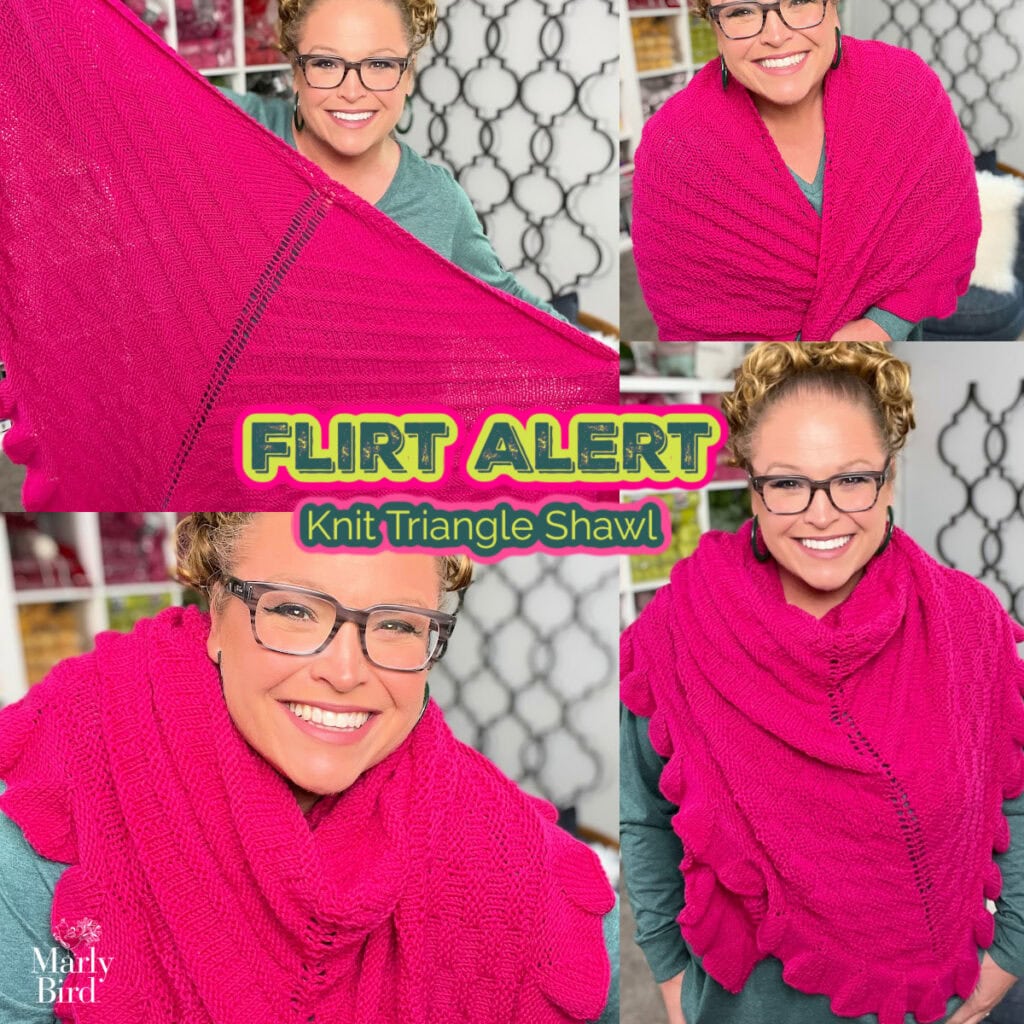
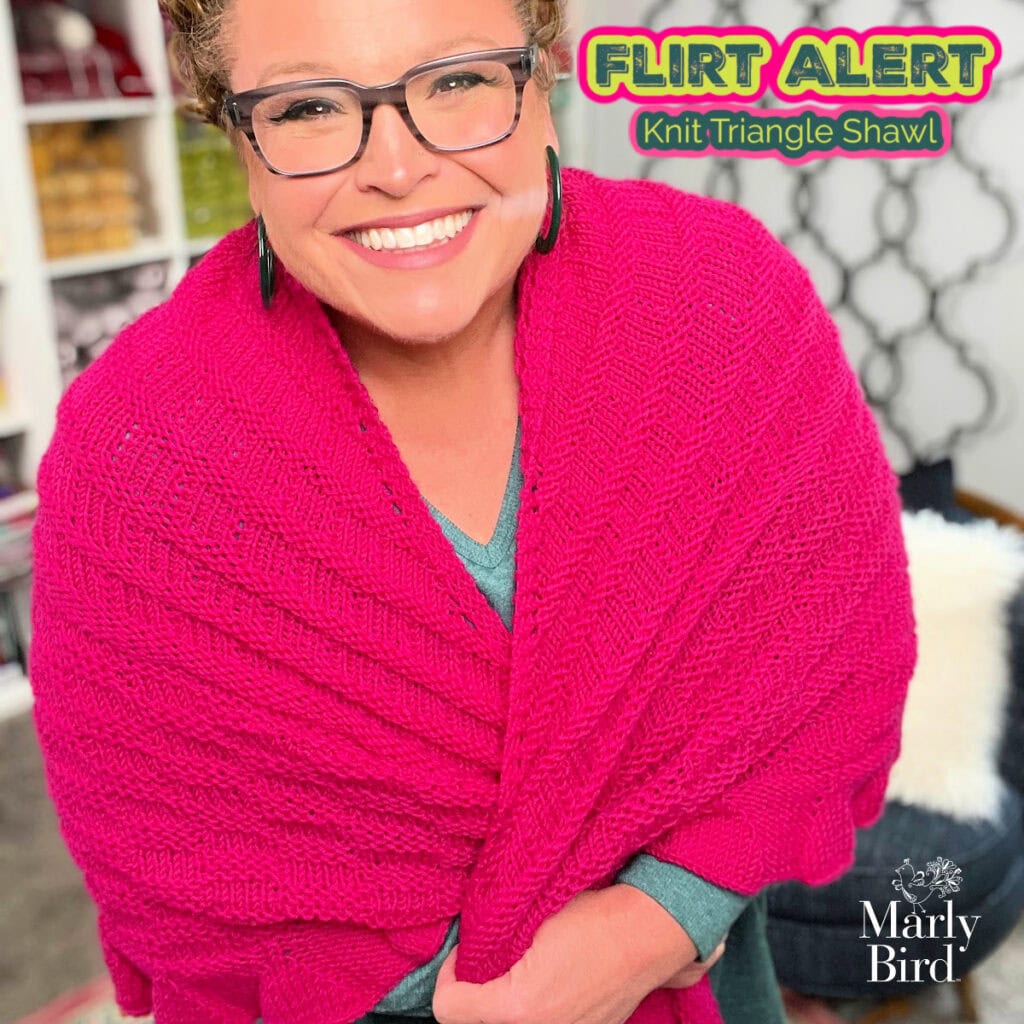
The Flirt Alert Knit Triangle Shawl is a free worsted weight knit shawl pattern worked top-down from a garter tab cast-on. Featuring textured stitch bands and a dramatic bell edging, this Tournament of Stitches 2018 design is perfect for confident beginners ready to explore shaping and texture.
There is something about a bold triangle shawl that just says, “Yes. I meant to do that.” 💅🧶
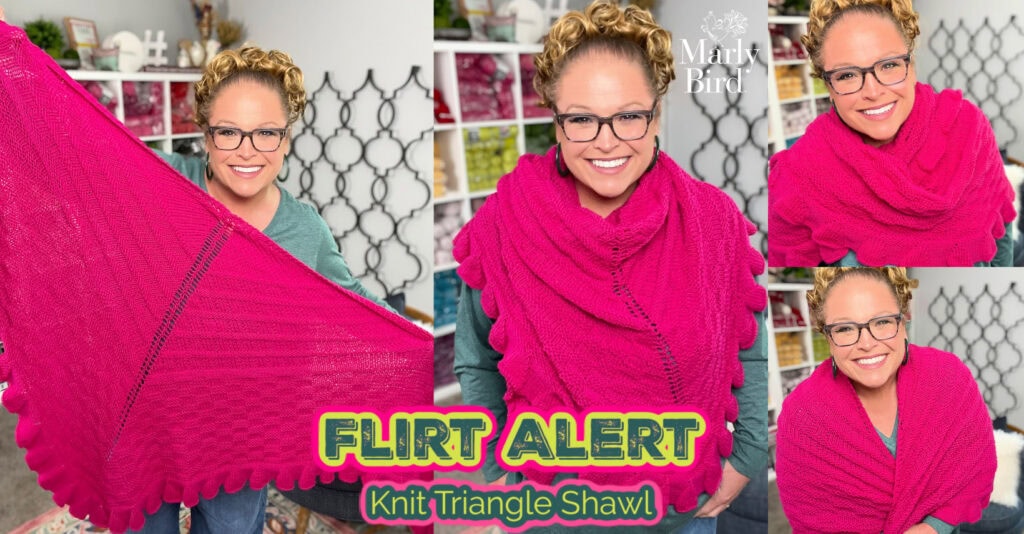
The Flirt Alert Knit Triangle Shawl is a free worsted weight knit shawl pattern packed with texture, structure, and just enough playful drama to keep your knitting interesting. Originally released as part of the very first Tournament of Stitches in 2018, this design was the Smooth Jazz concentration level — engaging, rhythmic, and satisfying without requiring total silence.
If you love understanding how shawls are built and how different shapes behave, be sure to explore my full guide to knit shawl patterns, where I break down triangle shawls, crescents, asymmetrical designs, and more so you can choose your next project with confidence. 💖
Affiliate Disclosure: This post contains affiliate links. To learn more please visit my privacy policy here💖
What You Will Love About This Pattern 💖
- Classic top-down triangle shawl construction
- Polished garter tab cast-on
- Textured stitch bands that build skill without overwhelm
- A dramatic bell edging that finishes strong
- Worsted weight yarn for faster knitting
- Generous, wearable size
- Designed for community knitting during Tournament of Stitches 2018
This shawl feels intentional. It has presence. It flirts just a little. 😘
About This Top-Down Triangle Shawl Construction
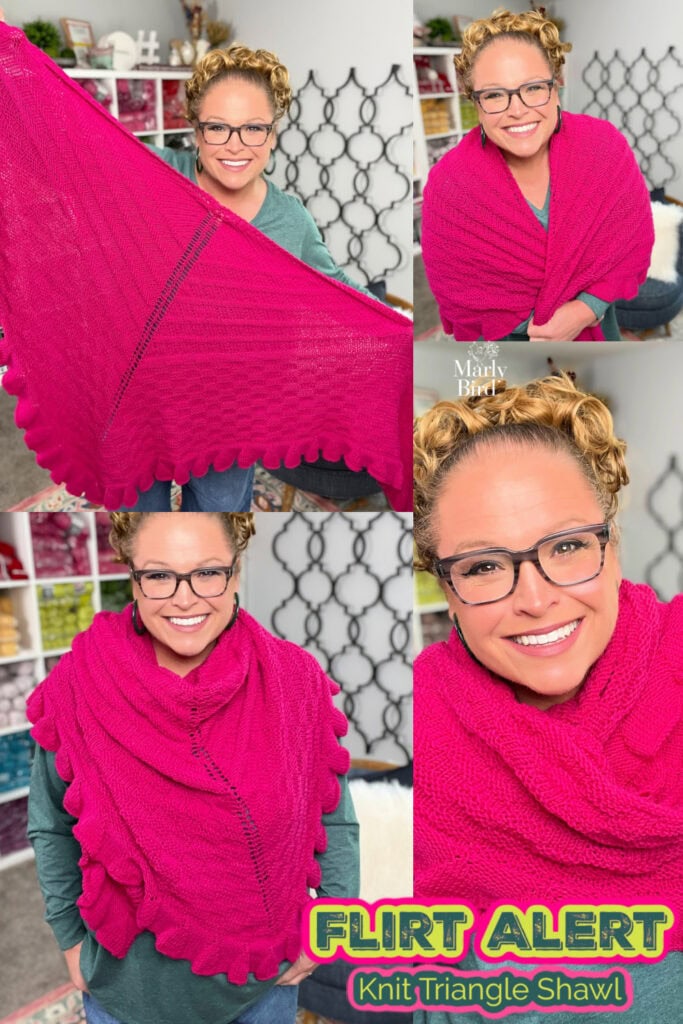
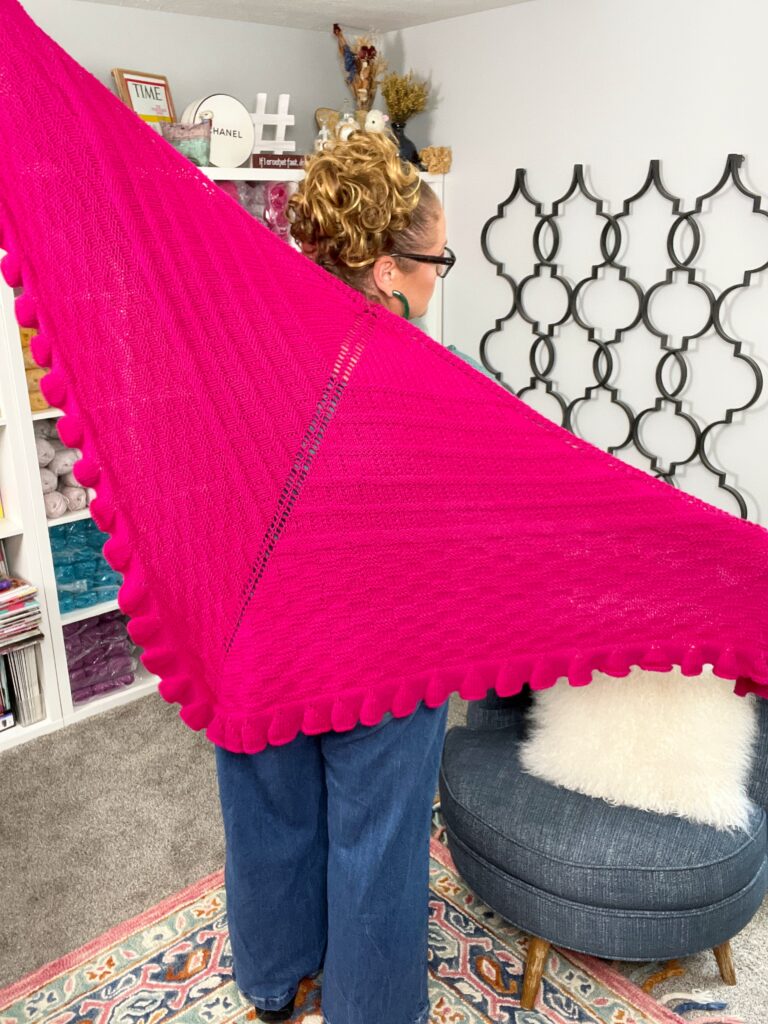
Flirt Alert is worked from the top center down, beginning with a traditional garter tab cast-on. From there, increases are worked along the center spine and both edges to create that iconic triangular shape.
Top-down triangle shawls are a favorite for a reason:
- You see growth immediately
- The center spine adds visual structure
- The shaping becomes predictable and rhythmic
- You can easily adjust the depth if needed
As you move through the pattern, you’ll knit textured stitch sections including:
- Slip Columns
- Slip Windows
- Garter Weave
- Bell Edging
Each section builds on the previous one. It keeps your brain engaged without feeling chaotic.
Want to understand the roots of this design?
👉 Read more about the Tournament of Stitches Mystery Make-Along and how it works.
Skill Level – Smooth Jazz from TOS 2018 🎷
Back in 2018, we categorized patterns by concentration level rather than traditional beginner/intermediate labels.
Flirt Alert was the Smooth Jazz level.
That means:
- You can knit with background noise
- You need to pay attention to stitch patterns
- There’s texture and shaping involved
- It’s not mindless knitting
If you’re comfortable with:
- Yarn overs
- Basic increases
- Slip stitches
- Reading stitch instructions
You’re ready.
This is an ideal project for knitters who want to grow their skills without feeling overwhelmed.
Finished Measurements & Gauge 📏🧶
Gauge of this textured knit shawl pattern is 18 stitches = 4 inches in Stockinette stitch (unblocked)
Finished Size of the triangle shawl is approximately 60 inches [152 cm] across the top edge and approximately 30 inches [76 cm] deep (down the center)
That gives you a generous triangle that wraps beautifully without feeling bulky or overwhelming.
Let’s Talk About Gauge (Especially If You’re New 👀)
Gauge matters more than most knitters realize.
In a top-down triangle shawl like this one, your gauge directly affects:
- The overall size
- The depth of the shawl
- How much yarn you use
- How dramatic that bell edging becomes
If your stitches are looser than the stated gauge, your shawl will:
- Grow larger
- Use more yarn
- Potentially run short before the edging
If your stitches are tighter than gauge, your shawl will:
- Be smaller
- Feel denser
- Possibly look less fluid
Because this shawl uses worsted weight yarn and textured stitch bands, the drape is part of the magic. You don’t want it stiff. You want it structured but soft.
✨ Designer Tip: Block your swatch. Merino wool relaxes when washed. A swatch that looks slightly small before blocking may open up beautifully after.
If you’re newer to knitting, this is a fantastic project for learning how gauge impacts final size and yarn requirements.
Choosing the Right Yarn 🧵💖
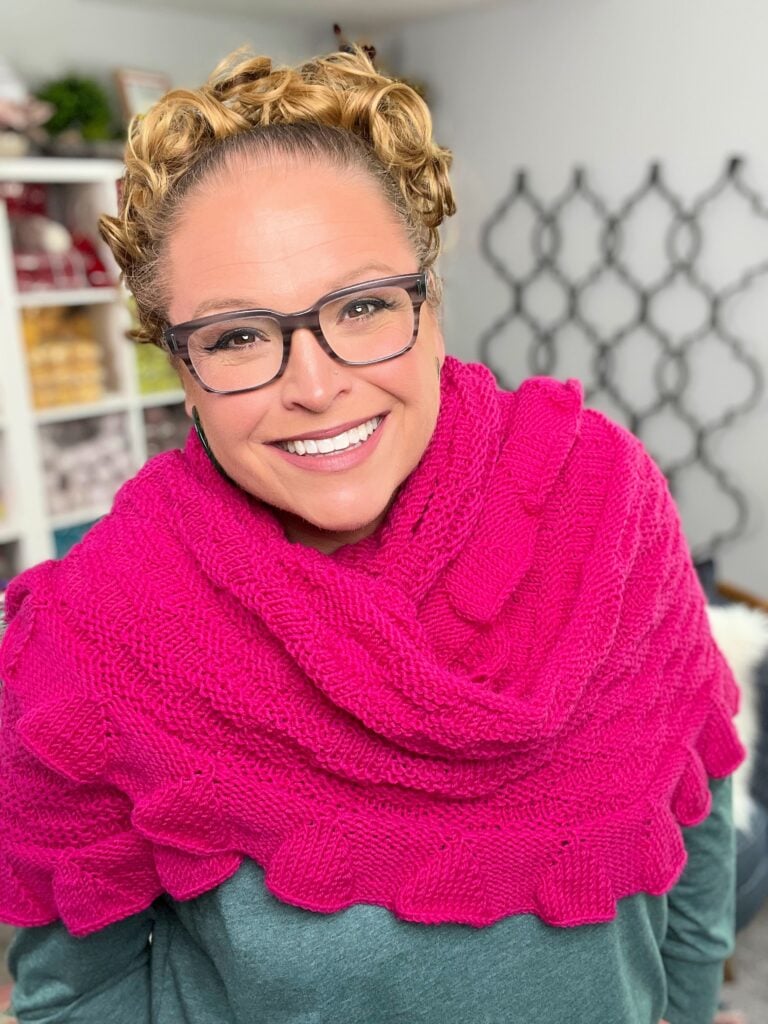
This worsted weight knit shawl pattern was designed in 100% merino wool for a reason.
Merino offers:
- Softness against the skin
- Excellent stitch definition
- Natural elasticity
- Beautiful blocking response
- A polished, high-end finish
The textured stitch bands in this pattern really shine in smooth merino. The bell edging opens beautifully after blocking.
Avoid overly fuzzy yarns if you want crisp stitch definition.
Budget-Friendly Option 💰
Soft, affordable superwash merino with excellent color options. Reliable and beginner-friendly.
Mid-Range Option 💖
Madelinetosh Tosh Vintage Yarn
Superwash Merino wool feel. This squishy soft skein is hand-dyed in small dye lots and is machine-washable!l sample yarn.
Splurge Option ✨
Incredible depth of color and luxurious feel. This pattern truly shines in a splurge yarn.
Yardage Planning Tips
Because this is a top-down triangle shawl:
- Rows get longer
- Stitch counts increase dramatically
- Yarn usage accelerates toward the end
If you knit looser than gauge, you may need additional yardage.
Always check:
- Total yardage required
- Yardage per skein
- Fiber content
- Weight category
Better to buy an extra skein than lose a game of yarn chicken at the edging. 😅
Needle Strategy for Growing Shawls 🪡✨
You’ll use a U.S. 9 (5.5 mm) circular needle.
As the shawl grows, the stitch count climbs into the hundreds. A longer cord makes knitting far more comfortable.
✨ Designer Tip: Pointier needle tips make yarn overs and textured stitches easier. A quality interchangeable needle set lets you switch cable lengths as the shawl grows without changing needle size.
Investing in good tools improves your experience dramatically.
Why This Shawl Still Deserves a Spot in Your Queue 💕
This design helped launch the Tournament of Stitches tradition.
And it still feels fresh.
The texture feels modern.
The triangle shape is timeless.
The bell edging adds personality.
It’s cozy enough for fall. Bold enough for winter. And playful enough to stand out.
Some patterns age. This one didn’t. 💁♀️
Styling Ideas 💖
Worsted weight gives this shawl versatility.
You can:
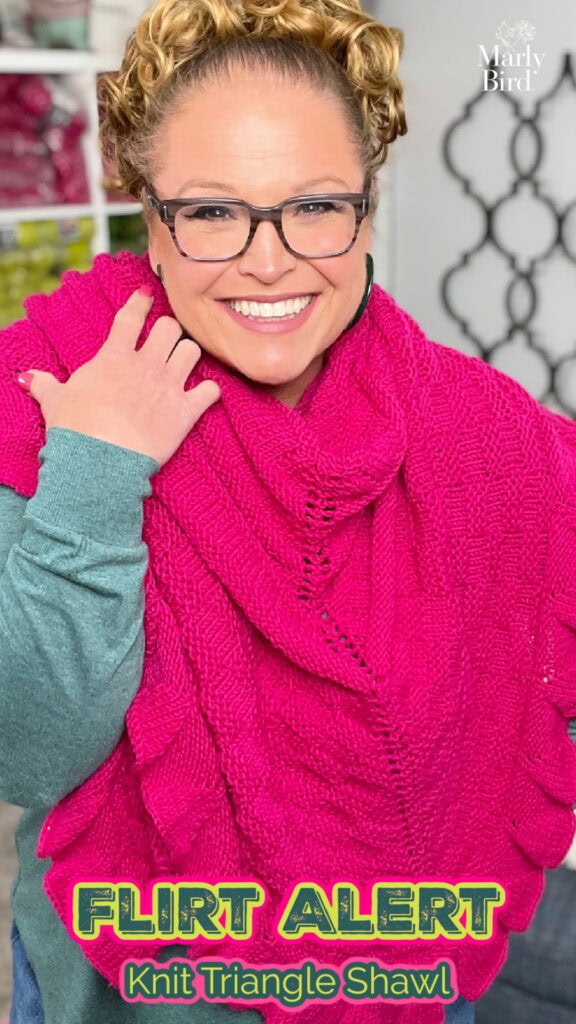
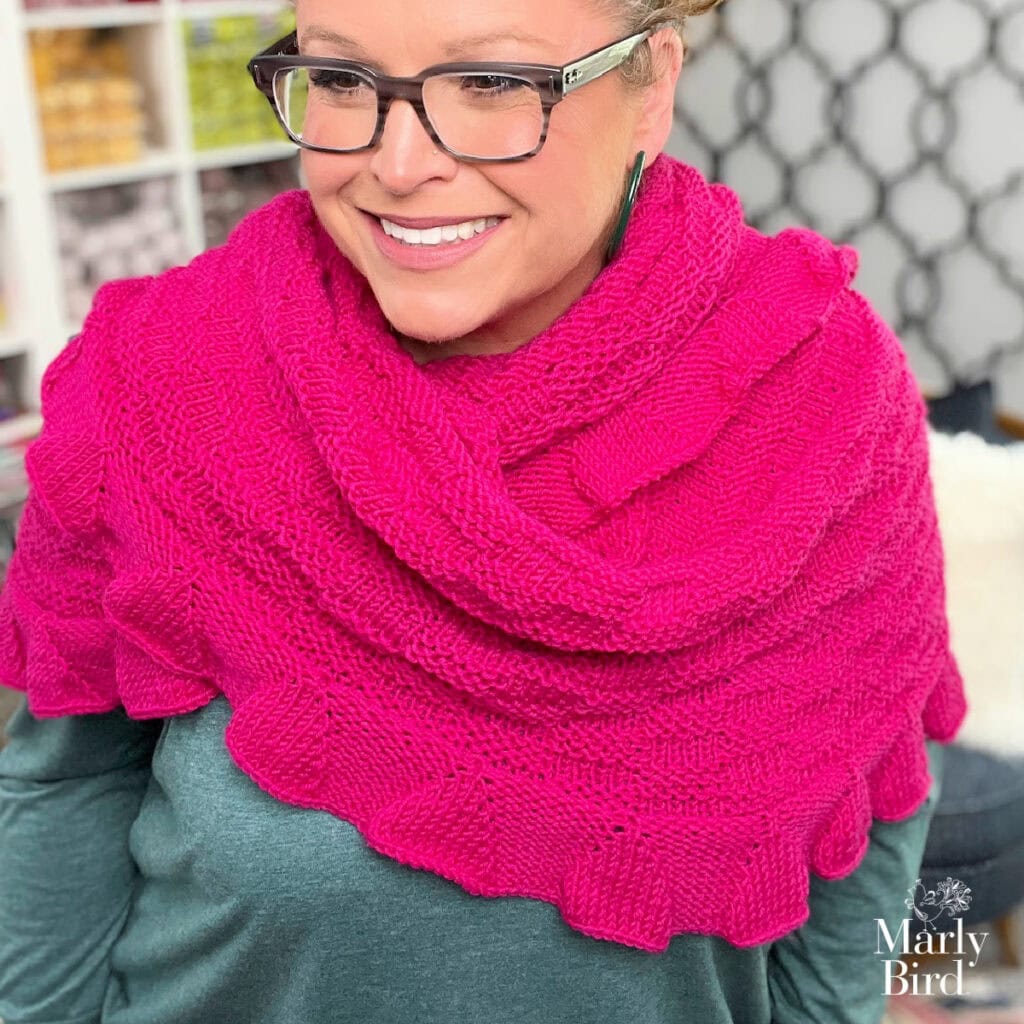
- Wrap it dramatically over your shoulders
- Tie it loosely in front
- Wear it like an oversized scarf
- Belt it over a fitted sweater
For an extra polished look, try using decorative shawl pins. If you’re not sure how to use one, check out my post on how to wear and style a shawl pin for inspiration.
This shawl in a bold color does not whisper. It announces. 😍
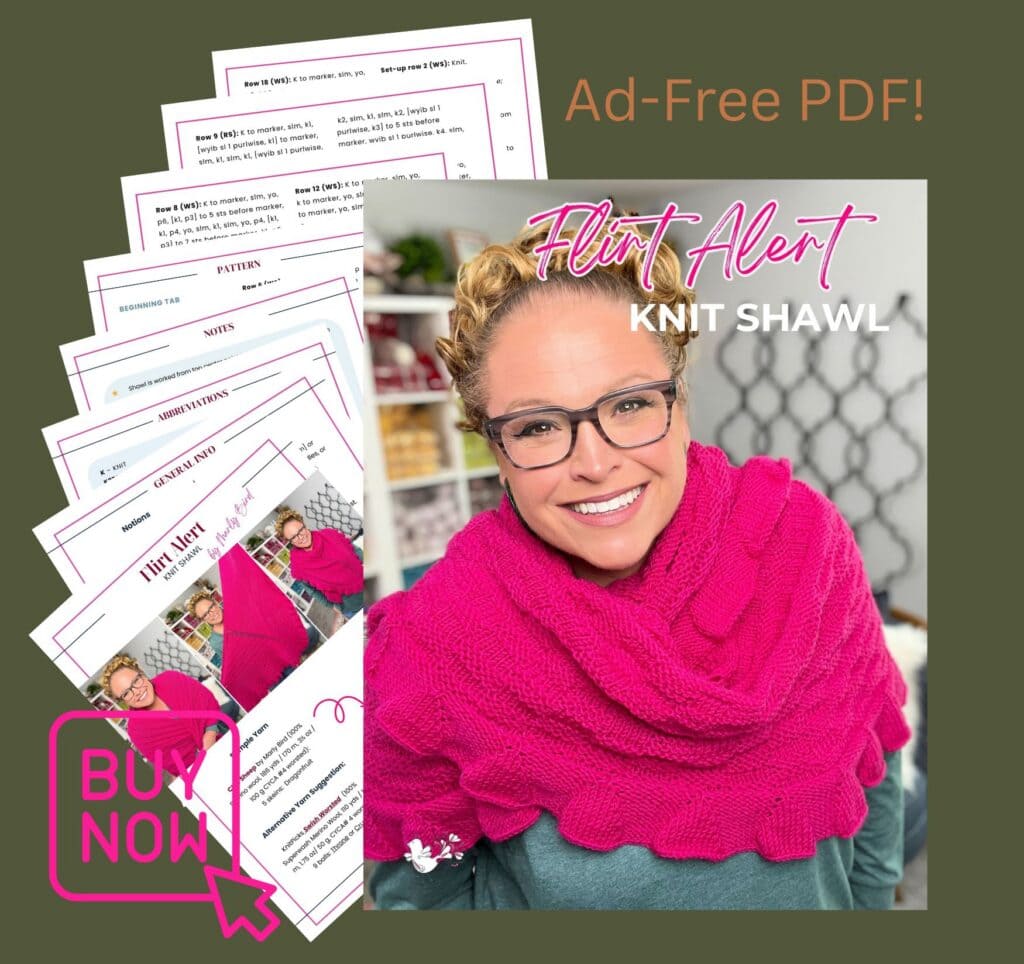
Get the Ad-Free PDF
Prefer a clean, printable version?
Includes full written instructions, edging chart, and tutorial support.
Free Flirt Alert Knit Shawl Pattern Details
SKILL LEVEL
Adventurous beginner
MEASUREMENTS
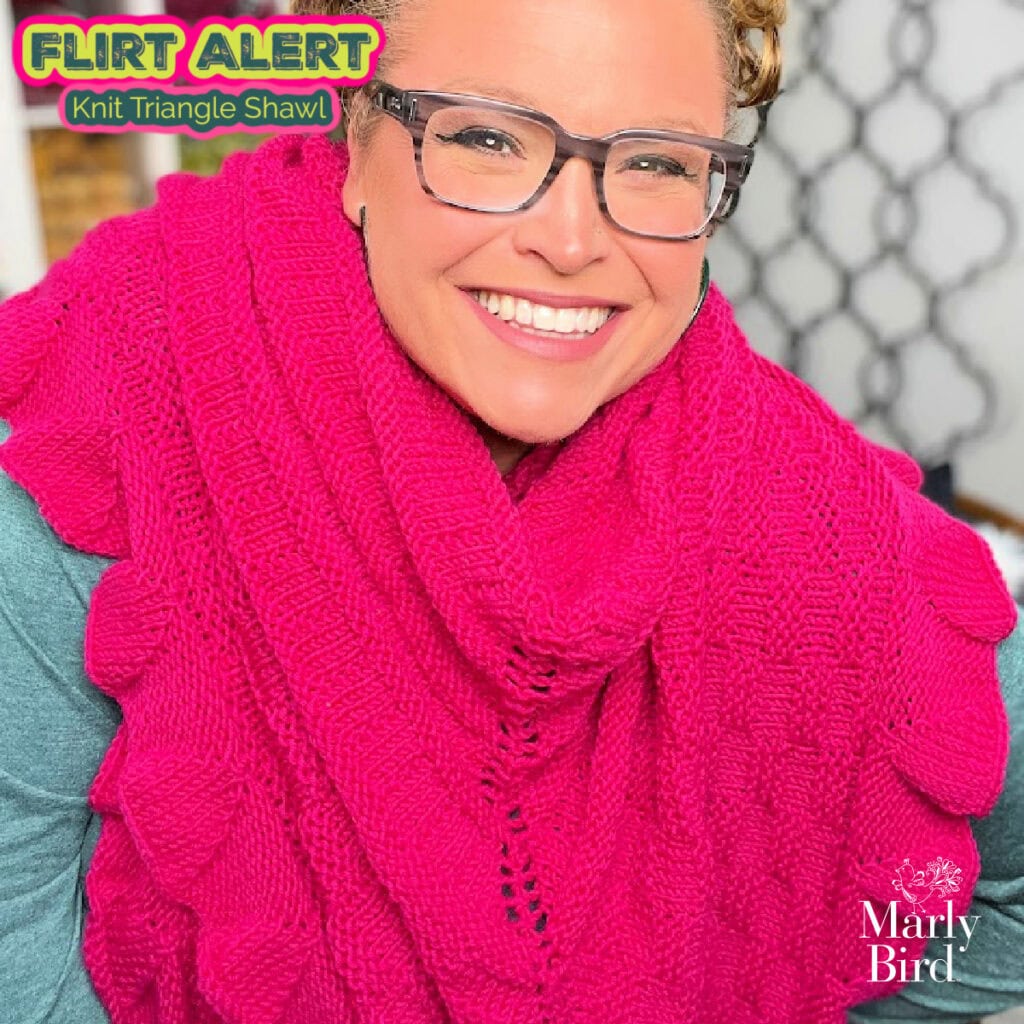
Shawl measures approximately 60” [152.5 cm] across top edge and 30” [76 cm] in depth.
Gauge
18 sts = 4” [10 cm] in Stockinette st.
MATERIALS
Yarn
Chic Sheep by Marly Bird (100% merino wool, 186 yds / 170 m, 3½ oz / 100 g CYCA #4 worsted)
5 skeins: Dragonfruit
Alternative Yarn Suggestion: KnitPicksSwish Worsted (100% Superwash Merino Wool, 110 yds / 100 m, 1.75 oz/ 50 g, CYCA# 4 worsted) 9 balls: Throne or Crush
Needles
U.S. 9 [5.5 mm] 24” [61 cm] or longer circular knitting needles, or size required for gauge.
Notions
- Stitch markers
- Tapestry needle
- Tape measure
- Scissors
- Blocking Squares
- Blocking Pins
- Soaking Basin
- Eucalan Wool Wash
- Blocking Wires (ideal for lace work)
- Ball Winder and Swift
- Steamer
ABBREVIATIONS
- K – Knit
- K2tog – Knit Two Together
- P – Purl
- Pm – Place Marker
- RS – Right Side
- Sl – Slip
- Slm – Slip Marker
- St(s) – Stitch(es)
- Tbl – Through Back Leg
- WS – Wrong Side
- Wyib – With Yarn in Back
- Yo – Yarn Over
CHARTS
Full Shawl Chart: only available in the ad-free PDF. Purchase the pdf from your favorite supplier.
Bell Edging Chart: only available in the ad-free PDF. Purchase the pdf from your favorite supplier.
⭐️ Checklist Sheet
Helpful spreadsheet to keep track of where you are in the pattern only available in the ad-free PDF. Purchase the pdf from your favorite supplier.
NOTES
- Shawl is worked from top center point to bottom corner, starting with a Garter st tab and growing outwards and down.
- The piece features bands of complimenting stitch patterns and a ruffled bell edging.
VIDEO TUTORIALS
- Garter Tab Traditional): >> https://vimeo.com/1005963949/c59d208209 <<
- Garter Tab (Judy’s Magic Cast-On): >> https://vimeo.com/1005964273/38c659f119 <<
- Long-Tail Cast-on >> https://www.youtube.com/watch?v=vEGwt4cedLM <<
- Purl Stitch (Continental) >> https://www.youtube.com/watch?v=LuDt-8jqh4g <<
- Knit Stitch (Continental) >> https://www.youtube.com/watch?v=M3brKFKg5Yc <<
- How to Add a Lifeline (3 ways) >> https://youtu.be/FiqYUE_aHAw <<
- How to Tink >> https://youtu.be/c7Gud7k4Y8k <<
- How to Tink Cables >> https://youtu.be/161zUDLjwVA <<
- How to Bury Ends >> https://www.youtube.com/watch?v=8_NBGUKjO-E <<

GROW
To Unlock Exclusive Subscriber Content click the Box below and join for free by simply adding your email and creating a password! If you are having troubles, clear your cache or reset your password or login to the Grow Publisher Portal.
>> Learn More About Grow Here <<
I’m thrilled to share this amazing pattern with you, many patterns on my blog are absolutely free! I kindly request that you don’t copy and paste or distribute this pattern. Prefer an ad-free experience? Buy a digital PDF pattern for a small fee from one of my online stores for a seamless crafting journey.
I appreciate your support and readership. You are the reason I can keep doing what I love and sharing it with others. So, thank you from the bottom of my yarn-loving heart! Disclosure: This post contains affiliate links, meaning I get a commission if you decide to make a purchase through my links at no cost to you.
FLIRT ALERT KNIT SHAWL PATTERN
BEGINNING TAB
Cast on 3 sts, and knit 7 rows.
Turn work 90 degrees, pick up 3 sts from side edge, turn work 90 degrees, pick up 3 sts from cast on edge.
Count: 9 sts.
SLIP COLUMNS SECTION – SHAWL ROWS #1-40
Row 1 (RS): Knit.
Row 2 (WS): K3, pm, yo, p1, yo, pm, k1, pm, yo, p1, yo, pm, k3
Count: 13 sts including yo’s.
Row 3 (RS): Knit.
Row 4 (WS): K to marker, slm, yo, p to marker, yo, slm, k1, slm, yo, p to marker, yo, slm, k3.
Count: 17 sts.
Row 5 (RS): Knit.
Row 6 (WS): K to marker, slm, yo, p to marker, yo, slm, k1, slm, yo, p to marker, yo, slm, k3.
Count: 21 sts.
Row 7 (RS): K to marker, slm, k2, [wyib sl 1 purlwise, k1] to 1 st before marker, k1, slm, k1, slm, k2, [wyib sl 1 purlwise, k1] to 1 st before marker, k1, slm, k3.
Row 8 (WS): K to marker, slm, yo, p to marker, yo, slm, k1, slm, yo, p to marker, yo, slm, k3.
Count: 25 sts including yo’s.
Row 9 (RS): K to marker, slm, k1, [wyib sl 1 purlwise, k1] to marker, slm, k1, slm, k1, [wyib sl 1 purlwise, k1] to marker, slm, k3.
Row 10 (WS): K to marker, slm, yo, p to marker, yo, slm, k1, slm, yo, p to marker, yo, slm, k3.
Count: 29 sts including yo’s.
Repeat Rows 7 – 10 only 7 more times, then Rows 7 and 8 only once more.
Count: 89 sts.
Count: 44 sts on each side of the center st.
SLIP WINDOWS SECTION – SHAWL ROWS #41-102
Row 1 (RS): K to marker, slm, p to marker, slm, k1, slm, p to marker, slm, k3.
Row 2 (WS): K to marker, slm, yo, k to marker, yo, slm, k1, slm, yo, k to marker, yo, slm, k3.
Count: 93 sts.
Row 3 (RS): K to marker, slm, k4, [wyib sl 1 purlwise, k3] to 3 sts before marker, wyib sl 1 purlwise, k2, slm, k1, slm, k2, [wyib sl 1 purlwise, k3] to 5 sts before marker, wyib sl 1 purlwise, k4, slm, k3.
Row 4 (WS): K to marker, slm, yo, p4, [k1, p3] to 3 sts before marker, k1, p2, yo, slm, k1, slm, yo, p2, [k1, p3] to 5 sts before marker, k1, p4, yo, slm, k3.
Count: 97 sts.
Row 5 (RS): K to marker, slm, k5, [wyib sl 1 purlwise, k3] to 4 sts before marker, wyib sl 1 purlwise, k3, slm, k1, slm, k3, [wyib sl 1 purlwise, k3] to 6 sts before marker, wyib sl 1 purlwise, k5, slm, k3.
Row 6 (WS): K to marker, slm, yo, p5, [k1, p3] to 4 sts before marker, k1, p3, yo, slm, k1, slm, yo, p3, [k1, p3] to 6 sts before marker, k1, p5, yo, slm, k3.
Count: 101 sts.
Row 7 (RS): K to marker, slm, k6, [wyib sl 1 purlwise, k3] to 5 sts before marker, wyib sl 1 purlwise, k4, slm, k1, slm, k4, [wyib sl 1 purlwise, k3] to 7 sts before marker, wyib sl 1 purlwise, k6, slm, k3.
Row 8 (WS): K to marker, slm, yo, p6, [k1, p3] to 5 sts before marker, k1, p4, yo, slm, k1, slm, yo, p4, [k1, p3] to 7 sts before marker, k1, p6, yo, slm, k3.
Count: 105 sts.
Row 9 (RS): K to marker, slm, k7, [wyib sl 1 purlwise, k3] to 6 sts before marker, wyib sl 1 purlwise, k5, slm, k1, slm, k5, [wyib sl 1 purlwise, k3] to 8 sts before marker, wyib sl 1 purlwise, k7, slm, k3.
Row 10 (WS): K to marker, slm, yo, p7, [k1, p3] to 6 sts before marker, k1, p5, yo, slm, k1, slm, yo, p5, [k1, p3] to 8 sts before marker, k1, p7, yo, slm, k3.
Count: 109 sts.
Row 11 (RS): K to marker, slm, k8, [wyib sl 1 purlwise, k3] to 7 sts before marker, wyib sl 1 purlwise, k6, slm, k1, slm, k6, [wyib sl 1 purlwise, k3] to 9 sts before marker, wyib sl 1 purlwise, k8, slm, k3.
Row 12 (WS): K to marker, slm, yo, k to marker, yo, slm, k1, slm, yo, k to marker, yo, slm, k3.
Count: 113 sts.
Row 13 (RS): K to marker, slm, p to marker, slm, k1, slm, p to marker, slm, k3.
Row 14 (WS): K to marker, slm, yo, k to marker, yo, slm, k1, slm, yo, k to marker, yo, slm, k3
Count: 117 sts.
Repeat Rows 3-14 only 4 more times.
Count: 213 sts.
GARTER WEAVE SECTION – SHAWL ROWS #103-168
Set-up Row 1 (RS): Knit.
Set-up Row 2 (WS): K to marker, slm, yo, p to marker, yo, slm, k1, slm, yo, p to marker, yo, slm, k3.
Count: 217 sts.
Note: This stitch pattern is very similar to basketweave with the exception that between each 5 Stockinette sts you will have 5 Garter sts. Outside of these repeats, keep the pattern in Stockinette st (knit on RS, purl on WS).
Row 1 (RS): K to marker, slm, k3, * p5, k5; repeat from * 9 more times, k to marker, slm, k1, slm, k2, * k5, p5; repeat from * 9 times, k to marker, slm, k3.
Row 2 (WS): K to marker, slm, yo, p to marker, yo, slm, k1, slm, yo, p to marker, yo, slm, k3.
Count: 221 sts.
Row 3 (RS): K to marker, slm, k4, * p5, k5; repeat from * 9 more times, k to marker, slm, k1, slm, k3, * k5, p5; repeat from * 9 times, k to marker, slm, k3.
Row 4 (WS): K to marker, slm, yo, p to marker, yo, slm, k1, slm, yo, p to marker, yo, slm, k3.
Count: 225 sts.
Row 5 (RS): K to marker, slm, k5, * p5, k5; repeat from * 9 more times, k to marker, slm, k1, slm, k4, * k5, p5; repeat from * 9 times, k to marker, slm, k3.
Note: On the next row, you are shifting where the 5 Garter sts will be placed for the next 5 rows.
Row 6 (WS): K to marker, slm, yo, * k5, p5; repeat from * 9 more times, k5, p to marker, yo, slm, k1, slm, yo, p4, * k5, p5; repeat from * 9 more times, k5, yo, slm, k3.
Count: 229 sts.
Row 7 (RS): Knit.
Row 8 (WS): K to marker, slm, yo, p1, * k5, p5; repeat from * 10 more times, yo, slm, k1, slm, yo, * p5, k5; repeat from * 10 more times, p to marker, yo, slm, k3.
Count: 233 sts.
Row 9 (RS): Knit.
Row 10 (WS): K to marker, slm, yo, p2, * k5, p5; repeat from * 10 more times, k to marker, yo, slm, k1, slm, yo, p1, * p5, k5; repeat from * 10 more times, p to marker, yo, slm, k3.
Count: 237 sts.
Note: On the next row, you are shifting where the 5 Garter sts will be placed for the next 5 rows.
Row 11 (RS): K to marker, slm, k3, * k5, p5; repeat from * 10 more times, k to marker, slm, k1, slm, k2, * p5, k5; repeat from * 10 times, k to marker, slm, k3.
Row 12 (WS): K to marker, slm, yo, p to marker, yo, slm, k1, slm, yo, p to marker, yo, slm, k3.
Count: 241 sts.
Row 13 (RS): K to marker, slm, k4, * k5, p5; repeat from * 10 more times, k to marker, slm, k1, slm, k3, * p5, k5; repeat from * 10 times, k to marker, slm, k3.
Row 14 (WS): K to marker, slm, yo, p to marker, yo, slm, k1, slm, yo, p to marker, yo, slm, k3.
Count: 245 sts.
Row 15 (RS): K to marker, slm, k5, * k5, p5; repeat from * 10 more times, k to marker, slm, k1, slm, k4, * p5, k5; repeat from * 10 times, k to marker, slm, k3.
Note:On the next row, you are shifting where the 5 Garter sts will be placed for the next 5 rows.
Row 16 (WS): K to marker, slm, yo, p5, * k5, p5; repeat from * 10 more times, p to marker, yo, slm, k1, slm, yo, p4, * p5, k5; repeat from * 10 more times, p to marker, yo, slm, k3.
Count: 249 sts.
Row 17 (RS): Knit.
Row 18 (WS): K to marker, slm, yo, p6, * k5, p5; repeat from * 10 more times, p to marker, yo, slm, k1, slm, yo, p5, * p5, k5; repeat from * 10 more times, p to marker, yo, slm, k3.
Count: 253 sts.
Row 19 (RS): Knit.
Row 20 (WS): K to marker, slm, yo, p7, * k5, p5; repeat from * 10 more times, p to marker, yo, slm, k1, slm, yo, p6, * p5, k5; repeat from * 10 more times, p to marker, yo, slm, k3.
Count: 257 sts.
Repeat Rows 1-20 twice more, then repeat Rows 1-4 only once more.
Count: 345 sts.
BELL EDGING – SHAWL ROWS #169-184
Set-up row 1 (RS): K to marker, remove marker, k2tog, k to next marker, remove marker, k1, remove marker, k to 2 sts before last marker, k2tog, remove marker, k3.
Count: 343 sts.
Set-up row 2 (WS): Knit.
Note: Full Shawl Chart ends here; Bell Edging Chart begins here. Only available in the ad-free PDF.
Row 1 (RS): P7, * k1, p7; repeat from * to end.
Row 2: K7, * p1, k7; repeat from * to end.
Row 3: P7, * yo, k1, yo, p7; repeat from * to end.
Count: 427 sts.
Row 4: K7, * p1 tbl, p1, p1 tbl, k7; repeat from * to end.
Row 5: P7, * yo, k3, yo, p7; repeat from * to end.
Count: 511 sts.
Row 6: K7, * p1 tbl, p3, p1 tbl, k7; repeat from * to end.
Row 7: P7, * yo, k5, yo, p7; repeat from * to end.
Count: 595 sts.
Row 8: K7, * p1 tbl, p5, p1 tbl, k7; repeat from * to end.
Row 9: P7, * yo, k7, yo, p7; repeat from * to end.
Count: 679 sts.
Row 10: K7, * p1 tbl, p7, p1 tbl, k7; repeat from * to end.
Row 11: P7, * yo, k9, yo, p7; repeat from * to end.
Count: 763 sts.
Row 12: K7, * p1 tbl, p9, p1 tbl, k7; repeat from * to end.
Row 13: P7, * yo, k11, yo, p7; repeat from * to end.
Count: 847 sts.
Row 14: K7, * p1 tbl, p11, p1 tbl, k7; repeat from * to end.
Bind off all sts loosely..
FINISHING
Weave in all loose ends. Block.
How to Block Your Flirt Alert Shawl 💦✨
Blocking is essential for this design.
The bell edging transforms after blocking. Without it, it looks reserved. After blocking? It flirts. 😉
Wet Blocking Steps
- Soak in lukewarm water.
- Gently remove excess moisture.
- Roll in a towel.
- Lay flat on blocking mats.
- Shape to measurements.
- Pin especially along the edging.
- Let dry completely.
Do not overstretch. Merino can grow when wet.
For full tutorials, read:
👉 How to Wet and Steam Block Knitting
Need supplies?
Blocking is when your shawl becomes finished art. 💖
More Knit Shawl Patterns You’ll Love 🧶
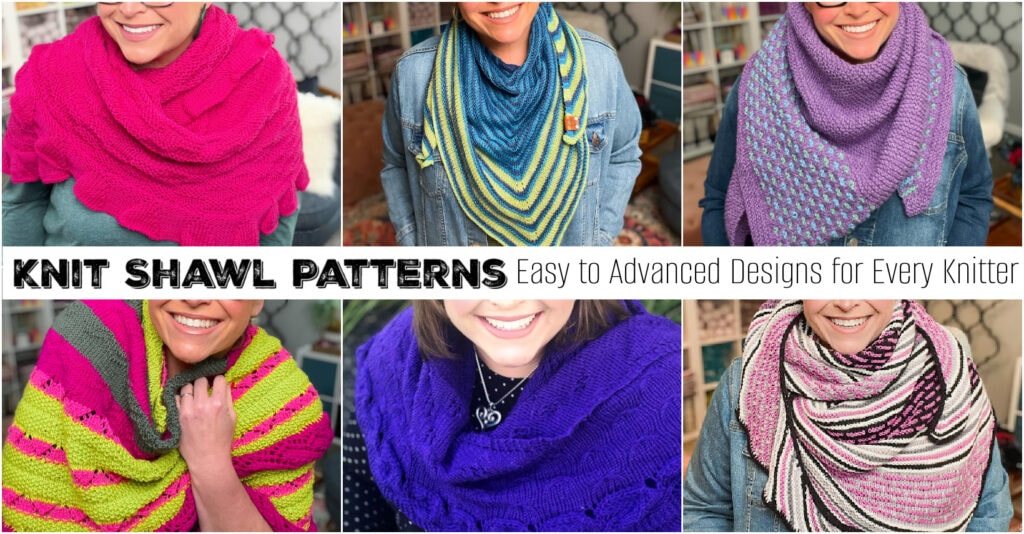
If this triangle has you inspired, explore even more styles in my complete Knit Shawl Patterns Guide.
From crescent shawls to mosaic designs to asymmetrical wraps, there’s a shawl for every mood and skill level.
Frequently Asked Questions
How much yarn do I need?
Follow the yardage listed in the pattern. If you knit loosely, consider having an extra skein available.
Can I make this shawl larger?
Yes. Continue the body repeats before beginning the edging, but ensure you have enough yarn.
What happens if I run out of yarn before the edging?
You can shorten the edging section or use a contrasting color for a design twist.
Is this good for gift knitting?
Absolutely. The size and warmth make it practical and impressive.
Can I use acrylic yarn?
You can, but blocking results will differ. Acrylic won’t bloom like merino.
Can I add tassels?
Yes. Tassels can add playful weight to the corners.
Is this a good first shawl?
For a confident beginner, yes. The structure is straightforward, and the texture builds skills.
Does it require blocking?
Yes. Especially for the edging.
Was this part of a make-along?
Yes. It was the Smooth Jazz level of the 2018 Tournament of Stitches.
How long does it take to knit?
Most knitters finish within 1–2 weeks depending on knitting time.
Final Thoughts 💕
Flirt Alert is bold. Textured. Confident. A little dramatic.
It honors the roots of Tournament of Stitches while remaining completely timeless.
Cast it on. Enjoy the rhythm. Let that bell edging flirt just a little. 😘🧶✨
❤️ Your BiCrafty Bestie,
Marly Bird