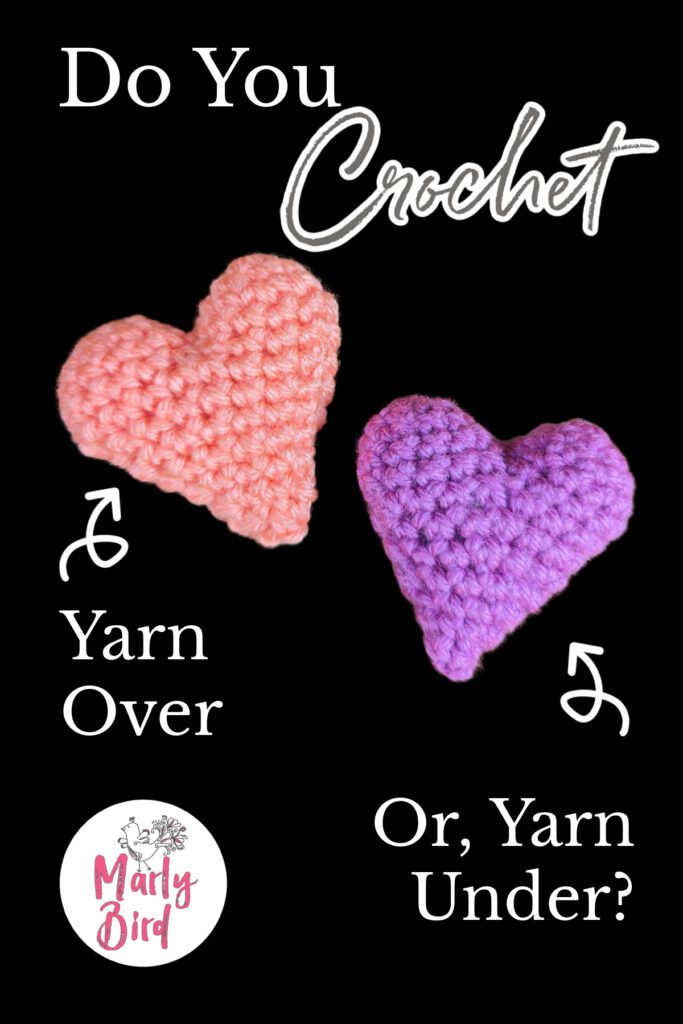
Crochet Yarn Over Or Yarn Under?
(YO -vs- YU – The Great Debate)
Have you heard about this great discussion in the crochet world? It’s pretty recent in terms of crochet history, but it sure is rocking the boat. Yeah – the one about crochet yarn over or yarn under!
Well, let’s dive in and see if we can figure out the big deal about the whole debate because there are always two sides to every story.
How Did You Learn To Crochet?
If you, like me, learned to crochet what feels like eons ago, you’d have likely learned from your grandma or, as I did, from an elderly lady who lived down the street from me. She was super-friendly and was thrilled that I was interested in learning a life skill from her that she so obviously LOVED dearly.
She crocheted what seemed like ALL-THE-TIME! She’d crochet for charity, for friends, and for neighbors. She’d even save those plastic circles that hold cans of sodas, beers, or Gatorades together and crochet around those to make table centerpieces. They were beautiful!
Chances are, she’d also learned from her Grandma or some other relative or friend. It was a way for the older, skilled crafters to pass on their knowledge to others in person and socially.
Now, we have so many other ways to share our teaching and learning through watching crochet videos, perusing images and ‘shorts’ online, and from crochet books, so learning to crochet in person has fallen away…somewhat.
But, I digress…
Is There A Correct Way To Crochet?
I’m trying to get at here that historically there was only one way to work crochet stitches, which was taught as the ‘correct’ way, and that was to work your crochet yarn over (YO) the hook.
Working a crochet yarn over (YO) means taking the yarn from below, up behind the hook, over the top to the front under the hooked end, then pulling that strand through the loops on the hook to complete your stitch.
I remember when I was first learning and hadn’t picked up my crochet for a while, I’d sometimes forget and crochet yarn under the hook, but it didn’t feel quite right.
There’s a certain feel and flow to crocheting that builds over time as you learned to speed up, then it becomes second nature. Now I can crochet basic stitches while watching tv, feeling for the holes and knowing instinctively if my hook’s in the right spot or if the yarn has split, but it’s almost 50 years since I first began my crochet journey.
What’s The New Crochet Way?
The more recent growth of amigurumi has brought to light the crochet yarn under the hook method of making single crochet stitches.
The object in amigurumi is to make the stitches tight and uniform to reduce the chances of stuffing wriggling through and gaps between stitches. In order to close up these gaps, many who crochet amigurumi have adopted the crochet yarn under (YU) technique.
You work a yarn under (YU) by bringing the yarn to the front under the hook, twisting the hook to grab the yarn from above, then pulling that strand through the loops on the hook to complete your stitch.
Does The Crochet Yarn Over Direction Matter?
In short – yes!
There are differences between using yarn over and under. Let’s look at single crochet, the most commonly used stitch for the YU technique!
| Yarn Over (YO): | Yarn Under (YU): |
| Uses more yarn | Uses less yarn |
| Produces a taller stitch | Produces a shorter stitch |
| May leave small gaps in your work (depending on the hook-to-yarn ratio) | Leaves little to no gaps in your work |
| Produces a slightly looser fabric | Produces a tighter, firmer fabric |
| Stitches slant slightly | Less stitch slant |
| Creates a V on the Right Side of the fabric | Creates an X on the Right Side of the fabric (WS looks the same as YO) |
| Natural arm/wrist movement | Unnatural arm/wrist movement |
| Easier to work | Harder to work1 |
So, What Is The Best Single Crochet For Amigurumi?
The answer is…it really is a personal preference. It depends on several things. Here’s a list of things to consider when you’re deciding which single crochet version to use for your crochet project:
- How do you want your fabric to look? Do you like the X stitch or the V? Do you like your stitches tighter//more snug? Are you working flat or in the round? (Yes – that makes the biggest difference in single crochet.)
- How do you want to work your fabric? Do you find one or the other easier to work, or does working the crochet yarn over or yarn under hurt your hand or wrist? Pick the way that’s more comfortable for you.
- How big do you want your amigurumi to be? Of course, you can always change your yarn or hook size to adjust the size of your creation instead of changing the stitch itself. The choice is yours alone.
- Is speed a factor? Do you want to produce things fast? Then use the method you know and are more comfortable with. There are no hard, fast rules.
- Does the yarn amount matter to you? Use the crochet yarn under technique. You won’t save skeins; only a few yards per piece. Obviously, here project size matters. The larger the project, the more you save by going under. Does yarn under use less yarn? Yes, but with the size of amigurumi pieces usually being small, you’re not really going to save substantial amounts of yarn.
Will You Choose Crochet Yarn Over Or Yarn Under?
Well, there you have it! It’s all here for you to draw your own conclusions.
Purists will say you should crochet yarn over because it’s correct.
Amigurumi crocheters may say they like to crochet yarn under because they prefer the results for their particular use.
Crocheters Beware!
Now, if you start to adopt the yarn under technique for any stitches other than single crochet in amigurumi, look out!
Check back to the comparison section above and think about it. Your stitches will become shorter and tighter, you may not get gauge so easily, and you won’t be happy with your garments, especially if you want a drape.
Working yarn under will make any long stitches work out shorter and firmer, so crochet lace won’t look nearly so good, or hang as well, as when using yarn overs to form your crochet stitches.
If you have problems with crochet gauge now, pay attention to how you work your stitches. Are you inadvertently working your stitches with the YU technique? Has discovering this solved your gauge problems immediately?
You’re welcome!
Be sure to check out Marly’s brand new pattern – SPARKLE THE UNICORN! Sooooo CUTE!!!
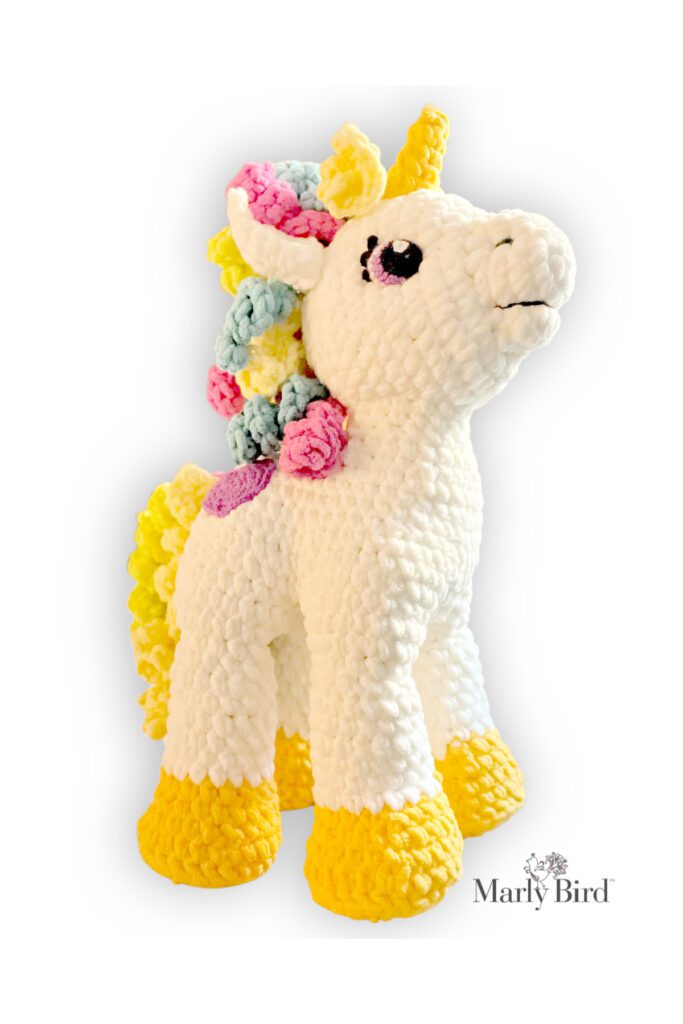
Available free in the blog post and also as an ad-free PDF!
Also, check out:
Magical Knit And Crochet Unicorn Patterns You Can’t Live Without!
Any questions? Get chatting in the Facebook Group.
And if you need VIDEO HELP, here’s Marly’s YouTube Channel!
CROCHET ON!
- Depending on how you learned to crochet. ↩︎
Frequently Asked Questions
What’s the difference between yarn over and yarn under in crochet?
These are two different ways to wrap the yarn around your hook! Yarn over (YO) wraps the yarn from back to front over the top of the hook… the standard method used in American and British crochet. Yarn under (YU) wraps the yarn from front to back under the hook. The two methods create slightly different stitch appearances and fabric textures. Most standard patterns default to yarn over, but yarn under creates a different twist to the stitch that some crafters prefer or that certain techniques specifically call for.
Which method should I use as a beginner?
Yarn over (standard wrap) is what almost all published patterns assume you’re doing! Start with yarn over and master that before exploring yarn under. All the standard stitches (single crochet, double crochet, etc.) are defined using yarn over. If you’ve been doing yarn under without realizing it… that’s why your stitches might look different from the pattern photos or why you might have had gauge issues. If you’re consistently using one method, your finished fabric will be consistent even if it’s not the “standard”… but for following patterns accurately, yarn over is the default.
Does using yarn over vs yarn under affect gauge?
Yes! The two methods create fabric with slightly different stitch architecture. Yarn under tends to create a tighter stitch (the wrapping direction pulls the loop tighter). This can affect gauge… if you switch from one method to the other mid-project, you might see a difference in the fabric density. If your gauge doesn’t match a pattern and you’ve checked your hook and tension, try the other wrapping method on a swatch to see if that’s the culprit. Some experienced crocheters specifically use yarn under for certain techniques where the different stitch appearance is the desired effect.
Are there specific techniques that use yarn under intentionally?
Yes! The waistcoat stitch (split single crochet) sometimes uses a specific yarn direction to create its distinctive “V” surface. Some extended stitches and unusual techniques specify the wrap direction. Some crocheters find that yarn under creates a tighter ribbing effect that they prefer for hat brims. And in certain colorwork techniques, the yarn direction affects how the colors show on each side of the fabric. As you advance in crochet, having both methods available gives you more control over subtle aspects of the finished fabric.
How do I know if I’ve been doing it “wrong”?
Here’s the thing… if your crochet is consistent and you’re happy with your results, you’re not doing it “wrong”! Both methods work and create beautiful fabric. The main issue arises when you’re following a pattern and your fabric looks different from the expected result… that’s when understanding the standard (yarn over) vs. alternative (yarn under) makes the difference. Watch Marly’s video tutorial for this post and compare your hand position and hook movement to what you see. If they match, you’re doing standard yarn over. If they don’t, you’ve discovered why your stitches look a bit different!